City Guide
Regensburg
Alemania · Best time to visit: May-Sep.
Day-by-day plan
Choose your pace
Duración del viaje
09:00
Landmark
Start the day at Bavaria's largest inhabited private residence, still home to the Thurn und Taxis princely family — the dynasty that invented Europe's modern postal service in 1500. At this hour the courtyards and St. Emmeram Basilica are quiet, with long morning shadows picking out the Baroque stucco and the Carolingian stonework beneath. Walk the perimeter, step inside the free-entry basilica for ten minutes of layered history, then leave before the first tour groups arrive at 10:30.
Tip: Enter via Emmeramsplatz rather than the main ticket office — the courtyard, basilica and cloister are all free and open 1.5 hours before the paid palace tours begin. Inside the basilica, the tomb of St. Emmeram (Bavaria's patron saint) sits behind the high altar — ornate Baroque stucco layered over a 700 AD Carolingian core, unique in Germany.
Open in Google Maps →11:00
Neighborhood
Walk 600 m north from Emmeramsplatz through Neupfarrplatz, crossing from princely gardens into the beating medieval heart where 1,500 listed buildings survived WWII intact. Loop Haidplatz (where emperors once watched tournaments at the Goldenes Kreuz inn), pass under the arcade of the Altes Rathaus where the Holy Roman Empire's Reichstag met for 140 years, then end at Porta Praetoria — a genuine Roman gate from AD 179 wedged casually into a bishop's wall, the oldest stone building in Bavaria. Mid-morning is when Regensburg wakes up slowly and the cobblestones are almost yours.
Tip: Look up at the left pillar of the Altes Rathaus entrance arch to spot three iron hooks — the official medieval measurements (Ellen, Schuh, Klafter) that Regensburg merchants were legally held to. Behind the building, an alley called 'Wahlenstraße' holds the city's oldest patrician tower-houses from 1200 — head up to catch that Italian-style skyline of stone watchtowers that most day-trippers walk right past.
Open in Google Maps →13:00
Religious
From Porta Praetoria, walk 200 m south down Kramgasse — a corridor of medieval townhouses that opens suddenly onto Domplatz, where the Gothic twin spires erupt 105 m into the sky. By 13:00 the square is lit in full midday sun and the crowds thin as locals peel off for lunch, leaving the plaza at its most photographable. Walk the exterior perimeter slowly to find the grinning 'Teufelchen' (little devil) carved on the south wall — an obscure piece of medieval humor even most Regensburgers forget is there.
Tip: The 'Dombaumeister' (master builder) carved his own self-portrait into the south-west buttress around eye level — a medieval architect's cameo signing off on his life's work. Skip the paid interior tour today and instead plan a return on a Thursday or Saturday at 18:00 for the Regensburger Domspatzen vespers (founded 975 AD, the oldest boys' choir in the world) — entry is free.
Open in Google Maps →14:15
Food
Walk 150 m north down Brückstraße — the lane slopes toward the river and the squat medieval stone hut materialises right at the water's edge, exactly where it has stood since 1146. Wurstkuchl has fed stonemasons building the Stone Bridge, emperors, Danube bargemen and now you — serving one thing for 880 years: finger-sized Regensburger sausages grilled over beechwood embers, sliced into hand-cut sauerkraut, smeared with a secret sweet mustard. You're here at 14:15 precisely to skip both the lunch crush and the 15:00 tour-group wave, and claim a river-facing bench with the Stone Bridge looming 20 m away.
Tip: Order '6 Würstl mit Kraut' (€12.50) — six beechwood-grilled sausages on sauerkraut with a thick slice of rye. Cash only, no cards. Ask for an extra dollop of 'Hausmacher Senf' (the house sweet mustard, secret recipe since the 1800s) — locals rate it the best in Bavaria. Skip the soup of the day entirely; the sausages are the whole point, and 6 is the correct quantity (8 is too much, 4 is an insult).
Open in Google Maps →15:30
Landmark
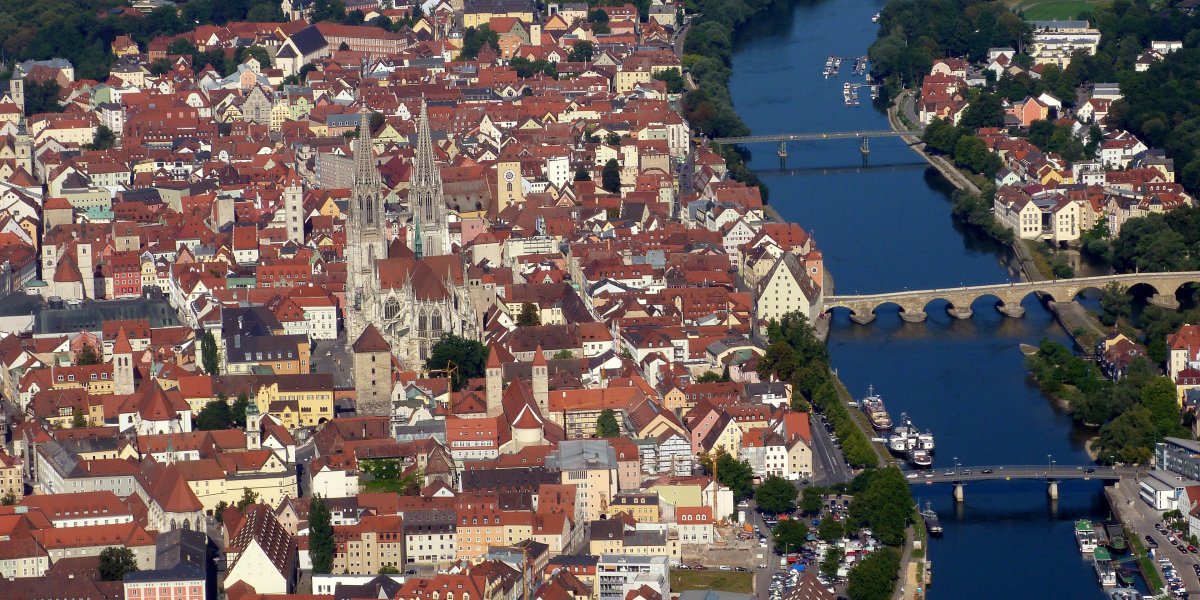
Step straight out of Wurstkuchl onto the south ramp and cross the 308 m Stone Bridge slowly — the 900-year-old engineering marvel that made Regensburg rich and became the architectural model for London Bridge and Prague's Charles Bridge. Pause mid-span for the signature Regensburg skyline: cathedral spires rising above red-tiled roofs with the Danube curling east beneath your feet. On the far side, wander Stadtamhof — an entire island village of 18th-century pastel houses, quiet as the old town is busy, with riverside benches where you can simply sit and watch the current run as the afternoon tips toward golden hour.
Tip: The signature skyline shot is NOT from the bridge itself — walk 80 m east along the Stadtamhof north shore past the Andreasstadel to the riverside promenade. Late-afternoon light (16:00-17:30 in summer) hits the cathedral facade square-on; stay until 19:00 to watch the stone turn honey-orange in golden hour. The bridge's middle arch was rebuilt after 1945 flood damage — look closely at the keystones to spot the subtly lighter modern stone among the 12th-century originals.
Open in Google Maps →19:00
Food
From the Stone Bridge's north end, walk 250 m west along the Danube promenade — river on your left, mature chestnut trees overhead — and the wooden gates of Spitalgarten open into one of Bavaria's oldest beer gardens, continuously poured since 1226 by the adjoining St. Katharinenspital almshouse brewery. Self-serve at the outdoor counter for the full experience: grab a Spital Dunkel (their dark lager, brewed 20 m from your table) and carry your tray to a long communal bench under the chestnuts. The cathedral spires poke over the rooftops across the river — 800 years of the same beer, the same view, the same almshouse foundation still pouring it.
Tip: Order 'Schweinsbraten mit Knödel' (roast pork with potato dumpling, €14.50) or half a 'Schweinshaxn' (crispy pork knuckle, €18) at the hot counter; the cold counter does Obazda cheese spread + pretzel for €6 if you want lighter. A Mass (1 L) of Spital Dunkel is €5.50, a Halbe (0.5 L) €3.20 — cash on the bench, no table service outdoors. TOURIST TRAP WARNING: avoid the restaurants on the south bank directly beside the Stone Bridge (the ones with the English menus in the window) — they mark up 40% and serve pre-cooked frozen sausages. Spitalgarten is where actual Regensburgers drink on a Tuesday — follow the locals, not the guidebook signs.
Open in Google Maps →Saltar al día
09:00
Religious
Start at Domplatz the moment the cathedral opens — five minutes' walk from anywhere central in the old town. At 9 the eastern stained-glass windows (some still original 13th and 14th century glass) cast colored beams across an almost empty nave, something you will not see again once the 10:30 tour groups arrive. Bavaria's most important Gothic church reveals itself best in this first quiet hour.
Tip: Skip the paid 10am German guided tour and simply sit in the nave for 20 minutes — the light show through the original glass is the real spectacle. Then pay €3 for the cloister (separate side entrance) — it is the only place inside the cathedral walls where you can see the spires from below.
Open in Google Maps →11:00
Landmark
Exit the cathedral on the north side and walk three minutes downhill toward the Danube — the bridge appears suddenly between two stone gate towers. Cross the full 309 metres to Stadtamhof on the far bank, then turn around: the cathedral spires rising above the bridge arches is the iconic shot of Regensburg, and at 11 the sun is finally high enough that the south-facing facade is fully lit instead of in shadow.
Tip: Walk to the second pier from the Stadtamhof side and lean over the upstream railing — that frame catches the cathedral, the medieval salt warehouse roofs, and the river in one shot. Ignore the bronze 'Bruckmandl' figure at the centre that everyone queues to photograph; the better angle is from below it looking up.
Open in Google Maps →12:30
Food
Walk back across the bridge — the Wurstkuchl is the squat stone building at the south foot of the bridge with smoke pouring from its chimney since 1146 (yes, the year). Order at the window: 6 finger-sized Regensburger sausages with sauerkraut and the house sweet mustard for €11, or 8 for €13.50. The pork is grilled over open beechwood and the mustard is still made on the premises.
Tip: Don't queue at the takeaway window if you want to sit — walk through the side door and you'll usually find a free table in the back room or on the river terrace. Cash is faster than card. Pair with the house Stein bread and a small Helles (€3.80); skip the dessert and walk it off across town.
Open in Google Maps →14:00
Landmark
Stroll south through Kohlenmarkt and the narrow lanes of Watmarkt for 12 minutes — you'll pass two of the patrician towers before emerging at the largest privately inhabited palace in Europe, still home to Princess Gloria. The palace tour walks you through Brussels tapestries, the gold-leaf ballroom, and the attached Romanesque cloister of the former St. Emmeram abbey: 800 years of Habsburg postal-monopoly fortune on full display.
Tip: Buy the combined 'Schloss + Kreuzgang' ticket at the gate (€14) — the cloister is genuinely the most beautiful Romanesque cloister in Bavaria and most visitors skip it because it's a separate door. Tours are in German; ask the desk for the free English audio guide before you start.
Open in Google Maps →16:30
Museum
A 7-minute walk back north through the old town brings you to Neupfarrplatz — the entrance is a small glass cube in the middle of the square, easy to miss. Underneath your feet is a Roman officer's quarters, a medieval Jewish synagogue destroyed in 1519, and a WWII civilian shelter, three layers of hidden Regensburg you walk through in 45 guided minutes.
Tip: Tours run only at fixed times (usually 14:30 daily, more in summer) and you must book in person at the tourist info on Rathausplatz — do this when you first arrive at the cathedral in the morning, not after lunch, or you'll miss the slot. €7.50 cash only.
Open in Google Maps →19:00
Food
A 4-minute walk west along Tändlergasse brings you to a 15th-century corner house whose vaulted cellar dining room is where locals come for slow-cooked Bavarian with a modern hand. Order the beef cheek braised in dark Schneider beer (€26) with potato gratin, or the Danube zander on lentils (€28) — the wine list leans Franconian and the sommelier will pour you a Silvaner before you ask.
Tip: Reserve a day ahead for any table after 7pm (+49 941 58920) and ask specifically for the cellar room, not the upstairs glass extension. Pitfall warning for this area: avoid the loud restaurants spilling onto Haidplatz and Bismarckplatz — they're priced for tour buses and the schnitzel is frozen. Anything along Tändlergasse, Watmarkt, or Kohlenmarkt is the real old-town circuit.
Open in Google Maps →09:30
Religious
Start at Alter Kornmarkt, a 5-minute walk from anywhere central. The grey stone exterior gives nothing away — step through the door and you fall into one of the most theatrical Rococo interiors in southern Germany: pink marble, white-and-gold stucco, ceiling frescoes by Christoph Thomas Scheffler. The early hour matters: at 9:30 the eastern light hits the gilded altar directly and the church is empty.
Tip: Photography is forbidden during mass — check the times posted at the door (usually 8am and 6pm on weekdays). Stand under the organ loft at the back for the best wide ceiling view; the perspective from near the altar is too foreshortened to capture the fresco.
Open in Google Maps →10:30
Neighborhood
From the Alte Kapelle, walk west along Wahlenstrasse for 4 minutes into the patrician quarter — this is where 13th-century merchants competed for status by building the tallest residential towers north of the Alps. The Goldener Turm at Wahlenstrasse 16 is the tallest still standing (50m, nine storeys); continue past Baumburger Turm and end at the wedge-shaped Haidplatz where medieval traders weighed gold under the loggia.
Tip: Step into the inner courtyard of the Goldener Turm during business hours (it's a residential building — keep your voice down) for a free vertical view straight up the tower shaft. Don't pay to climb any tower; none are open to the public on a regular schedule, despite what some blogs claim.
Open in Google Maps →12:30
Food
From Haidplatz, walk three minutes east into Watmarkt — the restaurant occupies the ground-floor stone vaults of the 13th-century Baumburger Turm, with a single dish on the menu. Uli has been steaming the same fluffy yeast dumpling (Dampfnudel) for forty years: served either with vanilla sauce or — the local way — sitting in a creamy potato soup with caraway, €10.50 either version. Lunch and theatre at once; Uli himself works the room.
Tip: Doors open at 12:00 and the kitchen stops seating at 14:00 sharp — arrive by 12:30 or you'll be turned away. Cash only, no reservations, no compromises. Order the savoury potato-soup version: the sweet Dampfnudel is everywhere in Bavaria but the soup pairing is uniquely his.
Open in Google Maps →14:00
Museum
A 6-minute walk east along the river — the modern glass-and-stone building on Donaumarkt opened in 2019 as the official state museum of all Bavaria since 1800. Skip the temporary exhibits and head to the permanent floor: original Empress Sissi dresses, a BMW Isetta prototype, the entire Oktoberfest section, and a Mercedes from the Wittelsbach garages, all curated with sharp Bavarian self-irony.
Tip: Closed Mondays — plan accordingly. The €5 English audio guide is essential because almost all label text is German only. The cafe on the top floor has the best free Danube view in the city; even if you skip the museum, ride the lift up for the panorama.
Open in Google Maps →16:30
Landmark
Walk 4 minutes north along Hinter der Grieb back toward the cathedral — the Porta Praetoria, the original 179 AD Roman gate of Castra Regina, is awkwardly embedded in the back wall of a hotel on Unter den Schwibbögen. Look up: the genuine Roman ashlar blocks sit below, medieval brickwork above. Then step into the Niedermünster next door for Roman foundations, an early-Christian baptistry, and the tomb of Saint Erhard — at this hour the south windows light it perfectly.
Tip: The underground 'Document Niedermünster' below the church requires a separate guided tour booked at the tourist info — but the upper church is free and most visitors walk past because the heavy door looks closed. Push it; it's open until 18:00.
Open in Google Maps →19:00
Food
Cross back over the Stone Bridge as the sun sets — the bridge faces west and you'll catch the best light of your trip on the cathedral spires behind you. Spitalgarten sits on the Stadtamhof side, a 600-year-old brewery with chestnut-shaded river-edge tables facing straight back at the Old Town panorama. Order the house Spitalbier Helles (€4.20 a half-litre) with Schweinebraten and a bread dumpling (€14), or the cold Wurstsalat (€10.50) on a warm evening.
Tip: The lower riverside terrace fills first — arrive by 18:45 and walk straight to the Selbstbedienung (self-service) section: you grab food at the counter and seat yourself, no waiter wait. Pitfall warning: skip the souvenir shops on Stadtamhof's Bruckstrasse on your walk back — overpriced cuckoo clocks and 'Bavarian' steins made in China. Real local shopping is the Wochenmarkt at Neupfarrplatz on Saturday mornings.
Open in Google Maps →
Trip builder
Plan this trip around Regensburg
Turn this guide into a bookable rail itinerary with FlipEarth.
Keep exploring
Related cities
More in the same country
FAQ
Frequently asked questions
How many days do you need in Regensburg?
Most travelers enjoy Regensburg in 1 days, with enough time for headline sights and a slower meal or museum stop.
What's the best time to visit Regensburg?
The easiest season for most travelers is May-Sep, especially if you want good weather and manageable crowds.
What's the daily budget for Regensburg?
A practical starting point is about €80 per person per day before hotels, then adjust based on museums, dining, and transport.
What are the must-see attractions in Regensburg?
A good first shortlist for Regensburg includes Schloss Thurn und Taxis (St. Emmeram Palace), Stone Bridge (Steinerne Brücke) & Stadtamhof.