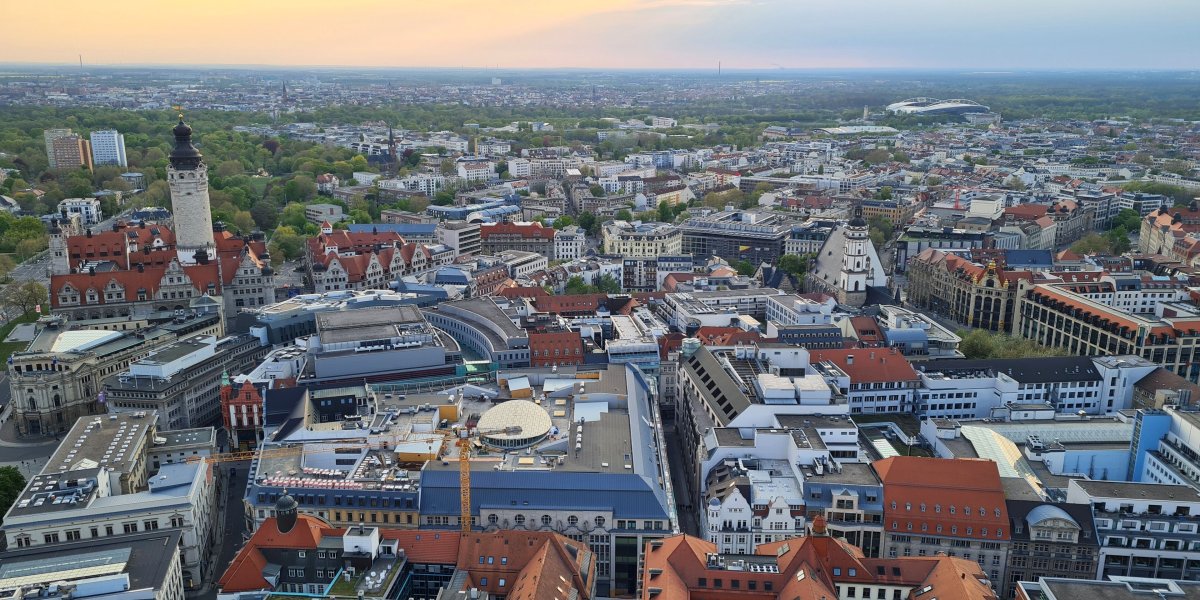
City Guide
Leipzig
Alemania · Best time to visit: May-Sep.
Day-by-day plan
Choose your pace
Duración del viaje
09:00
Landmark
Take tram 15 from Hauptbahnhof — 15 minutes south to the Völkerschlachtdenkmal stop. The monument announces itself from a kilometer away. At 91 meters, this is one of the largest monuments in Europe, erected to mark Napoleon's catastrophic 1813 defeat by coalition forces on the fields surrounding you. Circle the colossal base to take in the 12-meter stone warriors guarding each corner, then walk south to the reflecting pool where the entire monument mirrors perfectly in the still morning water.
Tip: Arrive before 09:30 — the reflecting pool produces a flawless mirror image only in calm morning air before the wind picks up. Stand at the southern end of the pool for the symmetrical shot. The monument faces east, so early light illuminates the facade directly. Skip the interior climb (€10) unless you have extra time — the exterior is the spectacle.
Open in Google Maps →11:30
Religious
Walk north from the monument along Straße des 18. Oktober, then through the Südvorstadt quarter along Karl-Liebknecht-Straße — a 50-minute stroll through Leipzig's liveliest neighborhood, where indie cafés, vinyl shops, and street art murals line both sides of the boulevard locals call KarLi. Johann Sebastian Bach served as choirmaster at Thomaskirche for 27 years until his death in 1750. The bronze Bach statue on the church's south side, gazing forward with a rolled manuscript in hand, is the essential Leipzig photograph.
Tip: Stand on Thomaskirchhof facing the Bach statue with the church tower rising directly behind it — this is the angle on every Leipzig postcard. If your visit falls on a Friday or Saturday, the Thomanerchor (St. Thomas Boys Choir, founded 1212) performs inside at 18:00 and can be heard faintly from the square — worth rearranging dinner for.
Open in Google Maps →12:00
Food
Walk 3 minutes east through Thomaskirchhof into Barfußgässchen, a narrow cobblestone alley that transforms into Leipzig's most atmospheric outdoor dining strip at lunchtime. This Saxon tavern has been pouring beer since 1841, and the alley-side tables put you in the middle of Leipzig's midday buzz. Order the Thüringer Rostbratwurst with sauerkraut and stone-ground mustard (€8.90) — fast, filling, and the perfect power-walk fuel. Pair it with an Ur-Krostitzer Pilsner (€3.80), brewed just 30 kilometers down the road.
Tip: Arrive right at noon to claim an outdoor table before the office crowd floods in at 12:15. Skip the interior if the weather is decent — Barfußgässchen's narrow width creates a cozy canyon of conversation and clinking glasses that is peak Leipzig atmosphere.
Open in Google Maps →13:00
Landmark
Step out of Zill's Tunnel and turn left — the vast Marktplatz opens before you in 30 seconds. The Altes Rathaus (1556) stretches across the entire east side of the square, one of Germany's finest Renaissance civic buildings, its deliberately off-center tower an architectural flourish that still sparks debate. Walk through the arched passage beneath the tower to reach Naschmarkt on the other side, where the petite Alte Handelsbörse (Old Trade Exchange, 1687) stands like a Baroque music box and a young Goethe gazes from his statue in front.
Tip: The best shot of the Altes Rathaus is from the northwest corner of Marktplatz — the full 90-meter Renaissance facade fits perfectly in a single wide-angle frame with the arcade arches below. Walk through to Naschmarkt and find the Goethe statue in front of the Handelsbörse — most visitors never realize it exists.
Open in Google Maps →14:00
Religious
Walk east along Grimmaische Straße and duck into the Mädlerpassage — Leipzig's grandest shopping arcade. Pause at the bronze statues of Faust and Mephisto guarding the Auerbachs Keller staircase (you will return here for dinner). Exit the arcade's east end and continue 3 minutes to Nikolaikirchhof. On October 9, 1989, seventy thousand people streamed out of this church holding candles, chanting 'Wir sind das Volk' — the night the Peaceful Revolution became unstoppable and the Berlin Wall's days were numbered. The palm-shaped Nikolaisäule beside the church echoes the famous interior pillars. Walk 2 minutes east to Augustusplatz, Leipzig's grandest square, flanked by the Gewandhaus concert hall and the Leipzig Opera.
Tip: Find the '89 memorial plaques embedded in the pavement of Nikolaikirchhof — most visitors walk right over them without looking down. The Nikolaisäule catches afternoon light beautifully from the north side. On Augustusplatz, avoid the overpriced terrace restaurants lining the east side — they charge Berlin prices for canteen-grade food. Save your appetite and your euros for dinner.
Open in Google Maps →19:00
Food
Walk 5 minutes west back through Grimmaische Straße to the Mädlerpassage. Descend the stone staircase past those Faust and Mephisto statues — you are entering the cellar where Goethe set a legendary scene from Faust, and where Leipzig's students have been drinking since 1525. The Großer Keller downstairs has vaulted ceilings painted with murals of the Faust legend and an atmosphere that earns every one of its five centuries. Order the Leipziger Allerlei — the city's signature dish of young seasonal vegetables, morel mushrooms, and crayfish tails (€18.90) — paired with an original Leipziger Gose, the sharp, salty wheat beer that nearly went extinct and was revived in this city (€4.50).
Tip: Reserve online for 19:00 or arrive by 18:45 — the Großer Keller fills quickly on weekends. Ask for a table beneath the Faust murals for the full theatrical effect. The Historische Weinstuben upstairs is the same kitchen at triple the price — locals always sit downstairs. End with a Leipziger Lerche (€5.50), a marzipan shortcrust pastry invented after the king banned the original recipe that used actual songbirds.
Open in Google Maps →Saltar al día
09:00
Religious
Start your morning on Nikolaikirchhof, a five-minute walk east from the Hauptbahnhof through Nikolaistraße — the square is quiet at this hour and the church door is already open. This is where the Peaceful Revolution began: every Monday from September 1989, thousands gathered for prayer meetings that swelled into the demonstrations that helped topple the Berlin Wall. Step inside to find extraordinary palm-tree columns and a cream-pastel neoclassical ceiling — at nine o'clock, with the nave empty and morning light through the east windows, the interior photographs beautifully.
Tip: Look for the small permanent exhibition about the Monday Demonstrations near the south entrance — five minutes of reading that gives everything else in this church emotional weight. Outside on the square, the bronze palm-column sculpture by Andreas Stötzner is the city's most meaningful photo spot.
Open in Google Maps →10:15
Landmark
Walk west along Grimmaische Straße, Leipzig's main pedestrian boulevard — you'll pass the ornate entrance of Mädler-Passage before the Markt opens up ahead (five-minute walk). The Altes Rathaus stretches nearly the full length of the square, one of Germany's finest Renaissance town halls, with an asymmetric tower and a painted arcade that most visitors walk beneath without looking up. Inside, the Stadtgeschichtliches Museum traces Leipzig's arc from medieval trade-fair capital to revolutionary city — the ground floor takes 45 minutes and earns back the €8 entry.
Tip: Stand under the arcade and look up — the painted Renaissance ceiling panels depicting Leipzig's trading history are one of the most overlooked details on the Markt. The museum is closed on Mondays.
Open in Google Maps →12:00
Food
Walk north from the Markt through Barfußgässchen, a narrow cobblestoned alley of restaurant terraces, and turn left onto Kleine Fleischergasse — the ornate baroque façade appears in three minutes. Europe's oldest continuously operating coffeehouse has poured since 1711; Bach, Schumann, Liszt, and Napoleon all sat in these rooms. Order the Leipziger Allerlei (€13), the city's signature dish of seasonal vegetables with crayfish butter and morel mushrooms, then a Quarkkäulchen (€7) — crispy fried quark pancakes with cinnamon sugar that every Saxon grew up eating.
Tip: Skip the ground-floor dining room and ask for a window seat on the second floor, where the original wood panelling survives. The top floor houses a free coffee museum — fifteen minutes well spent while your coffee settles.
Open in Google Maps →13:30
Religious
Walk south on Klostergasse toward Thomaskirchhof, past quiet courtyards — the bronze Bach statue appears before the church does (five-minute stroll). Bach served as Thomaskantor here for 27 years and his remains lie beneath a bronze plate in the chancel; the intimate Gothic nave, smaller and darker than Nikolaikirche, carries eight centuries of choral music in its walls. Stand directly over the grave plate and look up at the organ loft where he once played — the geometry of the space, his body below and his instrument above, is the most moving moment in the city.
Tip: On Saturdays at 15:00, the Thomanerchor — the 800-year-old boys' choir Bach once directed — performs motets in this space (€2 donation requested); arrive by 14:40 for a seat with a sightline to the choir. The small Bach Museum directly across the square (€10, 45 min) is worthwhile if you want deeper context.
Open in Google Maps →15:00
Museum
Walk northeast from Thomaskirchhof along Thomasgasse — the museum's glass cube rises from a sunken courtyard, unmistakable against the old-town roofline (seven-minute walk). The collection spans Cranach and Caspar David Friedrich to Max Beckmann and Neo Rauch, Leipzig's own New Leipzig School star whose enormous canvases command a full hall on the top floor. At 15:00 the school groups have left and the late-afternoon light through the glass walls gives the upper galleries an ethereal glow.
Tip: Head straight to the top floor and work your way down — the strongest paintings are on levels three and four, and most visitors exhaust themselves before reaching them. Closed Mondays; €10 admission, free the first Wednesday of each month.
Open in Google Maps →19:00
Food
Walk south from the museum along Katharinenstraße to Grimmaische Straße and duck into Mädler-Passage — Auerbachs Keller is in the basement, past the bronze Faust and Mephistopheles statues at the stairway (five-minute walk). Germany's most famous literary restaurant has poured wine since 1525; Goethe drank here as a student and later set the unforgettable tavern scene of Faust between these walls. Order the Sächsischer Sauerbraten (€22), beef marinated in vinegar and spices with red cabbage and dumplings, then a Leipziger Lerche (€8) — the almond pastry whose filling once contained real larks until songbird hunting was banned.
Tip: Reserve a table in the Historische Gaststuben, not the Großer Keller — the 16th-century Faust murals are the point, and these rooms seat only 60; book two days ahead for weekends. Avoid the restaurants lining Barfußgässchen just north of the Markt — they target tourists with terrace seats and serve reheated Schnitzel at Berlin prices.
Open in Google Maps →09:00
Landmark
Take Tram 15 from Augustusplatz — fifteen minutes south and the monument's silhouette swells through the window until its 91-metre scale becomes almost unreal. Built in 1913 to mark the centenary of Napoleon's catastrophic defeat at the Battle of Leipzig, this is the largest war memorial in Europe; inside the crypt, 324 life-sized stone horsemen ride in an endless circle around the dome. Climb the 500 steps to the viewing platform before the first tour groups arrive — on a clear morning the panorama stretches to the Harz Mountains.
Tip: Arrive at 09:00 to walk the reflecting pool and grounds before the interior opens at 10:00 — the monument is eerily powerful when nobody else is there. Clap once inside the crypt and listen: the echo lasts nearly eight seconds. Buy tickets online in summer to skip the weekend queue.
Open in Google Maps →11:30
Museum
From Völkerschlachtdenkmal, take Tram 15 back toward Augustusplatz and switch to Tram 14 heading west — the 35-minute ride transforms Gründerzeit boulevards into red-brick industrial blocks. The Spinnerei was once Europe's largest cotton mill; today its cavernous halls house over 100 artist studios and a dozen galleries, including EIGEN + ART, the gallery that launched Neo Rauch and the New Leipzig School. Wander the echoing corridors between exhibitions — the raw industrial architecture, cast-iron columns and metre-thick walls, rivals the art it shelters.
Tip: Most galleries open Tuesday to Saturday, 11:00–18:00 — check the Spinnerei website before visiting, as schedules vary by gallery. Start with Hall 12 (EIGEN + ART Lab) and Hall 18 (Galerie Kleindienst), then drift into unmarked studios with open doors — that's where the real discoveries happen.
Open in Google Maps →13:00
Food
Walk east from the Spinnerei along Spinnereistraße as factory walls yield to café-lined Karl-Heine-Straße — twelve minutes and the neighbourhood shifts from industrial to effortlessly bohemian. The Schaubühne Lindenfels is a 1920s Art Nouveau cinema reborn as Plagwitz's cultural living room, with a chestnut-shaded courtyard that locals treat as their canteen. Order the seasonal Flammkuchen (€10) with a glass of Gose (€4), the tart, slightly salty wheat beer revived from near-extinction that has become Leipzig's liquid signature.
Tip: Sit in the courtyard if weather allows — it fills slowly and is one of Plagwitz's most pleasant lunch spots. Budget €12–16 per person; no reservation needed at lunch.
Open in Google Maps →14:30
Neighborhood
Step outside and walk two minutes south to the Karl-Heine-Kanal, the tree-lined industrial waterway that threads through Leipzig's creative west. Turn east along the towpath and let the neighbourhood unfold: kayakers under iron bridges, street art on old factory walls, converted warehouses humming with design studios and third-wave roasters. This is the Leipzig that young Germans move to instead of Berlin — slower, cheaper, and creative without trying to prove it.
Tip: At Könneritzbrücke bridge, look south for the best photo angle — the canal, the willows, and the factory chimneys align perfectly in afternoon light. Duck into Westwerk (Karl-Heine-Str. 27) if the doors are open: a converted factory with rotating art exhibitions and a vinyl record shop.
Open in Google Maps →16:00
Park
Follow the canal east and the brick-and-concrete gradually yields to lindens and open meadows — you drift into Clara-Zetkin-Park without quite noticing the transition (ten-minute walk). Leipzig's largest park is where locals jog, debate, and decompress; named after the pioneering feminist Clara Zetkin, it feels like the city's collective exhale. Find a bench near the Palmengarten pond and let your legs recover — after two days of walking, this hour of stillness will feel earned.
Tip: The Musikpavillon in the park's centre sometimes hosts free afternoon concerts in summer — listen for it as you walk. Exit at the southeast corner toward Kurt-Eisner-Straße for the shortest route to dinner, about 15 minutes to Bayerischer Bahnhof.
Open in Google Maps →19:00
Food
Walk east through Südvorstadt's leafy streets, past the Karl-Liebknecht-Straße nightlife strip, until the neoclassical portico of the Bayerischer Bahnhof appears on Bayerischer Platz (fifteen minutes from the park). The oldest preserved railway terminus in the world, opened in 1842, now houses a brewery restaurant with copper kettles gleaming behind glass beside your table. Order the Schweinshaxe with Gose-braised sauerkraut (€16) and a flight of three house-brewed beers (€8) — this is how Leipzig ends an evening: unhurried, a little sour, and deeply satisfying.
Tip: On warm evenings the outdoor tables under the original station portico are the best seats — arrive by 18:30, as locals claim them fast after work. Skip the 'Original Leipziger Gose' bottles sold at tourist shops near the Hauptbahnhof: mass-produced imitations that taste nothing like the fresh, lemony, slightly funky version brewed ten metres from your table.
Open in Google Maps →
Trip builder
Plan this trip around Leipzig
Turn this guide into a bookable rail itinerary with FlipEarth.
Keep exploring
Related cities
More in the same country
FAQ
Frequently asked questions
How many days do you need in Leipzig?
Most travelers enjoy Leipzig in 1 days, with enough time for headline sights and a slower meal or museum stop.
What's the best time to visit Leipzig?
The easiest season for most travelers is May-Sep, especially if you want good weather and manageable crowds.
What's the daily budget for Leipzig?
A practical starting point is about €55 per person per day before hotels, then adjust based on museums, dining, and transport.
What are the must-see attractions in Leipzig?
A good first shortlist for Leipzig includes Völkerschlachtdenkmal (Battle of Nations Monument), Marktplatz & Altes Rathaus (Market Square & Old Town Hall).