City Guide
Heidelberg
Alemania · Best time to visit: Apr-Oct.
Day-by-day plan
Choose your pace
Duración del viaje
09:00
Park
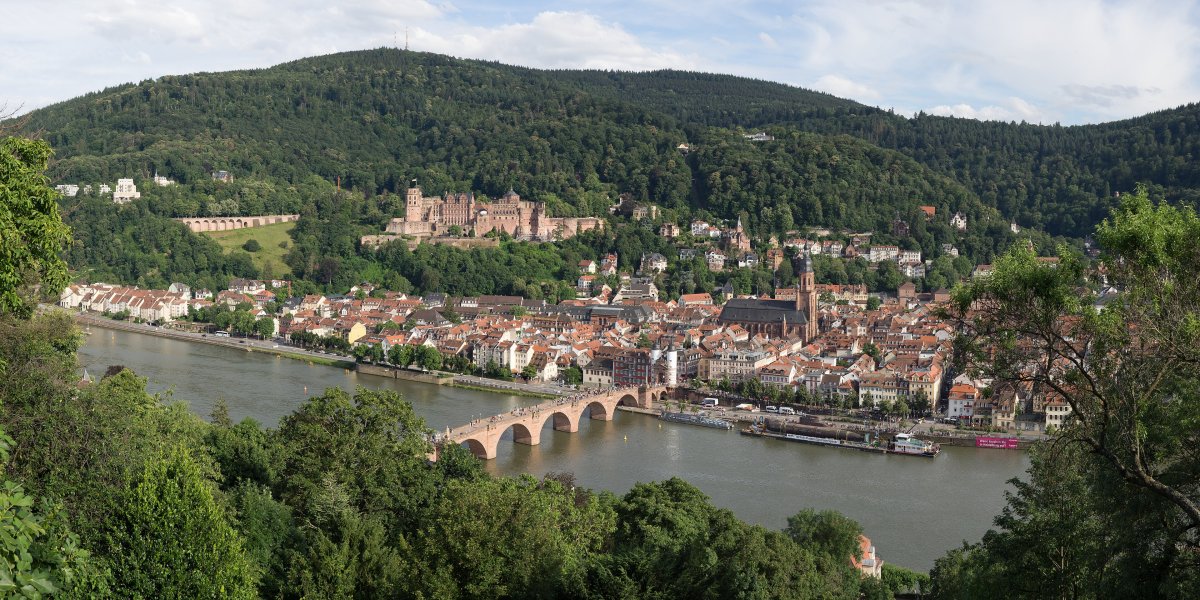
Cross the Old Bridge to the north bank and follow the stone sign for Schlangenweg — a steep cobblestone zigzag that climbs through chestnut canopy for 15 breathless minutes. The moment you crest the ridge, the most famous view in Germany unfolds: the red-sandstone castle ruin, the baroque bridge, the church spires of the old town, and the Neckar bending through the valley in one single frame that has defined German Romanticism since the 1800s. Walk east along the path to the Philosophengärtchen terrace for the cleanest, most unobstructed panorama — this is where Hegel and Goethe came to think, and you will understand why.
Tip: The Schlangenweg stairs start 50 meters past the bridge's north gate — look for the small stone marker at the base. Morning light before 10:30 hits the castle facade directly; by afternoon the castle falls into its own shadow and the photo flattens. Stand at the Philosophengärtchen iron railing for the widest angle — this is the exact vantage point printed on every Heidelberg postcard.
Open in Google Maps →10:30
Landmark
Descend the Schlangenweg — 10 minutes of cobblestone switchbacks back through the trees — and step onto the bridge from the north bank. Karl-Theodor-Brücke has connected the two halves of Heidelberg since 1788, and crossing it still feels like walking into a painting. The twin-towered Brückentor gate on the south bank was once the only entrance to the medieval city and still frames the old town in a way that stops you mid-step. Find the bronze Brückenaffe (Bridge Monkey) just past the south gate — touch its mirror for wealth, its outstretched fingers to guarantee your return to Heidelberg.
Tip: Best bridge photo: stand on the south bank about 20 meters downstream, shooting north with the Brückentor in the foreground and the green Heiligenberg hill rising behind. For the monkey statue, you have a window before the first tour buses arrive around 11:00. The monkey's plaque has a poem in Kurpfälzisch dialect — ask a local to translate it for you and you will both laugh.
Open in Google Maps →11:15
Religious
Step through the Brückentor archway and walk one block south — 2 minutes — into Marktplatz, where the Church of the Holy Spirit rises over the square like a red-sandstone anchor. This Gothic church has watched over Heidelberg since 1398 and once housed the Bibliotheca Palatina, the most important library of the German Renaissance, before Swedish troops carried it off to the Vatican. Below the church, the daily market fills the square with flowers, local cheese, and seasonal fruit around the Herkulesbrunnen fountain. Wander a few blocks west along Hauptstraße — at 1.6 km, one of Europe's longest pedestrian streets — and let the old town's rhythm settle in before lunch.
Tip: Skip the church tower climb — the Philosophers' Walk view you already have is vastly superior. Instead, duck two blocks south to Café Knösel at Haspelgasse 16 and buy a box of Heidelberger Studentenkuss pralines — the city's signature chocolate since 1863, invented because students and women were forbidden to kiss in public. A charming, lightweight souvenir.
Open in Google Maps →12:00
Food
From Marktplatz, duck one block north into Steingasse — a narrow cobblestone lane running parallel to the river — and Vetter's timber-framed entrance appears on your left within 2 minutes. This brewery holds a Guinness World Record for the world's strongest bottom-fermented beer (Vetter 33, 33.3% ABV), but the regular Helles is what you want with lunch. Order the Brauhaus-Bratwurst with sauerkraut and fresh bread (€11.90) or the crispy Schweinshaxe for a proper Heidelberg feast (€16.50). Copper kettles gleam behind the bar, the ceilings are low, and you are sitting exactly where Heidelberg students have been refueling between lectures for generations.
Tip: Skip the Vetter 33 — it is a novelty, not a pleasure. Order the Vetter Helles (0.3L, ~€4), which is genuinely excellent. Sit at the communal wooden tables in the back room for the best atmosphere. Service is brisk and German-efficient; you can be fed and out in 40 minutes, which is exactly what you want before the castle climb ahead.
Open in Google Maps →13:00
Landmark
Walk south from Steingasse through Marktplatz to Kornmarkt — a sloping square with a golden Madonna statue and a direct sightline straight up to the castle — then climb the Burgweg, a paved forest path that winds uphill for 15 minutes. You arrive at Germany's most photogenic ruin: a red-sandstone Renaissance palace that the French blew apart in 1693 and that Heidelberg decided was more beautiful broken than rebuilt. The Schlossterrasse gives you a vertigo-inducing view straight down over the old town rooftops and the Neckar. Walk through the open courtyard to face the ornate Friedrich Building facade, then circle through the Schlossgarten where romantic English-style gardens frame the ruin against open sky.
Tip: Walk up the Burgweg rather than taking the Bergbahn funicular — the 15-minute climb through the forest is half the charm, and the ticket price is the same either way. The Schlossterrasse faces north: between 13:00–14:00, overhead sun fully illuminates the rooftops below with no shadows. Skip the Großes Fass (Great Barrel) exhibit inside — it is an empty wine barrel in a dark room, genuinely anticlimactic. Spend those minutes on the garden terrace instead.
Open in Google Maps →19:00
Food
Descend the Burgweg back to Kornmarkt and stroll east along Hauptstraße for 10 minutes — the Red Ox's carved wooden sign hangs at number 217. This is not merely a restaurant; it is Heidelberg's living room since 1703. Mark Twain drank here, Bismarck argued here, and three centuries of university students have carved their names, fraternity crests, and love confessions into every inch of dark oak wall and ceiling. Order the Sauerbraten with potato dumplings and red cabbage (€18.90) — the vinegar-marinated beef is fork-tender, the sauce deep, sweet, and tart. Pair it with a Heidelberger Schlossbräu and raise your glass to the most romantic university town in Germany.
Tip: Reserve ahead for the main hall — not the modern annex — especially on Friday and Saturday evenings. Ask to sit near the far wall where the oldest student carvings from the 1800s are; the waiter will point out Twain's alleged seat if you ask. Avoid the generic tourist restaurants lining the western stretch of Hauptstraße near Bismarckplatz — they charge double for half the soul. The Roten Ochsen is the real deal, and it will be the meal you talk about when you get home.
Open in Google Maps →Saltar al día
09:00
Landmark
Take the Bergbahn funicular from Kornmarkt station — a two-minute ride lifts you straight to the castle gate. The Friedrich Building's Renaissance facade, lined with stone princes, still stands defiant after French troops blew the castle apart in 1693 — walk through the courtyard to the world's largest wine barrel, then step onto the terrace where the Neckar bends below you. At this hour the red sandstone glows amber in the morning light and the courtyard is nearly empty.
Tip: Take the first Bergbahn at 9:00 to arrive before tour buses flood the courtyard by 10:30. Don't skip the Apotheken Museum inside — included in your ticket, its 18th-century pharmacy jars and alchemist apparatus are one of the castle's best-kept surprises.
Open in Google Maps →12:00
Food
Walk down the cobblestoned Burgweg from the castle, passing the Kornmarkt Madonna fountain where the castle reflects in the water basin — a 10-minute descent into the old town. Duck into narrow Bauamtsgasse to find this wood-paneled tavern where Heidelberg locals have been eating for generations. Order the Heidelberger Schnitzel with potato salad (€14) or the Flammkuchen with bacon and onion (€10) — nothing fancy, everything honest.
Tip: Arrive right at noon to grab a table without waiting — by 12:30 the handful of wooden booths fill up. Sit downstairs for the cellar atmosphere rather than the brighter ground floor.
Open in Google Maps →13:30
Religious
Step outside and cross Marktplatz — the church's Gothic tower rises directly ahead, a 3-minute walk. This 15th-century church once housed the Bibliotheca Palatina, the most important library of the German Renaissance, before Catholic League troops seized it and shipped it to the Vatican in 1623. Climb the narrow tower staircase for an aerial view straight down into the rooftops and across to the castle — the perspective makes the old town look like a scale model.
Tip: Go right after lunch when most visitors are still eating — the one-way staircase gets congested by mid-afternoon. From the top, shoot westward to capture the castle framed by the river bend.
Open in Google Maps →14:30
Museum
Walk west along Hauptstraße past bookshops and student cafés, then turn left on Augustinergasse — a 5-minute walk. From 1778 to 1914, misbehaving university students were locked up here for offenses like dueling, public drunkenness, and disturbing the peace. The walls are floor-to-ceiling graffiti — silhouettes, coats of arms, bawdy poems, and protest slogans, all drawn by students who clearly considered imprisonment a badge of honor rather than a punishment.
Tip: Buy the combined ticket (€5) that covers both the Student Prison and the Old University's Alte Aula — you'll use the second half tomorrow. Open Tue–Sun; closed Mondays year-round, so plan accordingly.
Open in Google Maps →16:00
Landmark
Walk east back to Hauptstraße, then turn north on Steingasse toward the river — the medieval bridge gate towers appear at the end of the street, an 8-minute walk. Cross the 200-meter sandstone bridge built in 1788, stopping to rub the Brückenaffe's bronze mirror for good luck. Halfway across, turn around for the defining Heidelberg photograph: the castle floating above red rooftops, the church tower punctuating the skyline, the river pulling everything together — at 4 PM the afternoon sun lights the entire scene from the west.
Tip: The best castle-and-bridge photo is actually from the north bank — walk 50 meters past the bridge end and shoot back toward the south side. The Brückenaffe statue is on the south end: rub the mirror for the 'return to Heidelberg' legend, and the outstretched fingers for prosperity.
Open in Google Maps →19:00
Food
Walk back through the bridge gate, south on Steingasse, then east on Hauptstraße — a 5-minute stroll. Germany's most famous student pub has poured beer since 1703: Mark Twain drank here and wrote about it in A Tramp Abroad, and the walls are blackened with three centuries of fraternity photos and carved initials. Order the Sauerbraten with Spätzle (€18) and a half-liter of the house Pilsner (€4.50) — sit at the long communal tables and let the atmosphere do the rest.
Tip: Reserve for 19:00 to guarantee a seat in the historic main room — walk-ins after 20:00 end up in the modern annex next door, which has zero atmosphere. Steer clear of the 'traditional' restaurants lining Steingasse near the bridge — most are tourist traps serving reheated Schnitzel at double the price, banking on foot traffic from the Old Bridge.
Open in Google Maps →09:00
Park
Cross the Alte Brücke to the north bank and follow the Schlangenweg sign on your right — the steep switchback path zigzags through trees for 15 minutes before opening onto the Philosophers' Walk, the hillside path where Hegel, Goethe, and generations of Heidelberg thinkers came to clear their heads. The trail runs above the river with an unbroken panorama of the castle, the old town rooftops, and the Neckar — in morning light, the entire south bank glows. Halfway along, the Philosophengärtchen garden has exotic trees and a stone bench that may be the most peaceful seat in Germany.
Tip: Start by 09:00 — morning light casts long shadows across the castle facade that flatten by midday. Wear proper shoes; the Schlangenweg ascent is steep and cobbled. The best photo spot is a small clearing 10 minutes into the walk, where the castle and bridge align perfectly in one frame.
Open in Google Maps →12:00
Food
Descend the western end of the Philosophenweg into Neuenheim, cross the Theodor-Heuss-Brücke back to the old town, and turn into Schiffgasse — a 15-minute walk downhill. This locals' restaurant in a half-timbered house serves refined Baden cuisine that has earned it a loyal neighborhood following. Try the Maultaschen in broth — Swabian stuffed pasta (€13) — or the pan-fried trout with almond butter (€17); the seasonal lunch menu changes weekly and rarely disappoints.
Tip: The Mittagstisch lunch menu offers two or three daily specials at €12–15, a significantly better deal than the evening card. No reservations needed at lunch — just walk in.
Open in Google Maps →13:30
Museum
Walk west on Hauptstraße for 5 minutes — the museum occupies a Baroque townhouse at number 97. Two things alone justify the visit: Tilman Riemenschneider's Windsheim Twelve Apostles Altar, carved with a tenderness that makes 500-year-old wood feel alive, and the jawbone of Homo heidelbergensis, the 600,000-year-old fossil that put this city on the map of human evolution. The upper floor has Romantic-era paintings of the castle ruins by Turner and Rottmann — seeing them after yesterday's visit hits differently.
Tip: Open Tue–Sun 10:00–18:00, closed Mondays. Head straight to the Riemenschneider altar on the ground floor — most visitors rush past it to the fossil upstairs, but the altar is the finer work. Budget 20 minutes for the Romantic paintings on the top floor; they are the emotional coda to your castle visit.
Open in Google Maps →15:30
Landmark
Walk 5 minutes west to Universitätsplatz — the Old University building faces the square with quiet authority. Founded in 1386, this is Germany's oldest university, and the Alte Aula on the upper floor is its crown jewel: a neo-Renaissance ceremonial hall with stained glass, oak paneling, and murals depicting the history of learning. Standing in the room where Nobel laureates lectured and students debated for six centuries gives the entire Heidelberg visit its final layer of meaning.
Tip: If you bought the combined ticket at the Student Prison yesterday, entry is already covered — just show the same ticket. The Alte Aula is at its most atmospheric in afternoon light, when sun streams through the western stained glass windows.
Open in Google Maps →16:30
Religious
Step out of the university and cross Universitätsplatz — the church's sober facade is directly opposite, a 1-minute walk. Inside, the 18th-century Baroque interior opens into a soaring white nave that is the polar opposite of the medieval Heiliggeistkirche you saw yesterday — the absence of heavy ornamentation makes the space feel meditative and almost modern. Locals slip in for a quiet moment between errands, and after two days of walking, so should you.
Tip: Free entry, usually empty in the late afternoon — sit in a back pew for five minutes and let the silence recalibrate you before your farewell dinner. On the walk back east along Hauptstraße, skip the souvenir shops clustered near Marktplatz — they charge premium prices for generic trinkets; the same magnets and postcards are half the price at shops near Bismarckplatz.
Open in Google Maps →19:00
Food
Walk 5 minutes east on Ingrimstraße, a quiet street one block south of Hauptstraße — the restaurant's understated entrance is easy to miss, which is part of the charm. Heidelberg's finest restaurant pairs French technique with Baden ingredients in a candlelit dining room that seats barely 30 guests. Order the venison with red cabbage and juniper sauce (€28) or the pike-perch on lentils (€26), and pair it with a Spätburgunder from the Baden wine region — this is the meal you will remember longest.
Tip: Reserve at least two days ahead — there are only eight tables, and walk-ins are turned away most evenings. The three-course set menu (€45) is the best value if you want to experience the kitchen's full range. Ask for the window seat facing the alley for the most intimate setting.
Open in Google Maps →
Trip builder
Plan this trip around Heidelberg
Turn this guide into a bookable rail itinerary with FlipEarth.
Keep exploring
Related cities
More in the same country
FAQ
Frequently asked questions
How many days do you need in Heidelberg?
Most travelers enjoy Heidelberg in 1 days, with enough time for headline sights and a slower meal or museum stop.
What's the best time to visit Heidelberg?
The easiest season for most travelers is Apr-Oct, especially if you want good weather and manageable crowds.
What's the daily budget for Heidelberg?
A practical starting point is about €70 per person per day before hotels, then adjust based on museums, dining, and transport.
What are the must-see attractions in Heidelberg?
A good first shortlist for Heidelberg includes Alte Brücke (Karl-Theodor-Brücke), Heidelberger Schloss (Heidelberg Castle).