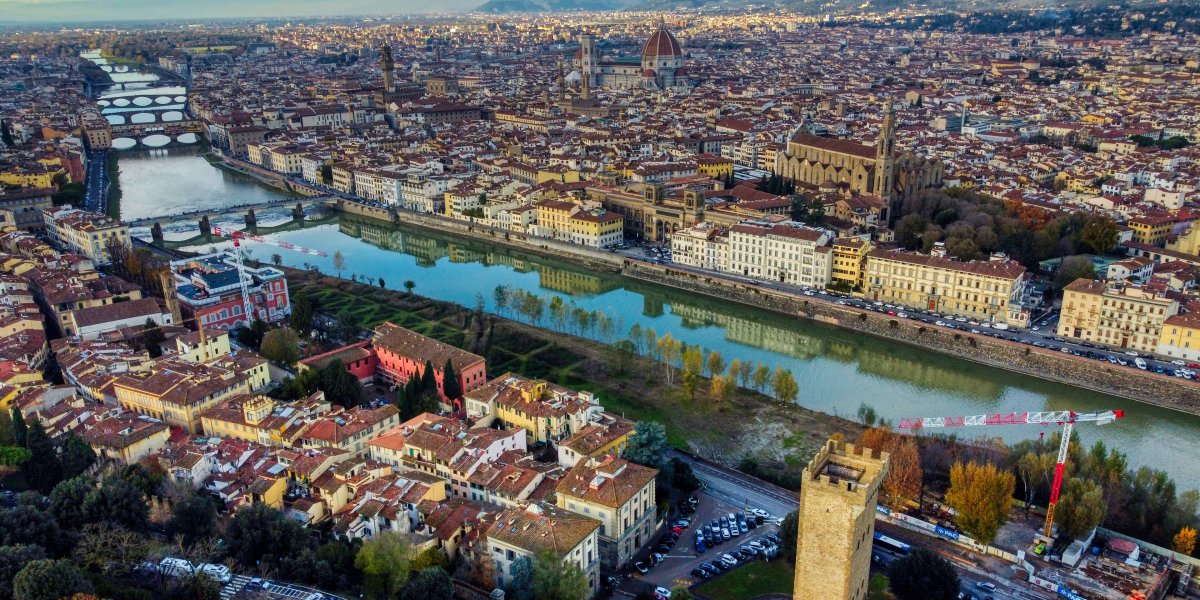
City Guide
Florence
Italy · Best time to visit: Apr-Jun, Sep-Oct.
Day-by-day plan
Choose your pace
Duración del viaje
09:00
Religious
From Santa Maria Novella station, walk south on Via dei Panzani — the dome appears and vanishes between buildings for ten minutes before revealing itself fully as you step into the piazza. Brunelleschi's terracotta dome and Giotto's bell tower soar above a facade of white, green, and pink marble panels so intricate they look carved from lace. Circle the entire cathedral — the quieter north side is arguably the most beautiful — then stand before Ghiberti's gilded 'Gates of Paradise' on the Baptistery's east face.
Tip: At 09:00 the sun hits the west facade head-on, lighting up the marble like a projection screen — by noon it falls into shadow and photographs flat. Stand at the northwest corner of the Baptistery for the unobstructed dome-and-belltower shot that every photographer chases.
Open in Google Maps →11:15
Landmark
Head south on Via dei Calzaiuoli, Florence's main pedestrian artery — a 7-minute stroll past leather shops and gelaterias with the Palazzo Vecchio tower pulling you forward like a compass needle. The piazza is an open-air sculpture gallery: the replica David guards the palazzo entrance, the Neptune Fountain anchors the north end, and the Loggia dei Lanzi shelters Cellini's bronze Perseus holding Medusa's severed head — the piece you'll stare at longest. Walk under the Uffizi's loggia on the south side for a dramatic framed view of the Arno and the hills beyond.
Tip: The Loggia dei Lanzi is free, uncrowded before noon, and one of the greatest sculpture collections in Italy hiding in plain sight — walk between the pieces, not just past them. Skip every café ringing the piazza; they charge €8 for an espresso that costs €1.50 one block away on Via dei Calzaiuoli.
Open in Google Maps →12:45
Food
Exit the piazza past the Uffizi courtyard, glance up at the loggia framing the Arno, then turn left onto Via dei Neri — the queue of locals tells you you've arrived, 3-minute walk. Order 'La Favolosa': prosciutto crudo, stracciatella, sun-dried tomatoes, and artichoke cream pressed into warm schiacciata flatbread (€7). Eat standing on the cobblestones like everyone else — this is Florentine street food at its peak, gone in four perfect bites.
Tip: There are multiple All'Antico Vinaio shops on Via dei Neri — the one at number 76r usually has the shortest queue. Skip the truffle sandwich (tourist upsell); regulars order La Favolosa or 'La Dante' with spicy nduja, pecorino, and zucchini cream (€6).
Open in Google Maps →13:30
Landmark
Walk west along Via dei Neri, duck south through the narrow Volta dei Girolami, and the river appears — Ponte Vecchio is right there, its medieval goldsmiths' shops cantilevered improbably over the water, 5-minute walk. The Medici evicted the butchers in 1593 because the smell offended them during their overhead commute through the Vasari Corridor — goldsmiths have lined both sides ever since. Cross slowly, pausing at the three open arches in the center for the upstream river view, then linger on the south bank for photos looking back at the bridge's full silhouette.
Tip: The best photo of Ponte Vecchio is not from the bridge — it is from Ponte Santa Trinita, one bridge upstream and a 3-minute detour west. Afternoon light between 14:00 and 15:00 in spring and autumn gilds the stone perfectly from that angle.
Open in Google Maps →16:00
Landmark
Turn left along Via de' Bardi past crumbling palazzo facades, then right onto Via di San Niccolò through the artisan quarter — potters, frame-makers, and a few excellent wine bars line the narrow street; at the old city gate the staircase begins, a steep but shaded 20-minute climb. The entire skyline spreads beneath you: every landmark you visited today now miniaturized into a single, impossible view — the dome, the tower, the bridge, the river, the hills dissolving into Tuscan haze. Claim a spot on the steps and watch the rooftops shift from amber to rose as the sun drops toward the horizon.
Tip: Grab a bottle of Chianti and paper cups from the alimentari on Via di San Niccolò before the climb — half the piazzale is locals doing exactly this. Stand at the balustrade just left of the bronze David replica for the classic skyline composition with the dome centered.
Open in Google Maps →19:00
Food
Descend the shaded staircase from the piazzale and turn right onto Via dell'Erta Canina — your knees will thank you for the downhill after the climb, and the quiet residential lane feels a world away from the tourist center, 10-minute walk. A former florist's shop turned neighborhood trattoria with a hidden garden courtyard, Beppa Fioraia serves Tuscan cooking without pretense: tagliata di manzo — sliced Chianina steak over rocket with shaved Parmigiano (€22) — or pici cacio e pepe (€13), with a half-litre of house Chianti (€8). Budget €35–45 per person.
Tip: Reserve the garden table a day ahead — call or message on Instagram, they respond quickly. Arrive at 19:00 sharp; by 19:30 every seat is taken. Tourist trap warning: the restaurants on Piazzale Michelangelo itself charge double for half the quality — La Loggia being the prime offender. Locals eat down the hill in San Niccolò, and now so do you.
Open in Google Maps →Saltar al día
08:15
Museum
Arrive at the Via Ricasoli entrance five minutes before opening — the doors open and the queue vanishes instantly. Walk straight through the Hall of Prisoners, where Michelangelo's unfinished slaves strain against raw stone, into the tribune where David stands alone under a natural skylight. At this hour with almost no one around, the silence makes it feel like a private audience with the Renaissance.
Tip: Book timed entry online at least two weeks ahead — walk-up lines exceed 90 minutes by 10 AM. Stand at David's left side and look up at the hand for the photo angle most visitors miss.
Open in Google Maps →10:00
Landmark
Exit the Accademia, turn right on Via Ricasoli, and in eight minutes the Duomo's terracotta dome appears above the roofline — that first reveal never loses its power. Enter through the Porta della Mandorla on the north side, climb 463 steps between the inner and outer shells where Vasari's Last Judgment fresco surrounds you at arm's length, and emerge onto the panoramic terrace with every red roof and cypress hill in Florence spread below. The morning light at this hour illuminates the fresco perfectly and the terrace is still uncrowded.
Tip: Book the dome climb slot on the official Duomo website days in advance — there is no elevator, no turning back, and slots sell out fast. The cathedral entrance is free and worth 15 minutes for the Uccello clock face above the west door.
Open in Google Maps →12:15
Food
Walk south through Via dei Calzaiuoli — Florence's main pedestrian artery buzzing with street musicians — and turn left on Via dei Neri; the queue spilling onto the sidewalk marks the spot. This legendary schiacciata sandwich shop has been a Florentine institution since the 1990s, serving warm, crisp, oil-kissed flatbread stuffed to order at a pace that keeps the terrifying line moving in under ten minutes.
Tip: Order La Favolosa (€6) — truffle cream, finocchiona salami, pecorino, and artichoke cream on schiacciata — with a glass of house Chianti (€3). The original shop at #74r has the fastest line; the newer locations across the street use the same kitchen.
Open in Google Maps →13:30
Museum
Walk two minutes south on Via dei Neri to the entrance on Via della Ninna — the post-lunch slot means the morning tour groups have cleared out. Your non-negotiables: Room 2 for Giotto's Ognissanti Madonna, Room 8 for Botticelli's Birth of Venus and Primavera side by side, Room 35 for Leonardo's Annunciation, and Room 83 for Titian's Venus of Urbino. The upper-floor windows frame Ponte Vecchio through the Vasari Corridor perfectly.
Tip: Book a 13:30 timed slot online — afternoons are roughly 40% less crowded than mornings. Beeline to Room 8 (Botticelli) on the second floor first before the room fills, then work backward through the collection.
Open in Google Maps →16:00
Landmark
Exit the Uffizi through the Piazzale degli Uffizi colonnade and Ponte Vecchio appears directly ahead — the medieval bridge lined with glinting goldsmith shops that has survived floods and wars since 1345. Cross slowly, pausing at the three arched openings in the center where the downstream Arno view is unobstructed. In late-afternoon light the river turns amber and the bridge doubles itself in reflection — this is the shot.
Tip: For the classic postcard view of the bridge itself, walk five minutes east along the north riverbank to Ponte alle Grazie and shoot back toward Ponte Vecchio with the Arno in the foreground.
Open in Google Maps →19:30
Food
Walk north from Ponte Vecchio through Via de' Tornabuoni — Florence's most elegant shopping street, perfect for window browsing as the evening settles in — for twelve minutes to this vaulted cellar restaurant that has served Florentine steaks since 1886. The low brick ceilings and white tablecloths feel like stepping into another century, and the bistecca alla fiorentina — thick-cut Chianina beef, charred outside, ruby within — is the definitive version of this city's most iconic dish.
Tip: Reserve three days ahead for 19:30. Order the bistecca alla fiorentina (€50/kg, minimum 1.2 kg shared for two) and start with ribollita (€12), a bread-thickened vegetable soup that is peasant food elevated to art. Budget €45-55 per person with house wine. Steer clear of any restaurant between here and Piazza della Signoria with laminated photo menus outside — they charge €25 for reheated tourist pasta.
Open in Google Maps →09:00
Museum
Cross Ponte Vecchio and walk straight up Via de' Guicciardini for five minutes — the massive rusticated façade of the Medici's grandest palace fills the entire street. The Palatine Gallery on the first floor is the treasure: Raphael's Madonna of the Chair and Titian's Mary Magdalene hang in rooms still decorated exactly as the Medici left them, gilt frames against silk damask walls. Unlike the Uffizi, there are no ropes and few crowds — you can stand inches from a Raphael.
Tip: Enter right at 09:00 and head directly to the Sala di Saturno for Raphael's clustered masterpieces. Buy the combined Pitti + Boboli ticket (€22) at the entrance to save €4 over separate tickets.
Open in Google Maps →11:00
Park
Exit Palazzo Pitti through the rear courtyard and you are already inside — the Boboli Gardens unfold uphill behind the palace like a Renaissance painting come to life. Follow the central cypress avenue to the Kaffeehaus terrace for a panoramic view over Florence's skyline, then loop back down past the Neptune Fountain and the Buontalenti Grotto with its fake stalactites and hidden Michelangelo casts. This is where the Medici came to escape the city without leaving it.
Tip: The Kaffeehaus halfway up the hill serves espresso with the best hidden view in Florence — most tourists walk right past it. Wear comfortable shoes; the gravel paths are steep and uneven.
Open in Google Maps →13:00
Food
Exit Boboli through the main Pitti entrance and walk two minutes into the quiet Piazza della Passera — the terrace tables under the orange awning are where Oltrarno locals actually eat lunch. No English menu on the door, no hawkers outside — just honest Tuscan cooking from a kitchen that has been refining the same recipes for decades.
Tip: Order the pear and pecorino ravioli (€14) — the signature dish unchanged for twenty years — and tagliata di manzo (€18) sliced over wild arugula. No reservation needed for lunch if you arrive by 13:00; budget €25-30 with house wine.
Open in Google Maps →14:30
Religious
Walk ten minutes west from Piazza della Passera through Oltrarno's artisan streets — peek into woodworking and leather workshops with doors flung open — to the Church of Santa Maria del Carmine. The Brancacci Chapel inside is small enough to miss, but Masaccio's frescoes painted in 1427 changed Western art forever: the Expulsion from the Garden of Eden shows a grief so raw that Picasso reportedly stood here in silence. You are limited to 30 minutes inside, and it is enough — the chapel is only as wide as a living room.
Tip: Book the €10 timed entry at the church entrance — only 30 people are allowed in at a time. Look for the Tribute Money on the upper left wall: the way Masaccio painted natural light falling across the apostles' faces directly influenced Leonardo da Vinci.
Open in Google Maps →16:30
Landmark
Walk east from the chapel through Oltrarno's quieter residential streets, passing through the artisan neighborhood of San Niccolò, then follow the signs uphill through tree-lined switchbacks — the twenty-five-minute climb rewards you with Florence's greatest panorama. The entire city spreads below: the Duomo's dome, Palazzo Vecchio's tower, every bridge in a row like piano keys across the Arno. Arrive before golden hour to watch the light shift from warm gold to rose across the terracotta rooftops — this sunset is not overhyped, it is the single most beautiful moment in Florence.
Tip: Grab a €3 beer from the kiosk on the east side and claim a spot on the steps below the bronze David replica — center-left gives you the Duomo and Ponte Vecchio in one frame. For an even quieter panorama, walk five minutes further uphill to Basilica di San Miniato al Monte.
Open in Google Maps →19:30
Food
Walk twenty minutes back downhill through quiet residential lanes to Via di Santo Spirito, where candlelight glows through arched windows. Il Santo Bevitore is Oltrarno's best-loved dinner spot — a short seasonal menu of refined Tuscan cooking paired with an exceptional wine list, served in a vaulted medieval space where locals outnumber tourists on any given night.
Tip: Reserve two days ahead for 19:30 and request the back room with stone arches. Order the slow-cooked pork cheek with polenta (€18) and the house Chianti Classico Riserva by the glass (€8); budget €35-45 with wine. On your walk back, resist the gelato shops clustered near Ponte Vecchio — they use powdered mix and charge double. Locals go to Gelateria La Sorbettiera on Piazza Tasso instead.
Open in Google Maps →Saltar al día
08:15
Landmark
Start your Florence story at the top. The 463-step climb spirals between the inner and outer shells of the largest masonry dome ever built — halfway up, you're close enough to touch Vasari's swirling Last Judgment frescoes. At the summit, the terracotta rooftops of Florence unfold in every direction, with the Tuscan hills fading into the morning haze.
Tip: Book the 08:15 first-entry slot at least two weeks ahead on the official Opera del Duomo website — this is the only way to climb the dome. Enter through Porta della Mandorla on the cathedral's north side (not the main facade). The Brunelleschi Pass (€30) also covers the Baptistery, Bell Tower, Museum, and Crypt — valid 72 hours. After descending, walk around to the cathedral's rear apse for Brunelleschi's architectural masterpiece from street level, with almost no one around.
Open in Google Maps →12:00
Food
Walk south from the Duomo along Via dei Calzaiuoli — Florence's main pedestrian artery, alive with street musicians — past the carved saints of Orsanmichele church; turn right into Via dei Magazzini just before Piazza della Signoria, an 8-minute stroll. This shoebox-sized trattoria with eight tables hasn't changed in decades. Order the peposo dell'Impruneta (beef braised for hours in black pepper and Chianti, €12) — the dish the dome builders ate — and a bowl of pappa al pomodoro (bread-and-tomato soup, €8). Budget €20–30.
Tip: No reservations taken — arrive by 12:00 sharp or face a 30-minute wait. Cash only. The owner's handwritten daily menu changes with the market. Sit at the back table by the open kitchen to watch the cooking.
Open in Google Maps →14:00
Museum
Step onto Piazza della Signoria from the osteria — Palazzo Vecchio's crenellated tower rises above the open-air sculpture gallery of the Loggia dei Lanzi — and walk through the courtyard colonnade to the Uffizi entrance, a 3-minute stroll. Don't try to see everything. Head to Room 2 for Giotto's revolution, Rooms 10–14 for Botticelli's Birth of Venus and Primavera, Room 35 for Leonardo's Annunciation, and Room 83 for Titian's Venus of Urbino. Pause at the Arno-side corridor windows for the most perfectly framed view of Ponte Vecchio you'll ever see.
Tip: Book skip-the-line tickets online (€25 peak season + €4 booking fee) and enter through Door 1 (reserved). Closed on Mondays. Afternoon is actually quieter than mid-morning when tour groups flood in. The second-floor rooftop café terrace has a surprise Duomo view most visitors never find — worth a coffee stop.
Open in Google Maps →16:30
Landmark
Exit the Uffizi and turn right — the Arno glitters straight ahead through the Piazzale degli Uffizi, a 2-minute walk. Europe's oldest surviving stone bridge, rebuilt in 1345 and famously the only Florentine bridge the retreating Germans spared in 1944. Goldsmith shops still line both sides, as they have since the Medici banned butchers for the smell. Cross to the Oltrarno side, then walk 50 meters downstream along Lungarno Torrigiani for the classic postcard angle — the bridge with its overhanging workshops reflected in the river.
Tip: The afternoon sun hits the bridge from the west, warming the stone to gold. For the best photo composition, stand on Ponte Santa Trinita (one bridge west) and shoot back toward Ponte Vecchio — this is the angle every photographer uses. The jewelry shops on the bridge itself are beautiful but overpriced; buy gold in the Oltrarno workshops instead.
Open in Google Maps →19:30
Food
Walk north from Ponte Vecchio through Via de' Tornabuoni — Florence's most elegant street, where Ferragamo, Gucci, and Pucci were born — past Piazza Santa Trinita and the Column of Justice, turning left onto Via del Porcellana; 12-minute walk. Open since 1869, this no-frills trattoria is Florence's worst-kept local secret. The petto di pollo al burro (chicken breast swimming in butter, €16) is absurdly simple and absolutely unforgettable. Start with the tortino di carciofi (artichoke omelette, €14) — the crust shatters and the center is silk. Budget €35–50.
Tip: Call to reserve for 19:30 — they only seat dinner from 19:30. Cash only. The dining room is a single row of shared marble tables; embrace the elbow-to-elbow conviviality. Avoid every restaurant you see around Santa Maria Novella station on your walk here — they survive on tourist turnover, with marked-up menus and frozen ingredients.
Open in Google Maps →09:00
Museum
Cross the Arno via Ponte Vecchio and continue straight up Via de' Guicciardini — the vast rusticated stone facade of Palazzo Pitti fills the piazza ahead, a 10-minute walk from the historic center. The Palatine Gallery upstairs is an overwhelming private collection: Raphael's Madonna of the Chair, Titian's Mary Magdalene, Caravaggio's Sleeping Cupid. Unlike the Uffizi's chronological order, paintings here are hung salon-style, floor to ceiling in gilded rooms named after the planets — it feels like breaking into a grand duke's private apartments.
Tip: Arrive at 09:00 opening — tour groups don't appear until 10:30, giving you the Raphael rooms almost to yourself. Buy the combined ticket (€22 peak season) which covers both the Palatine Gallery and Boboli Gardens. Start on the second floor with the Palatine Gallery, work through the planetary rooms (Jupiter, Mars, Venus), and save the Royal Apartments for last. Closed on Mondays.
Open in Google Maps →11:00
Park
Exit the Palatine Gallery and follow the palace signs toward the garden — no re-entry needed, it's all connected. You step out onto the terrace overlooking the amphitheater with the city skyline beyond. The original Italian Renaissance garden, designed in 1549 for Eleonora de' Medici. Climb to the Neptune Fountain for a panoramic overlook, then meander down the long Cypress Alley (Viottolone) where dappled light filters through centuries-old trees — exit through the Annalena gate onto Via Romana.
Tip: Included in your Pitti ticket. The Kaffeehaus — a mint-green Rococo pavilion halfway up the hill — has a terrace with one of Florence's best hidden views and almost no visitors bother to climb to it. Wear comfortable shoes; the garden is far hillier than it looks on the map. The Grotta Grande (Buontalenti Grotto) near the entrance has bizarre mannerist sculptures and painted cave walls — easy to miss but worth five minutes.
Open in Google Maps →13:00
Food
Exit Boboli through the Annalena gate, turn right on Via Romana, then duck left into the tangle of Oltrarno lanes — follow Via de' Serragli north and turn right on Via dei Vellutini to emerge into Piazza della Passera, one of Florence's most charming hidden squares; 8-minute walk. The pear-and-pecorino ravioli in walnut cream sauce (€14) is their signature — rich, nutty, perfect. The bistecca alla fiorentina (€48/kg, for two) here is as honestly Tuscan as it gets. Budget €25–35.
Tip: Book ahead and request an outdoor table on Piazza della Passera — the tiny square with its single tree is peak Oltrarno charm. After lunch, this is your free-strolling window: wander Via Maggio for antiques, peek into artisan woodworking and restoration studios on Via Santo Spirito, and stop in Piazza Santo Spirito to see Brunelleschi's austere church facade and the neighborhood's living-room piazza.
Open in Google Maps →17:30
Landmark
From Piazza della Passera, walk east through the Oltrarno via Via dello Sprone and Via de' Bardi to the medieval Porta San Miniato; take the stepped stone path up through the olive grove — steep but atmospheric and far quieter than the road. A 25-minute walk including the climb. The terrace that owns Florence's most famous panorama. In the golden hour the entire city turns to amber — the Duomo, Palazzo Vecchio's tower, the Arno's bridges stretching into the distance, and the Tuscan hills beyond.
Tip: Arrive by 17:30 in spring and autumn for the golden hour — sunset is roughly 19:30 in April–June, 18:30 in September–October. Find a spot on the upper steps (left side facing the city) for an unobstructed view. Bring a bottle of wine from a nearby enoteca — everyone does. Walk 5 minutes further uphill to Basilica di San Miniato al Monte for an even more spectacular view with a fraction of the crowd.
Open in Google Maps →19:30
Food
Walk down from the piazzale via the stone staircase into the quiet, leafy San Niccolò neighborhood — the medieval tower gate rises ahead on Via San Niccolò; 10-minute walk downhill. Tucked into the neighborhood at the foot of the hill, this is where Florentines eat after an evening passeggiata. The tagliatelle al ragù di cinghiale (wild boar ragù, €12) is Tuscan comfort at its purest; follow with tagliata di manzo (sliced steak over arugula and parmigiano, €16). Budget €25–35.
Tip: The small garden terrace in the back is the best seat in the house. House wine is honest and €4 a glass — no need to order by the bottle. Avoid the food trucks parked at Piazzale Michelangelo; they charge double for mediocre panini that coast on the view.
Open in Google Maps →08:15
Museum
Walk north from the center up Via Ricasoli — the street narrows and the gallery entrance appears at number 58/60, the queue already forming even before the doors open. You come for the David, and the David delivers. Michelangelo's 5.17-meter masterpiece stands at the end of a corridor lined with his unfinished Prisoners — slaves writhing out of raw marble, the creative act frozen mid-stroke. The progression from incompleteness to perfection is deliberate, moving, and unlike anything else in art.
Tip: Book the 08:15 first-entry slot online — the gallery is small and 1.5 hours is plenty. Approach the David from the main corridor (not the side) for the dramatic reveal Michelangelo intended. The best photo angle is from the right side, slightly below, where the light catches his face and the sling draped over his shoulder. Closed on Mondays.
Open in Google Maps →10:00
Museum
Exit the Accademia and walk south along Via Ricasoli, turning right on Via degli Arazzieri — the terracotta dome of the chapels rises behind the Basilica di San Lorenzo. The entrance is on Piazza di Madonna degli Aldobrandini; 7-minute walk. Michelangelo designed the New Sacristy as a meditation on time and mortality: the reclining figures of Dawn, Dusk, Day, and Night on the Medici tombs are among his most expressive works. Next door, the Chapel of the Princes is the opposite — a riot of marble and semi-precious stones built to prove that Medici wealth could outshine heaven itself.
Tip: Head directly to the New Sacristy and spend most of your time there — notice how Night's body seems to resist waking, how Dawn's face is unfinished as if emerging from sleep. The Chapel of the Princes is visually stunning but 10 minutes is enough. Closed on the 1st, 3rd, and 5th Monday and 2nd and 4th Sunday of the month — check before you go.
Open in Google Maps →12:00
Food
Exit the chapels and turn left — the leather stalls of the San Lorenzo market spread before you. Walk through the market (ignore the touts) and turn right on Via Rosina; Trattoria Mario is on the left under a faded green sign — look for the queue. A 4-minute walk. A Florentine institution since 1953: shared marble tables, paper tablecloths, and a kitchen that hasn't slowed down in 70 years. The ribollita (€7) is the definitive version — thick, earthy, restorative. If you're hungry, the bistecca alla fiorentina (€45/kg, minimum ~700g for two) rivals any in the city. Budget €15–25.
Tip: The queue starts forming at 11:45 — arrive by 12:00 for the first seating. No reservations, cash only, water is from the tap and free. They close at 14:30 and don't reopen for dinner. Do not buy leather goods from the outdoor stalls around San Lorenzo — quality is poor and prices are inflated for tourists. For real Florentine leather, visit Scuola del Cuoio inside Santa Croce, your next stop.
Open in Google Maps →14:30
Religious
Walk south through the center — down Via dei Calzaiuoli, past Piazza della Signoria, and east on Borgo dei Greci. The grand white marble facade of Santa Croce appears across a wide piazza; a 15-minute walk and your free-strolling window, so take it slow. The Pantheon of Italian Glories: Michelangelo, Galileo, Machiavelli, and Rossini are all buried here. The real treasures are Giotto's frescoes in the Bardi and Peruzzi chapels — the turning point of Western painting — and the Pazzi Chapel by Brunelleschi in the cloister, a perfect essay in Renaissance geometry that you can have almost to yourself.
Tip: The €8 ticket includes the church, cloister, museum, and Pazzi Chapel. Visit the Scuola del Cuoio (Leather School) through the door inside the sacristy — a working workshop since 1950 where you watch artisans tooling leather and can buy genuine Florentine pieces at fair, fixed prices. This is the real thing the San Lorenzo stalls imitate.
Open in Google Maps →19:00
Food
From Santa Croce, walk north on Via de' Macci — the trattoria is on the left after 5 minutes. The entrance is modest; don't confuse it with the upscale Cibrèo Ristorante next door, which shares the same kitchen at triple the price. Chef Fabio Picchi's deliberate no-pasta menu forces you to taste things you won't find elsewhere. The passato di peperoni gialli (velvety yellow pepper soup, €10) is legendary. Follow with polpettone (Tuscan herb meatloaf, €16) — home cooking elevated to art, and the perfect farewell to Florence. Budget €35–45.
Tip: Arrive at 19:00 — no reservations accepted, but the first seating rarely has a queue. Same kitchen, same chef, a third of the price of the restaurant next door: this is one of Florence's greatest dining secrets. For dessert, walk 3 minutes to Vivoli (Via Isole delle Stinche 7r) — Florence's oldest gelateria since 1930, where the crema and chocolate flavors alone justify the detour. Avoid the gelato shops between here and the Duomo with mountains of brightly colored product piled above the tubs — real gelato is stored flat and muted in color.
Open in Google Maps →Saltar al día
08:30
Landmark
Start your Florence story by climbing above it. The 463 steps spiral between the inner and outer shells of the largest masonry dome ever built — halfway up, you are close enough to touch Vasari's swirling Last Judgment fresco. At the summit, the terracotta skyline unfolds in every direction: the Arno bending south, Fiesole's green hill to the north, Giotto's Bell Tower at eye level. Come down slowly; the descent reveals construction details you miss going up.
Tip: Book the 08:30 timeslot on the official Opera del Duomo website at least two weeks ahead — this is the quietest slot, and the morning light through the oculus illuminates the fresco beautifully. Enter from Porta della Mandorla on the cathedral's north side, not the main façade. Your €30 Brunelleschi Pass also covers the Baptistery, Bell Tower, Cathedral Museum, and Crypt — valid 72 hours. After descending, walk around to the cathedral's rear apse for a street-level view of the dome's engineering with almost no one around.
Open in Google Maps →12:00
Food
Walk south from the Duomo along Via dei Calzaiuoli — Florence's main pedestrian artery, five minutes of Renaissance shopfronts and street musicians — past the carved saints of Orsanmichele church, then turn right into Via dei Magazzini just before Piazza della Signoria. This shoebox-sized trattoria with six tables hasn't changed in decades; the menu is handwritten on the wall each morning and the cooking is done behind a tiny counter in full view.
Tip: No reservations, cash only. Arrive by 11:50 and wait outside — by 12:15 the queue wraps past the corner. Order the ribollita (€10), thick and earthy with new-season olive oil, and the peposo dell'Impruneta (€12), a slow-braised beef and black pepper stew supposedly invented by the dome builders. Budget €18–25 per person.
Open in Google Maps →13:30
Museum
Step out of the osteria onto Piazza della Signoria — Palazzo Vecchio's crenellated tower rises above the Loggia dei Lanzi's open-air sculptures — and walk through the courtyard colonnade to the Uffizi's reserved-ticket entrance, a three-minute stroll. This is the Renaissance in chronological order under one roof: Cimabue, Giotto, Botticelli, Leonardo, Raphael, Titian, Caravaggio. The post-lunch crowd is thinner than the morning rush, and the western galleries catch beautiful afternoon light through the Arno-facing windows.
Tip: Book timed-entry tickets online (€25 peak season). Head straight to Room 2 for Cimabue and Giotto — watch painting evolve from flat Byzantine gold to three-dimensional space in a single wall — then Rooms 10–14 for Botticelli's Birth of Venus and Primavera before tour groups arrive after 14:30. The second-floor corridor has windows perfectly framing Ponte Vecchio — most visitors walk past without noticing. Closed Mondays.
Open in Google Maps →17:00
Landmark
Exit the Uffizi onto the Lungarno, turn left along the river past Ponte Vecchio, and cross at Ponte alle Grazie. From there, climb the shaded stone steps through the Giardino delle Rose — a free rose garden most visitors never find — emerging at the terrace ten minutes later. This is Florence's definitive panorama: the Duomo, the river, the tower of Palazzo Vecchio, and the Tuscan hills in a single, unobstructed sweep. Settle in and wait for golden hour; the entire city turns amber.
Tip: Stand at the left (western) end of the terrace for the best composition — Ponte Vecchio, the Duomo, and the hills layer together in one frame. Always take the stone steps from Porta San Miniato or through the Rose Garden, never the main road — it is charmless and exhaust-heavy. If you have fifteen extra minutes, walk up one more level to San Miniato al Monte for an even quieter view and one of Florence's most beautiful Romanesque façades.
Open in Google Maps →19:30
Food
Walk downhill from Piazzale Michelangelo through the quiet San Niccolò neighborhood — five minutes along Via dell'Erta Canina, past old workshop doors and jasmine-covered walls. This restaurant occupies a former florist's shop with a candlelit garden concealed behind the building. The menu is refined Tuscan with seasonal ingredients — the kind of place where Florence's architects and gallery owners come for a long Friday dinner away from the centro storico.
Tip: Reserve a garden table for sunset — call the day before. Order the tagliatelle al ragù bianco di chianina (€16) and the tagliata di manzo with roasted porcini (€24). Budget €35–45 per person with a glass of Chianti Classico. Warning: the tourist restaurants lining the main road up to Piazzale Michelangelo charge double for half the quality — never eat on the approach road.
Open in Google Maps →09:00
Museum
Head north from the Duomo up Via Ricasoli — a ten-minute walk past art supply shops that have served students for generations — to the Accademia's modest entrance. The gallery exists because of one sculpture: Michelangelo's David. But walk slowly. The Hall of Prisoners leading up to him displays four unfinished Slaves still half-trapped in raw marble, showing exactly how Michelangelo worked — chiseling from the front as if releasing a figure from water. Then David appears at the end of the hall, 5.17 meters of white Carrara marble, and everything else falls silent.
Tip: Book the 09:00 timed slot — the 08:15 opening attracts organized tour groups, while 09:00 is a brief lull before mid-morning crowds. Circle David fully: his left hand gripping the sling strap is tense in a way no photograph captures. The musical instruments collection on the ground floor is often empty and surprisingly beautiful — Stradivari pieces behind glass. Closed Mondays.
Open in Google Maps →11:30
Museum
Exit the Accademia, turn left, and walk three minutes north to Piazza San Marco — the modest entrance is on the right side of the church. This is the most intimate museum in Florence: a working Dominican monastery where Fra Angelico painted a fresco inside each monk's cell as an aid to silent meditation. Climb the stone stairs to the upper floor and the Annunciation appears at the top — pale pastels, infinite gentleness, painted for an audience of one monk at a time. No other museum in the world makes you feel this close to the artist's intent.
Tip: Cell 1 (Noli me tangere) and Cell 3 (the Annunciation) are masterpieces, but do not skip Cell 7 — the Mocking of Christ is Fra Angelico at his most emotionally devastating, all cruelty reduced to disembodied hands. Savonarola's austere cell (Cells 12–14) is at the far end of the corridor. The monastery closes early on some Sundays and first/third/fifth Mondays — check hours on the day.
Open in Google Maps →13:00
Food
Walk west from San Marco along Via Cavour, then turn left onto Via Rosina — eight minutes through the San Lorenzo market stalls selling leather goods and linen tablecloths. Trattoria Mario has occupied this corner since 1953: communal marble tables under a low ceiling, no written menu in sight — you sit, a waiter tells you what is cooking, and you point. It is loud, fast, gloriously chaotic, and the food is astonishingly good for the price. This is where Florentine market workers eat lunch.
Tip: Cash only, no reservations, lunch only — closes at 14:30. Arrive by 12:45. Share a communal table without hesitation; half the charm is sitting with Florentine regulars who have eaten here for decades. Order the bistecca (a sharing portion for two is about €25) or tortelli di patate (€9). Budget €12–18 per person including house wine served in a tumbler.
Open in Google Maps →15:00
Religious
Walk southeast from San Lorenzo through the centro storico — fifteen minutes along Via del Proconsolo, past the Bargello's stern tower — into the spacious Piazza Santa Croce. This is Florence's pantheon: Michelangelo, Galileo, Machiavelli, and Rossini are all buried here, their monuments lining the nave like a final roll call of Western genius. The afternoon light streams through the high windows and illuminates Giotto's frescoes in the Bardi and Peruzzi chapels — the same frescoes that taught Masaccio and, through him, all of Renaissance painting.
Tip: Michelangelo's tomb is on the right wall near the entrance, designed by Vasari — deliberately positioned so that when the doors open on Judgment Day, the first thing he sees is Brunelleschi's Dome. The leather school behind the basilica (Scuola del Cuoio, enter through the cloister) is one of the last genuine artisan workshops in the centro — students hand-stitch bags while you watch. Closed some religious holidays.
Open in Google Maps →19:30
Food
Walk west from Santa Croce along Borgo dei Greci — a narrow medieval street heavy with evening atmosphere — for five minutes until you reach Via della Vigna Vecchia. This wine-dark, brick-walled restaurant has been a Florence institution since the 1970s, famous for one thing: the assaggio, a tasting of five different first courses served as a shared plate. The portions are generous, the flavors rotate seasonally, and the room is spirited and sociable, with tables close enough for conversation with strangers.
Tip: Reserve for 19:30 — the 20:30 seating is packed and rushed. Order the assaggio di primi (€16), five pastas on one plate, and the tagliata di manzo (€22). Budget €28–35 per person. Warning: the streets between Santa Croce and Piazza della Signoria are lined with tourist menus advertising €12 'bistecca fiorentina' — these are traps serving pre-frozen meat. Walk past them without a second glance.
Open in Google Maps →09:00
Museum
Cross the Arno over Ponte Vecchio — pausing to glance upstream where the river bends and the hills begin — then continue straight along Via de' Guicciardini for three minutes to the fortress-like façade of Palazzo Pitti. This was the Medici's private residence, and they decorated accordingly. The Palatine Gallery hangs paintings the way the family lived with them: Raphaels, Titians, and Caravaggios crowded together in gilded rooms, floor to ceiling, overwhelming and deliberate. It feels less like a museum and more like walking through a dynasty's obsession.
Tip: Enter at 09:00 opening — the first hour is nearly empty because tour groups assemble at 10:00. Head directly to the Sala di Saturno for Raphael's Madonna della Seggiola, then Sala di Giove for his La Velata — arguably his most beautiful portrait. The Royal Apartments on the ground floor are often ignored but the Sala Bianca (White Room) is one of the most photogenic interiors in all of Florence. Closed Mondays.
Open in Google Maps →12:00
Food
Exit Palazzo Pitti through the main gate, turn left, and walk three minutes through Via dei Vellutini to Piazza della Passera — a tiny square that locals consider the true heart of Oltrarno. Trattoria 4 Leoni has tables spilling into this piazza, shaded by canvas umbrellas, with the sound of Vespa engines echoing off stone walls and church bells marking the quarter hour. The kitchen has been run by the same family for three generations and the menu is unapologetically traditional, except for one famous modern invention.
Tip: Book an outdoor table on the piazza — call the day before. Order the ravioli pere e pecorino (pear and pecorino ravioli, €14), their signature dish that has become a Florentine modern classic, and the bistecca tagliata with rucola (€20). Budget €22–30 per person. Arrive at noon sharp; by 12:30 the terrace is full and you will be seated inside.
Open in Google Maps →14:00
Park
Walk back to Palazzo Pitti and enter the gardens through the courtyard — the entrance is inside the palace itself. The Boboli Gardens are the prototype for every royal garden in Europe: sculpted hedges, hidden grottoes, gravel alleys lined with weathered classical statues, and sudden panoramas across the Florentine hills. The early afternoon sun is strong, but the cypress alleys provide deep shade, and the pace here is meant to be unhurried — a Renaissance garden was designed for slow conversation and stolen glances, not efficiency.
Tip: Walk the central axis uphill to the amphitheater first for a view back over the palace with the Duomo floating beyond. Then take the left fork toward the Kaffeehaus — a Rococo pavilion with a terrace café serving the best rooftop panorama in Oltrarno. End at the Isolotto, an oval island pool ringed by statues at the garden's lowest point — the afternoon light hits the water and stone beautifully. Bring water; there is only one café inside.
Open in Google Maps →16:30
Religious
Exit the Boboli Gardens from the Annalena gate on the western side, walk along Via Romana for two minutes, then turn right through quiet residential streets — Via del Campuccio, then Via Santa Monaca — to Piazza del Carmine. A fifteen-minute walk through lanes that feel like a different city. The church of Santa Maria del Carmine is unremarkable from outside, which makes what is inside more startling. The Brancacci Chapel holds Masaccio's frescoes, painted when he was twenty-five, which cracked open the door to the entire Renaissance.
Tip: Visits are limited to 30 minutes per group — book online in advance. The Expulsion of Adam and Eve is on the upper-left wall: Eve's open-mouthed cry of shame is the single most emotionally powerful image in all of Florentine art. Across the chapel, compare Masolino's Adam and Eve Before the Fall — serene, innocent, almost flat. The contrast across those two walls is the entire Renaissance in one room.
Open in Google Maps →19:30
Food
Walk five minutes east along Borgo San Frediano and then Via di Santo Spirito — a narrow Oltrarno street lined with restoration workshops and antique dealers pulling shutters down for the evening. Il Santo Bevitore is a wine bar and restaurant where the Oltrarno creative class gathers: designers, frame gilders, the occasional art dealer arguing over Brunello vintages. The kitchen treats Tuscan ingredients with care and a light modern touch — nothing fussy, nothing heavy, everything driven by what arrived at the market that morning.
Tip: Reserve for 19:30 — the 20:00 seating fills with walk-ins hoping to skip the wait. Order the burrata with seasonal caponata and aged balsamic (€14), then the guancia di manzo brasata al Chianti (braised beef cheek, €22). Their wine list is one of the deepest in Oltrarno — ask the staff to choose a Tuscan red by the glass. Budget €35–45 per person. Warning: Ponte Vecchio's south end funnels tourists into overpriced Oltrarno restaurants with English-only picture menus — walk five minutes further and the quality doubles.
Open in Google Maps →09:30
Shopping
Take Via Pietrapiana east from the centro storico — a fifteen-minute walk past hardware stores, barbershops, and fruit vendors that signal you are leaving the tourist center behind. Mercato di Sant'Ambrogio is where Florentine cooks actually shop: an outdoor produce market surrounding a covered hall of butchers, fishmongers, and aged-cheese sellers. There are no souvenir stalls, no English signs, no tour groups. Walk slowly through the outdoor stalls first — the seasonal produce is piled in painterly arrangements — then enter the covered hall where the real transactions happen.
Tip: The outdoor stalls run until about 13:00; the covered hall closes at 14:00. Buy a bag of ripe figs or apricots in season for your afternoon walk — they cost a fraction of what the centro storico charges. The cheese vendor in the northeast corner of the covered hall sells aged pecorino toscano by the wedge, vacuum-packed for travel. This is the souvenir worth bringing home.
Open in Google Maps →12:00
Food
You are already inside the market — Rocco's stall is at the back of the covered hall, unmissable by the line of construction workers and elderly couples waiting with plastic trays. This is Florence's most honest lunch: a glass counter displaying the day's cooking, paper cups of red wine, and home-cooked food that would shame most restaurants charging five times the price. The menu changes daily and is announced out loud, not written down. Point at what looks good — it all is.
Tip: Order the peposo or trippa alla fiorentina if they are on the board (€7–8), plus a contorno of cannellini beans drizzled with olive oil (€3). A full lunch with wine costs under €12 — the best-value meal in Florence by a wide margin. Grab a seat at the communal tables and do not worry about elegance. Service ends around 14:00; arrive before 12:30 for the full selection.
Open in Google Maps →13:30
Museum
Step out of the market's south exit and walk two minutes along Via dei Macci — the green copper dome of the Great Synagogue rises above the rooftops ahead. Florence's Tempio Maggiore Israelitico is one of the most beautiful synagogues in Europe: a Moorish Revival masterpiece from 1882, with horseshoe arches, intricate geometric mosaics across every surface, and a soaring interior that feels more like a Byzantine cathedral than anything you have seen this week. The attached museum traces Florence's Jewish community from the Renaissance through the Nazi occupation to today.
Tip: Security screening at the entrance takes a few minutes — bring photo ID and arrive with patience. The interior is best photographed from the rear women's gallery, where the dome's painted geometric patterns converge into a single point. The museum's section on the wartime rescue of Florentine Jews by their Christian neighbors is quietly devastating and rarely crowded. This is one of the most beautiful buildings in Florence and almost no tourists visit it.
Open in Google Maps →15:00
Neighborhood
Walk five minutes northwest to Piazza dei Ciompi — named after the 1378 wool-workers' revolt, the first labor uprising in European history. The piazza hosts a permanent flea market under a Vasari-designed loggia, surrounded by artisan workshops that repair, restore, and create furniture, frames, and leather goods exactly as they have for centuries. Wander the side streets — Via Pietrapiana, Borgo Allegri, Via dell'Agnolo — where carpenters and gilders still work with their doors propped open. This is the Florence that existed before the tourists came and will remain after they leave.
Tip: The daily flea market in the loggia has vintage prints, old books, and ceramic fragments from €2 — perfect lightweight souvenirs. On the last Sunday of each month, the entire piazza fills with a proper antique market worth timing your trip around. Walk into any open workshop door and watch — Florentine artisans are proud to explain their work. A framing workshop on Borgo Allegri still uses Renaissance-era gilding techniques passed down through apprenticeships.
Open in Google Maps →19:00
Food
Walk five minutes south along Via de' Macci back toward the market area. Cibrèo Trattoria is the informal sibling of the legendary Cibrèo restaurant — same kitchen, same philosophy, half the price, no reservations. The menu has no pasta by deliberate design; instead, it is built around the older Tuscan tradition of soups, stews, and roasted meats that predates pasta's arrival from the south. This is your farewell dinner, and it should taste like Florence itself: direct, generous, and entirely without pretension.
Tip: No reservations — arrive at 18:50 and join the short queue outside. The trattoria fills within twenty minutes of opening at 19:00. Order the passato di peperoni gialli (yellow pepper soup, €10) and the bollito misto with salsa verde (slow-boiled meats, €18). Budget €30–40 per person. Warning: restaurants near Santa Croce advertising 'traditional Florentine dinner' fixed menus for €25 are assembly-line kitchens targeting day-trippers. The real cooking is always one or two streets further from the basilica.
Open in Google Maps →Saltar al día
08:30
Landmark
Begin at Piazza del Duomo as the 8:30 first-entry group gathers at the dome entrance. The 463-step climb spirals between the inner and outer shells of the largest masonry dome ever built, brushing past Vasari's Last Judgment fresco close enough to see individual brushstrokes, before depositing you on a terrace where all of Tuscany unfolds in clean morning light. Your Brunelleschi Pass also covers the Baptistery, Giotto's Bell Tower, and the crypt — use it freely over the next 72 hours.
Tip: Book the 8:30 slot on the Opera del Duomo website at least one week ahead — it sells out daily. Pause at the interior drum gallery to stand face-to-face with Vasari's fresco at arm's length. On the summit terrace, shoot from the northeast side where the bell tower frames against the Fiesole hills.
Open in Google Maps →10:45
Landmark
Walk south from the Duomo along Via dei Calzaiuoli — seven minutes down Florence's pedestrian spine, the Palazzo Vecchio tower growing larger with every block. The L-shaped piazza is Florence's open-air sculpture gallery: Cellini's Perseus holds Medusa's severed head under the Loggia dei Lanzi, a David replica guards the Palazzo Vecchio entrance, and Neptune presides over his fountain — all free, all magnificent.
Tip: Stand at the south end of the Loggia facing Cellini's Perseus — late-morning light rakes across the bronze at its most dramatic. From this exact angle you can frame the David replica against the Palazzo Vecchio tower for the definitive piazza photograph.
Open in Google Maps →12:00
Food
Slip into Via dei Magazzini directly behind the Loggia — the osteria is twenty meters ahead, marked only by a small sign and the smell of garlic. This eight-table spot with a daily handwritten menu serves pappa al pomodoro (€8), Tuscan cooking stripped to its soul, and peposo dell'Impruneta (€14), a peppery beef stew slow-cooked in Chianti wine that once fueled the kiln workers who fired the Duomo's tiles. Budget €20-28.
Tip: No reservations — arrive at noon sharp, as by 12:20 the queue blocks the alley. Tables turn fast. Cash strongly preferred. If ribollita appears on the daily menu, order it without hesitation.
Open in Google Maps →17:30
Landmark
From lunch, stroll south through Piazza della Signoria and across Ponte Vecchio into Oltrarno — browse the goldsmiths' windows but save buying for another day. Follow Via de' Bardi east to the stone staircase at Piazza Giuseppe Poggi, climbing through the Giardino delle Rose where 350 varieties bloom April through June. The 25-minute walk is a journey from tourist to someone beginning to know Florence. At the top, the Duomo dome, Palazzo Vecchio tower, and the Arno's silver bend lock into one panorama that turns from grey to amber as the sun drops.
Tip: Arrive 45 minutes before sunset and claim the left (west) balustrade — this angle aligns all three landmark towers in one frame with the bronze David replica as foreground. Sunset varies: roughly 19:45 in April, 20:30 in May, 21:00 in June. Buy wine from Enoteca Fuori Porta on Via del Monte alle Croci (three minutes below) instead of using the overpriced terrace café.
Open in Google Maps →20:00
Food
Descend from Piazzale Michelangelo through the quiet streets of San Niccolò — fifteen minutes downhill past street art and shuttered artisan workshops to Piazza della Passera, a hidden car-free square. Their lampredotto — Florence's iconic tripe served as a proper sit-down dish (€10) — and the tagliere of Tuscan salumi with finocchiona, lardo di Colonnata, and sbriciolona (€16) pair perfectly with a glass of Morellino di Scansano. Budget €25-35 with wine.
Tip: Sit at the outdoor tables on the piazza in warm months — this car-free square is the Oltrarno at its most cinematic. Avoid restaurants on Ponte Vecchio and along the Arno tourist strip between the bridges — they charge triple for reheated food and attract zero Florentines.
Open in Google Maps →08:15
Museum
From the center, walk south toward the Arno — the Uffizi colonnade appears on your left as you approach Piazzale degli Uffizi. The gallery opens at 8:15, and that first hour is sacred: you'll share Botticelli's Birth of Venus with a handful of early risers. Work chronologically — Giotto's breakthrough flatness (Room 2), Botticelli's mythological explosions (Rooms 10-14), Leonardo's haunting Adoration (Room 15), Caravaggio's visceral Medusa (Room 90) — and pause at the terrace café overlooking Piazza della Signoria, the best mid-museum break in Italy.
Tip: Book the 8:15 entry on uffizi.it and enter through Door 1 (reserved tickets), not Door 2 (the queue that wraps to the Arno). Don't attempt all 100+ rooms — Rooms 2, 8, 10-14, 15, 35, 41, and 90 make the essential three-hour path. Closed on Mondays.
Open in Google Maps →12:00
Food
Cross the Arno via Ponte Vecchio — eight minutes from the Uffizi exit — then slip left into Via dei Michelozzi near Piazza Santo Spirito. This no-frills trattoria has filled with Santo Spirito locals since 1963; the ribollita (€7) is thick enough to stand a spoon in, and the pollo arrosto with roasted potatoes (€10) is the Tuscan equivalent of a grandmother's Sunday lunch. Budget €15-25.
Tip: Arrive before 12:30 — this place packs out with neighborhood regulars and does zero tourist marketing. The menu is in Italian only; point at what the next table is eating if needed. Cash only.
Open in Google Maps →14:00
Museum
Walk two minutes south from lunch to the massive rusticated facade of Pitti Palace. Start inside with the Palatine Gallery — give Raphael's Madonna della Seggiola and Titian's Mary Magdalene a focused thirty minutes — then escape through the courtyard into the Boboli Gardens. Wander up to the Kaffeehaus terrace for a panoramic view most visitors never find, down the cypress avenue to the Isolotto fountain, and let the gravel paths and hedged labyrinths reset your legs after a museum-heavy morning.
Tip: Enter Pitti Palace, go straight to the Palatine Gallery's Raphael rooms (Rooms 1-4), then exit into Boboli through the courtyard. The Kaffeehaus terrace halfway up the garden is the secret viewpoint. Boboli closes earlier than the palace — check posted hours. Closed on first and last Monday of the month.
Open in Google Maps →19:30
Food
Walk five minutes north through the Oltrarno to Via di Santo Spirito, where the evening passeggiata fills the narrow street with strolling locals. Il Santo Bevitore turns rustic Tuscan ingredients into something just elevated enough to feel like a celebration: the crostini neri with chicken liver (€8) are the best in the city, and the slow-braised Cinta Senese pork cheek with Brunello reduction (€18) dissolves on the tongue. Budget €35-45 with wine.
Tip: Reserve by phone for 19:30 and request the vaulted back room. Ask the sommelier for an off-menu small-producer Brunello — the wine list is deep. Around Piazza Santo Spirito, avoid any restaurant with a photo menu or an outdoor hawker — if the menu has pictures, keep walking.
Open in Google Maps →08:15
Museum
From the San Marco area, walk south on Via Ricasoli — the Accademia entrance is two minutes ahead on the left. The gallery is built as a crescendo: Michelangelo's four unfinished Prisoners strain against raw marble in the hallway, their agony pulling you forward into the Tribune where the David stands in a pool of skylight. Walk the full 360 degrees — the marble shifts from cool to warm as you circle, and the chisel marks on his back remind you a single human carved this from one block.
Tip: Book the 8:15 entry online — the line wraps around the block by 9:00. Most visitors cluster at David's front; walk behind him to see the unfinished chisel marks on his back, visible proof of the single-block carving. The Musical Instruments collection upstairs is superb and usually empty. Closed on Mondays.
Open in Google Maps →10:00
Shopping
Exit the Accademia and walk four minutes west on Via degli Arazzieri to the iron-and-glass market hall built in 1874. Ignore the touristy upper-floor food court; the ground level is where Florence actually shops. Weathered vendors sell porcini by the kilo, olive oil from last autumn's pressing, aged pecorino with truffle, and bundles of fresh herbs. Point, taste, ask questions — this is edible education before your cooking class tonight.
Tip: The ground floor (the real market) closes at 14:00; the upper floor is a modern food court, not the authentic experience. Vendors happily offer olive oil tastings — buy directly here for about half the price of center shops. The outdoor San Lorenzo leather stalls are mostly factory imports; save leather for the Scuola del Cuoio on Day 5.
Open in Google Maps →12:00
Food
Inside the Mercato Centrale ground floor, follow the longest queue of construction workers and market porters — that's Da Nerbone, serving bollito and lampredotto from the same counter since 1872. The lampredotto panino (€4.50) — slow-simmered tripe topped with salsa verde and fiery chili oil on a bun dipped in the cooking broth — is the single most Florentine thing you will eat this week. Add a glass of house Chianti (€3) and lean against the marble counter.
Tip: Order at the counter and specify 'con salsa verde e piccante' for the full lampredotto experience. The bollito plate (€6) with a ladleful of the master broth is equally good. No seating — lean on the marble like everyone else. Closes at 14:00.
Open in Google Maps →13:30
Museum
Walk two minutes south from the market to Piazza di Madonna degli Aldobrandini. The Princes' Chapel overwhelms with polychrome marble excess, but the true destination is Michelangelo's New Sacristy: four allegorical figures — Dawn, Dusk, Day, Night — draped over the Medici tombs with a weight that makes marble look like melting flesh. This is where the same genius who carved David twenty years earlier shows you what grief and exhaustion feel like in stone.
Tip: The New Sacristy receives its best natural light between 13:00 and 14:30, when the overhead lantern illuminates the sculptures evenly. Closed on alternating Sundays and Mondays — check the official schedule the night before.
Open in Google Maps →16:00
Entertainment
Walk fifteen minutes southeast through the center to Via dei Pandolfini for an evening of hands-on Tuscan cooking. In a small kitchen with six other guests, you'll roll pici — the thick hand-rolled pasta unique to southern Tuscany — knead fresh pasta dough by feel, and prepare a full three-course meal from scratch. Then you sit down together to eat everything you made, paired with wines your instructor selected. This replaces tonight's dinner.
Tip: Book at least three days ahead during peak season. The meal you cook becomes dinner, so skip any restaurant plans. Beware 'cooking class' touts near the Duomo and Ponte Vecchio hawking discounted drop-in sessions — they cram twenty people into a kitchen with premade dough and call it 'authentic Tuscan.'
Open in Google Maps →10:00
Neighborhood
Rent a car near Santa Maria Novella station by 9:00 (or join a small-group tour departing your hotel) and drive thirty-five minutes south through olive groves and cypress alleys into the Chianti hills. Greve's triangular Piazza Matteotti, ringed by medieval loggias, is the informal capital of Chianti Classico. Walk directly to Antica Macelleria Falorni, a butcher shop since 1729 — their self-service tasting counter lets you sample wild boar salami, finocchiona, and truffle pecorino with a glass of estate wine (€8-12).
Tip: Without a car, book a small-group wine tour (max 8 people) through your hotel the day before — avoid the large fifty-seat bus tours. If driving, Chianti roads are beautiful but winding and poorly signed; download offline maps. The Saturday morning market in the piazza is worth timing your trip around.
Open in Google Maps →11:30
Entertainment
Drive ten minutes northwest from Greve up a cypress-lined road to the medieval estate where the explorer Giovanni da Verrazzano was born in 1485. The Classic Tasting tour walks you through barrel-vaulted cellars and the ancient olive press before seating you in a stone-walled room for a guided tasting of their Chianti Classico Riserva, Vin Santo, and single-estate extra-virgin olive oil — everything produced within sight of the vineyard outside your window.
Tip: Book the Classic Tasting on their website at least two days ahead — walk-ins are rarely accommodated. Their single-estate extra-virgin olive oil is exceptional; buy a bottle directly here for about 30% less than Florence shops charge.
Open in Google Maps →13:30
Food
Drive fifteen minutes south to the hilltop village of Panzano in Chianti, where the world's most famous butcher holds court. Dario Cecchini — who recites Dante while breaking down a Chianina carcass — runs Solociccia on Via XX Luglio: a six-course meat tasting menu (€30) featuring everything except the bistecca — tartare, seared tagliata, herbed meatball, and a panna cotta finale. No written menu; you eat what Dario decides, and you will not argue.
Tip: Arrive at 13:00 — seatings are communal and start promptly. Dario often introduces the meal with a theatrical monologue in Italian and English. For the steak experience instead, book Officina della Bistecca next door (€50 prix fixe, communal ceremony around a butcher's table) weeks in advance — it exists nowhere else on earth.
Open in Google Maps →19:30
Food
Back in Florence by 18:00 after the scenic drive north, rest briefly before walking to Via del Porcellana — a quiet side street near Santa Maria Novella with no sign on the door. Open since 1869 and unchanged since, this twelve-table trattoria is the reservation-worthy meal of your trip. The tortino di carciofi (€12) — a golden disk with a trembling custard center — and the petto di pollo al burro (€16), a butter-drenched chicken breast of impossible simplicity, are two of the most perfect dishes in Italy.
Tip: Reservations by phone only — call two to three days ahead and request 19:30. Cash only, no printed menu; the waiter recites the options. Order both the tortino di carciofi and the pollo al burro — they are non-negotiable. Avoid the 'traditional Florentine' restaurants near the station with hawkers out front — Sostanza has no sign, no website, and no hawker, and that's exactly how you know.
Open in Google Maps →09:30
Religious
From the center, walk east along Borgo dei Greci for eight minutes into the wide Piazza Santa Croce. The largest Franciscan church in the world holds the tombs of Michelangelo, Galileo, Machiavelli, and Rossini, but the true treasures are Giotto's frescoes in the Bardi and Peruzzi chapels to the right of the main altar — luminous scenes of St. Francis's life that cracked open the door to the entire Renaissance three generations before Botticelli was born.
Tip: Most visitors turn left toward the famous tombs and miss Giotto entirely — turn right. Late-morning light through the east windows illuminates the frescoes best between 10:00 and 11:30. Check the website the night before for occasional religious-holiday closures.
Open in Google Maps →11:15
Shopping
Exit the basilica through the rear door (or enter from Via San Giuseppe 5r) directly into the leather school that Franciscan friars founded in 1950 to teach war orphans a trade. Artisans still cut, stitch, and emboss by hand at wooden workbenches in vaulted medieval rooms thick with the smell of vegetable-tanned leather. A belt, journal, or bag crafted in front of you is the most authentic souvenir Florence still has to offer.
Tip: Enter through the basilica's rear exit for the most dramatic approach. Prices are higher than street vendors (belts €30-80, journals €45-60), but this is genuine vegetable-tanned leather hand-stitched in Florence — the San Lorenzo market stalls mostly sell factory goods stamped 'Made in Italy.'
Open in Google Maps →12:30
Food
Walk five minutes west on Via dei Neri to the sandwich shop that has become a Florentine pilgrimage. Order La Favolosa (€6) — sbriciolona crumbled over truffle cream, pecorino, and artichoke paste, pressed into warm schiacciata fresh from the oven — and eat it standing in the street like everyone else. The line moves fast and the sandwich is gone faster.
Tip: The Via dei Neri 74r location across the street from the original has the same kitchen and a shorter queue. La Favolosa is the signature order, but La Dante (spicy nduja, stracciatella, sun-dried tomatoes) runs it close.
Open in Google Maps →14:30
Landmark
Walk fifteen minutes northwest through the heart of the city to Via della Scala. Behind an unmarked door lies the world's oldest pharmacy, founded by Dominican friars in 1612. The frescoed chapel, the apothecary room lined with 17th-century walnut cabinets, and the perfume laboratory feel more museum than shop — except everything is for sale. Their Acqua di Santa Maria Novella cologne and the rose water tonic have been made from identical formulas for four centuries.
Tip: The frescoed chapel room on the left as you enter is the original 1612 pharmacy — most visitors beeline for the product shelves and miss it entirely. The Acqua di Colonia (€45) and Pot-Pourri (€38) make the most distinctly Florentine souvenirs you can carry home. Entry is free.
Open in Google Maps →19:00
Food
Walk two minutes east to Piazza degli Ottaviani and descend into the brick-vaulted cellar where Buca Mario has served Florentine classics since 1886. The bistecca alla fiorentina — dry-aged Chianina beef seared over chestnut coals, always ordered for two (€50-55 per steak) — is the dish you came to Florence to eat. Split one, order a bottle of Chianti Classico Riserva, and let your last Florentine meal be the one that defines this city. Budget €40-55 per person.
Tip: Reserve for 19:00 on their website or by phone. Confirm the bistecca's weight and price before it's cooked (typically €5-6 per 100g); ask for it 'al sangue' (rare) as Florentines eat it. On your walk here, ignore anyone near the station offering 'free leather samples' or 'free restaurant tastings' — these are commission-driven traps designed to waste your final Florentine evening.
Open in Google Maps →
Trip builder
Plan this trip around Florence
Turn this guide into a bookable rail itinerary with FlipEarth.
Keep exploring
Related cities
Nearby cities
More in the same country
FAQ
Frequently asked questions
How many days do you need in Florence?
Most travelers enjoy Florence in 2 days, with enough time for headline sights and a slower meal or museum stop.
What's the best time to visit Florence?
The easiest season for most travelers is Apr-Jun, Sep-Oct, especially if you want good weather and manageable crowds.
What's the daily budget for Florence?
A practical starting point is about €110 per person per day before hotels, then adjust based on museums, dining, and transport.
What are the must-see attractions in Florence?
A good first shortlist for Florence includes Brunelleschi's Dome at the Cathedral of Santa Maria del Fiore, Ponte Vecchio.