City Guide
Colmar
France · Best time to visit: Apr-Jun, Sep-Dec.
Day-by-day plan
Choose your pace
Duración del viaje
09:00
Landmark
From the train station, walk southeast along Avenue de la République for five minutes — the Unterlinden Museum's medieval cloister appears on your left, a quiet preview of old Alsace. Turn right onto Rue des Têtes and stop at number 19: the Maison des Têtes, a wildly ornate 1609 Renaissance merchant house whose facade is studded with 106 grotesque sculpted heads and masks, each one different. The morning sun strikes the eastern face of the building and throws every carved grimace into sharp relief. Stand across the narrow street to frame the full facade, from the ground-floor wine shop up to the Bartholdi bronze of a cooper crowning the gable.
Tip: Arrive right at 09:00 when Rue des Têtes is still empty — by 10:00 tour groups clog the sidewalk. The best photo angle is from the opposite pavement near the small fountain, shooting upward at roughly 45 degrees to capture all 106 heads with the oriel windows and turret in a single frame.
Open in Google Maps →10:00
Religious
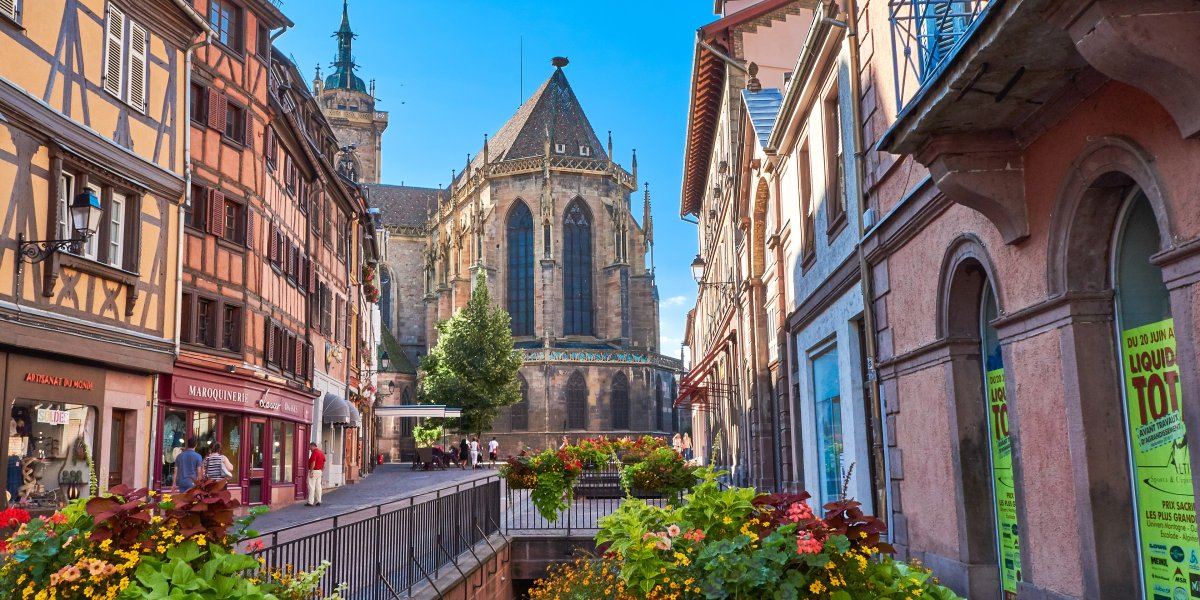
Walk south along Rue des Têtes as it becomes Rue des Marchands — Colmar's most picturesque medieval lane, lined with half-timbered facades painted in mustard, rose, and sky blue. In five minutes you step into Place de la Cathédrale and face the Collégiale Saint-Martin, a 13th-century Gothic church whose roof gleams with diamond-patterned Alsatian tiles in green, yellow, and brown. Circle the full exterior slowly: the south portal's tympanum depicts the Last Judgment in extraordinary carved detail, and the single asymmetric tower gives the silhouette an endearingly unfinished look. Mid-morning light illuminates the south and west facades at their best.
Tip: Walk to the southwest corner of Place de la Cathédrale for the classic postcard shot: polychrome roof tiles framed against the sky with half-timbered gables in the foreground. Then look closely at the south portal carvings — tiny sculpted mice hide among the stonework, a medieval mason's signature that most visitors walk straight past.
Open in Google Maps →11:00
Landmark
Continue two minutes south on Rue des Marchands and you cannot miss it: the Maison Pfister at number 11, the single most photographed building in Colmar. Built in 1537 for a wealthy hatter, it is a masterpiece of Alsatian Renaissance architecture — a wooden gallery wraps the corner, faded fresco panels depict biblical and allegorical scenes, and a delicate octagonal turret juts out over the cobblestones. Just beyond it, the Koïfhus (Old Customs House) anchors the Place de l'Ancienne Douane with its own glazed-tile roof and the Schwendi fountain at its feet. This small square is the beating heart of the old town and worth a slow lap.
Tip: Stand at the intersection of Rue des Marchands and Rue Mercière to nail the iconic corner composition — turret, frescoes, and wooden gallery all in frame. Late morning is ideal: the sun finally clears the roofline and hits the painted panels directly. The ground floor is a wine shop; step just inside the doorway for a glimpse of the inner courtyard without entering the building.
Open in Google Maps →12:00
Food
From Place de l'Ancienne Douane, walk east along Rue des Écoles for three minutes, cross the small bridge over the Lauch, and the red-brick Marché Couvert is right on the riverbank. This 1865 covered market hall is where Colmar locals do their Saturday shopping — cheese wheels stacked high, Alsatian charcuterie behind glass, and the warm yeasty smell of fresh bretzels. Grab a flammekueche traditionnelle (crème fraîche, onions, lardons — around €8–10) or a warm bretzel stuffed with melted Munster cheese (€5–6). Take your food to the canal-side terrace and eat with a view of pastel half-timbered houses reflected in the water.
Tip: The market is open Tuesday to Saturday; on Sundays and Mondays it is closed — if you visit on those days, walk one minute south to Rue de Turenne where bakeries sell flammekueche to go. At the market, order at the charcuterie counter and ask for a small board of local saucisse de Strasbourg and Munster with a bretzel — faster and more Alsatian than anything on a restaurant menu. Budget €10–15 total.
Open in Google Maps →13:30
Neighborhood
Exit the market from the south door, cross the bridge and turn right along Quai de la Poissonnerie — you are now entering Petite Venise, the scene that sells a thousand plane tickets to Colmar. The Lauch narrows into a canal flanked by half-timbered fishermen's houses painted in lavender, mint, saffron, and coral, their flower boxes spilling geraniums into the reflections below. Walk slowly along the quai to the Pont Saint-Pierre, Colmar's most famous viewpoint: from this little bridge the canal stretches south in a perfect mirror of candy colors. Then loop west into the Quartier des Tanneurs — a cluster of tall, narrow timber-framed houses with open upper galleries where hides once dried in the Alsatian wind.
Tip: Early afternoon is the sweet spot: midday sun is high enough to light both sides of the canal evenly, and the morning tour-boat queues have cleared. From Pont Saint-Pierre, shoot facing south for the classic reflection shot — crouch slightly to get more water in the frame. Skip the €7 flat-bottomed boat rides: they last 30 minutes, cover 200 meters you can walk in five, and the best views are from the bridges anyway.
Open in Google Maps →19:00
Food
From Petite Venise, walk north along Rue de Turenne for four minutes — Wistub Brenner sits at number 1, a cozy wood-paneled Alsatian winstub that has been feeding locals for generations. The room smells of slow-cooked onion and warm pastry dough. Order the baeckeoffe, a rich casserole of three meats layered with potatoes and onions, slow-baked in Riesling (around €18–20), or the classic choucroute garnie heaped with local charcuterie (€16–18). Pair it with a glass of Alsatian Riesling Grand Cru from a domaine in the nearby hills (€5–7). The portions are enormous — skip the starter and save room for a slice of kouglof if they have it.
Tip: Arrive at 19:00 sharp — by 19:30 every table is spoken for and they do not take reservations for parties under four. Ask for a window seat overlooking the street. Budget €25–35 per person with wine. Pitfall warning: avoid the cluster of restaurants around Place de l'Ancienne Douane with English-only menus and laminated photos of dishes in the window — they charge double for reheated tourist fare. A real winstub has a handwritten French-Alsatian menu, no photos outside, and locals at the bar.
Open in Google Maps →
Trip builder
Plan this trip around Colmar
Turn this guide into a bookable rail itinerary with FlipEarth.
Keep exploring
Related cities
More in the same country
FAQ
Frequently asked questions
How many days do you need in Colmar?
Most travelers enjoy Colmar in 1 days, with enough time for headline sights and a slower meal or museum stop.
What's the best time to visit Colmar?
The easiest season for most travelers is Apr-Jun, Sep-Dec, especially if you want good weather and manageable crowds.
What's the daily budget for Colmar?
A practical starting point is about €55 per person per day before hotels, then adjust based on museums, dining, and transport.
What are the must-see attractions in Colmar?
A good first shortlist for Colmar includes Maison des Têtes, Maison Pfister.