City Guide
Canterbury
Reino Unido · Best time to visit: Apr-Sep.
Day-by-day plan
Choose your pace
Duración del viaje
09:00
Landmark
From Canterbury West station, walk south on Station Road West and turn right onto St Dunstan's Street — the ancient pilgrim's road into the city. In eight minutes the twin drum towers of England's largest surviving medieval gate rise ahead, exactly as they have for pilgrims since 1380. Cross the small stone bridge over the River Stour for the iconic front-on photograph: crenellated towers framed by water, willow branches, and morning light. Walk through the archway and glance back — the downstream view with overhanging trees and half-timbered houses is Canterbury's most reproduced image.
Tip: Stand on the bridge at 09:00 when the sun is behind you — the Kentish ragstone glows warm gold and the river gives you a clean mirror reflection. Skip the small museum inside the towers; the exterior and bridge view is the real prize. Look for the arrow slits and murder holes in the gate passage ceiling — genuine 14th-century defensive features you can photograph from directly below.
Open in Google Maps →10:00
Religious
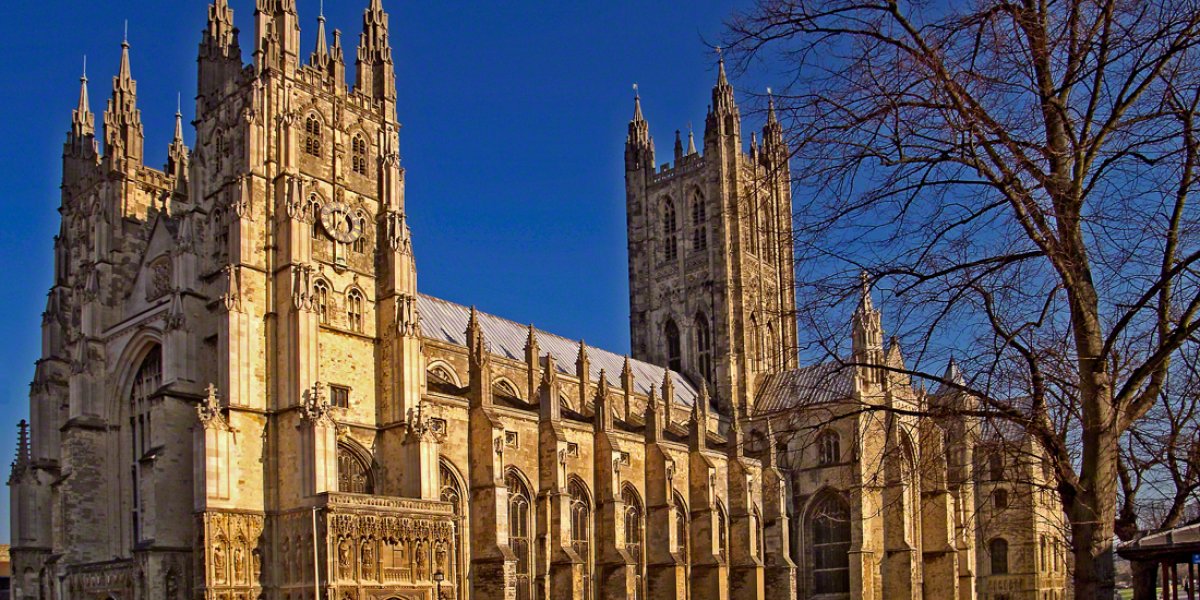
From Westgate Towers walk east along St Peter's Street, which becomes the High Street — a 10-minute stroll past timber-framed Tudor facades hiding above modern shopfronts (look up above every awning). At the Buttermarket square, the ornate Christ Church Gate frames your first jaw-dropping view of the Bell Harry Tower. Enter the precincts for free and circle the full exterior: the south side shows the soaring nave windows, while the north side through the Mint Yard arch reveals the finest flying buttresses and medieval stained glass visible from outside. The Green Court gives you the widest-angle view of the entire 1,400-year-old complex — the mother church of the Anglican Communion and a UNESCO World Heritage Site where Thomas Becket was murdered in 1170.
Tip: Walk through the Mint Yard arch to the north side of the cathedral — almost no tourists come here, and you get the best exterior view of the 12th-century stained glass and the Corona tower. For the classic postcard shot, stand at the northwest corner of the Green Court where the Bell Harry Tower and the full length of the nave align in a single frame. The precincts are free to enter; the £16 interior admission is worthwhile only if you have extra time.
Open in Google Maps →12:00
Food
Exit Christ Church Gate, turn right, and walk one minute south down St Margaret's Street — the tearoom sits in a crooked 15th-century building impossible to miss. This tiny, aggressively charming spot is Canterbury's most beloved quick lunch: wobbly timber beams, mismatched vintage china, and a queue of locals who know better than to eat at the generic cafés on the High Street. Order the Welsh rarebit — a bubbling, mustard-spiked cheese toast that is absurdly satisfying (£8.50) — or the Kentish cream tea with locally made jam and clotted cream (£9.50) if you want to save your appetite for dinner. Budget £10–15 per person.
Tip: Arrive at noon sharp before the 12:30 lunch rush. The ground floor fills first — ask for the upstairs room with the sloping Tudor floor and impossibly low beams. No reservations taken, but turnover is fast since most people are grabbing a quick bite.
Open in Google Maps →13:00
Landmark
From Tiny Tim's, walk east along Burgate and continue onto Longport — a pleasant 7-minute stroll past old city wall fragments and through a quiet residential stretch untouched by tourism. The ruined abbey appears behind a low wall on your right. Founded in 598 AD — older than the cathedral itself — this was one of the most powerful monasteries in medieval England until Henry VIII dissolved it in 1538. From Longport you can see the full sweep of roofless nave walls, scattered Norman column bases, and Anglo-Saxon burial markers framed against the open sky, with the cathedral's Bell Harry Tower rising behind. One photograph captures 1,400 years of English Christianity in a single frame.
Tip: The best exterior vantage point is from the Longport pavement about 30 metres past the main entrance — the ruins fan out with the cathedral tower centred behind them. Early afternoon light rakes beautifully across the broken walls. If you're tempted to enter the grounds (£10 English Heritage admission), it's worth it for the cloister foundations, but the view from outside already tells the story.
Open in Google Maps →14:30
Park
Walk south from the abbey along Longport, then left onto Lower Bridge Street and through the old city wall gate — a 10-minute walk tracing the surviving medieval wall at street level, one of the best-preserved stretches in southeast England. The Dane John mound is a grassy Norman-era hill rising from the centre of an elegant Victorian park. Climb the spiral path to the top for the only 360-degree panorama in Canterbury: the cathedral towers to the north, rolling Kentish countryside to the south, and the full circuit of the old city walls laid out below you. After a morning of medieval immersion, this is Canterbury's exhale — locals stretch out on the grass, the bandstand garden is immaculate, and the afternoon light softens everything.
Tip: Climb the mound for the only elevated viewpoint in Canterbury that frames both the cathedral and the city walls in a single shot — north-facing, so afternoon sun illuminates the cathedral perfectly. The wooden benches at the summit are the best rest stop of the day. Bring a coffee from one of the kiosks at the park entrance.
Open in Google Maps →17:30
Food
From Dane John Gardens, walk north through the old town centre along Castle Street and up the High Street — a 15-minute stroll that lets you absorb the medieval lanes one final time as the light turns golden. The Goods Shed occupies a converted Victorian railway building beside Canterbury West station: a daily farmers' market fills one side, a proper restaurant with an open kitchen occupies the other, and the chefs cook whatever the market stalls sold that morning. Order the pan-fried Romney Marsh lamb cutlets with seasonal greens (£19) or the daily whole fish landed on the Kentish coast that morning (£17–22). A glass of English sparkling wine from a local vineyard completes the Canterbury story. Budget £25–35 per person with a drink.
Tip: No reservations for parties under six — arrive at 17:30 to claim a table before the evening wave. Ask the fishmonger at the market counter what came in today; that fish is always the best thing on the menu. Canterbury West station is literally next door, so you can eat until the last minute before catching the high-speed train back to London St Pancras (56 minutes). Avoid the cluster of generic restaurants around the Buttermarket and lower High Street — they survive on cathedral tourist traffic, not food quality, and a basic pasta will cost you £16.
Open in Google Maps →
Trip builder
Plan this trip around Canterbury
Turn this guide into a bookable rail itinerary with FlipEarth.
Keep exploring
Related cities
More in the same country





FAQ
Frequently asked questions
How many days do you need in Canterbury?
Most travelers enjoy Canterbury in 1 days, with enough time for headline sights and a slower meal or museum stop.
What's the best time to visit Canterbury?
The easiest season for most travelers is Apr-Sep, especially if you want good weather and manageable crowds.
What's the daily budget for Canterbury?
A practical starting point is about €65 per person per day before hotels, then adjust based on museums, dining, and transport.
What are the must-see attractions in Canterbury?
A good first shortlist for Canterbury includes Westgate Towers, St Augustine's Abbey.