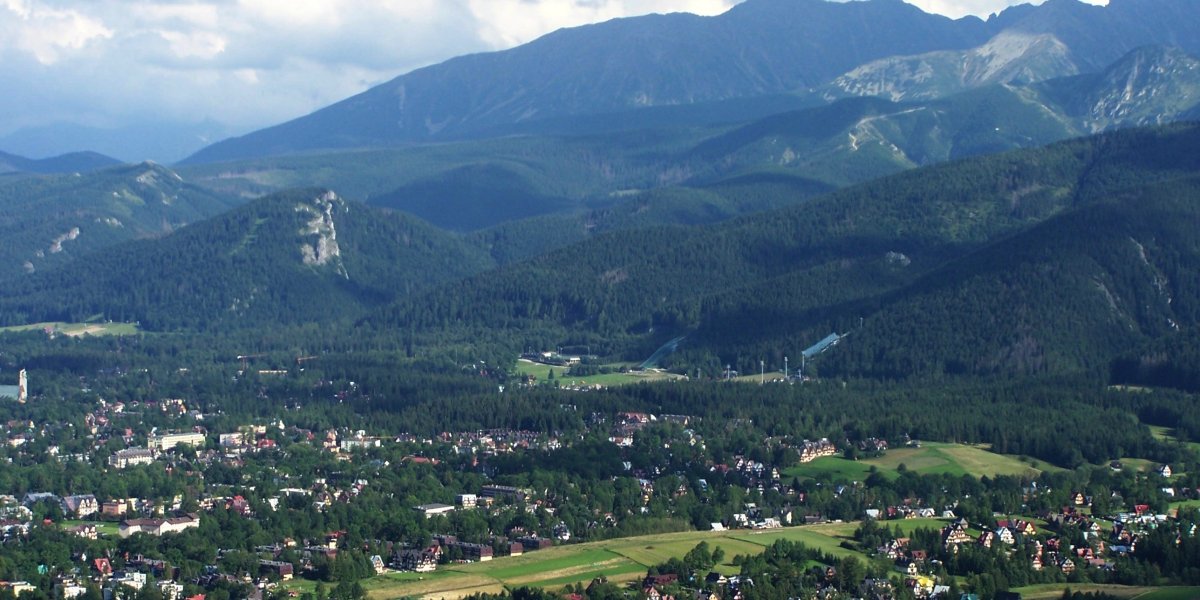
City Guide
Zakopane
Poland · Best time to visit: Jun-Sep, Dec-Mar.
Day-by-day plan
Choose your pace
Trip length
09:00
Landmark
From central Krupowki, walk 25 minutes south down ul. Bronislawa Czecha — a quiet residential stretch of carved wooden cottages that already starts setting the highland mood. Poland's most iconic ski jump rises 145 metres above the forest floor, and from the spectator terraces the full sweep of the Tatra ridge unfolds as your backdrop. Even out of season the structure is genuinely cinematic: the inrun towers above you like a steel arrow aimed at Giewont.
Tip: Climb the spectator stairs to the upper viewing deck — they're free and unmanned outside competitions, and the photo with the runway diving down toward the Tatras is the one you'll actually frame. Skip the paid 'observation tower' at the top; the view from the spectator stand is identical and costs nothing.
Open in Google Maps →10:45
Religious
Walk 25 minutes north along ul. Bronislawa Czecha and turn onto the cobbled ul. Koscieliska — the oldest street in Zakopane, lined with original 19th-century goral huts that gave the town its architectural style. The 1847 wooden church (Stary Kosciolek) is the oldest sacred building in town, built without a single nail, and immediately behind it lies Peksowy Brzyzek, a tiny artists' cemetery where Zakopane's most famous painters, writers and mountain guides rest under hand-carved wooden crosses. The atmosphere is more serene chapel garden than tourist site — and at this hour the tour buses haven't arrived yet.
Tip: Find the grave of Stanislaw Witkiewicz in the back-right corner — he invented the Zakopane architectural style you'll see everywhere today, and his headstone is itself a carved sun-motif masterpiece. The donation box is 5 PLN (~€1.20); everything else here is genuinely free.
Open in Google Maps →12:00
Neighborhood
Continue 15 minutes north on Koscieliska, cross the small bridge over Bystra creek, and step onto Krupowki — the kilometre-long pedestrian spine of town. Goral brass bands play, stalls grill kielbasa over wood embers, and shop windows overflow with hand-knit sweaters and carved walking sticks. This is when Krupowki is most alive: the lunch crowd thickening, street musicians warming up, golden afternoon light angling between the wooden gables.
Tip: Detour 50 metres onto ul. Witkiewicza to see Villa Koliba exterior (1893) — the original prototype of the Zakopane style, with carved trout-scale roof tiles and sun-rosette balconies. The carved wooden facade IS the photograph; you don't need to go inside to feel the weight of what Witkiewicz invented here.
Open in Google Maps →13:30
Food
At the top of Krupowki, follow the stream of locals turning right into Bazar pod Gubalowka — a covered market of highland food stalls at the very base of the funicular. Order oscypek z zurawina, smoked salty sheep's cheese seared on a hot grill and topped with cranberry jam (10 PLN / €2.50), paired with kielbasa z grilla (20 PLN / €5) and a mug of grzane piwo (mulled beer, 15 PLN). Eat standing, leaning on a wooden barrel — that's how the gorale themselves do it.
Tip: Real PDO-certified oscypek is bullet-shaped, dark golden, and has a small EU stamp burned into the side; the flat round white cheese sold by some Krupowki stalls is industrial bryndza — half the price but not the real thing. The stalls along the eastern wall of the bazar are the certified ones — look for the burnt EU mark before you pay.
Open in Google Maps →14:45
Landmark
From the bazar, the 1936 wooden funicular entrance is 50 metres ahead — three minutes and 300 vertical metres later you step onto the ridge (€8 round trip, though you'll only use it one way). At the top, a long wooden boardwalk opens onto an alpine meadow with the entire Tatra wall — Giewont, Swinica, Kasprowy Wierch — laid out south of you like a stone diorama. Walk 4 km west along the ridge to Butorowy Wierch, then descend on foot through the Szymoszkowa meadow back into town: nearly three hours of pure mountain panorama with golden-hour light hitting the peaks face-on.
Tip: Don't take the funicular both ways — walking down through the Szymoszkowa meadows gives you the 360° panorama and zero queue. The peak directly south is Giewont (1894 m), nicknamed the 'sleeping knight' — once you spot the silhouette of the body and crossed arms you can't unsee it. At sunset the entire ridge turns rose; aim to be on the ridge between 17:00 and 18:00.
Open in Google Maps →19:00
Food
Descend from the meadow into the upper end of town and walk 8 minutes east on ul. Pilsudskiego to Zohylina — a working goral inn (not a tourist set piece) where Krakovians drive up on weekends. Order kwasnica (sour-kraut sourdough soup served in a bread bowl, 22 PLN), jagniecina pieczona z mieta (mint-roasted highland lamb, 65 PLN / €15), and finish with szarlotka z lodami. At 20:00 the live highlander band starts — fiddles, gesliki, and yodelled spiewki that genuinely shake the rafters.
Tip: Reserve by phone before 17:00 (+48 18 206 6900) — walk-ins after 19:30 wait 45+ minutes once the band starts. Pitfall warning: never eat dinner on Krupowki itself. The restaurants with English photo menus and 'authentic highland feast' signs charge double for reheated food; the rule among Zakopane regulars is simple — if the menu has photographs, walk on.
Open in Google Maps →Jump to day
07:00
Landmark
Take a 10-minute taxi from central Zakopane south to the Kuźnice valley station — the road climbs through spruce forest just catching first light, and you arrive before the queue forms. From the 1,987-m summit the entire Polish-Slovak Tatra ridge opens at your feet, glaciers and all; at this hour the platform is half-empty and the air is still glass-clear before the convection clouds boil up by 11 AM.
Tip: Book the timed entry online the night before — walk-up tickets are gone by 8 AM in every season. Take the second train rather than the first: the first carries ski patrol and you get stuck waiting at the Myślenickie Turnie changeover. Bring a fleece even in July — it is regularly 15°C colder at the top.
Open in Google Maps →12:00
Landmark
Step off the cable car back at Kuźnice and walk 12 minutes north through the pines along Karłowicza — the great wooden tower of the K-125 ski jump appears suddenly through the trees, exactly the angle the world sees on TV every January. Ride the open chair lift to the in-run platform where Adam Małysz launched into Polish legend; the runout below stretches like a green ribbon and the entire Tatra wall frames it from behind, perfectly side-lit at noon.
Tip: The lift to the in-run platform only operates Apr–Nov (closed during the actual ski-jumping season, counterintuitively). Stand at the upper terrace, not the lower one, for the postcard shot — only from there does the Tatra ridge sit cleanly behind the jump structure.
Open in Google Maps →13:30
Food
Walk 15 minutes north along Piłsudskiego — past the wooden bus stop and the Mickiewicz bust — to the karczma locals actually pick over the Krupówki tourist traps. Order the kwaśnica góralska (smoked-rib sauerkraut soup, 28 PLN) and the moskole z bryndzą (grilled potato cakes with sheep cheese, 32 PLN); both arrive in cast iron and both are exactly the warming meal you need after a mountain morning. Budget: 70–90 PLN (~18 EUR) per person with a beer.
Tip: There are two Bąkowo sisters next to each other — go to Wyżnia (the upper, no. 28a), it has the open hearth where they grill oscypek to order in front of you. No lunch reservations, but tables turn fast; if there is a 10-minute queue, wait it out — the Krupówki alternatives are double the price and half the food.
Open in Google Maps →15:30
Museum
A 12-minute walk west onto Krupówki brings you to the green-shuttered Tatra Museum at no. 10 — the perfect indoor stop while the midday sun bleaches the streets outside. Inside: dense rooms of mountain-rescue history, smuggler boots, Witkiewicz-era highlander dress, and the original 1922 ethnography cabinet downstairs that defined how Poland sees these mountains.
Tip: Closed Mondays. Buy the 18-PLN combined ticket that also covers Willa Atma on Day 2 and Villa Koliba — saves you about 12 PLN total. Skip the temporary exhibition upstairs; the permanent rooms downstairs are the heart of the place.
Open in Google Maps →17:30
Neighborhood
Step straight out of the museum onto Zakopane's pedestrian artery and drift south — late afternoon is the only good hour here, when the day-trippers thin out, the highlanders' grills smoke up at the open-air stalls, and the wooden facades glow amber against the foothills. The smoked sheep cheese (oscypek) is grilled in front of you over wood embers and served on a wooden board with cranberry jam.
Tip: One grilled oscypek with cranberry is 12–15 PLN — never pay more than 15, the price is the local litmus test. Always ask for it 'z grilla, z żurawiną' (grilled, with cranberry) — the cold version is for tourists. Skip the souvenir blocks at the northern end; it is identical Chinese trinkets in every shop.
Open in Google Maps →19:30
Food
Five minutes south on Krupówki, the lantern-lit timber facade of Stek Chałupa hides what a góralska karczma becomes when it grows up — the steak destination locals book for birthdays. Order the antrykot wołowy (dry-aged rib-eye, 95 PLN) and the grilled oscypek with cranberry starter (28 PLN), and ask for the upstairs nook with the antler chandelier. Budget: 130–170 PLN (~35 EUR) per person.
Tip: Call to reserve the same day around 5 PM — they hold the upstairs tables 30 minutes. PITFALL: ignore every Krupówki restaurant with a host pulling you in from the street and a menu board in six languages — the prices are doubled and the meat is reheated. End the meal the local way: a glass of grzane piwo (mulled beer, 18 PLN).
Open in Google Maps →09:00
Museum
Start the day with a 6-minute walk west from Krupówki onto Kościeliska, the original highland village street — the houses lean closer together and the timber darkens with every block. Villa Koliba (1893) is the first house Stanisław Witkiewicz built in his new 'Zakopane Style', and the carved cembra-pine roof brackets, peg-jointed beams, and herbal folk-wall paintings became the template for the entire Tatra aesthetic.
Tip: Be at the door at opening — the south-facing salon catches the 9 AM sun and the honeyed pine glows in a way it never does later. Skip the audio guide; the staff in folk dress give free 10-minute English explanations if you simply ask. Closed Mondays.
Open in Google Maps →11:00
Religious
Continue 6 minutes further west down Kościeliska — the houses get older, the carvings deeper, the road quieter — until you reach the 1847 wooden church of St. Clement and Poland's most beautiful cemetery beside it. Witkiewicz himself rests here under a wooden tombstone he might have designed himself; so do composers, climbers, and village priests who refused to be buried anywhere else.
Tip: Pick up the 5-PLN map at the gate — the famous graves (Kornel Makuszyński, Tytus Chałubiński, Helena Marusarzówna) are not signposted in any order you can guess. The wooden church locks at 12 sharp; if the door is open when you arrive, slip in immediately for the 18th-century painted ceiling — that is the real reason to come.
Open in Google Maps →13:00
Food
Walk 5 minutes back east on Kościeliska to no. 8 — the oldest karczma in Zakopane, opened in 1882 by Sabała's contemporaries, with the same low-beamed parlour the original highlanders drank in. Order the kwaśnica góralska (sauerkraut and smoked-rib soup, 26 PLN) and the placek po zbójnicku (the 'highwayman potato pancake' with goulash, 42 PLN), both legendary and both the size of a wagon wheel. Budget: 70–90 PLN (~18 EUR).
Tip: Sit in the front room, not the rear conservatory — that front parlour is the 19th-century original with the carved Witkiewicz benches and the soot-blackened beams. The pierogi here are good but ordinary; spend the calories on the placek.
Open in Google Maps →15:00
Museum
A 7-minute walk south through the Kasprusie back streets brings you to the modest wooden villa where Poland's greatest 20th-century composer wrote his ballet Harnasie in the late 1920s. Inside: his upright piano, his hand-written scores, the folk-pattern wallpaper he chose himself — and a tiny salon where a recorded mazurka plays softly while you look out at the same Tatra view that drove the music.
Tip: Free admission on Sundays. Begin downstairs with the 20-minute film (English subtitles available on request) — without it the rooms upstairs are just nice wood; with it, every object lands. Closed Mondays.
Open in Google Maps →17:00
Landmark
Walk 10 minutes north up Krupówki to the lower funicular station — the queue that wraps the building at 11 AM has completely evaporated by 5 PM, and you ride up in a half-empty car. From the 1,123-m summit the entire Tatra wall lights up amber from the southwest at golden hour — the most photographed panorama in Poland, and the wooden footpath toward Butorowy Wierch is suddenly yours alone.
Tip: Buy a one-way ticket up (24 PLN) and walk down the marked footpath in 45 minutes — the descending forest path gives the best low-light photos of the wooden farms below, which you simply cannot get from the funicular window. The summit stalls grill oscypek for 10 PLN, cheaper than Krupówki — this is your last grilled cheese before the flight home.
Open in Google Maps →19:30
Food
Eight minutes downhill back to Krupówki — Karczma Po Zbóju ('The Robber's Inn') at no. 16 fills with locals only after 8 PM, when the day-trippers have safely returned to their buses. Order the żurek w chlebie (sour rye soup served inside a hollowed bread loaf, 24 PLN) and the jagnięcina po góralsku (highland lamb stewed with juniper, 58 PLN), and ask for the corner table by the cast-iron stove. Budget: 90–120 PLN (~25 EUR).
Tip: Reserve for after 20:00 — that is when the live góralska band starts in the cellar (no cover charge, and they take requests for the bagpipe pieces). PITFALL: avoid the dozen Krupówki 'highlander shows' with English-language menu boards and touts dragging tourists in — they bill 200 PLN per head, the oscypek is industrial, and the 'live music' is a Bluetooth speaker behind a fake fiddle.
Open in Google Maps →
Trip builder
Plan this trip around Zakopane
Turn this guide into a bookable rail itinerary with FlipEarth.
Keep exploring
Related cities
More in the same country
FAQ
Frequently asked questions
How many days do you need in Zakopane?
Most travelers enjoy Zakopane in 1 days, with enough time for headline sights and a slower meal or museum stop.
What's the best time to visit Zakopane?
The easiest season for most travelers is Jun-Sep, Dec-Mar, especially if you want good weather and manageable crowds.
What's the daily budget for Zakopane?
A practical starting point is about €100 per person per day before hotels, then adjust based on museums, dining, and transport.
What are the must-see attractions in Zakopane?
A good first shortlist for Zakopane includes Wielka Krokiew Ski Jump, Gubalowka Funicular and Ridge Walk.