City Guide
Gdańsk
Poland · Best time to visit: May-Sep.
Day-by-day plan
Choose your pace
Trip length
09:00
Landmark
From Gdańsk Główny station, walk north for 8 minutes through the underpass and across Plac Solidarności — you'll see three towering steel crosses before you even arrive. This is where the Iron Curtain began to crack. The Monument to the Fallen Shipyard Workers rises 42 metres above the square, a visceral memorial to the 1970 massacre and the Solidarity movement that changed Europe. Behind it, the rust-coloured hull of the European Solidarity Centre is worth circling for its architecture alone — the façade is shaped like a ship's bow rising from the docks. Walk to the original Gate No. 2 of the Gdańsk Shipyard where Lech Wałęsa scaled the wall in August 1980; the exact spot is marked and makes for a powerful photograph.
Tip: Arrive by 09:00 when the square is nearly empty and morning light hits the monument from the east, making the stainless-steel crosses glow. The best photo angle is from the south side of the square looking north with the ECS building framing the background. The small stretch of original shipyard wall beside Gate No. 2 still has faded protest posters under plexiglass — most visitors walk right past it.
Open in Google Maps →10:45
Landmark
From Solidarity Square, walk south along ul. Rajska through the quieter northern edge of the old town — the rebuilt brick facades here reveal Gdańsk's astonishing post-war resurrection (the city was 90% destroyed in 1945). After 12 minutes you'll reach St. Mary's Church, the largest brick church in the world, capable of holding 25,000 people. Its exterior alone is staggering — walk around the south side to appreciate the sheer scale of the flying buttresses against the sky. Then slip into Mariacka Street beginning at the church's eastern door: a cobblestoned corridor of gargoyle-adorned townhouses, amber workshops, and stone perrons (raised terraces unique to Gdańsk). This is the single most photogenic street in Poland.
Tip: Walk all the way to the river end of Mariacka first, then turn around — the view back towards St. Mary's towering above the narrow street is the iconic shot. Mid-morning sun lights the eastern facades beautifully while the street is still uncrowded. If you want amber, do not buy on Mariacka itself (heavy tourist markup); the parallel side streets like ul. Chlebnicka offer the same quality for 30-40% less.
Open in Google Maps →12:30
Food
Exit Mariacka Street at the river end, turn right along Długie Pobrzeże for 2 minutes, then cut left into ul. Elżbietańska — a 5-minute walk total. This no-frills pierogi house is where locals grab a fast, filling lunch without ceremony. The dumplings are handmade to order, stuffed generously, and served in cast-iron pans straight from the kitchen. Order the pierogi ruskie (potato, cheese and onion, ~18 PLN / €4) or the pierogi z mięsem (meat-filled, ~20 PLN / €4.50) — both come with crispy fried onions and a dollop of sour cream. Wash it down with a kompot (traditional fruit drink, ~8 PLN / €2).
Tip: Arrive before 12:30 to beat the lunch rush — by 13:00 the queue spills onto the street. Order at the counter, grab a window seat, and you'll be eating within 10 minutes. Total bill rarely exceeds €8-10 per person with a drink. Stick to the classic Polish fillings; the fusion options are forgettable.
Open in Google Maps →13:30
Landmark
Walk one block south from Pierogarnia Mandu and you'll emerge onto Długi Targ (Long Market), the grand civic heart of Gdańsk since the 14th century. The Renaissance and Mannerist townhouse facades — rebuilt with painstaking fidelity after the war — form one of Europe's most stunning urban ensembles. Neptune's Fountain (1633) stands at the centre, the bronze symbol of Gdańsk's maritime soul; behind it rises the ornate Artus Court where Hanseatic merchants once sealed fortunes over handshakes. Walk the full length of the market westward through the Golden Gate and the Upland Gate to experience the Royal Way in reverse — each gate is a layer of history, from Gothic to Renaissance to Baroque, stacked within a hundred metres.
Tip: Early afternoon sun illuminates the painted facades on the north side of Long Market — that's when the colours truly pop for photos. Stand at the Green Gate (east end) and shoot westward to capture Neptune's Fountain with the Main Town Hall tower in the background. Skip the Artus Court and Town Hall interiors today — the exteriors and gates tell the story just as well when time is tight.
Open in Google Maps →15:30
Landmark
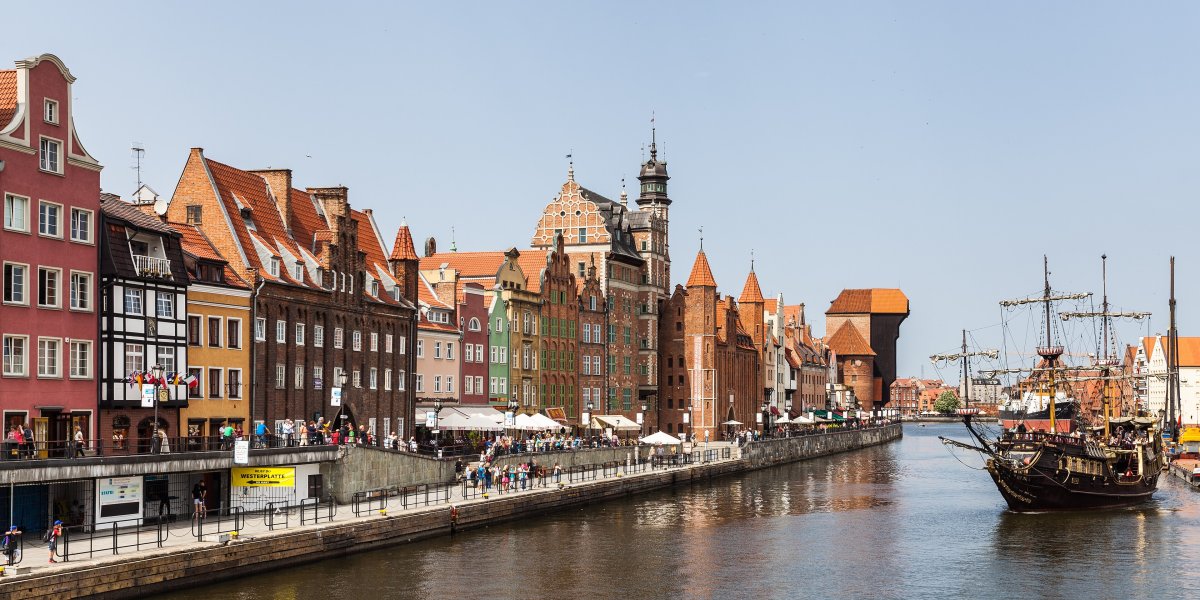
Step through the Green Gate — once the formal royal entrance to Gdańsk — and the Motława River opens before you. Turn left along Długie Pobrzeże (the Long Wharf) and within two minutes you'll face Żuraw, the medieval port crane — the largest working crane in medieval Europe and Gdańsk's most recognisable silhouette. This 15th-century timber-and-brick behemoth once hoisted masts onto ships and loaded two-tonne cargo barrels using a human-powered treadwheel inside its towers. The waterfront promenade stretches in both directions with views of Ołowianka island's restored granaries. Find a bench, slow the pace, and watch the river traffic glide past as the afternoon light softens over the brick skyline.
Tip: Late afternoon light turns the Crane and the waterfront facades golden — this is magic hour for the classic Gdańsk postcard shot. Cross the footbridge to Ołowianka island for the best panoramic view back at the Crane and Main Town skyline. Beware: the restaurants with outdoor hosts directly on Długie Pobrzeże are tourist traps — overpriced, mediocre food, and aggressive upselling. The good restaurants are one street back from the waterfront.
Open in Google Maps →19:00
Food
Walk 2 minutes north along the waterfront from the Crane, then duck left into ul. Wartka — Kubicki sits on a quiet canal just one step removed from the tourist bustle. Operating since the 1700s, this is one of the oldest restaurants in the Tri-City and still draws a genuinely local crowd. The menu leans into Pomeranian and Kashubian traditions with honest, unfussy cooking. Order the fried Baltic herring with cream and onion (śledź smażony, ~35 PLN / €8) followed by the duck leg with red cabbage and silesian dumplings (kaczka, ~65 PLN / €15). The house Żuławy beer on draught pairs perfectly with both.
Tip: No reservation needed on weekdays, but on Friday or Saturday call ahead or arrive by 18:45. Ask for one of the four canal-side tables — they overlook the water with a view of the Crane glowing under floodlights at dusk. End the night with a shot of Goldwasser (~15 PLN / €3.50), the city's legendary gold-flake liqueur brewed in Gdańsk since 1598 — it's the only souvenir you can drink on the spot.
Open in Google Maps →Jump to day
09:00
Religious
From the Golden Gate, walk east along ul. Piwna for 5 minutes — the massive brick walls of the world's largest brick church swallow the sky ahead. Arrive right at opening to climb the 400-step tower before the stairway becomes a single-file traffic jam; the panorama of terracotta rooftops, the Motława river, and distant shipyard cranes is worth every step. Back inside, the vast whitewashed nave holds 25,000 people, a 15th-century astronomical clock, and a Gothic altarpiece that survived the war.
Tip: Enter from the south door on ul. Podkramarska — shorter queue than the main entrance. Climb the tower before 10:00; by mid-morning it's a sweaty bottleneck. The best panorama photo faces east toward the river. The church interior is free; only the tower charges admission (20 PLN).
Open in Google Maps →11:15
Landmark
Exit St. Mary's from the west door and walk south for 2 minutes — you spill directly onto Długi Targ, Gdańsk's grand showpiece square. Neptune's Fountain (1633) anchors the center, flanked by ornate merchant houses in mint, ochre, and terracotta. Step inside Artus Court to see the Renaissance hall where Hanseatic merchants sealed deals beneath the world's tallest tiled stove (10.64 m), then walk the length of the square to the Green Gate for a framed view of the Motława river.
Tip: The south-facing merchant facades are most photogenic before noon when direct sunlight hits the painted plaster. From the Green Gate, shoot through the archway — it perfectly frames the river, the Crane, and Granary Island in one photo. Neptune's Fountain is the city's symbol; the best angle is from the Artus Court steps looking north.
Open in Google Maps →12:30
Food
From the Green Gate, double back west along Długi Targ and turn left into ul. Elżbietańska — a quiet cobblestone lane, 4 minutes from the square. This snug, no-frills pierogi house is where locals line up for handmade dumplings with fillings that change seasonally. It's the most authentic Polish lunch you'll find in the Main Town — fast, cheap, and deeply satisfying.
Tip: Order pierogi ruskie (potato-cheese, ~18 PLN / 4€) and pierogi z mięsem (meat, ~22 PLN / 5€). The sampler plate lets you try three fillings without committing. A full portion of 12 pieces with sour cream and a kompot comes to 10–12€. Arrive before 12:30 or after 13:30 — the room seats barely 30 and the lunch rush is real.
Open in Google Maps →13:30
Neighborhood
Walk east from the restaurant toward St. Mary's, then turn right into ul. Mariacka — the transformation is instant. This is Gdańsk's most photographed street: Gothic-Renaissance townhouses with carved stone gargoyles on every facade, ornamental front porches called perrons climbing the doorsteps, and amber workshops glowing from every threshold. The afternoon light slanting between the rooftops makes the amber in shop windows burn like captured sunsets. Walk slowly — every doorway is a different century.
Tip: The small workshops in the middle of the street offer better amber prices than the tourist-facing stores at either end. To test if amber is genuine, rub it briskly against fabric — real Baltic amber generates static and attracts small paper scraps. The best photo angle is from the Motława end looking west, with St. Mary's tower framed between the rooftops.
Open in Google Maps →15:00
Museum
Continue east to the end of Mariacka Street where the Motława riverfront opens wide, then walk 3 minutes north along the wharf. The Crane is Europe's largest medieval port crane — a half-timbered giant from 1444 that once hoisted masts and 2-ton cargo using human-powered treadwheels. Inside, the original oak mechanisms remain intact. The museum traces Gdańsk's maritime history from Viking trading routes to the Hanseatic golden age, and the upper floors give a unique vantage point over the river and Old Town skyline.
Tip: Buy the combined Maritime Museum ticket (32 PLN / 8€) — it includes the granary exhibitions across the river on Ołowianka Island, reachable by the small ferry included in the ticket. Closed Mondays. The best exterior photo of the Crane is actually from Granary Island across the river — you'll get that shot tomorrow.
Open in Google Maps →19:00
Food
Walk south along the Długie Pobrzeże waterfront for 3 minutes — the river reflects the illuminated merchant facades and the Crane glows behind you. Kubicki, operating since 1918, is tucked into a vaulted brick cellar on ul. Wartka. The menu is rooted in Polish-Kashubian tradition: roast duck with local apples, sour rye soup in bread bowls, and Baltic herring done a dozen ways. The candlelit interior feels like dining inside a medieval wine cellar.
Tip: Reserve for 19:00 — the cellar seats only about 40. Order kaczka po gdańsku (Gdańsk-style roast duck with apples and marjoram, ~62 PLN / 14€) and żurek w chlebie (sour rye soup in a bread bowl, ~28 PLN / 7€). Dinner with a glass of local mead runs 30–40€. Ask for the back wall table under the brick arches. Avoid the waterfront restaurants on Długie Pobrzeże with laminated picture menus displayed outside — they charge triple for half the quality.
Open in Google Maps →09:00
Landmark
From the old town, walk north along ul. Wały Piastowskie for 15 minutes — the cityscape shifts from pastel merchant houses to raw concrete and shipyard cranes. Three 42-meter steel crosses topped with anchors rise from Solidarity Square, marking where Polish security forces killed striking workers in December 1970. This is where Lech Wałęsa climbed Gate No. 2 in August 1980 to lead the strike that became Solidarity — the first crack in the Iron Curtain. Stand in the square, read the 21 demands inscribed on the wall plaques, and feel the weight of a place that rewrote European history.
Tip: Arrive before 10:00 when the square is empty and silent — the emotional impact is strongest when you're alone with the monument and the shipyard cranes behind it. The tablets listing the workers' 21 demands are on the wall to the right of the crosses — most visitors walk past them. Read demand No. 1: 'the right to form free trade unions' — the sentence that shook the Soviet bloc.
Open in Google Maps →10:00
Museum
The rust-colored ECS building sits directly behind the monument — cross the modern plaza for 2 minutes. Its Corten steel facade is designed to resemble a ship's hull, a nod to the shipyard that birthed the movement. Inside, one of Europe's most powerful museums unfolds chronologically: from the 1970 massacre through the 1980 strikes, martial law, underground resistance, and the fall of communism. Original artifacts — Wałęsa's pen that signed the Gdańsk Agreement, protest banners, samizdat publications, a recreated 1980s Polish apartment — make this history visceral, not academic.
Tip: Grab the free audio guide at the entrance — the Polish-language exhibits need context, and the narration adds personal stories that transform the visit. Budget 2 hours minimum. Room 5 (martial law recreation) and the rooftop terrace overlooking the shipyard cranes are the highlights. Closed Tuesdays. The rooftop café serves decent coffee with a view — a good breather before the afternoon.
Open in Google Maps →12:30
Food
Exit the ECS and walk south along the Motława canal for 10 minutes — the waterfront path passes old shipyard infrastructure being reclaimed by cafés and galleries. Brovarnia, Gdańsk's original craft brewery, has copper tanks visible behind glass and a terrace right on the water. The beer is brewed in-house and poured fresh from the tank; paired with a slow-roasted pork knuckle, it's the perfect midday reset between two powerful museums.
Tip: Order the beer sampler tray (5 × 150 ml, ~28 PLN / 7€) to try the range, then commit to the unfiltered wheat beer — it doesn't travel, so you can only get it this fresh here. The golonka (pork knuckle with horseradish and mustard, ~52 PLN / 12€) feeds two comfortably. Sit on the terrace if weather allows. Skip the pizza — you're here for the beer and pork.
Open in Google Maps →14:00
Museum
From Brovarnia, cross the Motława at the nearby footbridge, then walk northwest through the quiet streets for 12 minutes — the museum's angular tower, tilted as if knocked off-balance by history, cuts a dramatic silhouette above the rooftops. Opened in 2017, this is arguably the best WWII museum in Europe. The exhibition descends 14 meters underground and tells the war through a civilian lens — not generals and battle lines, but daily terror, resistance, and survival. The Westerplatte section, where WWII's very first shots were fired just kilometers from here, hits especially hard.
Tip: For a focused 1.5-hour visit, prioritize sections 1–11 (prewar through occupation) and section 17 (Westerplatte). Skip the interactive touchscreens — the real artifacts and film footage are far more powerful. Open 10:00–20:00 in summer, last entry 19:00. Closed Tuesdays. The building's slanted tower is best photographed from the west approach with the reflection pool in the foreground.
Open in Google Maps →16:00
Neighborhood
Walk south from the museum for 10 minutes to the Motława riverfront and cross the footbridge to Ołowianka — Granary Island. The old warehouses are being reborn as galleries and lofts, but the riverfront promenade delivers the postcard view you came for: the Crane, the painted merchant facades, and the church spires reflected in still water. In late afternoon, the west-facing Main Town catches golden-hour light while you watch from the peaceful east bank. This is the photograph that will make everyone at home jealous.
Tip: Walk to the southern tip of the island for the widest panorama — the entire Main Town waterfront fits in a single frame without a wide-angle lens. Best light: 16:00–18:00 in summer when the sun hits the facades head-on. The Crane's silhouette framed against St. Mary's tower is the quintessential Gdańsk shot — the one yesterday's tip promised you.
Open in Google Maps →19:00
Food
Cross back over the footbridge to the Main Town side and walk 3 minutes north along Długie Pobrzeże — Goldwasser's riverside terrace glows with warm light, its tables practically hanging over the water. This is the spot where Gdańsk's legendary gold-flecked liqueur was first distilled in 1598. The restaurant occupies a restored merchant house and serves traditional Gdańsk cuisine — Baltic fish, Kashubian duck, and sea buckthorn desserts — with the Motława as your backdrop for a farewell dinner.
Tip: Reserve a riverside window table — they go first and the sunset view over the water is worth the call. Order flądra bałtycka (Baltic flounder in brown butter, ~58 PLN / 14€) and end with a Goldwasser shot (22-karat gold herbal liqueur, ~20 PLN / 5€) — shake the bottle to swirl the gold flakes, then sip slowly. Avoid the amber jewelry hawkers on the waterfront promenade after dinner — they charge five times the Mariacka Street price for identical stones.
Open in Google Maps →
Trip builder
Plan this trip around Gdańsk
Turn this guide into a bookable rail itinerary with FlipEarth.
Keep exploring
Related cities
More in the same country
FAQ
Frequently asked questions
How many days do you need in Gdańsk?
Most travelers enjoy Gdańsk in 1 days, with enough time for headline sights and a slower meal or museum stop.
What's the best time to visit Gdańsk?
The easiest season for most travelers is May-Sep, especially if you want good weather and manageable crowds.
What's the daily budget for Gdańsk?
A practical starting point is about €50 per person per day before hotels, then adjust based on museums, dining, and transport.
What are the must-see attractions in Gdańsk?
A good first shortlist for Gdańsk includes Monument to the Fallen Shipyard Workers & European Solidarity Centre, St. Mary's Church & Mariacka Street, Long Market & Neptune's Fountain.