City Guide
Poznan
Poland · Best time to visit: May-Sep.
Day-by-day plan
Choose your pace
Trip length
09:00
Landmark
From Poznań Główny station, take tram 6 east to the Katedra stop — or walk 25 minutes along the Warta River as the city wakes up around you. Cross the small Bishop Jordan Bridge onto the island where Poland was born: in 966 AD the first Polish ruler was baptised here, and the twin-towered Poznań Cathedral — the nation's oldest — has anchored this sliver of land ever since. Circle the cathedral's eastern apse to catch the Golden Chapel glowing in the early sun, then walk the silent cobblestone lanes to the tiny Church of the Virgin Mary, one of Poland's oldest surviving buildings. At this hour the island belongs entirely to you and the river birds.
Tip: Walk behind the cathedral to the island's eastern tip for a reflection shot of the twin towers in the Cybina River — this angle never appears in guidebooks. The iron Bishop Jordan Bridge with the cathedral behind you also makes a strong foreground shot, and at 9 a.m. there is not a single tourist in your frame.
Open in Google Maps →10:45
Landmark
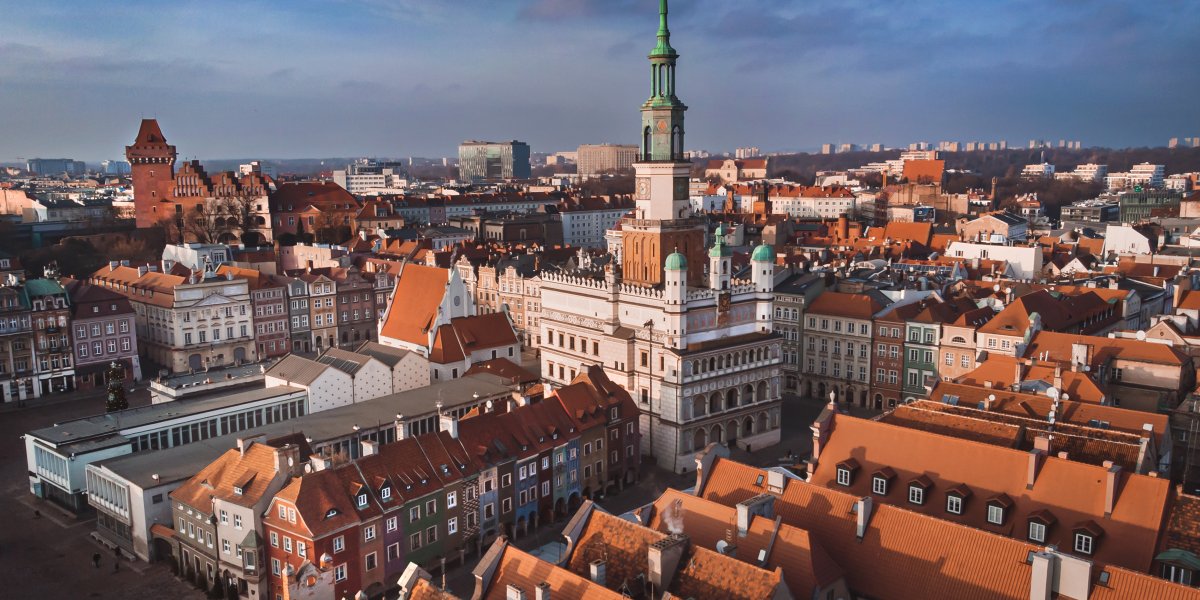
Cross back over Bishop Jordan Bridge into the Śródka neighbourhood — stop to photograph the enormous trompe-l'oeil 3D mural on the apartment building at the corner, a staircase that seems to climb into thin air — then walk 15 minutes west through the Old Town gates. The Old Market Square hits you all at once: a Renaissance Town Hall ringed by rows of candy-coloured merchant houses, the whole composition almost too symmetrical to be real. Position yourself at the tower's eastern face by 11:50; at noon sharp, two mechanical brass goats emerge from a door above the clock and butt heads while the crowd cheers — they have been doing this since 1551. After the show, explore the square's corners: the Bamberka Fountain and the tiny Fish Sellers' Houses tucked in the southeast.
Tip: Most tourists crowd the western side of the tower; stand on the eastern face for an unobstructed view of the goats with the pastel merchant houses as your backdrop. After the show, walk to the southeast corner to find the Domki Budnicze (Fish Sellers' Houses) — four impossibly narrow Baroque facades that are more photogenic than the main square itself.
Open in Google Maps →12:15
Food
Walk two minutes south of the square down ul. Wrocławska — Pyra Bar is where Poznań students and office workers demolish plates of the city's signature dish. Order pyry z gzikiem — potatoes mashed with tangy white cheese curd, chopped chives, and a drizzle of lard (15 PLN / ~€3.50) — and add a bowl of żurek, sour rye soup with egg and kiełbasa served in a bread bowl (18 PLN / ~€4). The whole meal takes 20 minutes and costs less than a single cappuccino in most Western European capitals. Budget €8–12 per person.
Tip: On your way out, grab a rogal świętomarciński (8–12 PLN / ~€2–3) from a certified bakery near the square — this croissant-shaped pastry with 81 layers of dough and white poppy seed filling has EU protected geographical status, meaning it can only legally be made in Poznań. Do not buy the mass-produced supermarket versions; ask for it fresh at a bakery displaying the certification.
Open in Google Maps →13:30
Landmark
Walk west along ul. Święty Marcin, Poznań's grandest boulevard — lined with Art Nouveau facades and the imposing main university building — for 12 minutes until the Imperial Castle looms at the end like a dark exclamation mark. Built in 1910 as Kaiser Wilhelm II's personal residence, this neo-Romanesque fortress is the last royal castle constructed in Europe, a monument to Prussian ambition rendered in dark quarried stone. Circle the full exterior: the northern tower is the most imposing angle, and the open inner courtyard reveals the building's overwhelming scale. The castle later served as Hitler's wartime headquarters and then a Communist cultural centre — its walls have absorbed more history than most cities' entire skylines.
Tip: Walk around to the castle's south side for a view across the surrounding park that almost nobody sees — this is where the building drops its government-office demeanour and looks like the fortress it was designed to be. Bullet scars from WWII are still visible on the northwest corner if you look at chest height.
Open in Google Maps →14:45
Shopping
Exit the castle grounds from the southern gate, cross through the small park, and walk 8 minutes south on ul. Półwiejska — the red-brick chimney of the former Hugger Brewery signals your arrival. Stary Browar is an internationally award-winning architectural hybrid: 19th-century industrial brick fused with soaring glass atriums, preserved brewery equipment displayed alongside sculpture installations, and a hidden rooftop courtyard garden that most visitors never find. Even if you buy nothing, walk the full circuit of every level — the building itself is the exhibit, and the central atrium floods with natural light in the mid-afternoon, exactly as the architects intended.
Tip: Head to the inner courtyard garden on the upper level for a quiet moment after a long day of walking — it is invisible from the main shopping floors. For a Poznań-only souvenir, look for locally made ceramics or handmade cosmetics from Polish artisan brands on the ground floor rather than the international chains upstairs.
Open in Google Maps →19:00
Food
The 10-minute walk north from Stary Browar back to the Old Market Square at dusk is its own reward — the merchant house facades catch the last golden light and the square transforms into an entirely different city from the one you saw at noon. Brovaria has brewed its own beer in the basement vaults since 2003 and is the square's only operating microbrewery. Order the duck confit with plum sauce (58 PLN / ~€13.50) or the massive slow-roasted pork knuckle — golonka — with crackling and mustard (52 PLN / ~€12), and pair it with a glass of unfiltered Brovaria wheat beer (16 PLN / ~€3.70). Budget €20–30 per person.
Tip: Reserve after 17:00 on weekends; on weeknights walk in at 19:00 and ask for a window table overlooking the illuminated Town Hall — it turns dinner into a private light show. One final warning for the square: do not eat at any restaurant with a hawker standing outside waving a laminated menu. If they need someone on the pavement to fill seats, the food is not filling them on its own. Brovaria never does this.
Open in Google Maps →Jump to day
09:00
Landmark
Head west along ulica Święty Marcin — Poznań's grandest boulevard of Art Nouveau facades — until the castle's imposing neo-Romanesque bulk appears at the end. Morning light warms the reddish-brown brick and the interior halls are deserted before tour groups arrive at 10:30. One of the last royal castles built in Europe, commissioned by Kaiser Wilhelm II in 1910: the restored throne room retains its original grandeur, and the underground passages converted to WWII bunkers add a haunting second layer.
Tip: Skip the ground-floor exhibition halls and go directly upstairs to the Throne Room — signage is poor and most visitors walk right past it. The ornate ceiling is the best single photo inside the castle. Closed Mondays.
Open in Google Maps →11:00
Landmark
Exit the castle, turn right and walk east along Święty Marcin as it narrows into a bustling pedestrian zone — the colorful merchant houses of the Old Market Square appear after a 12-minute walk. Arrive before noon to explore the Town Hall's Renaissance interior, then step outside at 11:55 to watch two mechanical goats emerge from the clock tower and butt heads twelve times — a tradition since 1551. Inside, the Great Hall's original 1555 polychrome ceiling by Giovanni Battista di Quadro is the finest Renaissance civic interior in northern Europe.
Tip: Stand on the west side of the square facing the clock by 11:55 — the sun is behind you at this angle, giving clean photos of the goats with the full tower. The pastel merchant houses behind you make an equally striking shot.
Open in Google Maps →12:30
Food
Walk south through the square and take ulica Wrocławska — 3 minutes to this beloved local haunt. Poznań locals insist: if you haven't eaten pyra z gzikiem, you haven't visited their city. Order the Pyra Klasyczna — baked potato with gzik (herbed quark, chives, and radish, ~€3.50) or the Pyra z Gulaszem (potato with slow-cooked beef goulash, ~€5).
Tip: Arrive at 12:30 rather than noon to dodge the sharpest lunch rush. Seating is limited to about 20 spots — the queue moves fast but grab a table by the window if one opens up.
Open in Google Maps →13:30
Museum
Walk back across the square to the east side — the museum entrance is 2 minutes from Pyra Bar, right on the Old Market Square. The afternoon session has a relaxed energy, perfect after a satisfying lunch. This is an interactive theatrical experience where you learn the secret 81-layer recipe of the rogal świętomarciński — Poznań's EU-protected croissant — then bake and taste your own, still warm from the oven.
Tip: Book the English-language session online at least one day ahead — weekend afternoons sell out fast. The show runs about 50 minutes and you leave with a warm rogal and the recipe to attempt at home.
Open in Google Maps →14:45
Religious
Exit the museum and head northwest through the Old Town along ulica Świętosławska — a 4-minute walk past colorful townhouses to the church entrance on ulica Gołębia. Afternoon light pours through the western windows, painting the baroque interior in gold — a timing most visitors never experience. Step inside and look up: the trompe-l'oeil ceiling creates an illusion of infinite height, and every surface is gilded, painted, or carved in a display of baroque excess that rivals churches three times its fame.
Tip: Sit in a pew in the center of the nave and look straight up — the 3D ceiling illusion only works from this vantage point. Free entry, photography allowed without flash. This is the most beautiful church interior in Poznań, yet most tourists never step inside.
Open in Google Maps →19:00
Food
Stroll back to the Old Market Square — 5 minutes on foot — as the Town Hall's illumination flickers on at dusk. Poznań's original brewpub occupies a handsome cellar vault directly on the square, brewing four beers on-site. Order the Golonka Piwna (beer-braised pork knuckle, ~€12) or the duck breast with plum sauce (~€14) alongside their unfiltered wheat beer — the crowd is 80% local even on weekends.
Tip: Reserve a table by the copper brewing tanks for the best atmosphere — call the morning of your visit. Avoid the restaurants on the square's east side with flashy multilingual menus on the pavement: they charge double for tourist-menu mediocrity and the service matches the food.
Open in Google Maps →09:00
Religious
Cross the Chrobry Bridge heading east over the Warta River — the twin spires of the cathedral emerge from the treeline during the 15-minute walk, one of Poznań's most quietly dramatic approaches. The cathedral is nearly empty at opening, with morning light flooding the nave through the eastern windows. Founded in 968, this is Poland's oldest cathedral: the Golden Chapel houses the tombs of Mieszko I and Bolesław Chrobry — Poland's founding rulers — and the crypt below preserves the excavated remains of the original pre-Romanesque baptistery.
Tip: The crypt is the hidden treasure — descend the narrow stairs on the left side of the nave to stand on 10th-century stones where Poland's Christian identity began. Allow 20 minutes underground; crypt entry costs about €2.50.
Open in Google Maps →10:45
Museum
Exit the cathedral and walk south along the riverbank path — the striking rust-colored Corten steel building cantilevered over the water appears after a 5-minute stroll. Late morning is the sweet spot, before the main visitor wave arrives after lunch. This multimedia museum tells the 1,000-year story of Ostrów Tumski through interactive stations and films, and the architecture is itself an exhibit — a glass bridge connects back to Cathedral Island at the upper level, framing the best panoramic view of the cathedral and river.
Tip: Go directly to the rooftop terrace before starting the exhibits — the panorama of the cathedral spires against the river and city skyline is the single best photograph in all of Poznań. Free on Saturdays; closed Mondays.
Open in Google Maps →12:30
Food
Cross the pedestrian bridge from Brama Poznania directly into Śródka — the bistro sits 2 minutes from the bridge landing, on the corner where the neighborhood's lanes converge. A neighborhood kitchen with a short daily menu of honest Polish comfort food. Try the Żurek (sour rye soup in a bread bowl, ~€4) or the Kotlet Schabowy (breaded pork cutlet with mashed potatoes, ~€7) — both generous and made from scratch.
Tip: Ask for the window table facing the square — you'll have a direct view of the famous Śródka mural across the street, a perfect preview of your next stop.
Open in Google Maps →13:45
Neighborhood
Step outside and cross the small square — the mural covers an entire building facade directly ahead. Early afternoon sun hits the south-facing wall at its best angle, making the colors blaze for photography. The centerpiece is the stunning trompe-l'oeil 'Opowieść Śródecka' by Radosław Barek — a multi-story painting transforming a flat wall into a fantastical window into Śródka's past — but wander the surrounding streets too for smaller murals, independent shops, and the kind of unhurried local atmosphere the Old Town traded away to tourism.
Tip: Photograph the main mural from the opposite sidewalk at about 8-10 meters — the 3D illusion is most convincing at this distance. Look for hidden details: a cat, a goat, and a miniature cathedral that mirrors the real one behind you.
Open in Google Maps →15:15
Shopping
Walk west from Śródka back across the river and through the Old Town — a pleasant 25-minute stroll retracing the medieval-to-modern axis of the city. Late afternoon thins the shopping crowd while angled sunlight catches the art installations through the glass atrium roof. A derelict 19th-century Hugger Brewery reborn as what ICSC voted the world's best shopping center in 2005 — the interior is a curated gallery of rotating art installations set against raw brick, steel beams, and soaring contemporary glass.
Tip: Enter through the courtyard on ulica Półwiejska — the preserved brewery chimney and original facade create the most dramatic first impression. Take the escalator up one level and look down at the central atrium to see how the architecture merges industrial ruin with modern design.
Open in Google Maps →19:00
Food
Walk north to the Old Market Square — a 10-minute stroll up Półwiejska — arriving as the illuminated Town Hall becomes your farewell image of Poznań. Muga elevates Polish ingredients with modern technique in a warm, unpretentious dining room right on the square. Open with the Tatar (beef tartare prepared tableside, ~€10), then the slow-roasted duck leg with red cabbage and Silesian dumplings (~€14) — the wine list leans Central European with excellent Hungarian and Slovenian bottles.
Tip: Request a terrace table facing the illuminated Town Hall — on a warm evening this is one of the most romantic farewell dinners in Poland. Avoid the kebab stands and 'Polish beer garden' tents on the square's southeast corner: they target tourists returning from Cathedral Island, charging triple for reheated food.
Open in Google Maps →
Trip builder
Plan this trip around Poznan
Turn this guide into a bookable rail itinerary with FlipEarth.
Keep exploring
Related cities
More in the same country
FAQ
Frequently asked questions
How many days do you need in Poznan?
Most travelers enjoy Poznan in 1 days, with enough time for headline sights and a slower meal or museum stop.
What's the best time to visit Poznan?
The easiest season for most travelers is May-Sep, especially if you want good weather and manageable crowds.
What's the daily budget for Poznan?
A practical starting point is about €55 per person per day before hotels, then adjust based on museums, dining, and transport.
What are the must-see attractions in Poznan?
A good first shortlist for Poznan includes Ostrów Tumski (Cathedral Island), Old Market Square & Town Hall, Imperial Castle.