City Guide
Trier
Germany · Best time to visit: May-Oct.
Day-by-day plan
Choose your pace
Trip length
09:00
Landmark
From the Hauptbahnhof, walk seven minutes southeast along Theodor-Heuss-Allee — the massive dark silhouette rising above the trees at the end of the avenue is your destination. Built around 170 AD from sandstone blocks fitted together without mortar, the Porta Nigra is the best-preserved Roman city gate north of the Alps. Its name — the Black Gate — comes from centuries of dark weathering that give the stone an almost brooding presence, but in early morning light the eastern facade glows amber and every chisel mark left by Roman stonemasons becomes visible.
Tip: The symmetrical shot from Porta-Nigra-Platz is obligatory, but then walk around to the eastern side where the unrestored half reveals raw Roman stonework — the contrast between the medieval church conversion on one side and the untouched structure on the other tells 1,850 years in a single frame. Skip the interior climb (around 4 euros): the best views of the gate are from street level.
Open in Google Maps →10:15
Religious
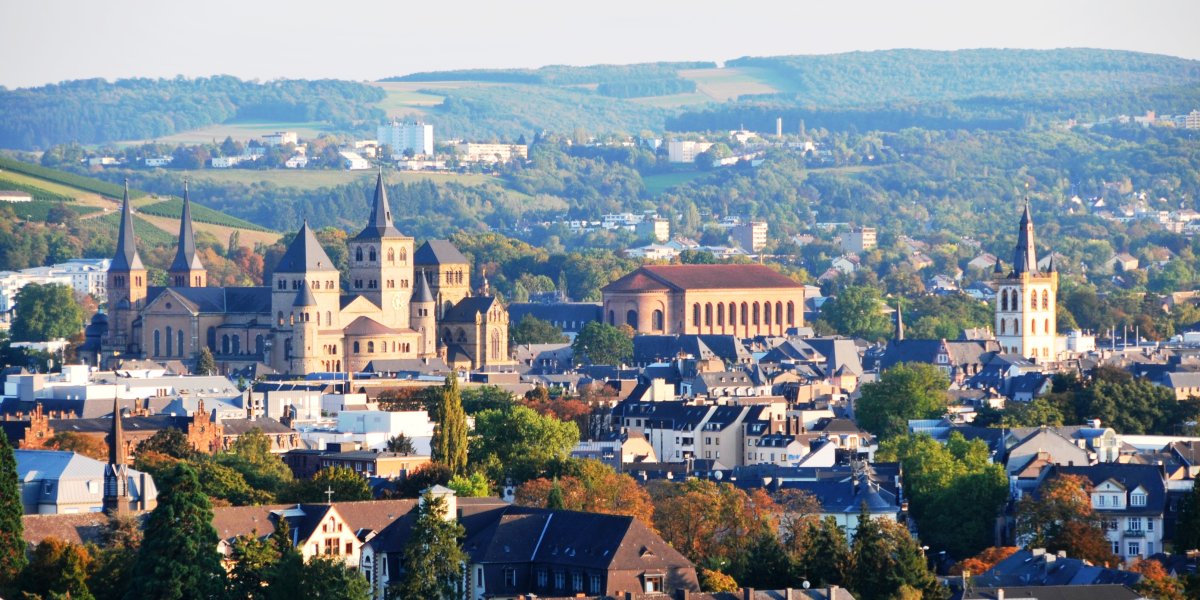
Walk south along Simeonstrasse, Trier's main pedestrian boulevard, past the medieval Dreikoenigenhaus with its raised doorway — built high so a ladder could be pulled up against intruders — then cut diagonally across the Hauptmarkt past the Petrusbrunnen fountain and the fire-red Steipe banquet hall, ten minutes total. The Dom has stood on this site since 326 AD, making it Germany's oldest cathedral: the fortress-like Romanesque west facade with its mismatched towers — one round, one square — was built not just for worship but as a statement of imperial power. Pressed against its south wall, the Liebfrauenkirche, one of Germany's earliest Gothic churches, creates a striking collision of two architectural eras visible in a single glance.
Tip: Stand on Domfreihof about 20 metres back from the main entrance to capture both the Romanesque Dom and Gothic Liebfrauenkirche in one wide-angle shot — the stylistic tension between them is the photograph. Then walk through the narrow passage between the two churches to find a quiet cloister garden that most visitors miss entirely.
Open in Google Maps →12:00
Food
Cross Domfreihof back to the Hauptmarkt — three minutes on foot. Zum Domstein sits directly on the main square and is one of the only restaurants in Germany serving dishes reconstructed from Apicius, the ancient Roman cookbook. For a quick power-walk lunch, grab a terrace table facing the Petrusbrunnen fountain and order the Flammkuchen mit Speck (around 10 euros) or the Roemischer Patina, a baked herb-and-egg dish from the original recipe (around 12 euros), with a glass of local Mosel Riesling (around 5 euros). Budget 15 to 18 euros per person.
Tip: Arrive right at noon to beat the tour-group wave that floods the square between 12:30 and 13:00. Skip the multi-course Roman tasting menu — it is slow and heavy. Save your appetite for a proper Mosel dinner tonight.
Open in Google Maps →13:00
Landmark
Walk south past the Liebfrauenkirche along Liebfrauenstrasse, then through a quiet lane onto Konstantinplatz — seven minutes total. The sheer scale hits you before the history does: a single brick hall 67 metres long and 33 metres tall, built around 310 AD as Emperor Constantine's throne room and the largest surviving audience hall from the Roman world. The rows of arched windows along the exterior were an engineering trick — they narrow toward the far end, creating forced perspective that made the emperor on his throne appear impossibly distant and powerful.
Tip: The best exterior photograph is from the southeast corner of the Palastgarten behind the building, where the massive red-brick apse towers above the rose garden with the pink rococo Electoral Palace in the foreground — Roman power framed by baroque elegance. Spend your remaining time wandering the manicured Palastgarten; it is one of the most peaceful corners of the city.
Open in Google Maps →14:30
Landmark
Exit the Palastgarten from its southern gate and walk south along Olewiger Strasse — the towering ruins of the Kaiserthermen, imperial baths that were never actually used as baths, loom through the fence on your right — then continue gently uphill for another ten minutes as the city falls away behind you. The amphitheatre appears embedded in the hillside: a 20,000-seat arena from around 100 AD where gladiators fought and prisoners were executed. Walk up the grassy eastern bank — the original stone seating terrace — and look down into the oval arena with Mosel vineyards rising on the hills behind it, a scene virtually unchanged in two millennia.
Tip: Afternoon sun lights the arena floor from the west, making 14:00 to 16:00 the ideal window for photographs from the eastern hillside rim. After your visit, continue ten minutes further south along Olewiger Strasse to reach Olewig, Trier's historic wine village, where several Weingueter offer Riesling tastings to fill the afternoon before dinner. Warning: the snack kiosks near the Kaiserthermen ruins on your walk here charge nearly double what any cafe in the old town would — walk past without slowing down.
Open in Google Maps →19:00
Food
Walk back north along Olewiger Strasse and Kaiserstrasse, twenty minutes through quiet residential streets, to Liebfrauenstrasse — the lane between the Dom and Liebfrauenkirche you passed this morning, now glowing in evening light. Weinstube Kesselstatt belongs to the Reichsgraf von Kesselstatt estate, one of the most prestigious wine houses on the Mosel, and its hidden courtyard garden is one of the loveliest dinner settings in Trier. Order the Winzersteak mit Rieslingsosse with roasted potatoes (around 20 euros) or the pan-fried Mosel Zander with seasonal vegetables (around 22 euros), paired with the estate's own Kaseler Nies'chen Riesling — a wine you genuinely cannot find outside this region. Budget 30 to 40 euros per person.
Tip: Call ahead to reserve a courtyard table — the garden seats only about thirty and fills by 19:30 in summer. If the courtyard is taken, the vaulted stone interior has its own atmosphere. Ask for the estate's Graacher Himmelreich Riesling if you prefer something drier. The Hauptbahnhof is a twelve-minute walk northwest from here — perfect timing for an evening train home.
Open in Google Maps →Jump to day
09:00
Landmark
Start at the north end of the old town where the blackened sandstone gate has stood since 170 AD — the best-preserved Roman city gate north of the Alps. Climb the east tower first for a view straight down Simeonstraße, the Roman road that still serves as Trier's main artery. At 9 AM the interior galleries are nearly empty, and the low morning sun lights up the weathered stone faces carved into the arches.
Tip: Buy the Kombiticket (around €12) at the Porta Nigra ticket office — it covers all Roman monuments (Porta Nigra, Kaiserthermen, Amphitheatre, Barbara Baths) and saves you several euros over individual tickets. Photograph the gate from the south side of Simeonstraße for the most dramatic angle with the full facade visible.
Open in Google Maps →10:15
Religious
Walk south along Simeonstraße, Trier's lively pedestrian high street — eight minutes past café terraces and the medieval Hauptmarkt fountain until the twin towers of Germany's oldest cathedral appear ahead. The Dom was built on the foundations of a Roman palace, and you can still see original 4th-century Roman bricks in the north wall. Step next door into the Liebfrauenkirche, one of the earliest Gothic churches in Germany, where the circular floor plan and rose-petal window tracery feel almost otherworldly in the quiet mid-morning light.
Tip: Enter through the main west portal and immediately look up — the massive Roman granite columns were recycled from the imperial palace that stood here in the 4th century. The cathedral treasury (Domschatzkammer, €2 extra) is small but holds the Sandal of St. Andrew and a stunning 10th-century portable altar. Visit the Liebfrauenkirche before 11:00 when tour groups begin to arrive.
Open in Google Maps →12:00
Food
Cross the Domfreihof square and turn right onto Hauptmarkt — Zum Domstein sits in a half-timbered building at number 5, directly facing the market cross. This is the only restaurant in Trier that serves dishes based on actual Roman recipes adapted from the ancient Apicius cookbook. At noon the ground floor fills with locals on their lunch break, and the terrace overlooking the Hauptmarkt is the best people-watching seat in the city.
Tip: Order the Lukanische Würstchen — Lucanian sausages with Roman herb sauce (~€14) — for the novelty, or the Mosel Riesling cream soup (~€8) if you want something lighter. Pair with a glass of local Riesling Kabinett (~€5). Arrive right at noon; by 12:30 the terrace seats overlooking Hauptmarkt are gone. No reservation needed for lunch, just walk in.
Open in Google Maps →13:30
Landmark
From Hauptmarkt walk south through narrow Sternstraße and across Konstantinplatz — five minutes until the enormous red-brick wall of the Konstantinbasilika fills your entire field of vision. Step inside and let the scale hit you: this is the largest surviving single-room structure from Roman antiquity, built as Emperor Constantine's throne hall around 310 AD. The bare brick interior stretches 67 meters long and 33 meters high, designed to make every visitor feel small before the emperor — and nearly two millennia later, it still works.
Tip: Stand at the exact center of the nave and look toward the apse — the windows are deliberately proportioned smaller than they appear, a Roman optical illusion to make the hall seem even longer. The early afternoon sun through the south windows creates dramatic shadow lines across the floor. The Basilica is a functioning Protestant church, so entry is free but it may close briefly for services; check the posted schedule at the door.
Open in Google Maps →15:00
Landmark
Exit the Basilica's south door and stroll through the manicured Palastgarten past the pink rococo facade of the Electoral Palace — five minutes of tree-lined path bring you to the Kaiserthermen entrance. These 4th-century imperial baths were among the largest in the Roman Empire, though they were never fully completed. The real thrill is underground: a labyrinth of service tunnels, heating channels, and vaulted passages where you walk the exact corridors Roman slaves used to stoke the hypocaust furnaces beneath the bathing halls.
Tip: The underground passages are the highlight — take the staircase down near the caldarium and follow the full circuit through the heating tunnels. Bring a light jacket; it is noticeably cooler below ground even in summer. Photograph the above-ground ruins from the southeast corner where you can frame the surviving wall against the Palastgarten trees.
Open in Google Maps →19:00
Food
Walk back north through the Palastgarten and along Liebfrauenstraße — twelve minutes past the cathedral's apse to the Palais Kesselstatt, a 17th-century aristocratic townhouse now home to one of Trier's most atmospheric wine restaurants. The vine-covered courtyard is where you want to sit on a warm evening. The menu is short, seasonal, and built entirely around Mosel wines from the Kesselstatt estate itself — this is terroir dining at its most honest.
Tip: Order the Winzersteak with Riesling reduction (~€24) or the pan-fried Saibling (Arctic char) with seasonal vegetables (~€22), and absolutely get a glass of the estate's Kaseler Nies'chen Riesling Spätlese (~€8). Reserve a courtyard table for 19:00 by phone that same morning — walk-ins after 19:30 often wait 30 minutes. Avoid the cluster of generic Italian restaurants along Fleischstraße near Hauptmarkt; they survive on tourist traffic alone and the quality shows.
Open in Google Maps →09:00
Landmark
From the old town walk southeast along Olewiger Straße past residential gardens and a vineyard slope — fifteen minutes until you reach the entrance of a Roman arena that once seated 20,000 spectators. At 9 AM you will likely be one of fewer than ten visitors in the entire complex. Walk down into the underground cellars beneath the arena floor where animals and gladiators waited before being raised into the ring — the stone drainage channels that carried away sand and blood are still clearly visible.
Tip: Climb to the top tier on the east bank for the best overview of the full elliptical arena — you can clearly see how the hillside was carved out to form natural seating. The underground cellar entrance is on the north side; follow the narrow passage all the way to the original animal holding pens. Early morning light rakes beautifully across the stone seats from the east.
Open in Google Maps →10:30
Museum
Retrace your steps back into the old town along Südallee then turn right onto Brückenstraße — fifteen minutes of flat walking past remnants of the old city walls. The baroque townhouse at number 10 is where Karl Marx was born in 1818. The museum traces his life and the development of his ideas through original documents, first editions of Das Kapital, and a surprisingly balanced exhibition that places the young Marx firmly in the context of 19th-century Trier's poverty, wine trade, and Prussian politics.
Tip: The ground-floor room with original family furniture and Marx's birth certificate is the emotional core of the visit — start there before heading upstairs. The interactive timeline on the second floor is excellent for understanding how his childhood in this small Mosel city shaped his later thinking. Photography is allowed throughout. Budget the full 1.5 hours; the exhibition is denser and more engaging than it looks from the outside.
Open in Google Maps →12:30
Food
From the Karl Marx House walk northeast up Brückenstraße toward Hauptmarkt then turn left onto Fahrstraße — six minutes to a cozy restaurant that has turned the humble potato into an art form. Kartoffel Kiste has been a Trier institution for decades, packed at lunchtime with university students and locals who come for the absurdly generous portions. The interior is rustic wood and checkered tablecloths — unpretentious and cheerfully loud at noon.
Tip: The Kartoffelpfanne mit Lachs — potato pan with smoked salmon (~€14) — is the bestseller, but the Bauernpfanne with bacon, onions, and sour cream (~€12) is more satisfying on a walking day. Add a small side salad (~€4). Bring cash; card acceptance can be unreliable. No reservation needed at lunch, turnover is fast.
Open in Google Maps →14:00
Museum
Walk south from Fahrstraße through the pedestrian zone past the Electoral Palace garden — eight minutes to one of Germany's finest archaeological museums. The collection spans 200,000 years but the Roman galleries are the reason to come: the largest Roman gold coin hoard ever discovered (2,650 coins), stunning floor mosaics pulled intact from Trier villa ruins, and carved stone funeral monuments that bring ordinary Roman citizens vividly to life. This is where the scattered ruins you have walked past for two days suddenly assemble into a complete picture of a thriving imperial capital.
Tip: Go straight to the gold coin hoard room on the ground floor — the sheer quantity is staggering and it is easy to miss if you follow the suggested route. The Neumagener Weinschiff, a Roman stone sculpture of a wine ship, is the museum's icon and a perfect symbol of how the Mosel wine trade stretches back two millennia. The museum is closed on Mondays; plan accordingly.
Open in Google Maps →16:00
Neighborhood
Exit the museum's north entrance and walk northwest along Weberbach, crossing Kaiserstraße toward the river — twelve minutes until the half-timbered houses of Zurlauben appear along the Mosel bank. This former fishermen's quarter is the most photogenic stretch of riverside in Trier, with pastel-painted facades reflected in the water and small wooden boat moorings lining the shore. By late afternoon the western sun turns the row of houses golden. Find a bench or a café terrace along the Zurlaubener Ufer and watch rowers and pleasure boats glide past.
Tip: Walk the full length of Zurlaubener Ufer from south to north — the best photo angle is from the northern end looking back, with the cathedral towers visible above the rooftops. If the weather is warm, stop at one of the riverside beer gardens for a glass of Viez (~€3), Trier's own sharp apple wine and the local answer to Frankfurt's Apfelwein. The light here between 17:00 and 18:00 in summer is exceptional for photography.
Open in Google Maps →19:00
Food
Walk back into the old town along the river path and through Viehmarktplatz — ten minutes to the Domfreihof, the quiet square behind the cathedral. Schlemmereule occupies a vaulted cellar space with exposed stone walls, candlelight, and a menu that leans into hearty Rhineland cooking with careful modern touches. This is a farewell dinner that feels like a local's secret rather than a tourist sendoff.
Tip: The Rinderroulade — braised beef roulade with red cabbage and potato dumplings (~€21) — is the best version in Trier, slow-cooked until it falls apart. Finish with the Mosel Riesling sorbet (~€7) as a palate cleanser. Book a table for 19:00; Domfreihof is peaceful in the evening and outdoor seats are coveted in good weather. On your way back to the hotel, skip the souvenir shops clustered around the Porta Nigra — they sell identical mass-produced trinkets at inflated prices. For a genuine keepsake, the wine shops on Hauptmarkt sell properly labeled estate-bottled Mosel Riesling starting at €8.
Open in Google Maps →
Trip builder
Plan this trip around Trier
Turn this guide into a bookable rail itinerary with FlipEarth.
Keep exploring
Related cities
More in the same country
FAQ
Frequently asked questions
How many days do you need in Trier?
Most travelers enjoy Trier in 1 days, with enough time for headline sights and a slower meal or museum stop.
What's the best time to visit Trier?
The easiest season for most travelers is May-Oct, especially if you want good weather and manageable crowds.
What's the daily budget for Trier?
A practical starting point is about €55 per person per day before hotels, then adjust based on museums, dining, and transport.
What are the must-see attractions in Trier?
A good first shortlist for Trier includes Porta Nigra, Basilica of Constantine, Roman Amphitheatre.