City Guide
Siena
Italy · Best time to visit: Apr-Jun, Sep-Oct.
Day-by-day plan
Choose your pace
Trip length
09:00
Landmark
Begin at Siena's northwestern crown, a red-brick Medici fortress built in 1563 whose ramparts are now Tuscany's most generous public terrace. Walk the full perimeter of the walls clockwise — on the south side the striped campanile of the Duomo rises clean above the terracotta rooftops, and on the west the Crete Senesi rolls out in morning haze. The fortress itself is a park locals use for jogging and dog-walking, so at this hour you get the views without the coach crowds.
Tip: Enter from the Piazza della Libertà gate and climb the south-facing ramparts first — between 09:00 and 10:00 the sun is behind you and the Duomo's marble facade is front-lit for the morning skyline shot. After 11:00 tour groups arrive and the light goes flat.
Open in Google Maps →10:30
Religious
Exit the fortress south through La Lizza park and drop down Via della Sapienza — 7 minutes of shaded plane trees and a steady descent into the historic core. This austere Dominican brick basilica (begun 1226) sits on the hill opposite the Duomo, which is precisely why every Siena postcard is shot from its rear terrace: the cathedral appears across the valley exactly framed between two medieval rooftops, with nothing modern in view. Saint Catherine of Siena preached here; her head relic is inside (we stay outside today).
Tip: Walk around to the eastern terrace behind the church — this is the iconic Duomo-across-the-valley viewpoint. The cathedral's striped facade is lit head-on until roughly 12:00, after which it falls into shadow, so time the shot before noon. A low stone wall makes the perfect tripod.
Open in Google Maps →12:00
Religious
Continue southeast down Via del Capitano — a 10-minute walk through narrow medieval lanes hung with the painted flags of Siena's 17 contradas. The Duomo is Italy's most theatrically decorated cathedral: alternating white-and-black marble stripes, a rose-window facade encrusted with gold mosaics and carved prophets, and a compact piazza that forces you right up against the detail. Circle around behind to the Facciatone — the massive unfinished wall of a 14th-century expansion the Black Death ended forever, its empty pointed arches now a dramatic sky frame.
Tip: For the postcard shot, cross to the stone steps of Santa Maria della Scala directly opposite the facade — you capture the full zebra-striped campanile, rose window and marble saints in a single frame. Best between 11:30 and 13:00 when the sun is frontal; by 14:00 the facade is half in shadow.
Open in Google Maps →13:30
Food
Duck east from the Duomo down the tight Costa dei Barbieri stairway — 5 minutes and you pop out into Piazza del Mercato, the old market square tucked directly behind Campo. This is a single-room family deli where Gino himself slices your panino behind a marble counter stacked with local pecorino di Pienza, cinta senese prosciutto, and jars of house-pickled artichokes. There are no tables — you eat standing at the counter or carry it to the wooden benches on the terrace overlooking the valley. Try the Finocchiona e Pecorino panino (€8) with wild-fennel salami, or the Cinghiale with wild boar salami and truffle cream (€9). Budget €10-15 with a glass of Chianti.
Tip: Arrive by 13:15 — after 13:30 the queue snakes out the door and Gino stops taking new orders by 14:30 sharp. Tell him 'quello che consigli oggi' (whatever you recommend today) and he'll cut you something off the menu, usually a salty fossa cheese aged in underground pits.
Open in Google Maps →14:30
Landmark
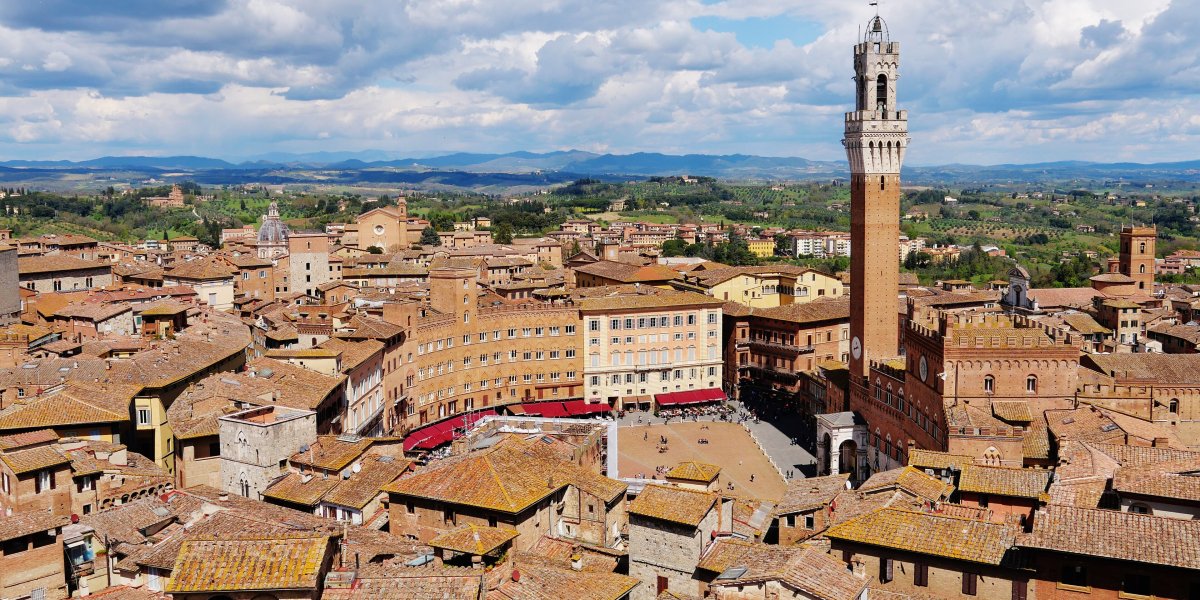
Climb the 80-meter Vicolo di San Pietro alley back up from the market — two minutes and you emerge onto the sloping red-brick shell that is the most beautiful square in Italy. The Campo is divided into nine segments radiating down to the Palazzo Pubblico and the 102-meter Torre del Mangia, and twice a year (July 2, August 16) this is the track where the bareback Palio thunders around the edge. Walk the full perimeter, then break away up Via Banchi di Sopra to Piazza Salimbeni (home of Monte dei Paschi, the world's oldest operating bank, founded 1472), loop back down the medieval palazzi of Via di Città, and finish by sitting on the warm bricks at the center of the shell as the light shifts.
Tip: From about 16:30 the sun hits the Palazzo Pubblico facade head-on and the brick goes molten orange — this is the golden moment. Sit on the pavement at the bottom of the shell like locals do (nobody stops you) rather than on the café terraces lining the square, where Bar Fonte Gaia and its neighbors charge €6 for an espresso. Walk 50 meters into any side street for the same coffee at €1.50.
Open in Google Maps →19:30
Food
Leave the Campo through the arch at Via del Porrione on the east side — 90 seconds, and Le Logge sits under a marble portico on the left. Siena's defining trattoria since 1880, housed in a 13th-century pharmacy with the original dark-wood apothecary cabinets still lining the walls floor to ceiling. The owner, Gianni Stoppini, also runs a wine estate in Montalcino, so the Brunello list is serious business. This is where you order pici — the thick, hand-rolled Tuscan spaghetti that essentially doesn't exist outside this region. Try the Pici al Ragù di Cinta Senese (€19) with heritage-breed Tuscan pork slow-cooked 6 hours, and the Tagliata di Chianina (€32) seared on rocket with shaved pecorino. A glass of their own Sangiovese runs €9. Budget €55-75 with wine.
Tip: Reserve 48 hours ahead by phone or email — Le Logge is full every evening and walk-ins are turned away by 19:45. Ask specifically for the sala interna (inner room) so you sit among the historic pharmacy cabinets, not at the outdoor tables. Pitfall warning for the Campo area: ignore any restaurant on Via di Città or the Campo perimeter that posts photos of food, offers an English-only menu, or has a host on the street calling you in — those are the classic Siena tourist traps serving pre-frozen pasta at double the price. If locals aren't eating there on a weekday, keep walking.
Open in Google Maps →Jump to day
09:00
Landmark
Enter Piazza del Campo from Via Banchi di Sotto and the shell-shaped square opens in front of you — climb the 400 brick steps before the sun turns the tower into a furnace. At 88 meters it is the tallest medieval civic tower in Tuscany, and from the top you watch the Campo curl like a terracotta seashell and the striped Duomo float above the rooftops. Visiting at 09:00 guarantees cool stairs, no queue at the narrow upper landing, and soft raking light from the east that carves every tower and crete senesi hill into relief.
Tip: They cap entry at 35 people at a time, so if you arrive after 11:00 you can wait 45 minutes. The ticket booth is inside the Palazzo Pubblico courtyard on the left — many tourists get lost looking for a separate tower entrance.
Open in Google Maps →10:30
Museum
Come down from the tower and walk 40 meters across the same courtyard — the museum entrance is on the ground floor of the Palazzo Pubblico, the building you just climbed. This is where Ambrogio Lorenzetti painted the Allegory of Good and Bad Government in 1338, the first great secular fresco cycle in European art, and where Simone Martini's Maestà watches over the Sala del Mappamondo. Morning is essential — the Lorenzetti hall faces west, so by afternoon the frescoes glare under reflected light and tour groups fill the narrow room shoulder to shoulder.
Tip: Buy the combined Mangia + Civico ticket (€20) at the booth before you climb — it saves €5 and a second queue. Skip the audio guide and go straight to the Sala della Pace; stand in front of the Effects of Good Government on the City wall — that mule caravan on the right is the world's first painted traffic jam.
Open in Google Maps →13:00
Food
Exit the Palazzo Pubblico through the back arch into Piazza del Mercato — the salumeria is 80 meters along the arcade on your left, under a faded sign painted in 1948. Gino's family cures their own finocchiona (fennel salami) and carves prosciutto di cinta senese from the black Tuscan pig; ask for the panino misto (€7) and the tagliere piccolo with pecorino di Pienza and a glass of Chianti Colli Senesi (€12). You eat standing at the marble counter or perched on the outdoor bench looking over the Valdimontone countryside that falls away behind the Palazzo.
Tip: Gino himself is there most mornings — ask for a taste of the cinta senese before ordering, he will cut you a sliver for free. The pecorino stagionato in fossa is the one locals buy by the kilo; the 'young' pecorino on most tourist menus is not the real thing.
Open in Google Maps →15:00
Religious
From Piazza del Mercato take Via di Salicotto north, cut through Via Banchi di Sopra and bear left down Via della Sapienza — 15 minutes of walking through Siena's quietest medieval alleys, past the University and a sudden view of the Duomo across the ravine. The brick basilica sits on a promontory like a fortress; inside, in the Cappella di Santa Caterina, is the preserved head of Saint Catherine of Siena, patron saint of Italy, displayed in a gilded reliquary alongside a thumb from her right hand. Afternoon light falls through the high rose window and turns the bare brick walls the color of Sienese earth — the Dominicans designed it this way, austere on purpose.
Tip: The Sodoma frescoes of Catherine's ecstasy are to the right of the altar — a coin-operated light switch (€0.50) on the pillar illuminates them; without it you will miss the faces entirely. Exit through the side door facing the Duomo for the single best photograph of the cathedral in Siena, framed between two cypresses.
Open in Google Maps →17:30
Landmark
Walk back down Via di Camporegio and Via Banchi di Sopra — 12 minutes, all downhill, and the Campo suddenly opens below you through the Croce del Travaglio. This is the hour Sienese call 'l'ora del Campo' — the sun drops behind the Torre del Mangia, the nine wedges of pink brick glow like embers, and residents lie down on the sloping pavement with a bottle of wine. Sit at the lowest point of the shell with your back to the Fonte Gaia, look up, and understand why this square is considered the most beautiful in Italy — the whole medieval republic designed it to pull your body toward the Palazzo Pubblico, the seat of the people.
Tip: The Fonte Gaia fountain you see is a 19th-century copy — Jacopo della Quercia's original panels are inside Santa Maria della Scala (tomorrow). Do not sit at a café table on the Campo — a coffee costs €8 and a €2 cover per person; locals buy a bottle from the enoteca on Via di Città and drink on the pavement, which is legal and free.
Open in Google Maps →19:30
Food
Leave the Campo through the arch next to the Torre and turn right into Via del Porrione — 90 seconds of walking. This is Gianni Brunelli's 1880 pharmacy turned osteria, still with the original walnut cabinets and apothecary jars, now serving the Brunelli family's own wine from their Montalcino estate. Order the pici cacio e pepe al tartufo (€22) — hand-rolled fat spaghetti rubbed with pecorino, black pepper and shaved summer truffle — and the peposo alla fornacina (€26), a slow-cooked beef stew of Chianti, black peppercorns and garlic that Brunelleschi's workers invented to eat beside the kiln. Budget €55–70 with a glass of the house Rosso di Montalcino.
Tip: Reserve at least two days ahead (+39 0577 48013) and ask explicitly for the ground-floor room — upstairs is a newer annex without the original wood. Around the Campo, any restaurant with a multilingual photo menu on an easel is a tourist trap charging €18 for a caprese; the giveaway is a waiter standing outside waving you in.
Open in Google Maps →09:00
Religious
From Piazza del Campo take the stepped Via dei Pellegrini west and in 4 minutes the striped Duomo rises in front of you like a wedding cake of black and white Carrara marble. Opening is at 10:30 for tourists but at 09:00 the cathedral is open for silent visit (no ticket needed) — this is the only hour you can stand alone on the inlaid marble floor by Beccafumi, which is otherwise covered in September and crowded all year. Pinturicchio's Piccolomini Library, entered from the left nave, holds ten frescoes painted in 1502 whose colors have never faded because sunlight never touches them — morning is when the ceiling gilding catches the lamps and the whole room glows like the inside of a jewel box.
Tip: Buy the OPA SI Pass (€20) at the Santa Maria della Scala ticket office across the square — it covers the Duomo, Library, Crypt, Baptistery, Museo dell'Opera and the Facciatone climb, and the queue there is half of the one at the Duomo ticket booth. The floor is fully uncovered only between late June and late July and again between mid-August and mid-October — outside those windows you still see 15 of the 56 panels, which is plenty.
Open in Google Maps →11:15
Museum
Step out of the Duomo and cross the square diagonally — the entrance is 30 meters away under the long brick arches facing the cathedral. This was the hospital of the medieval republic for 800 years, founded before the year 1000, and every fresco in the Sala del Pellegrinaio shows scenes of actual 15th-century medicine — wet nurses, orphans, the washing of pilgrims' feet — painted by Domenico di Bartolo in astonishing detail. Descend three levels below ground to see Jacopo della Quercia's original 1419 marble panels from the Fonte Gaia, pulled from the Campo for preservation, and the Etruscan collection carved from the living rock of the hill.
Tip: Included in your OPA SI Pass if you bought it here. The Oratorio di Santa Caterina della Notte, two floors below street level, is where Saint Catherine slept when she tended plague victims — most visitors miss it because the staircase is unmarked behind the Etruscan gallery; look for the sign 'oratorio' on a handwritten paper.
Open in Google Maps →13:00
Food
Walk south out of the Santa Maria della Scala, down Via del Capitano past the Palazzo Piccolomini, then left into Via di San Pietro — 4 minutes downhill. Twelve tables, a chalkboard menu that changes daily, and the owner Ettore cooking a meter from your plate. Order the pici all'aglione (€12), fat hand-rolled spaghetti in a slow-cooked garlic-and-San-Marzano sauce that is Siena's most ancient recipe, and the coniglio in porchetta (€16), rabbit stuffed with wild fennel and rolled like a porchetta. Budget €25–30 with a carafe of Chianti Colli Senesi.
Tip: No reservations accepted for lunch — arrive at 12:55 and wait 3 minutes rather than 13:20 and wait 45. Ask Ettore what he bought at the Wednesday market; whatever he points at first is the plate to order. Tiny kitchen, no gluten-free or vegetarian substitutions — the menu is what it is.
Open in Google Maps →15:00
Museum
From the osteria walk back up Via di San Pietro for 5 minutes — the museum entrance is tucked into the right wall of the unfinished 'Duomo Nuovo', the nave Siena began in 1339 and abandoned when the plague killed a third of the city. Inside hangs Duccio di Buoninsegna's Maestà, painted in 1311, displayed alone in a darkened room so its gold leaf breathes — you can walk around the back and see the 26 passion scenes Duccio painted on the reverse, invisible to the faithful in its original cathedral setting. End by climbing the narrow spiral staircase to the Facciatone — the top of that unfinished wall — for the single most photographed view in Tuscany: the Duomo striped like a zebra, the Campo curling below, and the Crete Senesi hills rolling to the horizon.
Tip: Facciatone entry is timed — your OPA Pass has a QR code and you must book the slot (free) at the turnstile; the 16:00 slot has the best light for photos since the sun rotates toward the Duomo facade. Only 25 people allowed at the top at a time, the last climb is at 17:30, and the staircase is one-way — do not forget anything at the bottom.
Open in Google Maps →17:30
Park
Walk north along Via dei Fusari and Via delle Terme, then along Via di Camollia — 15 minutes through the quietest Sienese neighborhoods, past the church of Santa Maria in Portico. The Medici built this bastion fort in 1561 after conquering the republic, so Sienese still call it 'il simbolo della sconfitta' — the symbol of defeat — but they reclaimed it as their park. Climb the grass ramp to the western rampart: you get the only 360-degree view of Siena, with the Duomo and Torre del Mangia to your east and the Tuscan hills sliding into pink behind you. Sunset here, around 19:30 in summer, is the local aperitivo ritual.
Tip: The old Enoteca Italiana closed in 2016 — ignore any blog that tells you to drink there. Instead, walk the rampart to the southwest corner: a small kiosk called 'Chiosco della Fortezza' opens from April to October and pours Brunello by the glass for €7. Siena has no violent crime but the fort after dark is a meeting spot for teenagers — be down by 21:00.
Open in Google Maps →19:30
Food
From the Fortezza walk back south through the city — 15 minutes along Via di Camollia and Via dei Termini, then a sharp right onto Via Franciosa just before the Duomo. The restaurant is carved into Etruscan tufa caves 2,400 years old, with candles in every niche and vaulted tunnels branching off the main room — ask for table 14 in the back cave. Chef Pino Nunziante makes the tagliatelle al ragù di lepre (€22), wild hare ragù over hand-cut pasta, and the piccione ripieno con prugne (€32), pigeon stuffed with prunes and balsamic — two Sienese dishes you will not find in any tourist osteria near the Campo. Budget €65–85 with a bottle from the Tuscan list.
Tip: Reserve two days ahead by phone (+39 0577 286054) and write 'tavolo nella grotta' — without that note the staff will put you in the brighter upstairs room, which ruins the point. Near the Duomo, avoid anywhere advertising 'authentic Tuscan menu' in four languages on a sandwich board — the infamous tourist trap here is Nannini in the Campo, where a pinci alla senese costs €24 and was boiled from a bag.
Open in Google Maps →
Trip builder
Plan this trip around Siena
Turn this guide into a bookable rail itinerary with FlipEarth.
Keep exploring
Related cities
More in the same country
FAQ
Frequently asked questions
How many days do you need in Siena?
Most travelers enjoy Siena in 1 days, with enough time for headline sights and a slower meal or museum stop.
What's the best time to visit Siena?
The easiest season for most travelers is Apr-Jun, Sep-Oct, especially if you want good weather and manageable crowds.
What's the daily budget for Siena?
A practical starting point is about €120 per person per day before hotels, then adjust based on museums, dining, and transport.
What are the must-see attractions in Siena?
A good first shortlist for Siena includes Fortezza Medicea, Piazza del Campo.