City Guide
Bologna
Italy · Best time to visit: Apr-Jun, Sep-Oct.
Day-by-day plan
Choose your pace
Trip length
09:00
Landmark
The vast heart of Bologna, dominated by the Basilica di San Petronio — the world's largest brick church, its facade famously half-finished since 1390 in marble below and raw brick above, a monument to ambition outpacing budget. On the northwest corner, Giambologna's sensual Fountain of Neptune gleams in the morning light, which at this hour illuminates the basilica head-on with the piazza still largely yours before tour groups arrive.
Tip: Duck under the Palazzo del Podestà arcade on the north side and whisper into the corner where two walls meet — the 13th-century 'whispering gallery' carries your voice diagonally to the opposite corner, 20 meters away. Medieval engineers built this so lepers could confess without approaching a priest. Most visitors walk right past it.
Open in Google Maps →10:30
Neighborhood
Exit Piazza Maggiore from the southeast corner and duck into Via Clavature — 30 seconds later you're inside Bologna's medieval market district, where Via Pescherie Vecchie and Via Drapperie overflow with mortadella, cracked wheels of Parmigiano-Reggiano, and handmade tortellini laid out on wooden boards. This is not a tourist market — locals shop here daily, and these streets have operated continuously since the Roman grid was first laid down. Slow down and let the appetite build; lunch is next.
Tip: On Via Drapperie, look up above the shopfronts — medieval iron brackets that once held market awnings 600 years ago are still embedded in the stone walls. At the intersection of Via Drapperie and Via Pescherie Vecchie, pause for the 14th-century Madonna shrine set into the corner, perpetually lit with fresh candles by local vendors.
Open in Google Maps →12:00
Food
One minute south on Via Caprarie 1, still inside the Quadrilatero — Tamburini has been Bologna's most revered gastronomia since 1932. Skip the sit-down section upstairs and head straight to the self-service counter in back: load a plate with tagliatelle al ragù (€9) or lasagna verde (€8), and eat standing at the steel counter alongside professors and tradesmen. Budget €10–15 per person; this is how Bologna does lunch.
Tip: Before you leave, ask the counter for 'un etto di mortadella tagliata fine' — 100 grams sliced paper-thin, about €3. Tamburini's mortadella, studded with pistachios and sliced translucent, is so far from supermarket bologna it might as well be a different species. Eat it immediately, standing right there. This is non-negotiable.
Open in Google Maps →13:00
Landmark
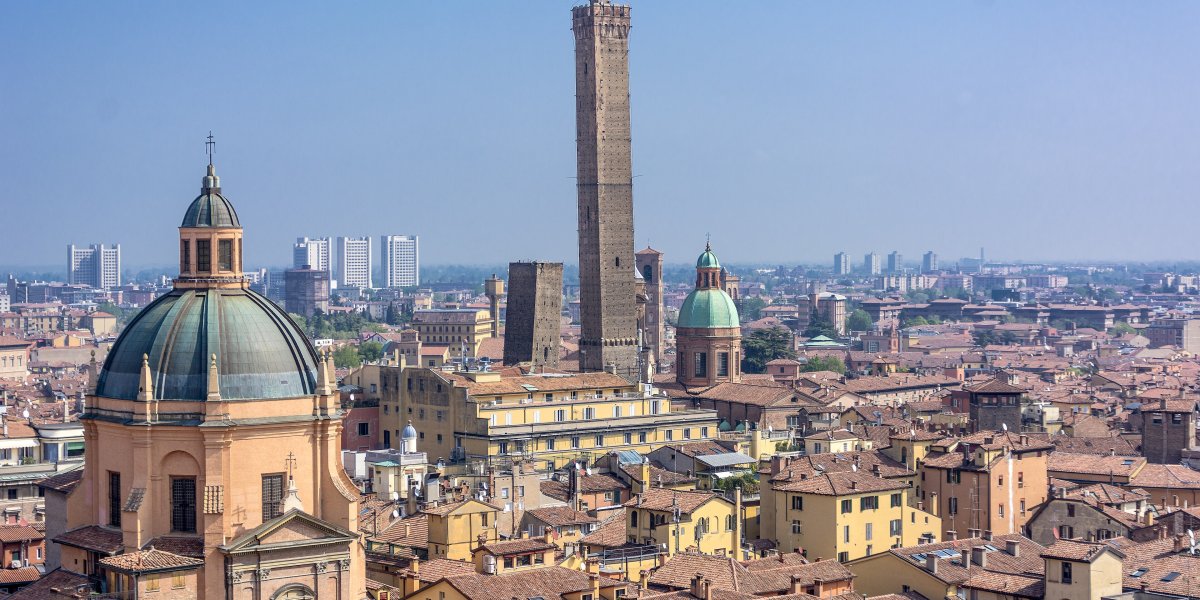
Walk northeast along Via Rizzoli for 5 minutes under the porticoes — the Two Towers reveal themselves gradually, growing taller with each step until you emerge into Piazza di Porta Ravegnana and they loom directly overhead. Torre degli Asinelli (97.2 meters, built 1109) and the leaning Torre Garisenda (48 meters, tilting 3.2 degrees — more than Pisa before its correction) are the last survivors of over 100 medieval clan towers that once made Bologna's skyline a 12th-century Manhattan. Early afternoon sun lights the warm brick perfectly for photos.
Tip: The best photo angle is from the southwest corner of the piazza, standing about 30 meters back on Via Rizzoli — this captures both towers with the Garisenda's lean dramatically visible against the sky. Note that Torre Garisenda has been fenced off for stabilization work since late 2024; you cannot approach its base, but the full view from the piazza is completely unobstructed.
Open in Google Maps →14:00
Religious
Walk south along Via Santo Stefano for 8 minutes through one of Bologna's most elegant porticoed streets, past antique bookshops and heavy wooden doors hiding secret courtyards, until the triangular Piazza Santo Stefano opens up without warning. The 'Sette Chiese' complex — seven interconnected churches and open-air cloisters dating to the 5th century — unfolds like a labyrinth; the Cortile di Pilato with its 8th-century marble basin is the most peaceful spot in the city. You arrive in early afternoon when soft warm light hits the terracotta facades at their most photogenic.
Tip: Piazza Santo Stefano is the most photogenic square in Bologna — the triangular shape, terracotta buildings, and total absence of cars make it feel like a film set. Grab a gelato from the gelateria on the corner of Via Santo Stefano and sit on the church steps to take it all in. The open-air cloisters inside the complex are free to enter and feel more like a Romanesque monastery than a city-center church.
Open in Google Maps →19:00
Food
From Piazza Santo Stefano, walk north along Via Cartoleria for 6 minutes through quiet university-district cobblestones — look for the unmarked door at number 10, where a 16th-century pharmacy has been converted into a 30-seat trattoria with original wooden apothecary cabinets still lining the walls. Start with tortelloni di ricotta al burro e salvia (€13), then tagliatelle al ragù (€14) — chef Emanuele Addone's version is the definitive expression of the dish in the city that invented it. Budget €35–45 with wine; reservation essential, call +39 051 222529 at least 48 hours ahead.
Tip: There is literally no sign on the door — look for Via Cartoleria 10 and trust the address. Request a 19:00 table when the kitchen is freshest and the room is still calm. If fully booked, walk 5 minutes northwest to Trattoria dal Biassanot at Via Piella 16/a, and on the way stop at the Finestrella di Via Piella — a small window in a wall that reveals Bologna's hidden canal, the last visible stretch of the medieval waterway that once powered the city's silk mills. Tourist-trap warning: avoid any restaurant on Via Rizzoli or Via dell'Indipendenza advertising a 'menù turistico' with photos outside — these are Bologna's worst price-to-quality offenders, charging €15 for microwaved lasagna in a city that invented it fresh.
Open in Google Maps →Jump to day
09:00
Landmark
Start at Piazza di Porta Ravegnana, where Bologna's two medieval towers lean against the sky. Climb the 498 wooden steps of the Asinelli Tower — at 97 meters, the tallest leaning tower you can enter in Italy. At the top, the entire Emilian plain unfolds: terracotta rooftops, the Apennine foothills to the south, and on clear mornings, a faint shimmer of the Adriatic to the east.
Tip: Book your time slot online at least 2 days ahead — walk-up slots sell out by 10:00. The 09:00 opening slot has the fewest climbers and the clearest morning light. Pause at the top and look northwest: you can spot the Portico di San Luca snaking up the hill toward the sanctuary.
Open in Google Maps →10:15
Religious
Walk west from the towers along Via Rizzoli — the porticoed street opens into the immense Piazza Maggiore in five minutes, with the Neptune Fountain on your left. The Basilica di San Petronio dominates the south side: the largest brick church in the world, its facade still half-unfinished after 600 years. Inside, find the Cassini Meridian Line — a 67-meter brass strip on the floor that acts as a sundial, with a beam of light tracking through a hole in the ceiling at solar noon.
Tip: Stand at the meridian line around 12:30 to see the sunbeam hit the brass strip — a quiet astronomical spectacle most visitors walk right over. The terrace (€3 extra) offers a rooftop view over Piazza Maggiore, but skip it if you already climbed the tower.
Open in Google Maps →11:30
Museum
Exit San Petronio and cross Piazza Maggiore south to Piazza Galvani — two minutes on foot. This was the original seat of the University of Bologna, and the walls and ceilings are plastered with thousands of student and professor coats of arms spanning centuries. The star is the Teatro Anatomico: an intimate, wood-carved amphitheater where Renaissance doctors dissected cadavers beneath a canopy held up by two carved figures known as the Spellati — the 'skinned ones.'
Tip: At 11:30 the theater is emptier than its afternoon peak — you may get it entirely to yourself for photos. Look up at the ceiling: the carved Apollo holding the constellation chart is the finest detail in the room. Closed Sundays after 14:00 and on public holidays.
Open in Google Maps →12:30
Food
Step out of the Archiginnasio and duck east into the narrow lanes of the Quadrilatero — Bologna's medieval food market district, three minutes on foot. Tamburini has been a salumeria since 1932: the ground floor is a deli paradise of aged Parmigiano, culatello, and glistening mortadella. Head upstairs to the self-service counter, grab a tray, and point at whatever looks irresistible behind the glass.
Tip: The tortellini in brodo (€9) is the test of any Bolognese kitchen — Tamburini passes. Pair it with the mortadella mousse on crostini (€4), which tastes nothing like the processed deli meat you know. Arrive before 12:30 to grab a seat at the communal tables; by 13:00 the line extends out the door.
Open in Google Maps →14:30
Landmark
Walk north from the Quadrilatero through Via Oberdan — twelve minutes on foot through quieter residential streets. On Via Piella, look for a small opening in the brick wall on your left; swing open the wooden shutter and there it is: the Canale delle Moline flowing silently below, flanked by colorful houses — a scene straight out of Venice. Bologna once had an extensive canal network for powering silk mills; most were covered in the 1950s, but this fragment survives.
Tip: Afternoon light (14:00–16:00) is best — the sun hits the canal and the pastel buildings glow. Walk 50 meters further along Via Piella to the bridge on Via della Grada for a wider, second view of the canal that almost no one photographs.
Open in Google Maps →19:30
Food
Walk east from Via Piella toward Via delle Belle Arti — ten minutes through the quiet streets north of the university. Every inch of wall space is covered with framed letters from decades of grateful visitors, but this is no tourist trap: Anna Maria Monari built her reputation on handmade pasta rolled by hand daily, and the kitchen hasn't compromised since 1981. This is where you eat the definitive Bolognese meal.
Tip: Reserve 3 days ahead — this is the hardest table in Bologna. Order the tortellini in brodo (€14) and the lasagna verde alla bolognese (€14): both are textbook-perfect. Avoid the restaurants with picture menus lining Via dell'Indipendenza near the train station — they charge double for reheated food no Bolognese would touch.
Open in Google Maps →09:00
Religious
Begin at Piazza Santo Stefano — a triangular piazza lined with terracotta facades that feels like stepping into a painting. The Basilica is not one church but a labyrinth of seven interconnected churches and chapels dating from the 5th century, built to replicate the holy sites of Jerusalem. Walk through the Church of the Crucifix into the octagonal Church of the Holy Sepulchre, then into the Cortile di Pilato — a medieval cloister with a stone basin said to be where Pontius Pilate washed his hands.
Tip: Arrive at 09:00 opening to have the churches nearly empty — by 10:30, tour groups flood in. Don't miss the small door on the right side of the Cortile di Pilato that leads to a Romanesque double-columned cloister — most visitors walk right past it.
Open in Google Maps →10:30
Religious
Walk north from Piazza Santo Stefano through Via Santo Stefano and Via Guerrazzi — ten minutes through porticoed streets where the morning sun slants through the arches. On Via Zamboni, enter the Basilica di San Giacomo Maggiore for a brief look at the Bentivoglio Chapel, then find the unmarked door to the left of the church: the Oratorio di Santa Cecilia. Inside, a complete Renaissance fresco cycle by Francia, Costa, and Aspertini covers every wall — depicting the life of Saints Cecilia and Valerian in luminous, jewel-toned detail.
Tip: The Oratorio is free and almost always empty — you may be the only visitor. The frescoes by Amico Aspertini on the right wall are the wildest: packed with surreal details, grotesque faces, and Renaissance humor that feels startlingly modern. The Oratorio closes for lunch (12:30–14:00), so visit in the morning.
Open in Google Maps →12:00
Food
Walk east along Via Zamboni for three minutes to Via Mentana — you'll hear the buzz of the university quarter before you see it. Osteria dell'Orsa has fed Bologna's students since the 1970s: long wooden tables, no reservations, enormous portions at prices that haven't kept up with inflation. This is how Bolognese university students eat when they want real food, not cafeteria pasta.
Tip: Arrive at noon sharp — by 12:30, the queue wraps around the corner. Order the tagliatelle al ragù (€9) and a side of crescentine fritte with culatello and squacquerone cheese (€7): the fried dough with cured meat and soft cheese is the snack Bologna invented for itself.
Open in Google Maps →13:15
Museum
Walk east along Via Zamboni for three minutes — the palazzo is at number 33, behind an unassuming entrance. This is the museum of the world's oldest university: Renaissance frescoes by Pellegrino Tibaldi, 18th-century anatomical wax models so precise they still unsettle, antique celestial maps, and natural history specimens. A cabinet of wonders assembled over 900 years of continuous scholarship.
Tip: The anatomical wax self-portraits by Anna Morandi Manzolini in Room 8 are the museum's emotional peak — an 18th-century woman who sculpted herself mid-dissection. Slow down in the Map Room, where 16th-century cartographers drew the world as they imagined it. Closed Mondays.
Open in Google Maps →15:00
Museum
Walk north for five minutes along Via delle Belle Arti — the street name tells you what's coming. The Pinacoteca houses one of Italy's finest collections of Emilian painting: Giotto's luminous Madonna, Raphael's Ecstasy of Saint Cecilia, and room after room of the Carracci school that launched the Baroque. This is not a blockbuster museum with overwhelming crowds — it is a quiet, deep collection where you can stand alone in front of a Raphael.
Tip: Go straight to Room 15 for Raphael's Ecstasy of Saint Cecilia, then work backwards through the Carracci galleries. The afternoon light through the upper windows peaks around 15:00–16:00 when the galleries are nearly empty. Free entry on the first Sunday of every month; closed Mondays.
Open in Google Maps →19:00
Food
Walk south from the Pinacoteca through Via Zamboni, then turn right on Via Cartoleria — ten minutes through evening-lit porticoes. Drogheria della Rosa occupies a former pharmacy: the original wooden medicine shelves still line the walls, now holding wine bottles instead of tinctures. The cooking is refined but unfussy — seasonal Bolognese dishes executed with a lightness that makes you realize how heavy-handed most tourist restaurants are.
Tip: Ask for a table in the back room with the original pharmacy shelving — it's the most atmospheric corner. Order the tortelloni with butter and sage (€14) and the bollito misto when available (€18). Reserve one day ahead. Steer clear of restaurants on the south side of Piazza Maggiore offering €12 'tourist menus' with frozen lasagna — no self-respecting Bolognese would be caught dead in them.
Open in Google Maps →
Trip builder
Plan this trip around Bologna
Turn this guide into a bookable rail itinerary with FlipEarth.
Keep exploring
Related cities
More in the same country
FAQ
Frequently asked questions
How many days do you need in Bologna?
Most travelers enjoy Bologna in 1 days, with enough time for headline sights and a slower meal or museum stop.
What's the best time to visit Bologna?
The easiest season for most travelers is Apr-Jun, Sep-Oct, especially if you want good weather and manageable crowds.
What's the daily budget for Bologna?
A practical starting point is about €70 per person per day before hotels, then adjust based on museums, dining, and transport.
What are the must-see attractions in Bologna?
A good first shortlist for Bologna includes Piazza Maggiore, Le Due Torri.