City Guide
Reims
France · Best time to visit: May-Sep.
Day-by-day plan
Choose your pace
Trip length
09:00
Landmark
Step out of Gare de Reims, cross Boulevard Joffre, and the arch looms ahead — a 3rd-century Roman triumphal gate stranded on a grass median like a forgotten giant. It is the largest surviving Roman arch north of the Alps, carved with Romulus and Remus, Jupiter, and the labors of the twelve months. At this hour the square is nearly empty; the weathered reliefs catch low eastern light that fills every chisel mark with shadow.
Tip: Walk around to the NORTH face — the carved panels of the four seasons (Leda and the swan, harvest scenes) are the best-preserved surface on the entire arch and almost invisible from the main approach. Shoot wide from the grass median to get the full three-arch sweep against the sky.
Open in Google Maps →10:15
Religious
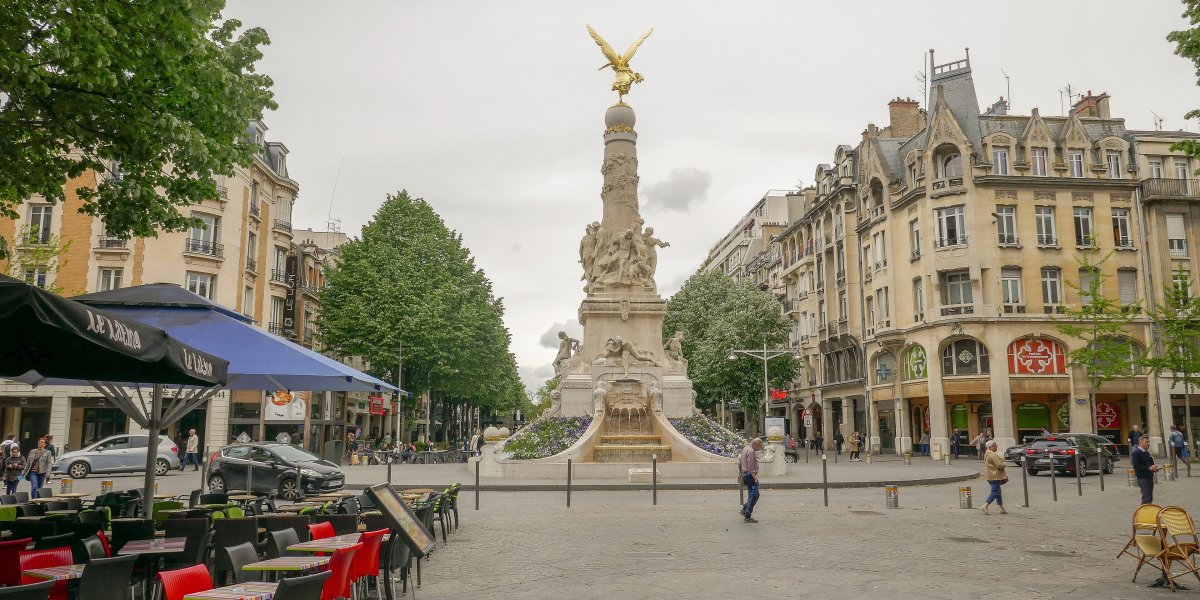
From the arch, head south down Rue de Mars into Place Drouet d'Erlon — Reims's café-lined pedestrian spine — then continue through Rue Condorcet until the west front of the cathedral rises in front of you. Fifteen minutes on foot, and you have just walked the city's entire medieval axis. This is where 25 kings of France were crowned, from Louis VIII to Charles X, with Joan of Arc standing beside the dauphin in 1429. Circle the exterior to meet the Smiling Angel on the north door of the west portal, then step inside for Chagall's cobalt-blue axial chapel at the east end. The bishop's Palace of Tau sits immediately south — a minute of exterior on your way out is all it needs.
Tip: Enter by the west portal and walk the full nave straight to the axial chapel behind the high altar — between 11:00 and noon the east-facing Chagall windows ignite in deep blue and the whole apse glows. The Smiling Angel is on the LEFT (north) door of the west facade, second figure in from the tympanum — it smiles because the morning northeast light rakes across its cheek.
Open in Google Maps →12:30
Food
Exit the cathedral's west doors, cross Place du Cardinal Luçon, and walk five minutes northwest along Rue du Tambour — Waïda's pink storefront on Place Drouet d'Erlon is unmissable. This is Reims's 1930s salon de thé, the last place in the city that still makes biscuit rose de Reims the traditional way: baked twice, dusted with cochineal, the pink biscuit that Madame de Pompadour supposedly dunked in champagne. For a quick savory lunch, grab a seat at the marble counter and order the quiche lorraine (~9€) with a small green salad plus an espresso, then ask for a biscuit rose wrapped to go (~2.50€). Total around 18€, out in under an hour.
Tip: Take the biscuit rose with you in your bag — you will dip it in champagne at Taittinger this afternoon, which is how locals actually drink their first glass. Do NOT sit on the terrace facing the square at lunch; service is twice as slow and you came here for speed. The interior counter is where regulars eat.
Open in Google Maps →14:00
Religious
Walk south from Waïda down Rue de Vesle past the cathedral, then continue on Rue Gambetta for fifteen quiet minutes — the crowds thin, the streets narrow, you cross the canalized Vesle, and the squat Romanesque towers of Saint-Rémi appear at the end of a boulevard. This is the older soul of Reims: an 11th-century UNESCO basilica built over the tomb of Saint Remigius, the bishop who baptized Clovis in 496 and, in that act, invented Christian France. Inside is everything the cathedral is not — long, dark, low-arched, lit by a chain of brass candelabras. Walk the full nave and circle the ambulatory behind the altar where the saint's 19th-century tomb sits in a pool of colored glass.
Tip: Stand at the west end of the nave and look east through the full 122-meter length — the perspective trick of the Romanesque arches receding into the choir light is the single most atmospheric photograph in Reims, and no one else bothers to take it. Stay silent; mass is said here daily and locals drop in to pray, unlike the cathedral which runs like a station.
Open in Google Maps →15:45
Landmark
A five-minute walk north on Rue du Barbâtre from the basilica brings you to 9 Place Saint-Nicaise and Taittinger's iron gates. The entrance looks modest — a courtyard, a reception desk — until you descend the stone staircase into 4th-century Gallo-Roman chalk crayères 30 meters below street level, where the temperature drops to 10°C year-round. This is the oldest champagne cellar in Reims: Roman slaves quarried the chalk for building stone, 13th-century monks stored wine in the pits, and since 1932 Taittinger has aged roughly three million bottles down here at any time. The guided tour (~1h) ends with a tasting of the Brut Réserve in the cave bar.
Tip: Book the 16:00 English tour online AT LEAST three days ahead — walk-ins are turned away 95% of the time in high season. Upgrade to the Prestige tasting (€55) if you want to try the Comtes de Champagne Blanc de Blancs, their flagship; tasting only the Brut Réserve on the standard tour is a missed opportunity at a house famous for its chardonnay. Bring a light layer — those cellars are cold.
Open in Google Maps →19:00
Food
Emerge from Taittinger's cellars blinking in daylight, walk twelve minutes north along Rue du Barbâtre and Rue Carnot into the old center until you reach 14 Place Myron Herrick — the Café du Palais glows on the corner, its stained-glass ceiling already lit for dinner service. The Vogt family has run this art-nouveau brasserie since 1930 across three generations; the dining room is a stage set of theatrical posters, gilt mirrors, and a painted glass canopy that floods the room in color when the lamps come on. This is where Reims eats its Champenois classics: jambon de Reims en gelée (~16€), pressé de foie gras with biscuit rose (~22€), salade au Chaource (~18€), mains 25-35€; a glass of grower champagne from their curated-only list around 10€. Budget around 55€ for a full dinner with one glass.
Tip: RESERVE at lunch before you go to the cathedral — the Café du Palais is the single most-booked table in Reims and turning up at 19:00 without a reservation means the overflow back room at best. Ask specifically for a table in the 'grande salle' under the verrière (the stained-glass ceiling) — that's the room in all the photographs. PITFALL: the 'champagne by the glass' on menus along Boulevard Joffre near the station and on the southern end of Place Drouet d'Erlon is almost always a no-name bulk cuvée sold at cathedral-tourist markup; Café du Palais is one of the rare central addresses with a genuine grower-only champagne list, which is why you came here instead.
Open in Google Maps →Jump to day
09:00
Religious
The most important Gothic cathedral in France for one reason: 25 French kings were crowned here, from Philip II in 1223 to Charles X in 1825. The western facade bears nearly 2,300 sculpted figures, and behind the altar three stained glass windows by Marc Chagall glow electric blue — installed in 1974 as his gift to the city that endured WWI's heaviest bombardment. Arrive right at opening for an empty nave and morning light pouring through the eastern apse.
Tip: Look for the Smiling Angel (L'Ange au Sourire) at the left portal — destroyed by German shells in 1914 and reassembled from 60 fragments, it is the city's unofficial emblem. The tower climb (250 steps, €8) runs only at 14:00 and 15:30 on weekends by reservation at the Palace of Tau; the rooftop view over vineyards is worth the wait.
Open in Google Maps →11:00
Museum
Step out of the cathedral's south transept and turn left — the Palace of Tau is 30 meters away, sharing the same square. This was the bishops' residence where the king slept the night before his coronation, then dressed and walked through a private corridor to the cathedral. Today it holds the royal treasures: the 9th-century Coronation Chalice used for 13 kings, Charlemagne's talisman, and the massive Pépersack tapestries woven specifically for the ceremonies. The vaulted Salle du Tau banquet hall is unchanged since the 15th century.
Tip: The 12th-century reliquary of Saint Ursula — a silver-gilt boat with 11 tiny virgin figures — sits quietly in the corner of the treasury room and is one of the rarest Gothic reliquaries in Europe; most visitors walk past it. Closed Mondays; buy the combined cathedral tower + Palace of Tau ticket (€16) here to save a second queue tomorrow.
Open in Google Maps →12:45
Food
Walk 8 minutes northwest on Rue du Cadran Saint-Pierre — you'll pass the Halles du Boulingrin, a 1929 Art Deco market in bare concrete arches. The brasserie sits right beside it: red leather banquettes, mirrored panels, waiters in long white aprons, and three generations of Rémois families who've celebrated here since 1925. Order the jambon de Reims (cured, parsley-flecked, €14) or the andouillette with mustard sauce (€19) — both regional specialties — and ask for a glass of Coteaux Champenois red (€8), the still wine from the same vineyards that produce champagne.
Tip: Arrive before 12:30 or after 13:30 to dodge the market-day rush — Tuesday through Saturday lunches fill the room fast. The front bar tables catch the best natural light and get the fastest service; back-room tables feel more intimate but the wait can stretch past an hour.
Open in Google Maps →14:30
Landmark
Walk 6 minutes east along Rue de Mars, then cut south through Rue Carnot to Place Carnegie — a tucked-away square most visitors never find. Built in 1928 with $200,000 from Andrew Carnegie to replace the library destroyed in WWI, this is one of the purest Art Deco interiors in France. The reading room retains original Ruhlmann-style furniture, Lalique light fixtures, and a zodiac-mosaic floor; the coffered ceiling above is set with geometric stained glass. Reims was rebuilt almost entirely in 1920s Art Deco after the war, and this library is the movement's masterpiece in the city.
Tip: Entry is free but only 20 people are allowed in at once; arrive after 15:00 when students thin out. Closed Sundays and Mondays. Photography (no flash) is allowed in the main hall — the mezzanine looking down at the central rotunda is the angle that actually captures the geometry.
Open in Google Maps →16:00
Landmark
Head north from the Carnegie on Rue de Mars for 8 minutes — the Roman arch appears suddenly at the top of Place de la République, framed by 1920s apartment blocks. Porte de Mars is a 33-meter triumphal arch built in the 3rd century AD, one of the largest surviving Roman arches in the Empire, with reliefs of Romulus and Remus — the twins who gave the Remi tribe, and eventually the city, its name. After a quick look, walk 5 minutes southwest to Place Drouet d'Erlon, Reims' café-lined pedestrian avenue, and settle on a terrace for a pre-dinner glass of champagne.
Tip: The arch's best photo angle is from Boulevard de la Paix looking south around 17:00, when the western sun lights the carved panels on the north face. On Place Drouet d'Erlon, skip the picture-menu tourist traps at the north end — locals prefer Le Wine Bar by Le Vintage at the southern tip for an actual grower champagne (€9 a glass) rather than the house pour.
Open in Google Maps →19:30
Food
Walk 6 minutes southeast from Place Drouet d'Erlon along Rue de Vesle to Place Godinot — Racine is the glass-fronted corner restaurant with only eight tables. Chef Kazuyuki Tanaka, a Japanese-born Frenchman who trained under Alain Passard, earned his Michelin star in 2018. The single tasting menu (€115, eight courses) changes weekly based on what arrived that morning from local producers: maybe a barely-seared carrot from the chef's own garden, a poached oyster with apple and champagne gelée, pigeon with beet and black garlic. The €75 champagne pairing features only small-grower houses you won't meet at the big maisons tomorrow.
Tip: Book at least two weeks ahead on the restaurant site — walk-ins are essentially impossible and Sunday/Monday are closed. Ask for counter seats facing the open kitchen; Tanaka-san speaks English and will talk you through each plate. One pitfall: the cathedral square at night draws a handful of aggressive vendors selling 'private' champagne bottles from backpacks — always counterfeit, ignore completely.
Open in Google Maps →09:30
Religious
Older, darker, and more spiritual than the cathedral — an 11th-century Romanesque church holding the tomb of Saint Remigius, the bishop who baptized Clovis (first Christian king of the Franks) in 496 AD, an event that made Reims the coronation city for 1,300 years. The nave runs 122 meters long, illuminated by the 'crown of light,' a circular chandelier with 96 candles representing the years of Saint Remi's life. Morning light through the eastern rose window lands directly on the tomb around 10:00 — arrive for that moment.
Tip: Enter through the north transept side door on Rue Simon, not the west facade — you emerge directly facing the saint's tomb for a more dramatic first impression. If your weekend includes Sunday, the 10:00 Gregorian chant Mass is open to visitors; silent, ancient, and unforgettable even for non-religious travelers.
Open in Google Maps →10:45
Museum
Exit the basilica's south door and the museum entrance is 40 meters ahead at 53 Rue Simon — it occupies the 17th-century Benedictine abbey cloister wrapping around the basilica itself. A three-story journey from Celtic coins to WWI artifacts, set inside a vaulted chapter house and refectory as impressive as the collection. Don't miss the 4th-century Roman mosaic from a local villa, the 16th-century tapestries narrating the life of Saint Remi, and the ground-floor display of stained glass shards recovered from the 1914 bombings. Gallo-Roman galleries explain how Reims (then Durocortorum) was the second-largest city in Roman Gaul.
Tip: Municipal museum entry is free — one of the best cultural deals in France. Closed Mondays. The Salle d'Armes on the second floor, a collection of 16th-century Rhenish armor, is almost always empty and worth 15 quiet minutes; most visitors rush past it to exit.
Open in Google Maps →12:45
Food
Take the Tram B from Saint-Remi stop four stops north to Opéra, then walk 3 minutes east to 14 Place Myron Herrick — 18 minutes door to door. Run by the Vogt family since 1930, the walls are a dense collage of paintings, posters, and mementos from three generations of hosting artists and journalists. The handwritten daily menu is short: try the oeuf cocotte au champagne (€14) or the house quiche with mesclun (€16). This is where to drink champagne by the glass — 30-plus grower champagnes (€9-18) and staff who will guide you to the right one.
Tip: Ask for Catherine Vogt if she's in — the third-generation owner knows every bottle and recommends the unusual ones tourists never request. The small back room (salle arrière) is quieter and shows off the best of the painted walls; skip the front terrace — it's pleasant but you'll miss the interior that makes this place legendary.
Open in Google Maps →14:30
Landmark
Take Tram B back to Saint-Remi stop, then walk 5 minutes east to 9 Place Saint-Nicaise. Taittinger's cellars descend 18 meters into 4th-century Roman chalk pits (crayères) and the 13th-century crypt of the former Saint-Nicaise Abbey, where three million bottles age in cool silence. The 45-minute tour walks the chalk galleries and the abbey crypt, ending with a comparative tasting of two cuvées: Brut Réserve and the blanc-de-blancs Comtes de Champagne (€30 standard, €55 prestige). Constant 10°C — bring a light sweater.
Tip: Book online at least a week ahead and pick the 14:30 slot — groups are smaller (6-8 people) than the morning tours. The prestige tasting is worth the extra €25 only if you genuinely love blanc-de-blancs; the standard visits the same cellars. Don't buy bottles at the gift shop — prices match any wine shop in town, but you'd have to carry them back to your hotel.
Open in Google Maps →16:30
Landmark
Leave Taittinger and walk 8 minutes east on Rue des Crayères to 5 Place du Général Gouraud — the domain is visible from blocks away: a fairytale Elizabethan-Gothic castle rising over the road. Widowed in 1858, Madame Pommery built this extraordinary Tudor estate to house 120 interconnected Roman chalk pits — 18 km of tunnels 30 meters below ground, the largest cellar network in Reims. The tour descends 116 steps to reach galleries decorated with enormous 19th-century bas-relief carvings cut directly into the chalk walls, plus rotating contemporary art installations. Finish with a Pommery Brut Royal in the above-ground tasting hall overlooking the park.
Tip: The descent on the old staircase lit by gaslight-style lamps is the most atmospheric in Reims — walk down slowly, look up at the vaulted ceiling. If you're visiting September-October, ask about the 'Experience Pop' contemporary art tour (same price) — the installations change yearly and some are hidden deep in the galleries where normal tours don't go.
Open in Google Maps →20:00
Food
Walk 6 minutes south through the Parc de Champagne to 64 Boulevard Henry Vasnier — the restaurant occupies the ground floor of the Domaine Les Crayères château, a 19th-century mansion set in seven hectares of park. Two Michelin stars under chef Philippe Mille, in what is simply the most beautiful dining room in Champagne: Versailles-style parquet, antique silver, tall windows opening to the park. The tasting menu (€235, eight courses) is built around champagne-pairing refinement — Oscietra caviar with roasted langoustine and Krug 2006, Sainte-Menehould pig's trotter with Dom Pérignon rosé. The sommelier's cellar holds more than 500 champagne references.
Tip: Book 4-6 weeks ahead — the dining room seats only 30 and is the gastronomic summit of Champagne. Smart dress (jacket preferred, not strictly required). One genuine local warning for the day: the houses around Place Saint-Nicaise are authentic, but avoid any 'private cellar visit' pitched by touts near the tram stop — these are scams selling mislabeled bottles at triple price, targeting visitors who missed the official house tours.
Open in Google Maps →
Trip builder
Plan this trip around Reims
Turn this guide into a bookable rail itinerary with FlipEarth.
Keep exploring
Related cities
More in the same country
FAQ
Frequently asked questions
How many days do you need in Reims?
Most travelers enjoy Reims in 1 days, with enough time for headline sights and a slower meal or museum stop.
What's the best time to visit Reims?
The easiest season for most travelers is May-Sep, especially if you want good weather and manageable crowds.
What's the daily budget for Reims?
A practical starting point is about €120 per person per day before hotels, then adjust based on museums, dining, and transport.
What are the must-see attractions in Reims?
A good first shortlist for Reims includes Porte de Mars, Taittinger Cellars.