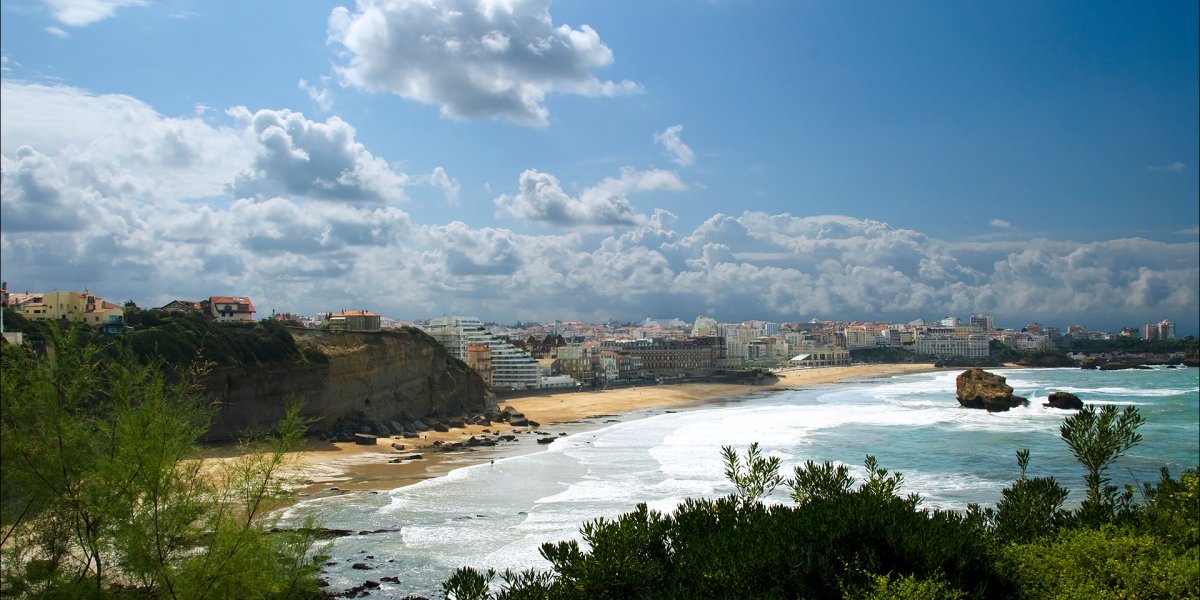
City Guide
Biarritz
France · Best time to visit: Jun-Sep.
Day-by-day plan
Choose your pace
Trip length
09:00
Landmark
Start at the northern tip of town: a 73-meter white lighthouse crowning Pointe Saint-Martin, marking the exact geographical seam where the flat dune coast of Les Landes ends and the rugged Basque cliffs begin. Skip the 248-step interior climb and instead walk the clifftop loop that rings the base — from the southern edge you see the entire crescent of the Grande Plage sweeping away, and on clear mornings the Pyrenees foothills float on the horizon like a blue stage backdrop.
Tip: Walk the clifftop loop clockwise for the postcard shot — lighthouse framed by tamarisk trees with the Atlantic behind. Morning light hits the east face golden until about 10:00; come at 09:00 and you'll share the headland with two joggers, not two coach groups.
Open in Google Maps →10:15
Landmark
From the lighthouse, take the coastal Promenade du Bord de Mer south for 15 minutes with the Atlantic crashing on your right and the Bellevue Casino emerging ahead. You arrive at the crescent of the Grande Plage, where Napoleon III built the Villa Eugenie in 1855 as a summer palace for Empress Eugenie — now the brick-red Hotel du Palais, the most photographed building in the Basque country. Walk the full length of the boardwalk past the red-and-white striped beach tents (Biarritz invented the concept), under the 1929 Art Deco facade of the Casino Barriere, and finish directly beneath the Empress's villa.
Tip: The iconic Hotel du Palais shot is from the south end of the beach looking north — you want the full brick facade with the Phare just visible behind. Never rent one of the striped beach tents (40 euros a half day); the free public sand starts exactly in front of the casino and the view is identical.
Open in Google Maps →12:30
Food
From the Hotel du Palais forecourt, cut inland three blocks via Avenue de l'Imperatrice and Rue Mazagran — 6 minutes through the town's belle epoque shopping streets to Les Halles market. A blue-tiled 1930s bouchon facing the market hall, crammed with Biarrots standing shoulder-to-shoulder at the zinc bar. Proper Basque pintxos country: order at the counter, pay at the end, stand and watch the plancha. Must-order the chipirons a la plancha (grilled baby squid with Espelette pepper, 13 euros) and a jambon de Bayonne with piperade toast (8 euros), washed down with a half-pitcher of Irouleguy rose (9 euros).
Tip: Arrive at 12:30 sharp when the pintxos trays come out fresh — by 13:30 the queue at the door is 20 minutes long and the best plates are gone. Stand at the bar: service is twice as fast and you can point at what the locals in front of you just ordered.
Open in Google Maps →14:00
Landmark
Walk three blocks back toward the sea via Rue du Port Vieux, then descend the stone staircase at Place Sainte-Eugenie — a pocket harbor of red-and-white fishermen's chalets appears suddenly below you, the last working port inside the city. Follow the seaside path around the Atalaye plateau to the iron footbridge leading out to the Rocher de la Vierge, a sea-lashed rock crowned with a white Virgin statue since 1865. The bridge itself was built by Gustave Eiffel (yes, that Eiffel); on a big Atlantic swell you can feel the whole span vibrate as waves detonate against the stanchions below.
Tip: Time your crossing for an incoming swell — stand on the middle of the Eiffel bridge when a big set rolls in and the steel hums under your feet. The definitive photo of the Rocher is not from the bridge itself but from the grass terrace on the Atalaye plateau to the north, where you catch rock, statue, and bridge in one frame with Spain on the horizon.
Open in Google Maps →16:30
Landmark
Continue south along the coast path past the Musee de la Mer facade and down the Atalaye cliff stairs — 10 minutes on a route hugging the rocks, with the entire Basque coast opening in front of you. This is the beach where European surfing was born in 1957 when screenwriter Peter Viertel brought the first board from California while filming The Sun Also Rises. A west-facing crescent beneath ochre cliffs, framed on clear evenings by three Spanish Basque peaks — La Rhune, Les Trois Couronnes, Jaizkibel — glowing pink across the border. At high tide the sand disappears entirely; at low tide it stretches a full kilometer.
Tip: The sunset frame is from the southern ramp, not the main staircase — you want the Spanish mountains silhouetted with longboarders paddling out in the foreground. From June through August the sun drops behind La Rhune around 21:30; grab a table at Etxola Bibi shack for a 6 euro sangria and check the tide chart before descending, because at high tide there is literally no beach left.
Open in Google Maps →19:30
Food
Climb the Cote des Basques ramp back to the clifftop — a 3-minute walk to a restaurant that hangs directly above the beach you just watched sunset from. A proper surfer's temple: longboards bolted to the ceiling, faded Rip Curl posters from the 80s, and a glass terrace cantilevered over the Atlantic. The kitchen is genuine Basque — order the axoa de veau (22 euros, shredded veal stewed with Espelette pepper and green piment doux), or the cote de cochon ibaiona (28 euros, thick-cut heritage-breed pork chop from the Pyrenees), and finish with the house gateau basque a la cerise noire (9 euros, warm almond cake filled with black Itxassou cherry jam).
Tip: Reserve a terrace table online 48 hours in advance and specify 'vue mer' — the indoor dining room is pleasant but the magic is eating while the moon rises over the surf line. Warning on the final stop: avoid every seafood restaurant on Place Sainte-Eugenie with a tout handing out menus — they sell 80 euro plateaux de fruits de mer built from previously frozen product trucked up from Bordeaux. Le Surfing is the real Basque kitchen at half the price.
Open in Google Maps →Jump to day
09:00
Landmark
From central Biarritz, walk north to the beachfront — five minutes downhill and the whole Belle Epoque crescent of the Grande Plage opens in front of you, with the E-shaped red-roofed Hotel du Palais anchoring the north end. This was Empress Eugenie's summer villa, built by Napoleon III in 1855, and the morning is the only time the eastern sun strikes its full facade before the beach crowds arrive. Walk the boardwalk from south to north so the palace grows larger in your view with every step, then round the front terrace for the postcard shot looking back over the bay.
Tip: Shoot the Hotel du Palais between 09:00 and 09:30 from the middle section of the boardwalk — the sun lands on the E-shaped wings from the east and the sand is still tide-combed flat. After 11:00 the light flattens and sunbathers block the foreground. Non-guests cannot enter the lobby; photograph from the public terrace instead.
Open in Google Maps →10:30
Landmark
Exit the Hotel du Palais and walk north along Boulevard du General de Gaulle for about fifteen minutes — you rise steadily through the tamarisk pines of Pointe Saint-Martin until the 73-meter white tower appears against the Atlantic. Climb the 248 spiral steps (no elevator) to the gallery: on a clear day the view stitches Anglet's beaches, the Landes dunes to the north, and Cap Higuer in Spain to the south into one unbroken coastline — the only spot in town where you see France and Spain in the same frame. Descend via the cliff path east of the tower for a short loop through the headland gardens before heading back to lunch.
Tip: The ticket desk opens at 10:00 in season; arrive in the first 30 minutes and the tight circular gallery is yours. In July-August the midday queue routinely hits 45 minutes because the gallery holds only twelve people at a time. Closed mid-November through mid-February — if you're off-season, call +33 5 59 22 37 10 to confirm hours before climbing the hill.
Open in Google Maps →12:30
Food
Walk back south from the lighthouse along Boulevard du General de Gaulle, then cut inland on Rue Mazagran — about fifteen minutes descending through residential Biarritz to Les Halles. Bar Jean is the red-and-white tiled corner opposite the market, hams dangling from the ceiling, every stool claimed by locals by 13:15. Order the brochette de poulpe (grilled octopus skewer, €8), a plate of pimientos del piquillo stuffed with cod (€9), and a glass of Irouleguy rose (€5) — this is the Basque Biarritz eats when tourists aren't watching.
Tip: Arrive at 12:30 sharp — by 13:15 every seat is taken and walk-ins wait 30 minutes. Sit at the bar rather than a table for faster service and better plancha theatre. The octopus skewer sells out by 14:00, so order it first; the anchoiade on toast is the other must. Cash preferred under €15.
Open in Google Maps →14:00
Museum
Head west on Rue du Centre then drop toward the coast at Esplanade du Rocher de la Vierge — the white Art Deco building perched on the headland is the museum, a ten-minute walk from lunch. Opened in 1935, the building itself is the first reason to come: note the zodiac friezes above the entrance and the curved seal-pool balcony that feels like an ocean liner's upper deck. Inside, the open-top seal pool is the main event — feeding happens at 10:30 and 17:00 — followed by the shark tank and the Bay of Biscay ecosystem gallery on the lower level.
Tip: Time your visit backward from the 17:00 seal feeding if you can — the seals barely move mid-afternoon but perform acrobatics when staff walk onto the pool deck with buckets. The ground-floor aquariums are dark and refrigerated; bring a light layer. Skip the on-site cafe (overpriced sandwiches) — the exit door drops you straight onto the Rocher de la Vierge walk.
Open in Google Maps →16:00
Landmark
Exit the museum and walk 100 meters west across the Esplanade to the metal footbridge — designed in Gustave Eiffel's workshops in 1887 — that carries you over the surf to the white Virgin statue planted on the rock in 1865. From the rock, take the cliff path south down the stone stairs to Port des Pecheurs, a cluster of hand-painted crampottes (fishermen's cabins) built into the cliff face. Continue around the quay to tiny Plage du Port Vieux, the sheltered half-moon cove where Biarritz locals swim when Atlantic swell closes the Grande Plage — it stays calm in almost any weather.
Tip: Come 16:00-17:00 in summer so the western sun hits the white statue head-on — at midday the rock backlights and the photo goes flat. On stormy Atlantic days the footbridge is closed and waves break straight over the rock; if you see surf hitting the Virgin, stay to watch rather than forcing the crossing. The cliff stairs down to the crampottes have no handrail on the seaward side in two spots — grip the wall, not the railing.
Open in Google Maps →19:30
Food
Walk five minutes back up from Plage du Port Vieux to Allee Port des Pecheurs — Chez Albert is the green-and-white canopied terrace at the far end of the crampottes, built directly on the fishing quay since 1954. The house mussels (moules marinieres Chez Albert, €22) and the plateau de fruits de mer for two (€78) come straight off the boats moored five meters below your table. In summer the sunset light tracks across the bay from 20:00 onward and the whole terrace turns gold.
Tip: Reserve at least 48 hours ahead for a terrace table after 20:00 (phone, not online — +33 5 59 24 43 84). Ask specifically for row 1 against the railing; rows 2-3 have no water view and you're paying the same. Tourist-trap warning: the dozen seafood spots signed as 'crampottes' around the Esplanade and Place Sainte-Eugenie are mostly cafes copying the look — frozen fish at double the price, with aggressive hawkers outside. Stay on the quay itself.
Open in Google Maps →09:00
Food
Wherever your hotel sits, Les Halles is five to ten minutes on foot — at this hour the neighborhood stirs only to pour coffee and unload crates of seabream. Step through the arched iron entrance on Rue des Halles: the inner hall is dense with black-hoofed Kintoa ham, aged Ossau-Iraty cheese, Getaria anchovies, and piles of Espelette chili. For breakfast, grab a stool at the cheese counter Mixel (plate plus espresso, €12) or order a slice of gateau basque with a cafe noisette at Maison Paries on the corner, then buy a whole gateau basque cerise to take home (€14) and a pack of Bayonne ham for later.
Tip: Friday and Saturday mornings are the locals' big shop — atmosphere peaks but counter queues run ten minutes each. Come Thursday if you want to actually talk to producers. Always-useful Basque phrase for the counters: 'une tranche fine s'il vous plait' (one thin slice please) — Bayonne ham is sliced to order. The hall closes at 14:00 and stays shut Monday; don't plan a late-morning or Monday return.
Open in Google Maps →10:30
Religious
Leave Les Halles through the north exit onto Rue du Centre and walk five minutes toward the ocean — you emerge onto Place Sainte-Eugenie, a small cliff-top square with the neo-Gothic church straight ahead and the blue of the Old Port falling away below. Built in 1903 and dedicated to Empress Eugenie's patron saint, the nave's south-facing stained glass throws colored lozenges onto the stone floor only between about 10:00 and noon. After the interior, step out to the square's north balustrade — the view framing Rocher de la Vierge with the crampottes tumbled below is Biarritz's single most photographed angle.
Tip: Interior is free and officially open 10:00-12:00 and 15:00-18:00; arrive at 10:30 before the cruise-ship groups show up around 11:15. For the balustrade shot, stand at the iron railing just left of the flower urns — you catch the church spire and Rocher de la Vierge in the same frame without parked cars in the foreground. Mass on Sunday mornings blocks the interior until 11:30.
Open in Google Maps →12:30
Food
Walk four minutes inland from Place Sainte-Eugenie to Avenue de Verdun — Le Pim'pi is a narrow chalkboard-fronted bistrot run by chef Benjamin, where the day's menu is rewritten each morning from what arrived at Les Halles an hour before you did. Order the axoa de veau (shredded Basque veal shoulder in Espelette pepper, €19) and the chipirons a l'encre (baby squid in their own ink over rice, €22) — these are the two dishes that actually define Basque cuisine and this kitchen cooks them better than almost any restaurant in town. Finish with the house gateau basque warmed with black cherry compote (€8).
Tip: Room is tiny (24 seats) — reserve a day ahead or walk in at 12:15 for one of the first tables. Ask for extra Espelette on the axoa (it's served mild by default for non-locals but the kitchen will happily kick it up). Closed Sunday and Monday; skip if your Day 2 falls then and reroute to Bistrot des Halles on Rue du Centre instead.
Open in Google Maps →14:30
Religious
Head northwest from the bistrot along Rue Mazagran to Avenue de l'Imperatrice — the chapel is tucked in a walled courtyard behind the old royal district, a seven-minute walk. Napoleon III commissioned this jewel in 1864 for Empress Eugenie, and the interior fuses Roman-Byzantine barrel vaults with Hispano-Moorish zellige tilework and carved cedar — an architectural love letter to her Spanish Andalusian roots. The gilded mosaic apse is best read from the rear pew, where the oculus drops a single disc of light onto the Virgin mosaic.
Tip: Opening hours are famously narrow: typically Thursday and Saturday only 14:30-18:00 from October to April, and daily except Sunday in July-August. Check the Biarritz tourist office website the morning of your visit — if closed, the courtyard and Moorish doorway are still a five-minute stop and photographs are allowed from outside. No flash permitted inside the chapel.
Open in Google Maps →16:00
Landmark
Walk west from the chapel down Avenue de l'Imperatrice, then pick up the clifftop Esplanade du Prince Imperial heading south — about twenty minutes along the cliff edge with the Atlantic tumbling below on your right. You pass the silhouette of Villa Belza, an 1880s neo-medieval mansion perched on a pinnacle of rock like a fairy-tale keep over the surf, before the stairs descend to Cote des Basques beach — where the first European surfboard was ridden in 1957 and where the Pyrenees appear on the southern horizon on clear afternoons. Arrive as the tide goes out around 16:30-17:00: the full arc of sand re-emerges and forty surfers work the breaks in the golden light.
Tip: Photograph Villa Belza from the Plateau de l'Atalaye railing (not from the beach below — the angle is wrong and power lines cross the frame). Cote des Basques is tide-dependent: at high tide the beach vanishes under cliff so check the day's tide table on the Biarritz Tourist Office website or the Windguru app before you descend. Watch only, don't wade, October through May — water runs 12-14°C and the rip currents at low tide pull hard to the south.
Open in Google Maps →19:30
Food
You are already at Cote des Basques — Le Surfing is the weathered-wood surf-shack restaurant halfway along the beach, vintage boards bolted to the rafters and a terrace railing that hangs directly over the sand. Order the magret de canard sauce piment d'Espelette (€26) or the chipirons plancha (€23) and pair with an Irouleguy rouge from Domaine Arretxea — the day's fish comes from the Port des Pecheurs boats you passed yesterday. In July-August sunset falls after 21:30 directly over the Atlantic and the whole terrace pauses when the sun touches the waterline.
Tip: Reserve three to four days ahead for a terrace rail table in the 19:30-21:30 sunset window — the front row is the only one worth paying for, the interior bar could be anywhere. In winter the terrace is glassed and heated but daylight is gone by 18:30, so shift dinner to 18:30 November through February to catch the last color. Tourist-trap warning: the cluster of 'surf-themed' bars up on Boulevard Prince de Galles above the beach charge Parisian prices for microwaved food and target day-trippers — stay here or walk the fifteen minutes back toward Place Clemenceau.
Open in Google Maps →
Trip builder
Plan this trip around Biarritz
Turn this guide into a bookable rail itinerary with FlipEarth.
Keep exploring
Related cities
More in the same country
FAQ
Frequently asked questions
How many days do you need in Biarritz?
Most travelers enjoy Biarritz in 1 days, with enough time for headline sights and a slower meal or museum stop.
What's the best time to visit Biarritz?
The easiest season for most travelers is Jun-Sep, especially if you want good weather and manageable crowds.
What's the daily budget for Biarritz?
A practical starting point is about €95 per person per day before hotels, then adjust based on museums, dining, and transport.
What are the must-see attractions in Biarritz?
A good first shortlist for Biarritz includes Phare de Biarritz, Grande Plage & Hotel du Palais, Port des Pecheurs & Rocher de la Vierge.