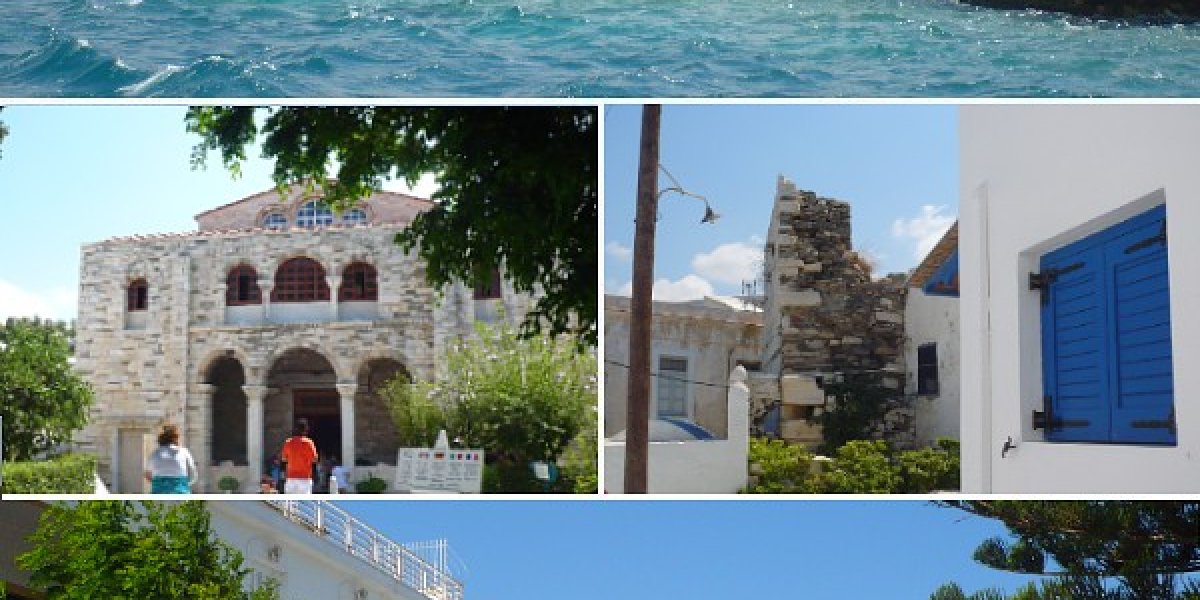
City Guide
Paros
Greece · Best time to visit: May-Oct.
Day-by-day plan
Choose your pace
Trip length
09:00
Landmark
From the ferry port, walk 300 m south along the seafront promenade — the iconic stone windmill on the harbor corner is your first Cycladic postcard. Continue west into the marble-paved alleys behind the bay and climb gently to the Kastro: a 13th-century Frankish castle built almost entirely from the fluted marble columns and lintels of an ancient temple of Athena, still embedded in the seaward wall. Wander the surrounding lanes — bougainvillea, blue shutters, and Paros's signature white marble underfoot, the same stone that became the Venus de Milo.
Tip: The unmissable photo is the Kastro's south wall, where round ancient column drums are stacked horizontally into the masonry like a giant cake. Shoot before 10:30 while the sun is still in the east behind you — after 11:00 it goes flat and the marble loses its glow.
Open in Google Maps →10:30
Religious
Walk 5 minutes east from the Kastro through the quiet back lanes — you emerge into a shaded square where Paros's most sacred building stands. Founded in the 4th century by St. Helen, mother of Constantine the Great, Panagia Ekatontapiliani is among the oldest continuously-used churches in Greece. Skip the dim interior; the magic is the marble courtyard, where the whitewashed walls glow against magenta bougainvillea and the blue Byzantine dome.
Tip: Local legend: 99 doors are visible and the 100th will only appear when Constantinople is Greek again. Best courtyard shot is from the southeast corner, framing the blue dome through the arched marble gate. Modest dress required even in the courtyard — shoulders and knees covered, or the warden will turn you away.
Open in Google Maps →12:30
Food
Walk 4 minutes back toward the harbor — Ragoussis sits on the main shopping lane just behind the waterfront. This is where Parikia locals actually queue at lunchtime: a traditional Parian bakery in business for four generations, glass cases stacked with spanakopita straight from the oven, koulouri Pariano (the island's sesame-crusted ring bread), and bougatsa still warm. Grab a tray, point at what's steaming, eat standing or at the bench outside in 15 minutes flat.
Tip: Two must-order items: the spanakopita (€3) with feta and wild greens — flakier than anything in Athens — and a slice of revani semolina cake (€2.50) for the road. Skip the cafes on the waterfront with photo menus aimed at ferry tourists; lunch there costs triple for half the flavor.
Open in Google Maps →14:00
Neighborhood
Catch the KTEL bus from Parikia's port square (€2, every 30 min, 25 min ride) to Naoussa. From the village bus stop, walk 400 m north along the bay until the road ends — the tiny fishing harbor suddenly opens in front of you, painted caïque boats moored to the quay, octopus drying on lines in the sun. At the harbor's western tip the half-sunken ruins of the 15th-century Venetian Kastelli sit directly in the water, the small whitewashed chapel of Agios Nikolaos on its breakwater. Behind, lose yourself in the maze of marble lanes that climb the hill — every corner a frame.
Tip: Walk to the very tip of the western breakwater for the single most-photographed view on Paros — Agios Nikolaos chapel with the Kastelli ruins behind it, fishing boats in the foreground. The afternoon western light hits the white walls perfectly between 15:30 and 17:00; after that the shadow flips and the shot is gone.
Open in Google Maps →17:00
Park
From Naoussa harbor, hop on the small water-taxi caïque that crosses the bay every 30 minutes (€5, 10 min) — the approach by sea is half the experience, with chapels and pastel houses receding behind you. Kolymbithres ('the Basins') is unlike any beach in Greece: enormous wind-and-sea-sculpted granite boulders divide the shoreline into a series of natural swimming pools. Slip into the turquoise water between the rocks for the most surreal swim in the Cyclades, then dry off on the warm stone in the slanting golden-hour light.
Tip: Skip the right-hand side with its packed sun-bed concessions and walk left across the rocks to the smaller free coves — clearer water, half the crowd, and the boulder formations are more dramatic. Bring rubber-soled shoes; the granite is sharp and slick where wet. Catch the 18:45 water-taxi back so you arrive in Naoussa harbor right at blue hour, the lights coming on along the quay.
Open in Google Maps →19:30
Food
Step off the water-taxi onto the Naoussa quay and walk left 50 m — Glafkos's tables are literally on the dock, wooden legs braced in the water, fishing boats bobbing within arm's reach. This is the Naoussa harbor dinner that ends up on everyone's camera roll: paper tablecloths, the silhouette of Agios Nikolaos chapel framed in the dusk, the smell of grilled octopus drifting from the open kitchen. Order the htapodi sti schara (charcoal-grilled octopus, €18) — tentacles sun-dried on the line outside the door earlier in the day — and the gouna (sun-dried mackerel split and grilled, €14, a Paros specialty you won't find on the mainland), paired with a half-litre of chilled Moraitis Monemvasia, the island's flagship white. Budget €40-50 per person with wine.
Tip: Stop in at 15:00 when you first arrive in Naoussa to reserve a water's-edge table for 19:30 — those tables go to whoever booked first, and there are only six of them. Pitfall warning: avoid the three or four tavernas in Naoussa where a host stands at the door with a laminated photo menu in five languages — those bills are double, the fish is frozen Atlantic, and the 'octopus' often isn't. The genuine harbor spots (Glafkos, Mario, Diavlos) have handwritten Greek-first menus, no touts, and the owner working the floor in an apron.
Open in Google Maps →Jump to day
09:00
Religious
From the ferry pier, walk 4 minutes inland along the palm-lined seafront and turn right at the small square — the cream-walled compound appears suddenly behind a stone gate. Founded in the 4th century after Saint Helena's vow on her way to Jerusalem, this is one of the oldest still-functioning churches in Christendom, and at 09:00 the morning light enters through the eastern apse and illuminates the marble iconostasis exactly as the Byzantine builders intended. The complex hides three churches inside one — duck through the low doorway on the left to find the underground baptistery with its cross-shaped marble font.
Tip: Legend says when the 100th hidden door is found, Constantinople will be Greek again — 99 are visible; locals say the last one is sealed inside the wall. Photograph the marble font from the upper level looking down — the cross shape only reveals itself from above.
Open in Google Maps →10:45
Museum
Exit Ekatontapiliani's side gate, cross the schoolyard and you are at the museum door in under 90 seconds. The whole reason to come is one waist-high marble slab in Room 2 — the Parian Chronicle, a 3rd-century BC marble timeline that dates every event in Greek history from the flood of Deucalion to Alexander the Great. Also here: the archaic Gorgon from Despotiko and a Cycladic figurine so minimal it looks like it was carved last Tuesday by a Calder student.
Tip: The Parian Chronicle is easy to miss — it's a brown-grey slab mounted at hip level, not the obvious white statues. Ask the guard for 'το Πάριο Χρονικό' and they'll walk you to it. Skip the souvenir replicas at the entrance — the British Museum has the larger fragment and a better print shop online.
Open in Google Maps →13:00
Food
Walk south from the museum 4 minutes along the marble-paved Market Street into the old town — you'll smell the grill before you see the sign. This is where the island's taxi drivers, hydrofoil crew and off-duty fishermen eat lunch at a wobbling pavement table, and the gyros pita (€3.80) comes wrapped tight enough to eat one-handed standing at the counter. Order the pork souvlaki skewer (€2.50) on the side and a half-litre of cold retsina (€3) — it cuts the smoke in the meat.
Tip: There's no seating list — claim a sidewalk chair the moment someone stands. Cash only, no card. Skip the harbor-front gyros joints aimed at ferry tourists; they cost double and use frozen pita.
Open in Google Maps →14:30
Landmark
From Souvlaki Hellas, head 300 m west uphill into the labyrinth — the alleys narrow, painted lines on the cobbles guide you, and you suddenly emerge at a 13th-century Venetian fortress wall built entirely out of recycled ancient temple. Look closely: fluted Ionic column drums lie sideways as wall blocks, marble cornices serve as window lintels, and a chunk of the demolished Temple of Athena forms the southwest tower. The afternoon sun at 15:00 throws long shadows across the marble joints — every photograph reveals another antique fragment.
Tip: Walk a full clockwise loop around the outside of the wall — the south face has the most spectacular embedded column drums but no signage points to it. The little chapel of Agios Konstantinos at the top has the island's best panoramic view of Naxos across the strait, and it's almost always empty.
Open in Google Maps →16:30
Neighborhood
From the Kastro descend the marble staircase east and you're back inside the old town's white maze — let yourself get lost for two hours, because that is the entire point. The afternoon light at 17:00 turns the whitewashed walls pale gold and the bougainvillea casts purple lace shadows; this is when every doorway with a blue door becomes a photograph. Loop through Agora Street, find the tiny Church of Agios Nikolaos with its painted dome ceiling, and end at the windmill on the port for the sunset facing Antiparos.
Tip: The most photogenic alley is Lochagou Gravari — look for the wooden gate with the climbing geranium halfway down. Sunset over Antiparos happens at 20:15 in June; arrive at the windmill 25 minutes early to claim the low stone wall facing west.
Open in Google Maps →19:30
Food
From the windmill, walk 6 minutes back into the old town along the painted-line route — Levantis hides behind a bougainvillea curtain on Agora Street and you'll miss it if you don't watch for the small brass plate. Open since 1986 and run by the Mavros family, this is the dinner spot Athenians fly down for — order the slow-cooked pork with mastiha and quince (€22) and the saganaki shrimp with ouzo flambé (€19), and let the sommelier pour a chilled Moraitis Monemvasia from a vineyard 6 km away. Garden tables under the lemon tree are worth the wait.
Tip: Reserve by phone the day before for a garden table — the indoor tables don't have the lemon-tree atmosphere. Avoid the seafront 'tourist menu' restaurants along the Parikia waterfront strip: laminated photo menus, English-speaking touts at the door, and inflated wine prices are the tells — locals never eat there.
Open in Google Maps →09:30
Neighborhood
Take the 09:00 KTEL bus from Parikia (€2, 25 minutes); from the Naoussa bus stop walk 4 minutes down toward the water and the harbor opens like a stage set. Arrive before 10:00 and you'll catch the last fishermen mending octopus nets on the quay while the bakeries lay out warm tyropita — by 11:30 the cruise excursions arrive and the spell breaks. Wander the alleys north of the bridge: each whitewashed dead-end ends in a flash of cobalt sea, and the church of Agios Nikolaos has the bluest dome on the island.
Tip: The most photographed view — fishing boats lined against the half-submerged castle wall — is shot from the southwest corner of the harbor, not the bridge. The morning light is behind you here until about 11:00; after that you'll be shooting into glare.
Open in Google Maps →11:00
Landmark
Walk west along the harbor quay for 3 minutes — the path ends at a stone causeway leading directly into the sea-fortress. Built in the 15th century to guard against pirates, the Kastelli now sits half-collapsed into the Aegean, and you walk on a marble floor with waves breaking under the cracks. Climb the broken tower for the postcard angle on the white-blue village across the inlet — this is the most-photographed shot in Naoussa and from up here you'll understand why.
Tip: Wear shoes with grip — the marble is polished and gets slippery in any spray. The best photo composition puts the broken arch in the left third with the village behind; the angle from the second collapsed step delivers it perfectly.
Open in Google Maps →12:30
Food
Walk back across the causeway and 60 seconds along the harbor — Barbarossa's blue chairs are right on the water, named for the Ottoman pirate who actually sacked Naoussa in 1537. This is where you eat gouna, the Cycladic specialty of sun-dried mackerel grilled over coals (€14), with a plate of marathopita (fennel pie, €7) and a small carafe of Parian ouzo (€5). The fish was hanging on rope outside the kitchen yesterday morning — ask the waiter to point at the drying rack on the far wall.
Tip: Arrive at 12:30 sharp — by 13:30 every harbor-front table is taken and the cruise crowds turn it into chaos. Order gouna with a side of skordalia (garlic-potato dip) and dunk the fish into it; the waiter won't suggest this combination, but every old Naoussa man does it.
Open in Google Maps →15:00
Landmark
From Barbarossa walk 3 minutes back to the bus stop and take the 14:40 caique water-taxi across the bay (€4 each way, 8 minutes) — a far better arrival than the dusty road bus. Kolymbithres is not a beach so much as a geological gallery: 60 million years of wind and waves have sculpted the granite into giant pink-grey sofas, tunnels and amphitheatres, and you swim into hidden pools between them. The 15:00 light sets the rock pink against the deep blue water — this is the photograph you came to Paros to take.
Tip: Walk past the first organised sunbed cluster to the second and third coves — they look identical from the entrance but the rock formations get more dramatic westward, and the tunnel swim-through is in the third cove. Bring water shoes; the granite is smooth but the sea-urchin clusters in the channels are not forgiving.
Open in Google Maps →17:30
Park
From Kolymbithres, follow the coastal footpath 1 km west — it climbs over juniper-covered headland and the path is marked by stacked white stones. The viewpoint at the small chapel of Ai Yannis Detis gives the widest possible Cycladic horizon, with Antiparos to the south and the white speck of Mykonos visible on a clear day. Drop down to Monastiri's tiny crescent for a final swim at 18:00 when the bay turns into liquid gold and the day-trippers have left for their cruise ships.
Tip: The chapel is unlocked — step inside for one minute to see the hand-painted icon of John the Baptist that fishermen leave votive offerings to. Don't be the person who walks back to Naoussa in the dark; catch the 19:15 return caique from Monastiri pier, or you'll be hiking 4 km on an unlit road.
Open in Google Maps →20:30
Food
From the Naoussa harbor walk 3 minutes east along the bridge and turn into the lane behind the church — Sigi Ikarou occupies a candlelit courtyard you would never find without looking. The chef trained in Athens and reinterprets Cycladic ingredients with restraint: order the slow-braised goat with sun-dried tomato and Naxos graviera (€26) and the octopus carpaccio with caper leaf (€18), paired with a glass of Moraitis Mandilaria (€9). End with the loukoumades flambéed in mastiha honey — the perfect final taste of the Cyclades.
Tip: Reserve at least one day ahead — the courtyard has 14 tables and they turn away walk-ins by 20:30 every night in season. The classic Naoussa tourist trap: harborfront waiters in white shirts physically intercepting tourists with 'menu, my friend' — every restaurant doing this is overpriced and mediocre. Real Cycladic kitchens never need to chase customers.
Open in Google Maps →
Trip builder
Plan this trip around Paros
Turn this guide into a bookable rail itinerary with FlipEarth.
Keep exploring
Related cities
More in the same country
FAQ
Frequently asked questions
How many days do you need in Paros?
Most travelers enjoy Paros in 1 days, with enough time for headline sights and a slower meal or museum stop.
What's the best time to visit Paros?
The easiest season for most travelers is May-Oct, especially if you want good weather and manageable crowds.
What's the daily budget for Paros?
A practical starting point is about €90 per person per day before hotels, then adjust based on museums, dining, and transport.
What are the must-see attractions in Paros?
A good first shortlist for Paros includes Parikia Waterfront & Frankish Kastro.