City Guide
Nuremberg
Germany · Best time to visit: May-Oct, Dec.
Day-by-day plan
Choose your pace
Trip length
09:00
Landmark
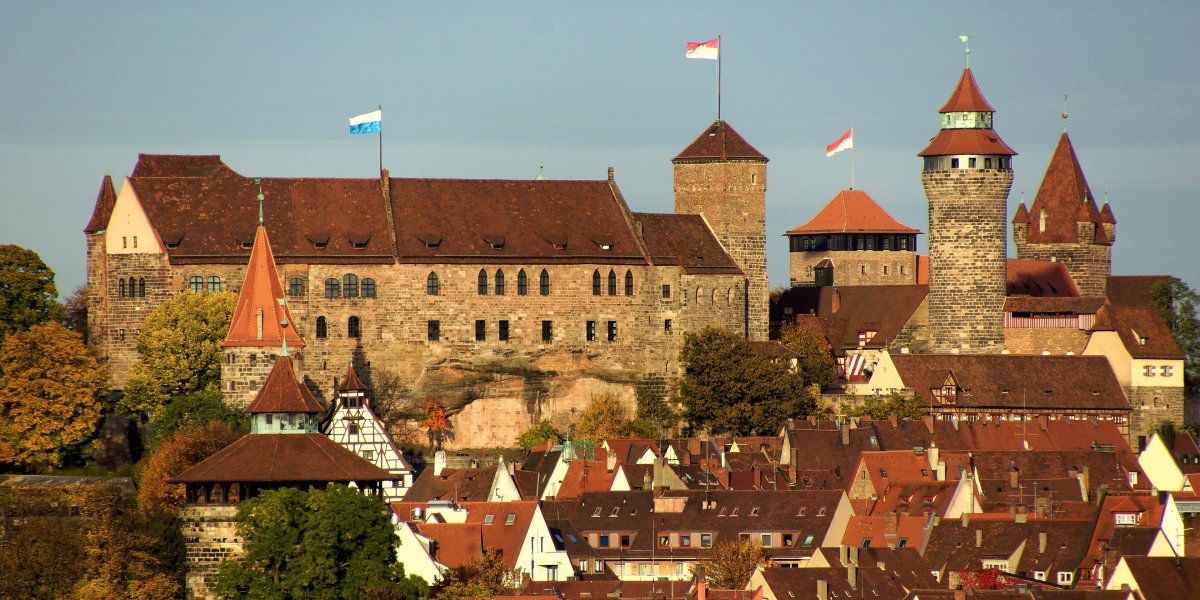
Begin at the city's crown — climb the cobbled Burgstraße from the old town, a 10-minute ascent that doubles as your morning warm-up. This sandstone fortress has commanded the ridge since the 11th century, hosting every Holy Roman Emperor who passed through Franconia. Walk the open courtyard, circle the Sinwell Tower, and find the Burggarten terrace on the north side for a panoramic sweep over Nuremberg's ocean of red clay rooftops and Gothic spires.
Tip: The northwest corner of the Burggarten gives the definitive Nuremberg photograph — half-timbered houses, church towers, and an unbroken sea of rooftops all compose in one frame. Arrive before 09:30 while the sun is low enough to paint long shadows across the old town; by mid-morning, tour buses fill the courtyard and the terrace becomes a crowd.
Open in Google Maps →10:45
Neighborhood
Exit the castle's western gate and descend through Obere Schmiedgasse to Tiergärtnertorplatz — pause for a photo of Albrecht Dürer's half-timbered house framing the cobblestone square, then turn right onto Weißgerbergasse. This is Nuremberg's best-preserved medieval lane: pastel-painted tanners' houses with steep gabled roofs that feels like walking through a film set. At the bottom, the Pegnitz river appears; follow it east past the colossal Weinstadel — a half-timbered wine warehouse from 1446 — to Henkersteg, the wooden covered bridge that is the most photographed spot in the city.
Tip: The money shot is from Maxbrücke looking east — Henkersteg, the Weinstadel, and the river all compose in one frame. Then walk onto the covered bridge itself for a moody shot through its timber beams. Come before noon while the sun hasn't yet cast harsh shadows into the river corridor.
Open in Google Maps →12:00
Food
Cross the river north and walk 8 minutes up Karlstraße past the Renaissance facade of the Altes Rathaus to Rathausplatz — the beechwood smoke hits you a block away. Bratwursthäusle has been grilling Nuremberg's famous finger-sized sausages over open flame since the 14th century. Order a plate of 12 Rostbratwürstchen with sauerkraut and a streak of sharp horseradish (€11.90), or grab the walk-and-eat classic: Sechs im Weckla — six sausages in a crusty roll (€4.50). Pair with a Tucher Helles (€4.20). Budget €10–16.
Tip: Don't overthink the menu — the only thing worth ordering is bratwurst, and that's a compliment. The Weckla (roll) version isn't the budget option; it's how locals eat on market days. The line moves fast, usually under 10 minutes. If every seat inside is taken, eat standing at the counter — same sausages, zero wait.
Open in Google Maps →13:00
Landmark
Walk 2 minutes south through Rathausplatz — the square opens up suddenly and the 19-meter Schöner Brunnen appears on your left. This is the Hauptmarkt, where Nuremberg's world-famous Christkindlesmarkt fills every inch each December. The Gothic spire of the fountain is covered in 40 painted figures of prophets, electors, and heroes; behind it, the Frauenkirche facade presides with its mechanical Männleinlaufen clock. Circle the fountain fence on the northeast side and find the single brass ring among the iron ones — it turns freely. Spin it three times; locals say it grants a wish.
Tip: The brass ring (Goldener Ring) sits between the two iron gates on the northeast fence — most tourists circle the wrong half looking for it. It's the one ring distinctly warmer in color than the black ironwork around it. The Männleinlaufen clock on the Frauenkirche plays daily at noon — you've missed today's show, but the facade rewards a long look regardless.
Open in Google Maps →15:00
Landmark
From the Hauptmarkt, walk southeast through Königstraße past the Hauptbahnhof and continue along Bayernstraße — a 45-minute walk through increasingly quiet streets until something enormous rises on the horizon. The Kongresshalle was designed to seat 50,000, modeled on the Roman Colosseum, and deliberately left unfinished after 1945. Walk along the granite-clad northern facade to absorb the scale, then continue south along the Große Straße — a 2-kilometer ceremonial road built 60 meters wide, wider than the Champs-Élysées. At its far end, the Zeppelinfeld opens up: the grandstand where the infamous rally footage was filmed, now deliberately left to weather and decay.
Tip: Walk the full Große Straße to feel its absurd scale — 15 minutes in, you realize you're still on the same road. The Zeppelinfeld grandstand at the far end is most powerful in late afternoon when the grounds empty and low sun rakes across the stone. If your legs are protesting after 12 km of old town, skip the walk here — catch the tram from Hauptbahnhof to Doku-Zentrum stop instead (10 minutes, €3.20), saving your energy for exploring the grounds themselves.
Open in Google Maps →19:00
Food
Head back from the Rally Grounds to the old town by tram (15 minutes) and walk north along the Pegnitz for 5 minutes — you'll see the restaurant before you believe it: a 14th-century hospital building spanning the river on two graceful stone arches, glowing golden in the evening light. This is Nuremberg's most atmospheric dinner table. Order the Fränkisches Schäufele — a crispy-skinned roast pork shoulder with potato dumpling and dark beer sauce (€17.90), the definitive Franconian main course and a world apart from your lunchtime bratwurst. Pair with a Schlenkerla Rauchbier for smoky resonance or a Zirndorfer Landbier for something malty and smooth (€4.50). Budget €25–35.
Tip: Request a table in the river-side wing — the vaulted ceilings and water views are the reason to eat here, not just the food. No reservation needed before 19:00 on weekdays; Fridays and weekends, book a day ahead by phone. One warning before you go: skip the restaurants lining the Hauptmarkt that you passed this afternoon — they charge double for mediocre food and survive on tourist footfall alone. Heilig-Geist-Spital is five minutes from the Hauptbahnhof when you're done, ready for your onward train.
Open in Google Maps →Jump to day
09:00
Landmark
Begin your morning at the highest point in the old town, where the Imperial Castle has commanded the skyline since the 11th century. Arrive right at opening — the courtyards are nearly empty, the morning sun warms the sandstone walls, and the city below is still waking up. Walk through the Palas (Imperial Palace), peer into the 50-meter Deep Well as a guide drops candles to reveal its depth, then climb the Sinwell Tower for a 360-degree panorama of terracotta rooftops stretching to the Franconian hills.
Tip: Buy the combined ticket (Palas, Sinwell Tower, Deep Well). The Deep Well demonstration runs every 30 minutes — go to the tower first for photos before morning haze builds, then catch the well on your way down. The Sinwell Tower's top platform is small; at opening you will have it entirely to yourself.
Open in Google Maps →10:45
Museum
Walk downhill from the castle gate and through Tiergärtnertor — the most photogenic square in Nuremberg, framed by half-timbered houses and a centuries-old linden tree. Dürer's house stands 100 meters ahead on your left. This beautifully preserved 15th-century home is where Germany's greatest Renaissance artist lived and worked for nearly two decades. The audio guide features Agnes Dürer narrating each room with sharp humor — it brings the creaking floorboards and paint-splattered studio to life in a way no museum label ever could.
Tip: The top-floor studio has the best natural light in the house — Dürer chose it for exactly that reason. Visit on a sunny morning and you will see why. After your visit, linger in Tiergärtnertor square for a coffee at Wanderer — the outdoor tables face the castle wall and it is one of the few genuinely atmospheric café spots in the old town.
Open in Google Maps →12:30
Food
Exit Dürer's House and walk south down Bergstraße, past timber-framed facades and through the shadow of St. Sebald Church — 8 minutes on foot to Rathausplatz. This is the bratwurst pilgrimage every visitor must make. The Nürnberger Rostbratwürstl are grilled over a beechwood fire exactly as they have been for centuries: small, finger-sized, smoky, and snapping with each bite. Order Sechs auf Kraut (six on sauerkraut, €8.90) or go all in with twelve (€12.50). The sharp horseradish on the side clears your sinuses in the best possible way.
Tip: Sit downstairs near the open beechwood grill — the smoke and sizzle are half the experience. Arrive by 12:15 to beat the lunch rush; by 12:45 there is a queue out the door. Pair with a Tucher Helles from the tap (€4.20/0.5L). Skip the tourist-menu platter and just order bratwurst and kraut — it is what every local orders and the only thing the kitchen truly perfects.
Open in Google Maps →14:00
Landmark
Step out of the restaurant and walk one minute south through the archway to Hauptmarkt, Nuremberg's grand market square since 1349. The 19-meter Schöner Brunnen (Beautiful Fountain) rises at the northwest corner — find the seamless brass ring hidden in the iron fence and spin it three times for good luck. Cross to the eastern edge for the Frauenkirche, whose mechanical clock, the Männleinlaufen, performs at noon daily. You have missed the show, but the church interior — especially the Tucher Altarpiece — rewards a quiet visit. Stroll the market stalls if they are running; this square is Nuremberg's heartbeat.
Tip: The best photo of the Schöner Brunnen: stand at the southeast corner of the square and shoot northwest with the castle rising in the background — afternoon light makes the gilded figures glow. There are actually two rings on the fountain fence; the gold one grants luck, the black iron one most tourists spin is the decoy. If market stalls are selling fresh Lebkuchen, buy one — it tastes nothing like the boxed versions.
Open in Google Maps →15:45
Religious
Cross the Museumsbrücke over the Pegnitz — pause halfway for a classic Nuremberg photo, with the Heilig-Geist-Spital arching over the water below. Continue 3 minutes south to Lorenzer Platz. St. Lorenz is one of the great Gothic churches of Germany, and the interior will stop you in your tracks: look up to find Veit Stoß's Angelic Salutation, a carved wooden masterpiece floating from the ceiling in a halo of golden light, and Adam Kraft's 20-meter stone tabernacle spiraling upward without any visible support.
Tip: Stand in the center of the nave facing east — this is the angle where late-afternoon light through the rose window catches the Angelic Salutation most dramatically. A €2 donation at the entrance gets you the laminated guide explaining the symbolism most visitors walk right past. The church is free to enter; guided tours run at 14:00 on Saturdays, usually in German.
Open in Google Maps →19:00
Food
Walk 3 minutes northeast back to the Pegnitz riverbank. The Heilig-Geist-Spital stretches across the water on two graceful stone arches — at dinner hour with its walls lit amber and the river gleaming below, it is the most atmospheric dining room in Nuremberg. This 14th-century hospital-turned-restaurant serves Franconian classics perfected over centuries. Order the Nürnberger Schäufele (crispy roast pork shoulder with potato dumplings, €16.90) — you will hear the crackling before it reaches your table.
Tip: Call ahead and request a window table on the river side, especially Friday and Saturday. After dinner, walk east along the Pegnitz toward Henkersteg (Hangman's Bridge) — beautifully lit at night and nearly deserted. Avoid the restaurants directly on Hauptmarkt with oversized photo menus outside; they charge 30–40% more for microwaved food and target day-trippers who do not know better.
Open in Google Maps →09:30
Museum
Take tram 8 from Hauptbahnhof toward Doku-Zentrum stop (12 minutes). The Documentation Center is housed inside the never-completed Congress Hall — a deliberately preserved ruin of Nazi megalomania modeled on the Roman Colosseum at twice the scale. The permanent exhibition traces how an entire nation was seduced by spectacle, using Nuremberg's own role as the regime's propaganda stage. This is not comfortable viewing, but it is essential — and the building itself, crumbling and unfinished, speaks louder than any display inside it.
Tip: Start with the orientation film on the ground floor before heading upstairs — it provides crucial context that makes every room after it land harder. The audio guide is included in your ticket and strongly recommended; without it you will miss the connections between the exhibition spaces and the architecture of the Congress Hall itself. Allow yourself to feel the oppressive scale — that discomfort is the point.
Open in Google Maps →11:45
Landmark
Exit the Documentation Center and walk south along the Große Straße (Great Road), the 2-kilometer granite boulevard designed for military parades that never fully materialized. After 15 minutes you reach Zeppelin Field — the vast stone grandstand where hundreds of thousands gathered for the regime's choreographed spectacles. Stand on the tribune and look out across the silent expanse. The deliberate emptiness is the memorial: this place was preserved not to glorify, but to ensure no one can ever look away from what happened here.
Tip: Walk up onto the Zeppelin Tribune's central podium — it is open to the public. The vantage point that captures the sheer scale best is from the center of the field looking back at the tribune. Sit for a moment. This is not a place for selfies; it is a place for silence. The information panels along the Great Road explain each structure — read them as you walk south.
Open in Google Maps →13:00
Food
Walk north along the shore of Dutzendteich lake — 10 minutes through a surprisingly peaceful park, with willow trees dipping into the water. After a heavy morning, the sun-drenched lakeside terrace of Gutmann is exactly the emotional reset you need. Order Obatzda with a warm pretzel (€8.50) — the tangy Bavarian cheese spread is addictive — or the Fränkischer Leberkäs with potato salad (€11.90). A half-liter of Zirndorfer on the terrace watching the ducks is the lunch you did not know you needed.
Tip: Sit on the south-facing terrace for maximum sun and lake views. This is a local family favorite on weekends — arrive before 13:00 to grab a table without a wait. The Obatzda is house-made and far better than what you will find in the old town tourist restaurants.
Open in Google Maps →14:30
Museum
Take tram 8 back toward the center (Opernhaus stop, 10 minutes) and walk 2 minutes south to Germany's largest museum of art and cultural history. Do not attempt to see everything — two hours means being strategic. Head straight to the second floor for the Dürer and Cranach rooms, then the medieval arms and armor hall where the craftsmanship will astonish you, and finish outside at the Straße der Menschenrechte — 30 white pillars inscribed with articles of the Universal Declaration of Human Rights in 30 languages, a powerful bookend to this morning's visit.
Tip: Enter from the Kartäusergasse entrance, not Kornmarkt — shorter queue and you begin near the highlights. The museum café on the ground floor does an excellent Kaffee und Kuchen (~€6) if you need a mid-afternoon reset. Free admission on Wednesdays after 18:00; on a weekend visit the €8 ticket is among the best value in German museums.
Open in Google Maps →16:45
Neighborhood
Exit the museum and walk north through the old town for 12 minutes, crossing the Pegnitz at Maxbrücke — glance left for a postcard view of the Weinstadel, the city's longest half-timbered building, dating to 1446. Turn right onto Weißgerbergasse: Nuremberg's best-preserved medieval lane, where tanners once worked and where every sandstone-and-timber facade has been lovingly restored. In late afternoon the western sun paints the buildings in warm amber. This is the Nuremberg that locals love and most tourists never find.
Tip: Number 26, the Pilatushaus, has the most ornate facade on the street — pause here for your best photo. The small artisan shops are genuinely local: look for handmade Franconian pottery and small-batch Lebkuchen from producers you will not find at the train station. Skip the souvenir shops clustered near the castle gates — same goods, double the price.
Open in Google Maps →19:00
Food
Walk 3 minutes south on Bergstraße — you will smell the malt before you see the sign. Altstadthof is Nuremberg's only old-town microbrewery, and their Rotbier (red beer, €4.50/0.5L) is a revival of an ancient Franconian recipe: dark copper, faintly smoky, unlike anything you have tasted elsewhere. Pair it with the Bierbraten (beer-braised pot roast with dark beer gravy, €15.90) or the Fränkische Bratwurstpfanne (pan-fried sausages with caramelized onions and beer sauce, €13.90). This is how Nuremberg says goodbye.
Tip: Book the 30-minute rock cellar tour (€9.50, runs at 17:00 and 18:00) — you descend into medieval tunnels beneath the old town where beer was stored at a constant 8°C for centuries. It is the most unexpected experience in Nuremberg and pairs perfectly with a pre-dinner beer. Avoid the restaurants on lower Bergstraße advertising all-you-can-eat deals — tourist traps with reheated food aimed at day-trippers who will not return.
Open in Google Maps →
Trip builder
Plan this trip around Nuremberg
Turn this guide into a bookable rail itinerary with FlipEarth.
Keep exploring
Related cities
More in the same country
FAQ
Frequently asked questions
How many days do you need in Nuremberg?
Most travelers enjoy Nuremberg in 1 days, with enough time for headline sights and a slower meal or museum stop.
What's the best time to visit Nuremberg?
The easiest season for most travelers is May-Oct, Dec, especially if you want good weather and manageable crowds.
What's the daily budget for Nuremberg?
A practical starting point is about €55 per person per day before hotels, then adjust based on museums, dining, and transport.
What are the must-see attractions in Nuremberg?
A good first shortlist for Nuremberg includes Kaiserburg (Imperial Castle), Hauptmarkt & Schöner Brunnen, Nazi Party Rally Grounds (Reichsparteitagsgelände).