City Guide
Montpellier
France · Best time to visit: Apr-Oct.
Day-by-day plan
Choose your pace
Trip length
09:00
Landmark
Start at the city's highest point, where the old royal road met the ramparts — the Arc de Triomphe faces due east, and at 9 AM the morning sun pours through its bas-reliefs like stage lighting, something you will miss by an hour. Behind the arch opens the Promenade du Peyrou, a long terrace pointing west toward the Château d'Eau water tower and the Saint-Clément Aqueduct — Montpellier's mini Pont du Gard — disappearing into the distance. Walk the full length to the stone balustrade at the far end: on clear mornings you see south all the way to the Mediterranean haze and north to the Cévennes ridgeline.
Tip: Arrive before 9:30 — tour groups descend after. For the iconic photo, stand under the northwest corner of the arch looking back at the Château d'Eau; the aqueduct arches line up behind it into a single perspective. Skip the paid Château d'Eau interior tour — it's 10 minutes and the best view is from outside anyway.
Open in Google Maps →10:45
Religious
Exit Peyrou through the east gate and walk down Rue Foch — Montpellier's Haussmann-era answer to Parisian grandeur, all ironwork balconies and Second Empire stone — then cut north through the medieval Ecusson, 10 minutes. Saint-Pierre is the only southern French Gothic cathedral with a porch flanked by two 14-meter conical towers that look like rocket boosters planted in the stone. Its south wall directly adjoins the Faculty of Medicine, founded in 1220 and one of the oldest in the world — Rabelais and Nostradamus both studied here. You are looking at 800 years of continuous teaching.
Tip: For the best photo of the conical towers, stand across Rue de l'Abbé-Marcel-Montels at the southwest corner — this is the only angle where both towers frame against the sky without power lines. Duck into the free Jardin des Plantes (France's oldest botanical garden, 1593) beside the cathedral — it's almost empty before noon and the view back to the cathedral tower rising above the magnolias is the photograph every guidebook misses.
Open in Google Maps →12:15
Food
Weave south from the cathedral through Rue de l'Aiguillerie and Rue de la Loge — the medieval shopping spine of the Ecusson, still lined with original 15th-century stone shopfronts, 8 minutes. Les Halles Castellane is Montpellier's 1855 cast-iron covered market where locals actually shop, not a food-hall tourist trap. Bouzigues oysters at La Ola come straight from the Thau lagoon 20 km away — €12 for a half dozen opened to order — paired with a glass of local Picpoul de Pinet (€4) from the wine stall. For something warm, the plat du jour at Les Arceaux de la Halle runs €14 and changes daily.
Tip: Eat standing at La Ola's counter on the far northeast end of the hall — the locals' bar, and the oysters are shucked in front of you, not pre-opened on ice. Ignore the restaurant terraces on Place Castellane just outside: same oysters, double the price. Market closes at 13:30 sharp on weekdays, so don't dawdle.
Open in Google Maps →13:45
Landmark
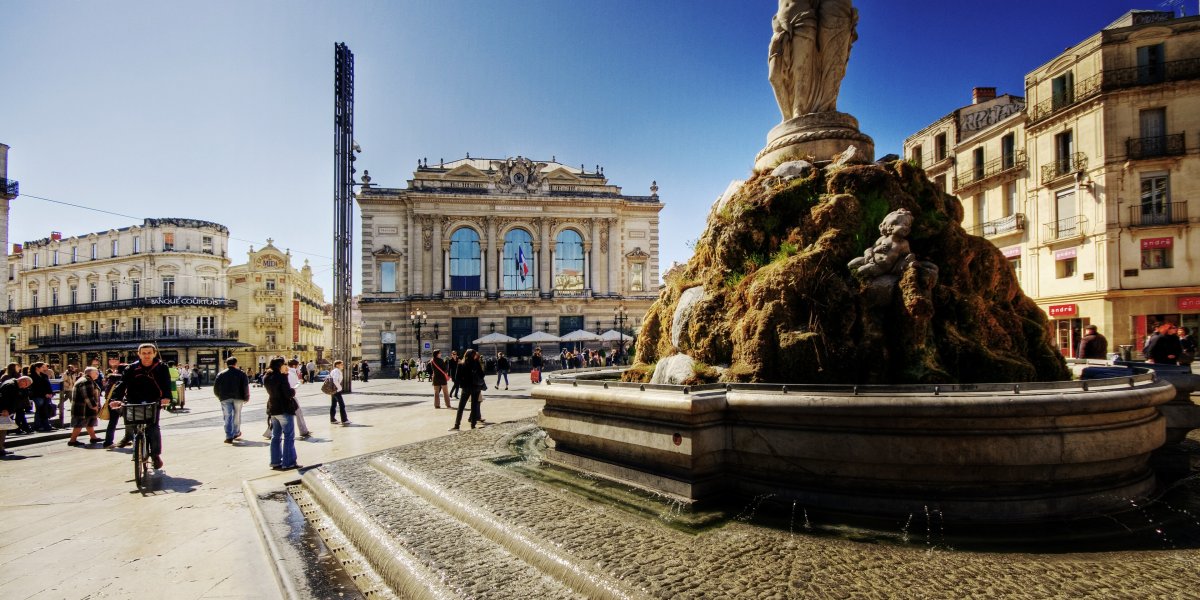
Three minutes east from Les Halles the lanes suddenly open onto the widest pedestrian square in France — locals call it Place de l'Oeuf (the Egg) for its curved shape. The 1890 Opéra Comédie anchors the south end and the Three Graces fountain marks the center (the original is inside the opera; this is a 1990 bronze copy). Then stroll north up the Esplanade Charles-de-Gaulle, a 500-meter plane-tree-shaded promenade lined with pétanque players, all the way to the honey-stone exterior of the Musée Fabre and the Champ de Mars park. This is where Montpellier's student life happens — take a café en terrasse on a side street and watch the city move.
Tip: Photo angle — stand at the north end of the Esplanade looking south back toward the Opéra: the plane trees form a green tunnel framing the fountain, impossible to shoot from inside the square itself. For coffee, skip the Comédie-facing cafés (€4.50 espresso, soulless) and slip one block west to Café Riche on Rue Boussairolles — same espresso for €1.80 and the regulars are city hall workers, not tourists.
Open in Google Maps →16:00
Neighborhood
Cross back south through Place de la Comédie and slip through the glass-roofed Polygone shopping gallery — five minutes later you emerge into another century and another architectural language. Ricardo Bofill designed Antigone in the 1980s as a postmodern neoclassical counterpoint to the medieval Ecusson: travertine colonnades, pedimented façades, and a single symmetrical axis marching east for a full kilometer through Place du Nombre d'Or, Place du Millénaire, and Place de Thessalie, all the way to Place de l'Europe on the Lez river. Beyond the river rises Jean Nouvel's 2014 RBC tower — white, twisted, unmistakable. Walk the full axis to the Lez, cross Pont Juvénal for the view back, then retrace. This is the one neighborhood in Europe where Roman grammar meets 1980s concrete.
Tip: The killer photograph is from the exact center of Place du Nombre d'Or at 16:30-17:00 — low sun hits the travertine columns side-on and lights the entire axis eastward in gold. Stand on the circle's mosaic compass point for perfect symmetry. Cross to the east bank of the Lez for five minutes to see the full Antigone façade reflected in the water — almost nobody does this and it's the money shot.
Open in Google Maps →19:30
Food
Walk back west from the Lez through Antigone and across Place de la Comédie into the lamplit Ecusson — the twenty-minute walk through the medieval lanes at dusk is half the meal. La Diligence sits inside a 13th-century vaulted stone cellar on Place Pétrarque, one of the oldest dining rooms in the city and a Michelin guide regular. The kitchen does classic Languedoc with modern precision: the tielle Sétoise (spiced octopus pie from the coast, €18) and the foie gras poêlé with Muscat de Frontignan (€24) are the dishes to order. The three-course tasting menu is €48 and the wine list leans heavily on Pic Saint-Loup reds from 30 km north.
Tip: Reserve by noon — the eight-table cellar fills by 20:00 and walk-ins get turned away. Ask specifically for a table in the back vaulted alcove rather than the front room; it's warmer, quieter, and lit only by candles. Pitfall warning for the Ecusson at night: avoid any restaurant ringing Place de la Comédie with a picture menu or an outside hawker — they charge €22 for microwaved moules frites and are universally disliked by locals. The authentic bistros are always one street off the main square, and they never need a hawker.
Open in Google Maps →Jump to day
09:00
Landmark
Your first morning begins on Montpellier's great egg-shaped plaza — still quiet before the crowds, the rising sun warming the Opera Comedie's honey-stone facade and the bronze Three Graces catching their first gold. Grab a cafe noisette at an outer terrace and watch a southern French city take its morning breath before the day's bustle claims the stones.
Tip: Skip the two cafes directly on the plaza (30% markup) — sit at Cafe Riche on the south corner where locals drink (cafe + croissant under 6€). Best photo: back to the Opera, frame the Three Graces with the morning sun catching their bronze, before 09:30 when the delivery carts clear.
Open in Google Maps →10:00
Museum
Cross the Esplanade Charles de Gaulle under its plane trees — a 3-minute walk north and the glass-and-steel entrance is set into a 17th-century hotel particulier. Step in the instant doors open at 10:00 to have the Courbets and Delacroix to yourself. The jewel is Frederic Bazille, the Montpellier Impressionist who died at 29 — and one hall of Soulages black that will change the word 'black' for you.
Tip: Closed Mondays. Skip the audio guide — English cartouches are excellent. Head straight to the first-floor 19th-century rooms (Bazille, Courbet, Delacroix) before school groups arrive at 11:00. Save the Soulages wing on the top floor for last — it's always the emptiest room in the building.
Open in Google Maps →12:30
Food
Exit the museum south on Rue Baudin and wind back into the Ecusson's medieval lanes — 7 minutes to a former 19th-century public bathhouse, preserved mosaic floors and bath alcoves still intact beneath vaulted ceilings no new restaurant can fake. Order the brandade de morue (salt-cod purée, a Languedoc classic, 18€) or the 7-hour lamb shoulder (26€); the 2-course lunch formula at 22€ is the smart move. Budget 25-35€ per person.
Tip: The 22€ 2-course lunch formula includes brandade as a main — unbeatable value. Walk in at 12:30 without reservation and ask for 'une table dans les alcoves' — the preserved bath-cubicle tables at the back. After 13:00 the queue forms and those tables are gone.
Open in Google Maps →14:30
Religious
Walk west on Rue de l'Aiguillerie for 8 minutes — medieval lanes overhung with wrought-iron balconies — to a facade unlike any other in France: two massive stone cylinders flanking the door, remnant of a 14th-century fortified chapel. Next door stands Europe's oldest working medical school, founded 1220, where Rabelais once walked. Step inside the cathedral — the sudden simplicity after the Ecusson's bustle is a shock worth the walk.
Tip: Enter through the side door on the left — the monumental front door is often locked. The medical school courtyard is free on weekdays; on weekends the carved monumental doors on Rue de l'Ecole de Medecine are your view. Look up at the vault over the cathedral entrance for the university arms — a detail most visitors walk straight past.
Open in Google Maps →16:00
Landmark
Continue west for 5 minutes — through the 1691 Arc de Triomphe built for Louis XIV, then up onto the grand stone terrace looking west toward the Pic Saint-Loup. Late afternoon light turns every limestone slab gold, and the Chateau d'Eau at the far end is fed by the 17th-century Aqueduc Saint-Clement — France's longest surviving urban aqueduct, two tiers of arches marching into the countryside. Stay until the sun dips behind the arches; this is Montpellier's postcard angle.
Tip: The photograph: stand at the far west end by the Chateau d'Eau and shoot east back through the aqueduct's double row of arches, just before sunset — the arches frame the falling sun. Skip the paid Arc de Triomphe climb (Saturdays 10:30 only) — the Promenade view at ground level is better. Pitfall: drinks cafes just outside the arch inflate 50% — walk 3 minutes back into the Ecusson for a real one.
Open in Google Maps →19:30
Food
Walk back east for 8 minutes along Rue Foch, then down a narrow side lane to a 20-seat room with an open kitchen — a Michelin Bib Gourmand, one of Montpellier's most disciplined chef-led rooms. The menu shifts weekly; Mediterranean fish, garrigue vegetables, a pigeon two-ways (32€) and whole sea bass (36€) anchor it, with the 4-course tasting menu at 59€ the intelligent choice. Budget 60-80€ per person.
Tip: Reserve 3-4 days ahead — 20 seats means the room books out weekly. Ask for a counter seat near the open kitchen to watch the pass. The 59€ 4-course menu beats a la carte; wine pairings (+35€) are a masterclass in Languedoc whites. Pitfall for the Peyrou area: the 'charming tourist bistros' clustered within 100m of the Arc de Triomphe serve 28€ microwaved duck confit — avoid anything inside that radius, including the ones with chalkboards and geraniums out front.
Open in Google Maps →09:00
Park
Begin at the gates on Boulevard Henri IV in the upper Ecusson — France's oldest botanical garden, founded 1593, three centuries before Kew. At 09:00 the gates are barely open, ancient plane trees cast long shadows over the allees, and you can walk where Montpellier medical students have collected herbs since Rabelais's day. Climb the raised terrace to the carp pond — the 1598 ginkgo biloba still drops its fan-leaves every November.
Tip: Closed Mondays — if your weekend includes one, swap it with an afternoon slot. Head straight to the Montagne d'Intailles (raised terrace) at 09:00 before schoolchildren arrive at 10:30. The ginkgo near the orangery is France's oldest — medical students still touch its trunk for exam luck, a 400-year-old ritual no guidebook mentions.
Open in Google Maps →10:30
Landmark
Walk east across the Ecusson for 20 minutes — through Place de la Canourgue, down Rue Foch's wrought-iron corridor, across Place de la Comedie, and through the Polygone mall's passage that spits you out onto Place du Nombre d'Or. The contrast is intentional and shocking: medieval lanes one moment, a neoclassical postmodern city the next — oversized columns, golden-ratio proportions, places named after Greek myth. Built 1979-2000 by Catalan architect Ricardo Bofill; walk the full axis east through Place du Millenaire and Place du Peuple Europeen to the Hotel de Region by the Lez.
Tip: The photograph: stand on the Hotel de Region's steps at the east end and shoot back west — the entire axis frames Place de la Comedie's Opera 1.5km away, the only view in France where postmodern columns frame a 19th-century opera house. Do not tram it 'to save the walk' — you'd skip the Polygone passage, which is the physical moment of the shock.
Open in Google Maps →12:30
Food
Cross the Pont Juvenal over the Lez — 5 minutes — and L'Arbre Blanc rises above you like a concrete tree, Sou Fujimoto's 2019 masterpiece of 113 cantilevered balcony-leaves. The ground-floor restaurant Cala serves Mediterranean small plates: octopus a la plancha (24€) and sea bream carpaccio (18€) headline a 28€ 3-course lunch formula. Budget 30-45€ per person, and the terrace faces back across the Lez to the Antigone skyline you just walked.
Tip: Request a terrace table facing the Lez — the view back at Antigone is why you came. The 28€ 3-course lunch beats a la carte; the octopus is the headline and the sea bream carpaccio is the sleeper pick. Before leaving, walk around the tower's base and look straight up — 113 balconies fan out like petals; this upward angle is the one that made L'Arbre Blanc famous on Instagram.
Open in Google Maps →14:30
Entertainment
Take Tram Line 1 eastbound from Place de l'Europe — 3 stops, 6 minutes, then a 4-minute walk through Odysseum to the aquarium entrance. Smaller than Barcelona's or Genoa's but tightly focused on the Mediterranean ecosystems you're 10km north of, not the usual tropical filler. The 15:00 storm-simulation room is a genuine multi-sensor spectacle, and the walk-through shark tunnel closes the loop at the end.
Tip: Book the ticket online in advance — skip the 20-minute weekend queue. Time arrival to catch the 15:00 storm-simulation room; the tropical tanks at the start are skippable, but the Mediterranean section is what's unique to this city. Exit through the shark tunnel slowly after 16:00 when it empties out — the only moment it's photographable without someone else's shoulder in the frame.
Open in Google Maps →17:00
Landmark
Tram back 3 stops to Place de l'Europe (6 minutes) and walk 5 minutes to the tower's lobby — the elevator opens on the 17th floor, inside one of those cantilevered balcony-leaves. Pic Saint-Loup due north, the Antigone axis west, the Mediterranean shimmering south, and the Cevennes beyond. Order a Picpoul de Pinet (the local white, 9€) and watch the southern sky run from blue to pink to violet.
Tip: Le Sky opens at 17:00 daily — arrive at opening to grab a west-facing window seat; they're gone in 10 minutes on a sunny evening. Picpoul de Pinet at 9€ is the order; house cocktails at 14€ are uneventful. Do not stay for dinner here (overpriced small plates) — treat it as a drinks stop only. Pitfall for Port Marianne: Avenue Pierre Mendes-France lines up tourist bistros serving 25€ mediocre pizza — always walk 5 minutes inland for anything real.
Open in Google Maps →19:30
Food
Tram back to Comedie (8 minutes), then walk north up Rue de l'Aiguillerie for 5 minutes — a doorway opens into a 17th-century vaulted stone cellar. One Michelin star, Cevennes and Lozere mountain cuisine: aligot Aubrac (potato-tome cheese whipped tableside into a meter-long ribbon, 16€ as a side) and Boeuf Aubrac with Cevennes honey (42€), anchored by the 5-course tasting menu at 85€. Budget 90-130€ per person; the stone courtyard is the seat to ask for in warm weather.
Tip: Reserve a week ahead — 30 seats, one Michelin star, no walk-ins. Order the aligot as ceremony: the waiter whips it tableside and lifts it into a meter-long ribbon — the 5-minute theatre you'll remember longer than any dish. Stone courtyard in warm weather; vaulted cellar from October on. Skip wine pairings on a budget — ask the sommelier for a single glass of Pic Saint-Loup (the local red, 14€). Pitfall for the Ecusson evening: the 'medieval restaurants' lit with neon on Place Jean Jaures five minutes south are tourist traps serving reheated cassoulet at 32€ — the only authentic Cevennes cuisine in Montpellier is here.
Open in Google Maps →
Trip builder
Plan this trip around Montpellier
Turn this guide into a bookable rail itinerary with FlipEarth.
Keep exploring
Related cities
More in the same country
FAQ
Frequently asked questions
How many days do you need in Montpellier?
Most travelers enjoy Montpellier in 1 days, with enough time for headline sights and a slower meal or museum stop.
What's the best time to visit Montpellier?
The easiest season for most travelers is Apr-Oct, especially if you want good weather and manageable crowds.
What's the daily budget for Montpellier?
A practical starting point is about €120 per person per day before hotels, then adjust based on museums, dining, and transport.
What are the must-see attractions in Montpellier?
A good first shortlist for Montpellier includes Promenade du Peyrou & Arc de Triomphe, Place de la Comédie & Esplanade Charles-de-Gaulle.