City Guide
Lübeck
Germany · Best time to visit: May-Sep.
Day-by-day plan
Choose your pace
Trip length
09:30
Landmark
Cross the Hauptbahnhof plaza and walk east along Konrad-Adenauer-Straße — within five minutes the red-brick twin towers of the Holstentor rise out of the Trave, flanked by the gabled Salzspeicher salt warehouses. Arriving before the 10:30 coach groups gives you the field-side façade and its carved 'Concordia domi foris pax' motto almost to yourself, still washed in soft morning east light on the city-facing side. This is the single image every guidebook uses for Lübeck — and you've just earned it fifteen minutes after stepping off the Hamburg train.
Tip: For the postcard shot that captures both leaning towers AND the stepped gables of the Salzspeicher in one frame, stand at the southwest corner of the Holstentorplatz lawn — not on the footbridge where every tour group clusters. The gate visibly tilts (its foundations sank into the marsh centuries ago); shoot straight on, not angled up, to keep the lean honest.
Open in Google Maps →11:00
Landmark
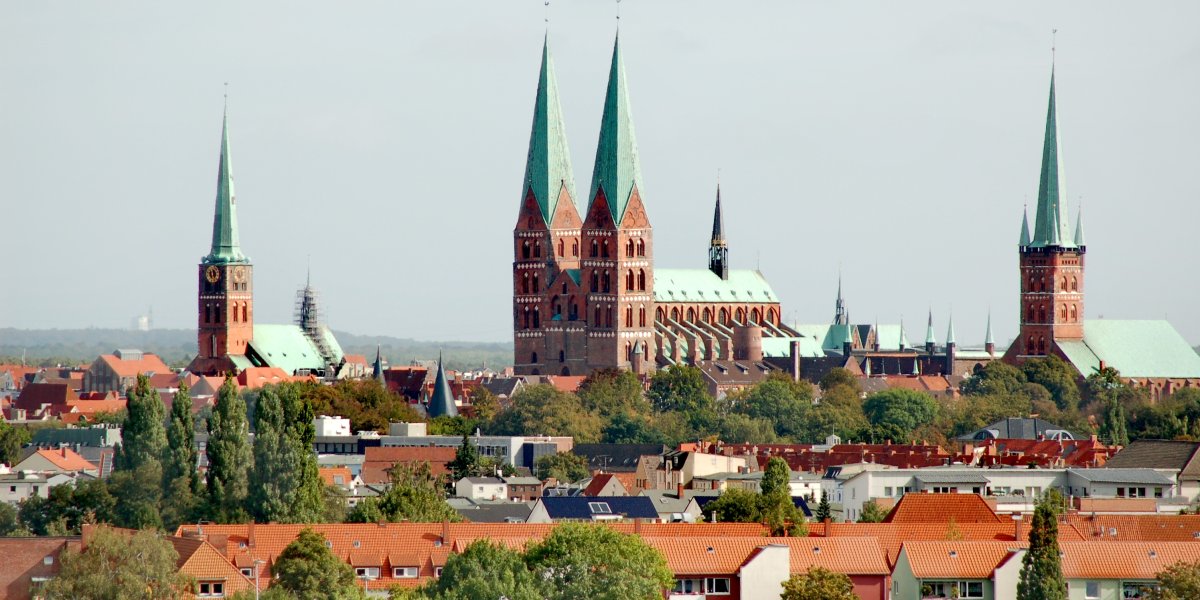
Walk east across the Holstenbrücke, follow Holstenstraße up the gentle rise of the old-town island for five minutes, then cut left onto Schmiedestraße — St. Petri's single Gothic tower stands directly ahead. Take the elevator to the 50-meter outdoor platform (€5): this is the only point in Lübeck where all seven red-brick church steeples line up in one frame, crowned by the twin towers of Marienkirche and the slender copper helm of the Rathaus. Mid-morning sun from the east lifts the whole skyline out of shadow — by afternoon Marienkirche is backlit and the photo goes flat.
Tip: On the platform, head to the northeast corner — from there the composition stacks Marienkirche front-center with the Rathaus turrets behind and the Trave bending away to the Baltic. The platform is tiny; arriving before 11:30 means you'll have it almost empty. Skip the interior exhibition on the ground floor — it's thin and eats into your day.
Open in Google Maps →12:15
Food
Back down the tower elevator, walk three minutes east along Schüsselbuden to Breite Straße — Lübeck's medieval spine. Bäckerei Junge is a Lübeck-born bakery from 1897 that every local grew up on; the counter turns over every three minutes even at noon. Order the Matjes-Fischbrötchen with onion and apple (€4.50) and a Lübecker Franzbrötchen (€1.80), take them the two minutes to the Markt square, and eat standing with a view straight onto the Rathaus arcade.
Tip: Do NOT sit down at the tourist café terraces that line the Markt — they charge triple for the same sandwich with worse fish. If the Matjes is sold out, the Krabbenbrötchen (North Sea shrimp, €7) is the only acceptable substitute — the salmon roll is freezer stock. Pay cash; the card reader breaks at lunch rush.
Open in Google Maps →13:15
Landmark
Ten steps from the bakery you're already in the Markt — the Rathaus with its glazed black-brick facade and wind-hole arcade (circular openings that lightened the gable against Baltic storms) sits on its south edge. Walk the square counter-clockwise, then slip through the northern passage to the Marienkirchhof. St. Mary's 38.5-meter brick vault is the tallest in the world and the template every Hanseatic port copied around the Baltic — the model you will see echoed in Gdańsk, Stralsund, Rostock. The bronze church bells shattered on the floor of the south chapel during the 1942 air raid have been left exactly where they fell, visible through the south window as a silent memorial.
Tip: The iconic twin-tower composition is NOT from the Markt — walk around to Schüsselbuden, the narrow lane along the church's west flank, and aim up from the Mengstraße corner. Early afternoon puts the west façade in direct sun. Circle to the north door to avoid the tour-group clot at the main west entrance; the exterior brickwork detail on the north side is also the least restored.
Open in Google Maps →15:00
Landmark
Cross the Markt north and Breite Straße 89 is one minute away — Café Niederegger, the marzipan house since 1806, the reason Lübeck marzipan is a protected origin. Take a slice of Nuss-Nougat Marzipan Torte (€4.80) upstairs in the mirrored salon overlooking the street, then continue north along Breite Straße. In ten minutes Koberg opens up — a vast medieval square that feels more Flemish than German — and on its north edge stands Heiligen-Geist-Hospital (1286), one of Europe's oldest functioning social buildings, its frescoed entrance chapel visible through the open archway even when the wards are closed. Four minutes further north is the Burgtor, the surviving northern gate of the city wall; loop back south along the quiet Große Burgstraße and down the Obertrave riverside path for the reverse panorama of the spires you photographed this morning.
Tip: At Niederegger, the ground-floor shop sells the same marzipan 30% cheaper than the upstairs café — buy a 200g marzipan loaf (€9) downstairs to take home, and only order one slice and a coffee upstairs for the room. Pitfall warning: AVOID the 'traditional Hanseatic cuisine' restaurants clustered immediately inside the Holstentor along An der Untertrave — they're tourist traps with microwave kitchens targeting day-trippers who don't know any better. Every actual Lübecker eats further east along Breite Straße and An der Obertrave.
Open in Google Maps →19:00
Food
Three minutes south from Koberg on Breite Straße, number 2 sits at the foot of Jakobikirche — Schiffergesellschaft, a sea captains' guild hall in continuous use since 1535 and a restaurant since 1868. Carved wooden ship models hang from the beamed ceiling above long pew-style oak benches where Hanseatic skippers once settled accounts after a Baltic run. Order Labskaus (sailor's hash of corned beef, potato, beet, topped with a fried egg and pickled herring, €18.50) — the one dish you cannot eat convincingly anywhere else in Germany — and Rote Grütze mit Vanillesauce (red-berry pudding, €7.80) for dessert. Average budget: €30–45 with a beer.
Tip: Reserve at least two days ahead — walk-ins after 19:00 rarely get a seat, and the ones you do get are in the modern back room, not the 16th-century front hall. When you book, explicitly request 'die Kapitänsstube' or a bench in the front hall; that's the entire reason you came. The house-only dark beer (Mönkhoff Dunkel) is poured nowhere else in town — order it over any branded lager.
Open in Google Maps →Jump to day
10:00
Landmark
Start at the fountain on Puppenbrücke bridge for the classic postcard composition — twin brick towers leaning toward each other like two tired old friends, the morning sun lighting their southeast faces. Enter the museum right at 10:00 opening so you have the upper chambers — Hanseatic armor, the scale model of 17th-century Lübeck, original cannons — nearly to yourself before the coach tours arrive at 11. The leaning is real, not an illusion: soft marshy ground has pulled the towers askew for 550 years.
Tip: Buy tickets online the night before at die-luebecker-museen.de — the on-site queue hits 30 minutes by 10:30. For the iconic photo, shoot from the west (Puppenbrücke) side between 10:15–10:45 when light rakes across both brick faces; after noon the gate is backlit and grey.
Open in Google Maps →11:45
Landmark
Leave the Holstentor heading east, cross Holstenbrücke over the Trave, and pass the six red-brick Salzspeicher salt warehouses on your left — a 5-minute walk that is already a photo essay. Take the elevator up Petrikirche tower for Lübeck's only 360° rooftop view: seven spires, one red-brick sea, the river wrapping the island like a moat. The church interior is bare whitewash (bombed 1942 and never rebuilt inside), so spend your time above, not below.
Tip: Buy only the tower ticket (€5), skip the combined church ticket — the nave is empty. Exit the viewing platform on the south side for the three-church composition (Marienkirche + Dom + Petrikirche in one frame) that no ground-level photograph can capture.
Open in Google Maps →13:00
Food
Walk 300m northeast through Kolk lane — restored 17th-century merchant houses painted mustard and rose — to the black-glazed brick Rathaus. Duck into the vaulted 15th-century cellar where Lübeck's senators have lunched for 600 years; you are eating underneath the town hall's council chamber. Order Labskaus (corned beef, beetroot, pickled herring, fried egg on top — €15) or the Lübecker Pannfisch with mustard sauce (€17); this is the proper local version you will not find in Hamburg.
Tip: Order a small Schleswig-Holstein Köm schnapps after Labskaus — it's the traditional digestif and locals will nod approvingly. Ignore the tourist photograph menu card near the door; the real house specials are on the handwritten paper insert.
Open in Google Maps →14:30
Religious
Exit the Rathaus and walk 100m north to the green-copper twin towers — you were sitting directly beneath them at lunch. Built 1250–1350, this is the mother church of Brick Gothic: its proportions were copied across the Baltic from Gdańsk to Tallinn, which is why this single church matters more than the cathedral. Afternoon light pours through the south clerestory windows onto the whitewashed nave at exactly this hour — the effect is impossible to get in the morning.
Tip: Go straight to the south tower chapel: the bronze bells that fell and shattered during the Palm Sunday 1942 RAF raid still lie embedded in the stone floor, left as a war memorial — most visitors walk past without noticing. The astronomical clock on the north wall chimes at noon; if you return tomorrow, catch it.
Open in Google Maps →16:15
Food
From Marienkirche's north portal, walk 2 minutes north along Breite Straße to the white-tile facade at number 89 — Niederegger has been making marzipan here since 1806. Take the stairs to the free second-floor Marzipan Salon: twelve life-size marzipan figures narrate Lübeck's history — Barbarossa, Thomas Mann, Willy Brandt — before you descend to the café. Order the Nusstorte (€5.50) with a Melange; the almond paste here is 100% almond, not the cheap 50% sugar-blended version sold everywhere else in Germany.
Tip: Buy the Marzipanbrot loaf (€14) as gifts rather than individual shaped pieces — same quality, half the price per gram. The sealed boxes travel airline baggage fine for 3 weeks; the fresh fruit-filled ones do not — ask for the Urmasse (classic) variety.
Open in Google Maps →19:15
Food
Walk 5 minutes west down Alfstraße — a cobbled lane of 16th-century gabled merchant houses — to number 36, where a small copper kettle hangs over the door. Head down the steps into a medieval vaulted brick cellar, low-lit and loud with locals, where Lübeck's only in-house brewery has poured unfiltered Zwickelbier since the 1980s revival. Order the Schweinshaxe (roast pork knuckle, €18) or the Bauernteller (smoked sausage platter, €16) with a half-liter of the cloudy gold Zwickel.
Tip: Book by 17:00 the same day and ask for a table 'im Keller' not 'im Gastraum' — the upstairs dining room is ordinary, the cellar is the experience. Pitfall warning: avoid any restaurant along Holstenstraße between the gate and the Markt after dark — they are chain-quality kitchens charging Michelin prices to cruise day-trippers who never return.
Open in Google Maps →10:00
Museum
Start at the far north tip of the island, a 15-minute walk up Große Burgstraße from the Markt — you pass through the Burgtor, Lübeck's surviving medieval north gate, on the way. This 2015 museum is the only place in Europe that explains how a league of merchants ran the Baltic for 400 years, built with reconstructed 14th-century Novgorod streets and Bergen wharfs you physically walk through. Arrive right at 10:00 opening so you have the Novgorod scene empty for the photographs — by noon school groups fill it.
Tip: Skip the audio guide — the museum is designed as a linear walk-through narrative, each room a new century. The combined ticket with the adjacent Burgkloster monastery (€16) is worth €2 extra; most visitors miss the 13th-century cloister entirely and it's the quietest medieval space in the city.
Open in Google Maps →12:15
Religious
Walk 3 minutes south along Große Burgstraße to Koberg square; the hospital's five-gabled red-brick facade closes the square like a stage set. Founded in 1286, this is one of the oldest surviving social welfare buildings in the world — pensioners actually lived in the tiny wooden cells at the rear until 1970. Enter the main hall to see the painted Gothic ceiling (14th-century star and vine frescoes restored in the 1990s); it is free and almost always empty before noon.
Tip: Walk past the front hall to the rear — the Kabäuschen (tiny cells, €1 donation) where the elderly lived is the real highlight most tourists skip. Each 4m² cabin has the original bed, chair, and Bible on the shelf, frozen from the day the last resident moved out in 1970.
Open in Google Maps →13:15
Food
Exit the hospital, turn right, walk 30 seconds — the restaurant occupies the vaulted brick cellar directly across Koberg square. As the name promises, everything revolves around potato: order the Lübecker Nationalgericht (pork with prunes, pears, green beans, potatoes — €14), a dish you will not find in any other German city. Share a long oak table with locals on lunch break; this is the opposite of tourist food.
Tip: Lunch reservations are unnecessary but be there before 13:30 or the Nationalgericht sells out — they cook a limited batch daily. The Himmel und Erde (€12, potato-apple-blood-sausage) is the second must-order if you are two; ask to share.
Open in Google Maps →14:45
Religious
Walk south from Koberg through the full length of the old town — about 15 minutes down Königstraße, past Thomas Mann's school (Katharineum) and into the quieter, residential southern quarter. The Dom is older than Marienkirche (founded 1173 by Henry the Lion) but smaller and humbler, which is exactly the point — you feel the weight of eight centuries without the drama. Enter through the north portal and walk straight toward Bernt Notke's 17-meter Triumphal Cross (1477), one of medieval Europe's greatest wood carvings.
Tip: Sit in the choir between 15:15 and 15:45 — this is when southern stained glass throws red and blue across the sandstone pillars, the one window of pure color in an otherwise austere nave. Exit through the south door into the Domgarten for a little-known viewpoint of the cathedral towers reflected in the Mühlenteich pond.
Open in Google Maps →16:00
Museum
Walk 15 minutes north-northeast through Hüxstraße — Lübeck's prettiest shopping lane, antique bookshops and independent boutiques all the way — to Glockengießerstraße 21. This small museum occupies the actual house where Nobel laureate Günter Grass wrote and sketched; his ink drawings hang beside the typed pages of The Tin Drum. Lübeck produced three Nobel literature winners (Mann, Grass, Brandt got Peace) — this is the one museum that makes that lineage feel like a single conversation.
Tip: Do not skip the rear garden — the bronze 'Oskar with tin drum' sculpture stands in the courtyard, and the glass pavilion displays Grass's original lithographs in rotation. Captions are bilingual German/English; the free audio guide adds 20 minutes but is genuinely good, unlike most museum audio.
Open in Google Maps →19:00
Food
Walk 5 minutes west down Glockengießerstraße and Breite Straße to number 2 — you can already see the ornate stepped gable from a block away. Since 1535, this has been the sailors' guild hall of Lübeck; dine under wooden ship models hanging from smoke-blackened oak beams, at long carved benches where Hanseatic captains once signed contracts. Order the Finkenwerder Scholle (whole pan-fried plaice with bacon and North Sea prawns — €34), the house signature no other restaurant in Germany makes the same way.
Tip: Reserve at least 48 hours ahead via schiffergesellschaft.com and request 'Kapitänstisch' — the long communal captains' table under the chandelier is the room's best seat, not the private side alcoves. Pitfall warning: skip the 'Lübecker Stadtrundfahrt' horse-carriage tours waiting outside — €45 for 25 minutes of tourist-trap narration; the old town is 2km across and walking it yourself after dinner, lit by the bronze streetlamps along the Trave, is the actual memory you came for.
Open in Google Maps →
Trip builder
Plan this trip around Lübeck
Turn this guide into a bookable rail itinerary with FlipEarth.
Keep exploring
Related cities
More in the same country
FAQ
Frequently asked questions
How many days do you need in Lübeck?
Most travelers enjoy Lübeck in 1 days, with enough time for headline sights and a slower meal or museum stop.
What's the best time to visit Lübeck?
The easiest season for most travelers is May-Sep, especially if you want good weather and manageable crowds.
What's the daily budget for Lübeck?
A practical starting point is about €90 per person per day before hotels, then adjust based on museums, dining, and transport.
What are the must-see attractions in Lübeck?
A good first shortlist for Lübeck includes Holstentor & Salzspeicher, St. Petri Viewing Platform, Marienkirche & Rathaus.