City Guide
Lodz
Poland · Best time to visit: May-Sep.
Day-by-day plan
Choose your pace
Trip length
09:00
Landmark
Begin at opening — Izrael Poznański's 19th-century textile empire is now a 27-acre red-brick city, and the soft eastern light at 9am makes the towering chimneys and Neo-Renaissance Palace facade glow before the mall crowds arrive. Walk the full length of the main rynek (square), then circle around the back where the original raw factory walls — uncleaned, unrestored — show what industrial Łódź actually looked like. This is your one-shot overview of what made Łódź the Manchester of the East.
Tip: Skip the main front entrance and walk in through the gate on ul. Drewnowska — you come face-to-face with the Poznański Palace facade before the courtyard even opens up. The classic shot of the bronze 'Dziewczynka z Manufaktury' (Manufaktura Girl) statue is from the northwest corner with the tall brick chimney framed behind her; before 10am the square is nearly empty.
Open in Google Maps →11:00
Neighborhood
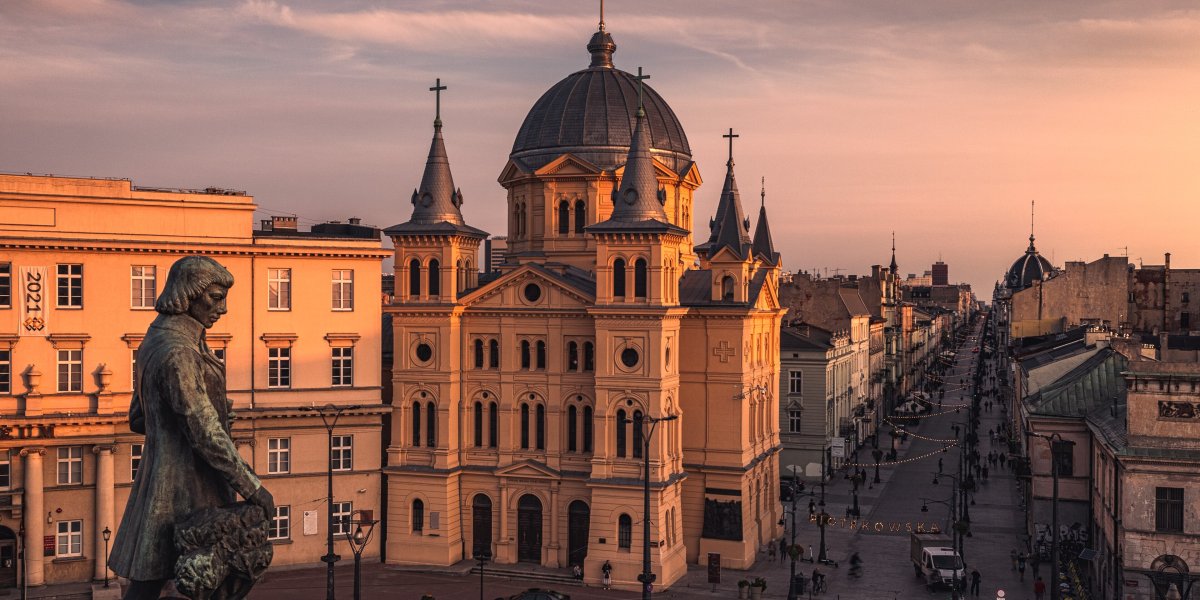
Exit Manufaktura through the south gate and walk down ul. Ogrodowa for 8 minutes to Plac Wolności — Łódź's neoclassical north pole with the Kościuszko monument — then plunge into Piotrkowska, one of Europe's longest pedestrian streets at 4.2 km. Late-morning sun catches the upper-floor caryatids and Secesja stucco that 90% of visitors never look up to see. Stop for selfies with the bronze 'Tuwim's Bench' at #104, Artur Rubinstein at his piano outside #78, and the brass Łódź Walk of Fame stars beneath your feet.
Tip: The famous murals are NOT on Piotrkowska itself — they sit one block east and west, around ul. Roosevelta and ul. Traugutta. Most of all, do not miss Pasaż Róży at Piotrkowska 3 — a small unmarked passage opens into a courtyard covered floor-to-roof in mirror mosaic; it is the single most photographed corner of the city and easy to walk past without noticing.
Open in Google Maps →13:00
Food
You are already on Piotrkowska — duck through the unassuming gateway at #138/140 into OFF Piotrkowska, a restored factory courtyard packed with street-food kiosks, craft beer windows, design studios and the city's young creative class. Order pierogi ruskie (potato-cheese, ~25 PLN) at Pierogarnia and a bowl of żurek (rye sour soup served in bread, ~18 PLN) at the soup window, then eat outside at the long picnic tables under the brick facade. Quick, cheap, and where actual locals come for lunch — budget 30-45 PLN per person.
Tip: Walk past the first kiosk you see at the entrance — it is the tourist trap. Push deeper into the back courtyard where the Polish-language counters are; the lines move faster, prices drop about 20%, and the żurek there is the real version (with sausage and egg, not the watered-down one). Bring some cash — several windows have a 5 PLN card minimum surcharge.
Open in Google Maps →14:30
Neighborhood
Exit OFF Piotrkowska heading east on ul. Tymienieckiego — a 25-minute walk past the abandoned Scheibler family villa brings you to Księży Młyn (Priest's Mill), Karol Scheibler's self-contained textile empire of worker housing, schools, a fire station, and the colossal red-brick spinning mill. Mid-afternoon is the time: low western light turns the parallel famułas — 18 identical four-story workers' tenements — into a cinematic vanishing-point shot. Walk the entire row of cobblestone street to grasp the scale of 19th-century industrial paternalism.
Tip: The signature photo is from the eastern end of ul. Księży Młyn looking west — stand in the middle of the cobblestone (almost no traffic) and shoot the receding tenement perspective with one figure walking ahead. The buildings are real apartments today, not a museum; do not peer into ground-floor windows, and stay out of the inner courtyards marked 'teren prywatny'.
Open in Google Maps →17:00
Landmark
Head northwest on ul. Targowa for an 18-minute walk to EC1 — the city's first power plant (1907), now a science-and-film hub sitting on the edge of the brand-new Łódź Fabryczna railway plaza. You are not going inside; the magic is the exterior — a cathedral of riveted steel and glazed brick that once electrified the entire textile city. By 5pm the warm interior lights begin to glow through the tall cathedral windows, and the contrast with the ultra-modern glass dome of the new station behind it is the quietest cinematic moment of your day.
Tip: Walk all the way around to the southern face — the one looking onto the train station plaza — for the dramatic shot: the dark silhouette of the 1907 power plant rising against the futuristic curved glass roof of Łódź Fabryczna. Stay until 5:30pm in summer for blue hour, when the brick turns deep cobalt and the windows go gold.
Open in Google Maps →19:30
Food
From EC1, walk west on ul. Narutowicza for 20 minutes, crossing Piotrkowska, to ul. 6 Sierpnia 2/4 — Anatewka, Łódź's iconic Polish-Jewish restaurant since 1992 and the most evocative way to close a day in this city. Candles, live klezmer violin, lace tablecloths, and the pre-war Jewish heritage of Łódź served on a plate. Order the Anatewka-style carp in jelly (~45 PLN), goose-stuffed pierogi with cranberry (~38 PLN), and finish with szarlotka apple cake (~22 PLN); budget 100-150 PLN per person.
Tip: Reserve by phone the morning of (they answer in English) — the online widget often shows fully booked when tables are actually free. Pitfall warning: avoid the Polish 'tourist' restaurants on lower Piotrkowska with picture menus and tour-bus signage out front — they double prices for half the soul. And around Łódź Fabryczna station after dark, brush off anyone offering 'city tour' or 'taxi help' on the plaza; they are unlicensed and the meter games are well-rehearsed.
Open in Google Maps →Jump to day
09:00
Landmark
Łódź doesn't open with a postcard skyline — it opens with a street. Begin at Plac Wolności with its neoclassical town hall and Kościuszko monument, then walk south along Piotrkowska, Europe's longest pedestrian boulevard at 4.2 km. Bronze sculptures wait in the pavement — Tuwim's bench at no. 104, Rubinstein's piano at no. 78, Reymont's trunk near no. 137 — and the brass stars under your feet honor Polański, Wajda and Kieślowski, all alumni of the Łódź Film School just around the corner.
Tip: Photograph Tuwim's bench at no. 104 before 09:30 — by 11:00 every tour group is rubbing his nose for luck and the bronze is permanently smeared. Don't miss the unmarked passage at no. 37: a hidden Art Nouveau courtyard most visitors walk straight past.
Open in Google Maps →11:00
Neighborhood
Continue south down Piotrkowska — the brass stars keep going under your feet — and at no. 138/140 slip through the unassuming gateway into OFF Piotrkowska. The abandoned Ramisch cotton mill that local artists squatted in 2011 is now Łódź's coolest creative quarter: brick walls four stories high are wrapped in murals, and courtyards hide concept stores, vinyl shops and indie tattoo studios above food trucks and craft-beer bars.
Tip: Climb the iron staircase to the upper galleries — the murals read better from above and the courtyard photographs best with the long shadow of the chimney across it. Sundays before noon are dead; arriving 11:00–13:00 catches the stalls open before the lunch crowd lands.
Open in Google Maps →13:00
Food
You don't need to leave OFF Piotrkowska — Drukarnia hides in the same brick courtyard. A wine-bar-bistro where Łódź creatives lunch under exposed iron beams and recycled printing-press lamps. Order żurek (sour rye soup, 22 zł) served in a hollowed-out bread loaf and a plate of pierogi ruskie (potato-cheese dumplings, 28 zł), and wash it down with a glass of Riesling from Dolny Śląsk — yes, Poland makes wine now, and the whites will surprise you.
Tip: Skip the laminated English menu — ask for the daily lunch set (zestaw obiadowy, ~35 zł), which is what every local at the next table is eating. The brick-vaulted indoor seating stays cool in summer; the courtyard tables get rough afternoon sun after 13:30.
Open in Google Maps →14:30
Landmark
From OFF Piotrkowska take tram no. 12 four stops north (10 minutes) — or walk 25 minutes up Zachodnia past Art Nouveau tenements — and you arrive at Manufaktura: Izrael Poznański's 19th-century textile empire, 27 hectares of red brick that once employed 15,000 weavers. Today it's Europe's largest urban regeneration project. The original spinning hall is now a hotel, the weaving sheds shelter museums and shops, and the rynek between them hosts summer concerts and winter ice rinks.
Tip: Enter through the original brick gatehouse on ul. Karskiego — not the modern mall entrance on Drewnowska — for the full Manufaktura wow-moment as the rynek opens up in front of you. The dancing fountains in the square run April–September only; on summer evenings kids are playing in them by 16:00.
Open in Google Maps →16:30
Museum
Cross the Manufaktura rynek to the western edge — five minutes from where you just stood — to MS2, set inside the old weaving hall. It holds the world's first permanent collection of avant-garde art, founded by Władysław Strzemiński and Katarzyna Kobro in 1931, alongside rotating contemporary Polish video and installation work. The hanging system was designed by Daniel Libeskind.
Tip: MS2 closes at 18:00 (Tue–Sun, closed Mondays) — buy your ticket online to skip the desk queue and head straight to the second-floor permanent collection. If pressed for time, skip the temporary exhibits on level 1; the Strzemiński/Kobro rooms are the reason to come.
Open in Google Maps →19:30
Food
From MS2 walk south down ul. 6 Sierpnia for ten minutes — past the freshly renovated 19th-century tenements lit by gold sodium lamps — to Anatewka, Łódź's beloved Jewish restaurant, named for the village in Fiddler on the Roof. The interior is half museum: oil lamps, sepia photographs, klezmer violinists wandering between tables most evenings. Order the gęś po żydowsku (Jewish-style goose, 79 zł) and a side of cymes (carrot-prune stew, 28 zł); the kreplach soup (45 zł) is the comfort dish locals come back for week after week.
Tip: Reserve at least 24 hours ahead — Saturday nights book a week out. AVOID the lookalike 'Jewish quarter' restaurants further down 6 Sierpnia that copy Anatewka's formula at double the price; one well-known imposter charges €45 for goose and serves it visibly pre-frozen. The wandering musicians expect 5–10 zł per table — keep small notes ready.
Open in Google Maps →09:00
Neighborhood
Tram no. 12 from the city centre drops you at Tymienieckiego in fifteen minutes; then walk three minutes east into a different century. Karol Scheibler's Księży Młyn — 'Priest's Mill' — is a complete self-contained worker town built in the 1870s, when his cotton empire eclipsed Poznański's. The morning sun strikes the long red-brick terraces of family houses (famuły) at a perfect raking angle, windows reflecting orange off soot-darkened bricks. Walk down ul. Księży Młyn between the famuły past the gas plant, firehouse and workers' school — every building still Scheibler's, all still inhabited.
Tip: Arrive by 09:00 — these are still residents' homes and the bus tours don't roll in until 10:30. The single best photo angle is the cobblestone lane between the famuły looking west toward the chimney; shoot from a low crouch to compress the perspective and stack the brick rooflines.
Open in Google Maps →11:00
Museum
Five minutes south of the famuły, through the old factory garden, brings you to a cream-stuccoed neo-Renaissance villa — the home Scheibler built for his daughter Matylda when she married Edward Herbst in 1876. Inside is the most complete preserved 19th-century industrialist's residence in Poland: original silk wall coverings, the children's nursery untouched since 1900, the dining room set as for tonight's family supper. It runs as a branch of the Łódź Museum of Art.
Tip: Free admission on Tuesdays — but the upstairs bedrooms close at 16:00 sharp, so the morning slot is the right slot. Don't miss the small gallery in the orangery: a Lucas Cranach Madonna hangs almost casually behind a single velvet rope.
Open in Google Maps →13:00
Food
Walk west out of Księży Młyn along ul. Tymienieckiego for fifteen minutes, threading past Scheibler's old tannery and the disused factory railway tracks, to find Galicja — a wood-paneled traditional Polish restaurant the local office crowd has lunched at for two decades. Order pierogi z mięsem (meat dumplings, 26 zł) and bigos staropolski (hunter's stew with three meats and sauerkraut, 32 zł); both arrive heavy enough that you'll happily skip afternoon coffee.
Tip: The weekday lunch set (zupa + danie + kompot, ~38 zł) costs roughly half the dinner price and arrives in fifteen minutes flat. Tables by the front window catch the early-afternoon sun; ask for 'stolik przy oknie' when they seat you.
Open in Google Maps →14:30
Museum
Two minutes' walk from Galicja lands you at EC1 — Łódź's first power plant, built in 1907, now Poland's largest interactive science centre. Three former generator halls house the Centre of Science and Technology, a planetarium under the old cooling tower, and a film centre dedicated to David Lynch (yes, that Lynch — he taught at the Łódź Film School and openly calls the city his spiritual home). The original turbines and copper switchgear stay in place, woven into the exhibits.
Tip: Buy the combined Science Centre + Planetarium ticket (45 zł) at the desk — it's roughly 35% cheaper than separate entries. The planetarium runs hourly; the 16:00 Polish-language session has English subtitles on small screens mounted above each seat.
Open in Google Maps →16:45
Religious
Five minutes' walk south of EC1 brings you to the Archcathedral Basilica of St. Stanislaus Kostka, its spire rising 104 m over the city — the third-tallest church in Poland and a Gothic Revival exclamation mark Łódź's industrial barons paid for in 1912 to prove they could build cathedrals as well as factories. The afternoon light through the southern stained glass at 17:00 paints the nave amber, perfect timing for arrival.
Tip: Climb the south tower (12 zł, last entry 17:30 in summer) for the only high view over Łódź's red-brick skyline — there are no other towers in this flat city, so this perspective doesn't exist anywhere else. Wear non-slip soles; the spiral stairs are smooth granite.
Open in Google Maps →19:00
Food
Walk eight minutes north up Piotrkowska from the cathedral; by now the boulevard is strung with warm bulbs and the cafés have moved chairs onto the cobbles. Quale at no. 87 is Łódź's most reliable upscale dinner — contemporary Italian-Polish, where the wood-fired bottarga pasta (62 zł) and slow-braised veal cheek with pearl barley (89 zł) are the dishes regulars never skip. The brick-vaulted basement room is the one to ask for.
Tip: Reserve the lower vaulted room when booking ('sala dolna') — the upstairs tables sit uncomfortably close to the kitchen pass. AVOID the restaurants on south Piotrkowska that display laminated 'tourist menus' in four languages with photo-printed dishes; most are franchise traps charging Warsaw prices for frozen pierogi served by uninterested staff.
Open in Google Maps →
Trip builder
Plan this trip around Lodz
Turn this guide into a bookable rail itinerary with FlipEarth.
Keep exploring
Related cities
More in the same country
FAQ
Frequently asked questions
How many days do you need in Lodz?
Most travelers enjoy Lodz in 1 days, with enough time for headline sights and a slower meal or museum stop.
What's the best time to visit Lodz?
The easiest season for most travelers is May-Sep, especially if you want good weather and manageable crowds.
What's the daily budget for Lodz?
A practical starting point is about €60 per person per day before hotels, then adjust based on museums, dining, and transport.
What are the must-see attractions in Lodz?
A good first shortlist for Lodz includes Manufaktura, EC1 Łódź.