City Guide
Hydra
Greece · Best time to visit: May-Jun, Sep-Oct.
Day-by-day plan
Choose your pace
Trip length
09:00
Landmark
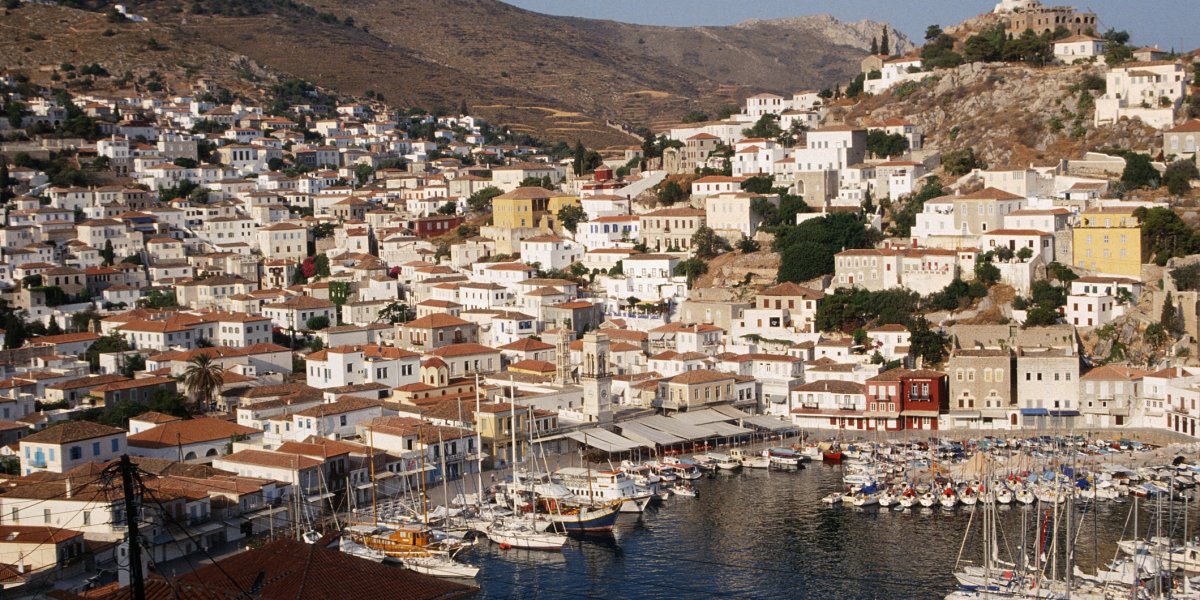
Step off the Flying Dolphin onto the same marble quay 18th-century shipping captains paced — no cabs, no shuttles, just the curved harbor and donkeys waiting for luggage. Walk the port counterclockwise past the whitewashed cannons that once defended Hydra against the Ottoman fleet, then climb the eastern breakwater for the photo every Hydra postcard is built on: the entire stone amphitheatre town in one frame. The 09:00–10:00 light rakes gold across the western mansions and the cruise tenders haven't unloaded yet.
Tip: Walk to the very tip of the eastern jetty (where the Piraeus boat docks) and turn around — that's the one spot where the cannons line up perfectly with the captains' mansions rising behind them. The big day-cruise tenders begin unloading around 10:30, so shoot before then; afterwards the harbor doubles in noise.
Open in Google Maps →10:30
Religious
From the harbor, climb the stepped alley behind the western quay for two minutes — the pebble-mosaic courtyard of the Monastery of the Dormition of the Virgin Mary opens up beneath a slender stone clocktower that is the silhouette every Hydriot captain saw on his way home. Keep climbing north into Kala Pigadia ('Good Wells'), the upper-village neighborhood where Leonard Cohen bought his house in 1960 for $1,500. His blue-shuttered home still sits at the end of a narrow lane — a private residence, not a museum. The mid-morning shadows in these alleys are the softest light you'll find all day.
Tip: Leonard Cohen's house is at the corner where Donkey Lane (Anemoiti) meets Kala Pigadia — look for the bougainvillea and the unmarked blue shutters; no plaque, by the family's request. Be respectful, the house is still lived in. The two stone wells that give the neighborhood its name are 30 m further up — locals fill bottles there in summer.
Open in Google Maps →12:45
Food
Descend the alleys back toward the harbor for 5 minutes — Flora's is tucked into a tiny stone lane behind the Monastery, marked only by the smell of butter and the row of cats outside. Order two amygdalota (almond cakes, €2.50 each), a hot spanakopita (€4), and a Greek coffee (€2.50). Flora is third-generation; her grandmother started baking these for the captains' wives. There are no tables — sit on the stone step outside with the locals. It is the most Hydra lunch you can have, and you'll be back on the cliff path in 45 minutes.
Tip: The amygdalota come wrapped in waxed paper at the counter — buy two extra for the boat ride back to Piraeus, they keep three days. Cash only, no card. Flora closes 14:00–17:00 for siesta, so don't push lunch past 13:30 or you'll find a shuttered door.
Open in Google Maps →14:00
Neighborhood
Walk west along the harbor for five minutes — once the marble quay ends, the coastal path turns into a stone donkey-track hugging the sea. After 200 m you reach Spilia, the rocky bathing platform with iron ladders bolted into the cliff; another five minutes and you're at Hydronetta, the cliff-bar whose café tables are the most photographed in the Saronic Gulf. Keep walking the path for fifteen more minutes — cypresses, prickly pear, the open Aegean on your left — until the trail opens into Kamini, a still-working fishing harbor of painted caïques and a stone breakwater built donkey-load by donkey-load in the 1800s.
Tip: The cliff path narrows to single-file in two spots — when you meet a donkey train (and you will), step against the inner wall; the animals have right of way and they know the path better than you do. At 14:30 the sun is overhead, so shoot Hydronetta looking down at the swimmers from the upper terrace rather than at the water itself — the contrast washes out from the side.
Open in Google Maps →16:00
Landmark
From Kamini's tiny harbor, keep following the coastal path west for fifteen more minutes — you'll cross a single-arched 18th-century stone bridge built for the donkeys carrying salt, and drop into Vlychos, a quiet pebble cove where Hydriots come when the main port turns into a circus. The water is the deepest blue you'll see all day; bring goggles. Swim, dry on the warm pebbles, and watch the late-afternoon light turn the cliffs of Dokos island orange across the channel around 17:30. The 15-minute walk back to Kamini for dinner is golden hour itself, with the sun setting straight down the path ahead of you.
Tip: Marina's is the older, quieter of Vlychos's two beach clubs — sunbeds €10 a pair, closer to the stone bridge and shaded by tamarisk trees. The pebbles are large and oven-hot by 16:00, so water shoes save your feet. CRITICAL for day-trippers: the last Flying Dolphin back to Piraeus is usually 17:30 in winter, 19:00–20:30 in summer — check the schedule on your phone before you sit down, the WiFi at Vlychos is thin.
Open in Google Maps →19:30
Food
Walk back along the cliff path to Kamini — fifteen minutes east, the sun setting directly ahead of you into Dokos. Kodylenia's sits on the rocks above Kamini's tiny harbor, the terrace tables stepping down toward the waves; a family taverna run by the same Kodylenia line for three generations. Order the grilled octopus (€18, charred just so on the wood grill), the homemade taramasalata (€7), and the astakomakaronada — lobster spaghetti (€90/kg, the splurge dish of the Argo-Saronic) — with a half-bottle of crisp Assyrtiko. The last light hits the white tablecloths at 20:15. This is the dinner you came to Greece for.
Tip: Reserve a sunset table the same morning by phone (+30 22980 53520) — the front row goes by 17:00. The lobster is sold live by weight; ask the waiter to bring it to the table and confirm the price before they cook it, not after. PITFALL WARNING: at the main port, avoid every harbor-front taverna with a photo menu, English-only barker outside, or 'tourist menu' chalkboard — they overcharge by 40% and the fish is frozen. The three local picks are Kodylenia's in Kamini (this one), Gitoniko (Christina's) up the alleys behind the harbor, and Techne near the Monastery; everything else on the waterfront is a trap.
Open in Google Maps →
Trip builder
Plan this trip around Hydra
Turn this guide into a bookable rail itinerary with FlipEarth.
Keep exploring
Related cities
More in the same country
FAQ
Frequently asked questions
How many days do you need in Hydra?
Most travelers enjoy Hydra in 1 days, with enough time for headline sights and a slower meal or museum stop.
What's the best time to visit Hydra?
The easiest season for most travelers is May-Jun, Sep-Oct, especially if you want good weather and manageable crowds.
What's the daily budget for Hydra?
A practical starting point is about €120 per person per day before hotels, then adjust based on museums, dining, and transport.
What are the must-see attractions in Hydra?
A good first shortlist for Hydra includes Hydra Harbor & Captains' Cannons, Vlychos Beach & the Old Stone Bridge.