City Guide
Venice
Italy · Best time to visit: Apr-Jun, Sep-Oct.
Day-by-day plan
Choose your pace
Reisedauer
08:30
Landmark
Take Vaporetto Line 1 from Ferrovia — the 35-minute ride down the Grand Canal past crumbling palazzi is Venice's greatest overture, delivering you to the San Marco Vallaresso stop well before the cruise-ship hordes descend around 10:00. At 8:30 the piazza is nearly deserted: morning sun ignites the Basilica's golden mosaics, the Campanile's shadow stretches like a sundial across the marble, and the only sound is your own footsteps echoing off the Procuratie arcades. Walk the full perimeter — the Doge's Palace colonnade, the astronomical Clock Tower where two bronze Moors have been striking the bell since 1499, and the waterfront columns framing your first glimpse of San Giorgio Maggiore floating across the basin.
Tip: Buy a 24-hour vaporetto pass (€25) at the Ferrovia ticket machine before boarding — single rides are €9.50 each and you will need at least two today. Stand at the center of the square facing the Basilica at 8:45 for the money shot: the east-facing facade catches full morning sun, turning the gold mosaics incandescent, and at this hour nobody will be in your frame.
Open in Google Maps →10:15
Landmark
Exit the Piazza through the archway beside the Doge's Palace and turn left along the waterfront — in two minutes you reach Ponte della Paglia, the small stone bridge with the only unobstructed view of the Bridge of Sighs framed between the palace walls. This enclosed white limestone passage once carried prisoners from the interrogation chambers to the cells across the canal; legend says its name comes from the sighs of the condemned catching a last glimpse of the lagoon through the stone-latticed windows. After your photos, continue east along Riva degli Schiavoni, the wide waterfront promenade with sweeping views of San Giorgio Maggiore island — this sunlit stretch is a Venice highlight most visitors rush past.
Tip: Shoot from the left side of Ponte della Paglia (facing the bridge) in the morning — light falls on the western face without harsh shadows. Arrive by 10:30 at the latest; after that, cruise-ship passengers pack the bridge shoulder-to-shoulder with selfie sticks and you will not get a clean frame.
Open in Google Maps →12:15
Food
From Riva degli Schiavoni, plunge into the narrow calli heading northwest — this 60-minute wander through Venice's labyrinth of hidden campos, footbridges, and dead-end alleys is the most magical stretch of the day, and getting slightly lost is the whole point (follow yellow signs for 'Rialto' when you want to resurface). All'Arco is a standing-room-only cicchetti bar barely bigger than a closet, wedged beside the Rialto fish market — locals elbow in for crostini piled with baccalà mantecato, silky creamed salt cod on bread (€2.50), and sarde in saor, sweet-sour sardines with pine nuts and onions (€2.50). Order five or six pieces, a glass of house white (€3), and eat standing at the counter like a Venetian — budget €12–18 per person.
Tip: Arrive before 12:30 — the best cicchetti sell out fast and All'Arco closes when the food is gone, usually by 14:30. Point at what looks good; the owners are fast and friendly, no Italian needed. Closed Sundays.
Open in Google Maps →13:30
Landmark
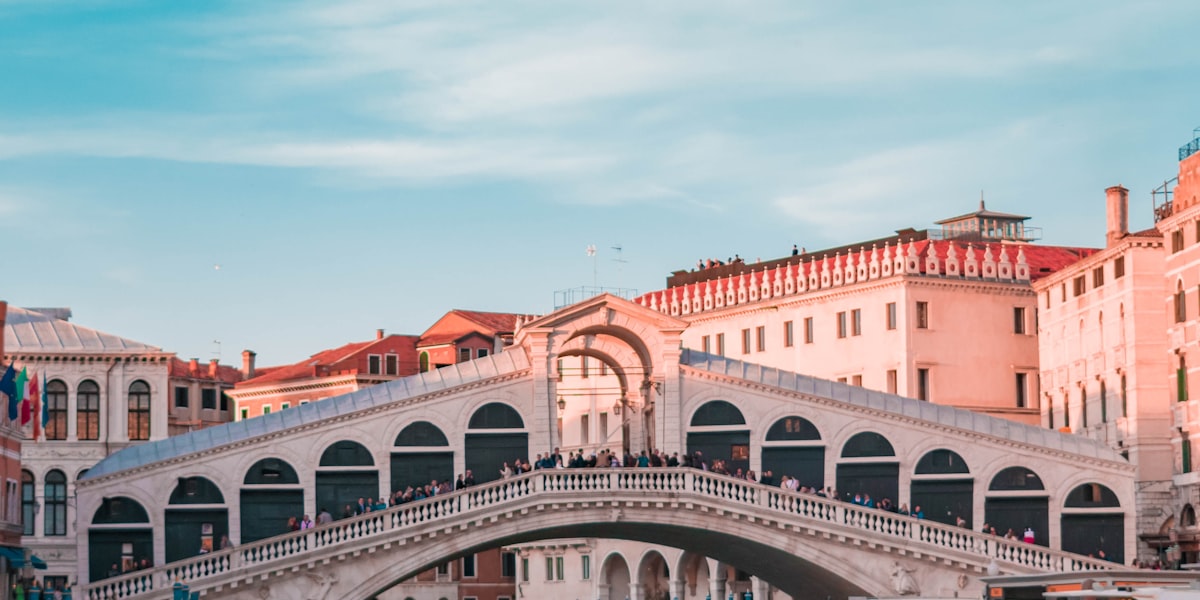
Step out of All'Arco and the bridge is a 2-minute walk through the thinning market stalls — you will see the crowd thickening before you see the stone. The Ponte di Rialto has spanned the Grand Canal at its narrowest point since 1591, and climbing to its apex delivers the view that launched a thousand postcards: gondolas gliding below, water taxis carving white wakes, and the canal stretching north in a gentle S-curve lined with Renaissance palazzi in faded ochre and terracotta. Cross to the San Marco side and descend to the fondamenta along Riva del Carbon for the classic postcard angle — the full white stone arch reflected in the green water with the canal receding behind it.
Tip: The best photograph is from Riva del Carbon on the San Marco side, about 50 meters east of the bridge — you capture the full arch with the Grand Canal behind it. For a panoramic rooftop view, walk into T Fondaco dei Tedeschi (the former German trading house next to the bridge, now a luxury department store) and take the escalators to the top-floor terrace — it is free, but you must book a 15-minute slot at the ground-floor desk or online.
Open in Google Maps →15:30
Religious
From Rialto walk west through the quieter San Polo alleys, cross the wooden Ponte dell'Accademia — pause here for the Grand Canal's most painterly panorama — then follow the Dorsoduro fondamenta south for 20 minutes past neighborhood bacari and laundry strung between buildings; this hour-long stroll through residential Venice is the antidote to the tourist crush you left behind. The Salute's twin baroque domes rise at the very tip of Dorsoduro where the Grand Canal pours into the lagoon — Baldassare Longhena designed it in 1631 as Venice's votive offering to end the plague, and its white Istrian stone catches afternoon light like a beacon. Sit on the broad steps facing the water: to your left the Campanile and Doge's Palace you stood under this morning, straight ahead the island of San Giorgio Maggiore, and below you the endless crossing of vaporetti and gondolas in a choreography unchanged for centuries.
Tip: Late afternoon light between 15:00 and 17:00 hits the canal-facing facade and turns the Istrian stone warm gold — this is the exact angle Canaletto painted and Turner watercolored, and it photographs best from the steps looking northeast with the Grand Canal traffic in the foreground. The church interior is free and nearly empty if you want a quick look (open 9:00–12:00 and 15:00–17:30 daily).
Open in Google Maps →19:00
Food
Walk west from the Salute along Fondamenta delle Zattere, the long sun-drenched promenade facing Giudecca island — stop at Gelateria Nico halfway for their legendary gianduiotto, a brick of hazelnut-chocolate gelato drowned in whipped cream (€5, a Venetian ritual since 1935), and let the sky turn pink over the water. Riviera sits right on the Zattere with a terrace over the Giudecca Canal, serving refined Venetian seafood that justifies every step of the walk: the spaghetti alle vongole veraci (€20) is textbook — briny, garlicky, laced with white wine — and the frittura mista of lagoon fish (€24) arrives shatteringly crisp. Book a terrace table facing west for sunset; budget €45–55 per person with a glass of wine.
Tip: Reserve by phone at least two days ahead and request the canal-side terrace — walk-ins at sunset are nearly impossible in season. If full, Lineadombra (5 minutes back toward Salute, floating pontoon terrace over the canal) is an excellent backup at a similar price. One final warning: avoid any restaurant between San Marco and Rialto with laminated photo menus, outdoor hawkers, or a 'tourist menu' sign — you will pay €25 for microwaved seafood and regret every bite.
Open in Google Maps →Zu Tag springen
09:00
Landmark
Cross the Piazzetta from the waterfront and enter the square while it is still half-empty — few moments in travel match the first sight of the Doge's Palace colonnade catching the morning sun. This was the nerve center of a maritime empire that lasted a thousand years: gilded council chambers, Veronese and Tintoretto ceilings, and the infamous Bridge of Sighs connecting the palace to its prison cells. The scale of the Grand Council Chamber alone — the largest room in Europe without internal supports — will recalibrate your sense of Venetian ambition.
Tip: Book the 9:00 timed-entry ticket online at least 3 days ahead (€30). Enter through the waterfront entrance on the Molo — shorter queue than the Piazzetta side. The Bridge of Sighs passageway is on the upper floor near the prison cells; most visitors miss it by turning back too early. Give the armoury room a quick look — the swords and ceremonial halberds are eerily beautiful.
Open in Google Maps →10:45
Religious
Step out of the Doge's Palace, turn left, and the Basilica entrance is a 2-minute walk directly across the Piazzetta. At mid-morning the sun is high enough to ignite 8,500 square meters of gold mosaic ceilings from within — the tessera glow rather than glare, and the effect is closer to standing inside a jewel than a building. The floor undulates like a frozen sea, warped by centuries of subsidence, adding to the sensation that this church belongs to no fixed era.
Tip: Book the €3 skip-the-line reservation on venetoinside.com — without it, expect a 45-90 minute queue. The Pala d'Oro altarpiece (€5 extra) behind the main altar is the single most precious piece of medieval goldwork in Europe — do not skip it. No large bags allowed; free bag drop is at Ateneo San Basso, 1 minute left of the entrance. The upstairs museum (€7) gives terrace access overlooking the Piazza and a close-up of the bronze horses.
Open in Google Maps →12:00
Food
Walk west from San Marco through narrow calli toward the Accademia Bridge — a 12-minute stroll crossing small bridges where gondolas rest under striped poles and shuttered windows lean over the canals. This standing-room cicchetti bar on Fondamenta Nani has poured wine to Dorsoduro locals since 1944. Press up to the glass counter and point — the crostini are assembled fresh all morning, and the baccalà mantecato here is the benchmark against which all others in Venice are measured.
Tip: Arrive by 12:00 sharp — by 12:30 the local lunch crowd descends and the best crostini vanish. Must-order: baccalà mantecato crostino (€2.50) and sarde in saor (€2.50); a glass of house white is €2. Stand at the canal-side counter for one of the best cheap-lunch views in Venice — the gondola boatyard across the water. Cash only.
Open in Google Maps →13:00
Museum
Walk 2 minutes east along the fondamenta — the museum entrance is directly beside the Accademia Bridge. Five centuries of Venetian painting fill 24 rooms: Bellini's luminous madonnas, Giorgione's enigmatic 'Tempest,' and Veronese's colossal 'Feast in the House of Levi' — originally a Last Supper until the Inquisition objected to its rowdy guests. The post-lunch slot means thinner crowds in the later rooms, where some of the finest Carpaccio paintings hang in near-solitude.
Tip: Rooms 1–5 and Room 10 hold 80% of the masterpieces — prioritize these if energy flags. Veronese's 'Feast' in Room 10 spans an entire wall and demands distance to appreciate; step as far back as you can. Leonardo's Vitruvian Man lives here but is displayed only on rare occasions — check the website. Closed Mondays. Buy tickets online to skip the slow queue.
Open in Google Maps →15:00
Religious
Exit the Accademia and turn left along the waterfront, walking east for 8 minutes — the Zattere promenade opens wide with views across to Giudecca Island as the afternoon light softens. At the tip of Dorsoduro, the Salute's massive white dome rises from the water like a ship's prow. Built as a citywide vow to end the devastating 1630 plague, this octagonal church is Venice's most recognizable silhouette — inside, the cavernous marble space is hushed, and Titian's ceiling paintings in the sacristy are the hidden reward.
Tip: The sacristy (€6) contains Titian's 'Cain and Abel' and Tintoretto's 'Marriage at Cana' — nearly empty because most visitors skip the fee. After the church, walk 3 minutes to the tip of Punta della Dogana for the best panoramic viewpoint in Venice: San Marco, San Giorgio Maggiore, and the Grand Canal mouth all in one frame. Late-afternoon light here is extraordinary for photography. Avoid the souvenir stands lining the route back toward San Marco — everything is overpriced and factory-made.
Open in Google Maps →19:00
Food
Walk west along the Zattere for 10 minutes — the evening light turns the Giudecca Canal amber as the waterfront empties into that particular Venetian stillness. Riviera sits right on the fondamenta with one of the city's finest dining terraces. The cooking is refined Venetian lagoon cuisine — seafood prepared with precision and seasonal ingredients — and the wine list favors small northeastern Italian producers you will not encounter outside the Veneto.
Tip: Reserve at least one week ahead and request a waterfront table (tavolo in riva). Arrive at 19:00 for sunset over Giudecca from your seat. Must-order: spaghetti alle vongole veraci (€24) and the grilled catch of the day (~€28). The house Prosecco is from a small Valdobbiadene producer and far superior to what's poured elsewhere. Avoid the restaurants ringing Piazza San Marco — they charge €15 for a cappuccino with a 'music surcharge' and serve frozen seafood at triple the honest price.
Open in Google Maps →08:30
Neighborhood
Take vaporetto Line 1 from the Zattere stop to Rialto Mercato — a 15-minute ride up the Grand Canal that passes under the Accademia Bridge and past palazzo facades glowing in early light. The Rialto fish market has operated on this exact bend of the Grand Canal since 1097. By 8:30 the stalls are in full cry: crates of moeche (soft-shell crabs), seppioline (baby cuttlefish), and shimmering branzino on crushed ice. The adjoining fruit and vegetable market under stone arcades is equally vivid — artichoke pyramids in spring, porcini towers in autumn.
Tip: Closed Sundays and Mondays — plan accordingly. Walk to the canal edge behind the fish stalls for a view of Ca' d'Oro's Gothic facade across the water, framed by market awnings — one of Venice's best photo compositions. Fish vendors close by 11:00, produce by 12:00, so this must be a morning visit. Buy a 24-hour vaporetto pass (€25) before boarding — it pays for itself after three rides.
Open in Google Maps →09:45
Museum
Walk southwest from the market through Campo San Polo — Venice's second-largest square, where children kick footballs against medieval walls — a 10-minute stroll through progressively quieter streets. The Scuola is Tintoretto's life's work: over 60 canvases covering every wall and ceiling of two vast halls. He won the commission through sheer audacity — instead of submitting a sketch like his rivals, he installed a finished painting overnight. The upper hall is overwhelming in the best sense; the candle-like light through high windows gives the paintings a molten quality that reproductions never capture.
Tip: Mirrors are provided on the upper floor to view the ceiling without straining your neck — grab one from the basket near the entrance. The 'Crucifixion' on the far wall of the upper hall is considered one of the greatest paintings in Western art; stand at the back of the room to absorb its full sweep. Opens at 9:30 — arrive by 9:45 and you will share the halls with almost no one.
Open in Google Maps →11:30
Religious
Exit San Rocco and turn right — the Frari's colossal brick facade looms 30 seconds away across the campo. The walk down the nave toward Titian's 'Assumption of the Virgin' is one of art history's great reveals: the painting glows above the altar, perfectly framed by the Gothic choir screen, its reds and golds intensifying as you approach. Canova's pyramid tomb stands to the left; Titian's own memorial faces it from the opposite wall — two titans of art watching each other across the centuries.
Tip: Stand at the very back of the nave and look through the choir screen at the Assumption — Titian designed the painting specifically for this sightline, and the red of the Virgin's robe against gold is still electrifying after 500 years. Giovanni Bellini's triptych in the sacristy is easily missed but ranks among his finest work. Entry €5. The church interior is cool — a welcome refuge on hot days.
Open in Google Maps →12:30
Food
Exit the Frari and walk northeast for 5 minutes through quiet San Polo backstreets — follow signs toward Rialto but peel off before the crowds thicken. A sign outside once read 'no pizza, no lasagna, no tourist menu,' and that philosophy still holds. This deliberately hidden restaurant has served definitive Venetian seafood since 1983 — the fish on your plate was in the market you visited this morning, and the recipes are the ones Venetian grandmothers argue about.
Tip: Reserve by phone at least 2 days ahead — only 35 seats and they refuse walk-ins when full. Closed Sundays and Mondays. Must-order: fritto misto di pesce (€22) and risotto di gò (€20) — a lagoon goby fish risotto you cannot find outside Venice. Ask for the daily specials; they change with the market. The house white Veneto is excellent and half the price of anything else on the list.
Open in Google Maps →14:30
Neighborhood
Walk north from San Polo into Cannaregio for 15 minutes — the alleys widen, tourist density drops sharply, and laundry lines appear between buildings overhead. The word 'ghetto' was born here in 1516, when Venice confined its Jewish community to this small island and locked the gates at night. Forced to build upward, residents created the tallest residential buildings in Venice — look up and count seven, eight stories in a city where four is normal. The campo is small and contemplative; bronze relief plaques on the walls commemorate the 200 Venetian Jews deported in 1943.
Tip: The Museo Ebraico offers guided tours of three synagogues (€12, hourly from 10:30). The Levantine and Spanish synagogues are the most beautiful — carved walnut, Murano glass chandeliers, and gilt ceilings hidden inside plain exteriors. After the tour, find Panificio Volpe Giovanni around the corner — a Jewish bakery open since 1897; try the impade almond cookies (€2). The campo itself is worth sitting in quietly for a few minutes.
Open in Google Maps →19:00
Food
Walk 5 minutes east from the Ghetto along Fondamenta della Misericordia — Venice's best locals-only aperitivo strip, where Venetians stand with spritz glasses at canal-side counters as the day winds down. The restaurant sits on Campo dei Mori, named after four medieval stone statues of Moorish merchants embedded in the surrounding walls. The Sicilian chef merges Venetian lagoon seafood with southern Italian heat — inventive but never gimmicky, with a distinctly neighborhood atmosphere.
Tip: Reserve 2–3 days ahead and request a table in the campo for warm evenings — the stone Moors silently watch over your dinner. Must-order: tartare di tonno con pistacchio (€18) and tagliolini al nero di seppia (€22). Arrive via Fondamenta della Misericordia at 18:30 and stop at Al Timon for a pre-dinner spritz (€4) standing by the canal — this is peak Venetian daily life, not a tourist setup. Avoid the restaurants along Strada Nova, Cannaregio's main drag — they survive on foot traffic alone and serve €16 pasta with defrosted sauce.
Open in Google Maps →Zu Tag springen
08:30
Religious
Start your Venice morning by walking through the quiet streets toward Piazza San Marco — at 08:30 the square is nearly empty, and you can stand in front of the basilica with no one in your photo. Step inside when it opens at 09:30: 8,500 square meters of gold-leaf mosaics blaze overhead as the first sun filters through the east windows, turning the ceiling into a shimmering heaven. Go upstairs to the Loggia dei Cavalli for a balcony view over the piazza that most visitors never see.
Tip: Book the €3 skip-the-line reservation on the basilica's official website — it saves 30-60 minutes. The Pala d'Oro altarpiece (€5 extra) is a dazzling wall of gemstones and gold enamel from Constantinople; see it before the crowd builds after 10:00. Sunday mornings are for Mass only — no tourist visits until 14:00.
Open in Google Maps →10:15
Museum
Exit the basilica and walk diagonally across the piazza toward the waterfront — the pink-and-white Gothic palace is two minutes away, framed by the two tall granite columns at the Piazzetta. This was the seat of power for a thousand-year republic, and the interior matches the ambition: climb the gilded Scala d'Oro staircase, stand beneath Tintoretto's Paradise — the world's largest oil painting — in the Great Council Hall, and cross the Bridge of Sighs into the prison cells where Casanova himself was held.
Tip: Buy the combined 'Museums of St. Mark's Square' pass (€30) online to skip the ticket line. If you want the full experience, book the 'Secret Itineraries' guided tour (€28, reserves 2 weeks ahead) — it unlocks Casanova's actual cell, the torture chamber, and the lead-roofed attic prison that no standard ticket accesses.
Open in Google Maps →12:30
Food
Walk east from the Doge's Palace through Calle de la Canonica and cross two small bridges into Castello — 8 minutes through quiet residential streets where laundry hangs between buildings and cats doze on windowsills. This narrow bar-restaurant is packed with Venetians at lunchtime for a reason: the glass counter overflows with cicchetti (Venetian tapas). Order the baccalà mantecato on crostini (€2.50 each) and a plate of sarde in saor — sardines in a sweet-sour onion marinade (€14). Arrive at 12:30 sharp; by 13:00 every seat is gone.
Tip: Stand at the bar for cicchetti and a glass of house white (€3) for a quick €12-15 lunch, or sit down in the back room for a full plate of cuttlefish-ink risotto (€16) if available. No reservation for the bar; for a table, call the morning of. Cash is faster here.
Open in Google Maps →14:00
Landmark
Walk back west to the piazza — 8 minutes retracing your morning steps. The afternoon light now illuminates the basilica's façade, completely changing its character from the soft morning. Take the elevator 98.6 meters up Venice's tallest structure for the only true bird's-eye view of the city: a rust-red sea of rooftops, the snaking Grand Canal, the islands of San Giorgio and Giudecca, and on clear days, the snow-capped Dolomites on the northern horizon. Afterward, take 30 minutes to wander the Procuratie arcades at your own pace.
Tip: At 14:00 the wait is 5-10 minutes; at 11:00 it's 45+. The north side of the observation deck faces the Rialto Bridge — best angle for a panoramic photo. If you want an espresso at the legendary Caffè Florian, order standing at the bar (€6.50) — sitting with the live orchestra adds a €6 surcharge per person.
Open in Google Maps →19:00
Food
Walk east from the piazza through Campo Santa Maria Formosa into the quiet back streets of Castello — 10 minutes as the evening light gilds the canal water beneath your feet. This is Venice's most coveted seafood dinner: only nine tables in a room the size of a living room, with chef Bruno changing the menu daily based on the morning's Rialto market catch. The spaghetti with baby calamari and zucchini flowers (€22) is silky perfection, and the mixed grilled fish (€28) arrives glistening with lagoon freshness. Wine list is deep and fairly priced, with bottles from €28.
Tip: Reserve 2-3 weeks ahead by phone (+39 041 522 7220) — no online booking. Two seatings: 19:00 and 21:15; take the first. Beware the restaurants with outdoor hawkers along the waterfront between San Marco and the Rialto — they charge €25 for frozen lasagna and €8 for a Coke. If someone stands outside waving a menu at you, walk past.
Open in Google Maps →09:00
Neighborhood
Take Vaporetto Line 1 from San Zaccaria to Rialto Mercato — 10 minutes gliding up the Grand Canal past a parade of Gothic and Renaissance palazzos, the single best free spectacle in Venice. Step off into the Pescheria fish market, operating on this spot since 1097: fishmongers shout over crates of lagoon soft-shell crabs (moeche), spider crabs, and silvery anchovies still twitching. The adjacent Erbaria produce section is a photographer's dream — pyramids of white asparagus and violet artichokes under weathered Gothic arches.
Tip: The fish market is Tuesday-Saturday only, and starts winding down by 10:30 — arrive at 09:00 when vendors are animated and the morning light through the canal-side arches is soft gold. Cross the Rialto Bridge afterward and photograph it from the San Polo side — the classic postcard angle most tourists miss because they only stand on top of it.
Open in Google Maps →10:30
Religious
Walk southwest through the narrow calles of San Polo — 8 minutes, crossing Campo San Polo, the city's second-largest square, usually filled with local children playing and old men reading newspapers on benches. This enormous Gothic church is Venice's artistic treasure chest. Stand at the far end of the nave, let your eyes adjust to the dimness, and watch Titian's Assumption (1518) emerge in blazing gold above the main altar — arguably the most dramatic reveal in European art. In the sacristy, Bellini's triptych Madonna is heartbreakingly luminous. Canova's pyramidal tomb near the entrance is worth studying for its sheer sculptural audacity.
Tip: Morning light through the apse windows illuminates the Assumption perfectly — this is the intended effect Titian designed for. The church is open Mon-Sat 09:00-18:00 but only Sun 13:00-18:00, so weekday mornings are best. The Chorus Pass (€12) covers this and 14 other churches across Venice if you plan to visit more.
Open in Google Maps →12:30
Food
Exit the Frari, turn right, and walk 5 minutes north through Rio Terà delle Carampane — you'll cross a tiny bridge and dead-end into a hidden courtyard. That's the point: this place hides from tourists on purpose. A sign at the door reads 'no pizza, no lasagna, no tourist menu' — and they mean it. Order the fritto misto di laguna (mixed fried lagoon fish with baby shrimp and zucchini, €22) or the risotto di gò (goby fish risotto, €20) — a dish nearly extinct outside Venice, earthy and briny with flavors of the lagoon floor.
Tip: Reserve at least 3 days ahead for lunch; dinner is harder. Closed Sunday and Monday. The spaghetti alle vongole veraci (€18) is textbook — clams from the lagoon, white wine, garlic, nothing else. Ask your server which fish came in from Chioggia that morning and order it grilled whole. Skip the dessert here; save room for gelato later.
Open in Google Maps →14:30
Museum
Walk south from Antiche Carampane through Campo San Polo and continue into Dorsoduro — 15 minutes through increasingly charming streets. You'll pass Campo Santa Margherita, Venice's liveliest student square, where you can grab a gelato from Gelateria Il Doge (pistachio is excellent, €3) before reaching the museum. Venice's motherlode of painting: Giorgione's enigmatic Tempest — art history's most debated painting — hangs in a room of its own. Veronese's enormous Feast in the House of Levi was so scandalous the Inquisition summoned him. In Room 20, Gentile Bellini's Procession in St. Mark's Square shows the piazza exactly as it looked in 1496.
Tip: Least crowded after 14:00 — morning tour groups are gone by then. The museum is compact enough to see everything essential in 2 hours without rushing. Closed Mondays. Book timed entry online (€1.50 booking fee) to guarantee admission. The first-floor rooms with the Byzantine gold-ground paintings are often skipped; don't — they show you where Venetian art began.
Open in Google Maps →19:30
Food
Walk east along the Fondamenta delle Zattere waterfront — 15 minutes of Venice's most beautiful promenade, facing the island of Giudecca across the wide canal. This is your free strolling time; the sunset casting copper light on the water is reason enough to walk slowly. Lineadombra sits right on the waterfront with a canal-side terrace that catches the last golden hour light. The crudo di pesce (raw fish tasting, €22) is pristinely fresh, and the tagliolini with scampi and burrata (€24) is rich and indulgent. The wine list leans toward small Veneto producers you won't find elsewhere.
Tip: Call to reserve the terrace table for 19:30 — you'll watch the sky turn pink over Giudecca while you eat, which is worth the phone call alone. Closed Tuesdays. If the terrace is full, the interior is elegant and calm. The Dorsoduro waterfront area is blessedly free of tourist-trap restaurants — almost everywhere along the Zattere is honest, but Lineadombra is the best of them.
Open in Google Maps →09:00
Religious
Walk north from central Venice into the border of Cannaregio and Castello — the streets are quiet at this hour, and you'll hear your own footsteps on the stone. Watch for the first glint of marble through a narrow alley: this tiny Renaissance jewel appears like a treasure chest dropped into a neighborhood of brick. Built in 1489 and wrapped entirely in polychrome marble — pink, white, dove-grey — the interior feels like standing inside an inlaid music box. Venice's most popular wedding church; if you're lucky, you'll see one being prepared.
Tip: The interior needs only 15-20 minutes, but the exterior is the real star: stand on the small bridge to the south and photograph the church reflected in the canal — morning light is ideal, with no shadows on the marble façade. Covered by the Chorus Pass if you bought one at the Frari yesterday.
Open in Google Maps →10:15
Neighborhood
Walk northwest through Cannaregio's residential streets — 10 minutes past local bakeries and modest canal-side bars where old men drink spritz at 10 AM. Cross the wooden bridge into a hushed campo surrounded by astonishingly tall buildings — seven, eight stories — because the community couldn't expand outward. This is the world's first Jewish ghetto (1516), and the word itself was born here, from the Venetian 'geto' meaning foundry. Bronze reliefs on the campo wall memorialize the 200 Venetian Jews deported in 1943. The Museo Ebraico houses five synagogues hidden behind unmarked doors, each exquisite.
Tip: The Museo Ebraico's guided synagogue tours (€12, includes museum) depart hourly from 10:30 — the 10:30 slot is least crowded. Closed Saturdays and Jewish holidays. After the tour, walk 2 minutes to Panificio Volpe Giovanni for traditional Jewish-Venetian pastries — the bussola cookie and the impade (marzipan-filled pastry, €2-3 each) are recipes unchanged for centuries.
Open in Google Maps →12:30
Food
Walk east from the Ghetto along Fondamenta della Misericordia — 5 minutes along a photogenic local canal lined with neighborhood bars and moored boats, a world away from San Marco. This Cannaregio institution has been run by the same family for decades, and locals reserve their Sunday table here. The fegato alla veneziana (calf's liver slow-cooked with sweet onions, €22) is the best in the city — silky, caramelized, nothing like liver you've had before. The bigoli in salsa (thick hand-extruded spaghetti with anchovy-onion sauce, €16) is Venice's most iconic pasta, and this is where to try it.
Tip: Reserve for lunch — they're small and fill fast with regulars. Closed Monday and Tuesday. Ask for the table by the window overlooking the canal. The house wines are sourced from small Veneto vineyards and are excellent; order a glass of Soave (€5) with the fish, Valpolicella (€5) with the liver. Don't skip the homemade tiramisù (€8).
Open in Google Maps →14:30
Landmark
Walk southeast through the quietest parts of Castello — 15 minutes. Along the way, stop in Campo Santi Giovanni e Paolo to admire Verrocchio's bronze equestrian statue of Bartolomeo Colleoni, Venice's answer to Rome's Marcus Aurelius, then wind south through narrow alleys. Books are stacked in gondolas, bathtubs, and a full-size fishing boat because this shop floods regularly — the owner, Luigi, simply shrugs and stacks higher. Climb the staircase made entirely of ruined encyclopedias in the back courtyard for a view over the canal wall. Cats roam freely among the shelves. Afterward, take 30 minutes to wander Castello's backstreets — Venice's most residential sestiere, with clotheslines overhead, hidden courtyard gardens, and barely a tourist in sight.
Tip: Skip the main entrance if crowded and head straight to the back courtyard — that's where the staircase of books and the canal-wall photo spot are. Afternoon light in the courtyard is better for photography than morning. The shop itself is free; buy a postcard (€1) or a print if you want a souvenir, but don't pay tourist prices for books you can find cheaper online.
Open in Google Maps →19:00
Food
Walk west toward the Rialto Bridge — 12 minutes through the Castello-San Marco border streets, emerging at the Grand Canal just as the evening light gilds the bridge's stone arches. Cross to the San Polo side. Open since 1954, this is the restaurant Venetians send their visiting relatives to: old-fashioned, white-tablecloth honest, zero pretension. The mixed grilled fish (grigliata mista, €25) arrives on a platter the size of a small table. The spaghetti alle vongole (€16) is perfectly al dente with briny lagoon clams. No reservations — arrive at 19:00 sharp and you'll be seated immediately; by 19:30 there's a line out the door.
Tip: Sit downstairs, not upstairs — the downstairs dining room has more atmosphere. Closed Wednesdays. Order the semifreddo al torroncino (€8) for a sweet farewell to Venice. Final warning: the restaurants on both sides of the Rialto Bridge with multilingual photo menus and outdoor hawkers are the worst tourist traps in Venice — €25 for frozen seafood, €8 for a Coke, rude service. If someone waves a laminated menu at you on the street, keep walking.
Open in Google Maps →
Trip builder
Plan this trip around Venice
Turn this guide into a bookable rail itinerary with FlipEarth.
Keep exploring
Related cities
Nearby cities
More in the same country
FAQ
Frequently asked questions
How many days do you need in Venice?
Most travelers enjoy Venice in 1 days, with enough time for headline sights and a slower meal or museum stop.
What's the best time to visit Venice?
The easiest season for most travelers is Apr-Jun, Sep-Oct, especially if you want good weather and manageable crowds.
What's the daily budget for Venice?
A practical starting point is about €100 per person per day before hotels, then adjust based on museums, dining, and transport.
What are the must-see attractions in Venice?
A good first shortlist for Venice includes Piazza San Marco, Bridge of Sighs, Rialto Bridge.