City Guide
Urbino
Italien · Best time to visit: Apr-Oct.
Day-by-day plan
Choose your pace
Reisedauer
09:00
Landmark
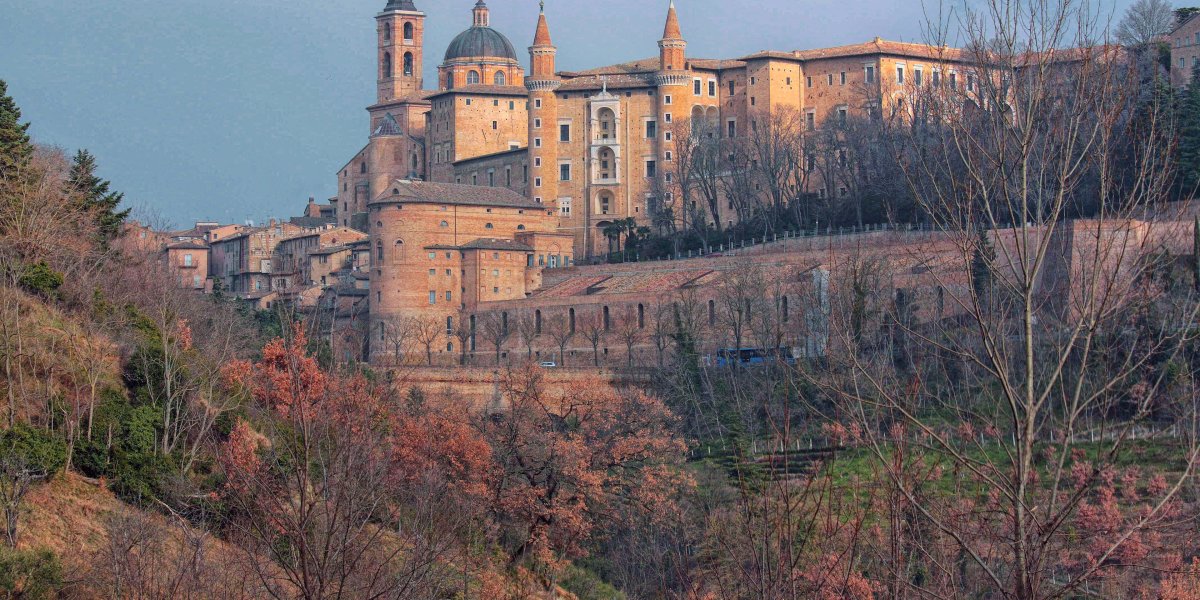
Begin at the highest point in town — the 14th-century hilltop fortress sitting in the green Parco della Cesana. From the grassy ramparts the entire UNESCO old town unfurls beneath you, the twin Torricini towers of Palazzo Ducale piercing the skyline like two sandstone needles. Morning haze burning off the Marche hills makes for the single most photographed view in Urbino.
Tip: Arrive by 09:00 — coach tour groups don't reach the fortress until 10:30. The free grassy platform on the south side of the keep gives the textbook postcard angle (Torricini centered, hills behind); skip paying €4 for the rooftop, the elevation gain inside adds only 10 meters.
Open in Google Maps →11:00
Landmark
Descend the fortress hill via Via dei Mille and turn onto steep Via Raffaello — a 12-minute walk down sandstone-paved streets the boy Raphael Sanzio actually walked as a child. The house where he was born in 1483 is an unassuming three-story palazzo with a bust of the master above the door. We're skipping the small interior museum; the real magic is the street itself.
Tip: Stand directly opposite the door at house number 57 — the morning sun hits the warm sandstone facade dead-on between 10:30 and 11:30, the only window when the plaque inscription is fully readable in your photo. Turn 180° afterward: the cobbled view down Via Raffaello toward the valley is the exact view Raphael saw leaving home.
Open in Google Maps →12:30
Food
Walk 5 minutes further down Via Raffaello, turn left at Piazza della Repubblica onto Via Cesare Battisti — this loud, wood-paneled spot is where Urbino's university students refuel between classes. Order the crescia sfogliata (the local flat-folded flatbread, layered with lard and stuffed hot off the griddle) filled with prosciutto di Carpegna and aged pecorino — €7. Glass of Bianchello del Metauro on the side, €4. A proper Marche lunch in 40 minutes flat.
Tip: Walk straight to the standing bar counter on the left — table service runs 25 minutes behind on weekdays at 12:45 when the university breaks. Order 'crescia sfogliata farcita' (not 'piadina' — wrong region, they'll correct you with a frown).
Open in Google Maps →14:00
Landmark
Cross Piazza della Repubblica heading east, climb the gentle slope of Via Vittorio Veneto for 3 minutes — the cathedral square opens suddenly on your right. The white neoclassical Duomo, rebuilt by Giuseppe Valadier after the 1789 earthquake collapsed the original, faces the great Egyptian-style obelisk at the center of Piazza Rinascimento. This is the ceremonial heart of the ducal city — Federico da Montefeltro's stage set, still in use 550 years later.
Tip: Position yourself at the southwest corner of Piazza Rinascimento (where Via Mazzini enters the square) — from this single spot you frame the obelisk, the Duomo façade, and the Palazzo Ducale entrance arch in one composition. The cathedral interior is whitewashed and disappointing after the exterior — skip it without regret.
Open in Google Maps →15:45
Landmark
Thirty seconds across the square — the rusticated façade of Federico's palace, one of Italy's most refined Renaissance buildings. Step into the Cortile d'Onore (the courtyard is free, no ticket needed) to read the Latin inscription circling the colonnade. Then circle west: descend Via Mazzini, then steep Via dei Maceri, all the way down to Borgo Mercatale at the foot of the palace cliff. From the parking square below, look up — the iconic Torricini twin towers, framed by the loggia and the hanging gardens, rear above you in golden-hour light. Stay through sunset, then climb back up through the Rampa Elicoidale — Francesco di Giorgio Martini's spiraling horse-ramp, free to walk, an architectural wonder in itself.
Tip: Between 18:30 and 19:15 in summer (17:00-17:45 in spring/autumn), low western sun strikes the Torricini directly — the sandstone goes molten orange. Shoot from Piazzale Roma at the south end of Borgo Mercatale, not from the parking lot. Pitfall warning: ignore every restaurant with a multilingual chalkboard menu on Via Raffaello and Via Vittorio Veneto — their 'crescia' is supermarket piadina reheated in a microwave, served at triple price. Real Urbino kitchens hide one street back, on Via dei Vasari and Via Santa Margherita.
Open in Google Maps →19:45
Food
Exit the Rampa Elicoidale at Piazza Rinascimento, walk 2 minutes north on Via dei Vasari — a low stone doorway and a hand-painted sign mark the city's most beloved traditional kitchen. White-tablecloth but unpretentious, brick-vaulted rooms, the same family running it since 1979. This is where local professors take visiting scholars. Order passatelli in brodo di cappone (hand-pressed Parmesan-and-breadcrumb noodles in capon broth, €13), then tagliata di vitello al tartufo nero del Montefeltro (sliced veal with local black truffle, €24). Bottle of Bianchello del Metauro Superiore, €22.
Tip: Reserve at least 24 hours ahead (+39 0722 4447) — they hold only 30 covers and turn walk-ins away by 20:00. Ask for 'la sala in fondo' (the back room) — vaulted, candlelit, half the noise of the entrance room. Order truffle dishes only October–December and March–May when it's freshly shaved tableside; outside those months ask for the cinghiale (wild boar) ragù pappardelle instead.
Open in Google Maps →
Trip builder
Plan this trip around Urbino
Turn this guide into a bookable rail itinerary with FlipEarth.
Keep exploring
Related cities
More in the same country
FAQ
Frequently asked questions
How many days do you need in Urbino?
Most travelers enjoy Urbino in 1 days, with enough time for headline sights and a slower meal or museum stop.
What's the best time to visit Urbino?
The easiest season for most travelers is Apr-Oct, especially if you want good weather and manageable crowds.
What's the daily budget for Urbino?
A practical starting point is about €80 per person per day before hotels, then adjust based on museums, dining, and transport.
What are the must-see attractions in Urbino?
A good first shortlist for Urbino includes Fortezza Albornoz, Casa Natale di Raffaello, Duomo di Urbino & Piazza Rinascimento.