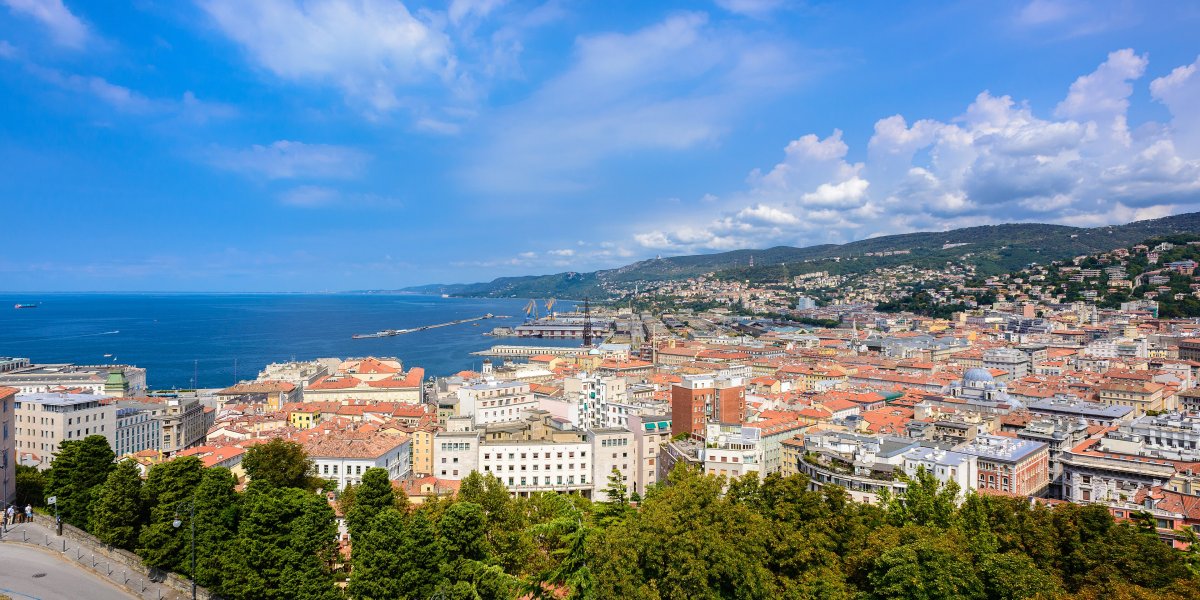
City Guide
Trieste
Italien · Best time to visit: Apr-Oct.
Day-by-day plan
Choose your pace
Reisedauer
09:00
Landmark
Start your day here, not in the center — bus 6 from Piazza Oberdan drops you at the park entrance, then a 10-minute downhill walk through umbrella pines opens onto the sea and a blinding-white castle on its own promontory. Archduke Maximilian built this dream before sailing off to be shot in Mexico, and the place still feels haunted by its own romance. Skip the interior and walk the sea terrace and Italian garden instead — the view back toward the castle with the Gulf of Trieste behind it is the photograph everyone remembers.
Tip: Arrive right at 09:00 — by 11:00 the cruise-ship buses from Venice roll in and the terrace becomes unshootable. For the iconic shot, walk past the castle to the small Sfinge viewpoint on the south side: the castle, the pines, and the open Adriatic all line up with morning light hitting the facade head-on.
Open in Google Maps →12:00
Food
Take bus 6 back to the center and walk three minutes east from Piazza della Borsa — a narrow door, zero signage glamour, and the smell of boiled pork that has pulled Triestini in since 1897. This is a buffet in the old Austro-Hungarian sense: stand at the counter, point at the steaming vat of porcina, walk out in twenty minutes. The caldaia (mixed boiled pork plate with kren horseradish and mustard, €13) is the city on a plate; a panino caldo with porcina and kren is €6 if you want to eat faster.
Tip: Go to the counter at the back, not the table service area — the line moves three times faster and the food is identical. Say 'un panino con la porcina e kren' and a glass of Terrano red (€3) and you've ordered like someone who grew up here. Do not ask for cappuccino after — it marks you instantly.
Open in Google Maps →13:00
Neighborhood
Walk five minutes north from Pepi, cross Via Roma, and the Borgo Teresiano opens up — a perfectly straight canal cut inland by Empress Maria Theresa so cargo ships could unload at the doorstep of the neoclassical church of Sant'Antonio Nuovo. On the middle bridge, a bronze James Joyce strides toward you with his hat and notebook; he wrote most of Dubliners in the apartments lining this canal. Early afternoon is when the water flattens and the church reflects perfectly — late-morning wind usually breaks the mirror.
Tip: For the postcard shot, stand on the Ponte Rosso facing north: Joyce in the foreground, boats moored below, Sant'Antonio's columns closing the vanishing point. Cross to the east quay and order a €1.20 capo in b (macchiato in a glass) standing at Caffè Stella Polare — the old literary haunt where Joyce drank, with zero tourist markup.
Open in Google Maps →14:30
Landmark
Walk south along Via San Spiridione for eight minutes and the city suddenly drops away: three sides of imperial Habsburg facades, the fourth side wide open to the Adriatic. This is Europe's largest seafront square, and the trick is to walk straight through it onto the Molo Audace — a 200-meter stone pier jutting into the gulf, named for the first Italian destroyer that docked here in 1918. From the end of the pier you get the only angle where the entire piazza frames itself against the city behind. Afternoon sun sits behind you and lights up the Palazzo del Governo mosaics in gold.
Tip: Walk to the very end of Molo Audace — most visitors stop halfway. The bronze compass rose set into the stone at the tip marks the exact point the Audace moored; it's the single best photo spot in Trieste, and at 15:00 on a clear day the light is cinematic. Watch the bora wind forecast though — when it gusts over 60 km/h the pier is closed without warning.
Open in Google Maps →16:30
Landmark
From Piazza Unità, walk up Via della Cattedrale — a steep 15-minute climb past medieval walls into the oldest layer of the city. Do it now, while your legs still have something left and the sun is dropping west over the gulf. Skip the museum ticket; the ramparts are free and they are the whole point. Beside the castle sits the stocky Romanesque Cattedrale di San Giusto with its rose window and 14th-century mosaics — duck inside for ten minutes, it is almost always empty. Then circle the castle walls: one side gives you the terracotta roofs tumbling down to the Adriatic, the other gives you the Carso hills rolling into Slovenia. It is the only place you see both Trieste's worlds at once.
Tip: Time your walk along the west rampart for about 18:00 — the sun sets behind Miramare and the entire gulf turns copper. Come down via the Scala dei Giganti staircase (not back the way you came); it drops you directly at the Roman theater and saves ten minutes. WARNING: avoid the restaurants directly on Piazza Unità with laminated multi-language menus and hosts pulling you in — they are pure tourist traps with €25 pasta; the places where locals actually eat are one block inland. Also ignore the Bora-branded souvenir kiosks on the square; identical fridge magnets are half price at any tabacchi on Via San Nicolò.
Open in Google Maps →19:30
Food
Walk four minutes east from Piazza Unità into the quiet lanes behind the old stock exchange — a barrel-vaulted 18th-century cellar that was literally the city's ice store before refrigeration. This is where Triestini bring out-of-town family: short chalkboard menu, Adriatic seafood landed that morning, zero tourist theater. The sarde in saor (sweet-sour sardines with onions and raisins, €12) is the definitive Adriatic antipasto; the spaghetti ai ricci di mare (sea-urchin pasta, €22) appears when the sea allows and is the single dish worth planning a trip around. Budget €55-70 per person with a glass of Vitovska, the local Carso white.
Tip: Reserve by phone at least 24 hours ahead (+39 040 305614) — the room seats barely 30 and walk-ins are almost always turned away after 20:00. Ask for a table in the back vault, not the front glass room. Order the sea-urchin pasta only if the owner nods when you ask 'c'è stamattina?' — if he hesitates, it came frozen, take the scampi alla busara instead.
Open in Google Maps →Zu Tag springen
09:00
Religious
Start at the base of the old town and climb the worn stone staircase of Via della Cattedrale — ten quiet minutes through cypress trees and tilted red rooftops, each landing opening a wider view of the Gulf below. The asymmetrical facade, patched together from two earlier churches in the 14th century, is a love letter to Trieste's mongrel identity: Roman columns, a Byzantine rose window, Venetian-Gothic stone. Inside, the 12th-century gold-ground mosaics in the two apses glow in the morning side-light — this is the one hour the east apse is properly illuminated.
Tip: Enter through the right-side door, not the main facade — it leads directly to the Virgin mosaic in the north apse. Bring a 1-euro coin for the mosaic lights; the coin-box timer runs about three minutes, long enough to photograph both apses if you move decisively.
Open in Google Maps →10:15
Landmark
Step out of the cathedral and continue fifty meters uphill along the low stone wall — the castle entrance is on your right, marked by the Venetian lion. Built by the Habsburgs on top of a Venetian fortress on top of a Roman forum, the ramparts give you the one panorama that actually explains Trieste: the Adriatic wrapping the Piazza Unità on your left, the Karst plateau rising sharply on your right, and Slovenia on the horizon. The Lapidarium Tergestino in the bastions houses the Roman-era inscriptions that prove this was once Tergeste — ten minutes is enough.
Tip: Climb the Bastione Rotondo first (the round bastion, furthest from the entrance) — the southwest corner gives the single best photograph of Piazza Unità seen from above, with the sea beyond. Tour groups always start at the Lapidarium and never make it to this bastion — you will have it to yourself.
Open in Google Maps →12:30
Food
Walk back down Via della Cattedrale, then cut through Via del Teatro Romano past the Roman ruins — a ten-minute descent that takes you from Habsburg fortress to working-city bustle. Open since 1897, this is the temple of Trieste's defining dish: boiled pork shoulder (porzina) and sausages (cragno) carved to order from a steaming cauldron, served on a wooden board with fresh-grated horseradish (kren) and senape mustard. Order a 'piatto misto' (mixed plate, €16) with a glass of Terrano wine (€3.50), and eat standing at the marble counter like the locals do at lunch.
Tip: Arrive by 12:30 sharp or after 14:00 — between 13:00 and 14:00 the queue snakes out the door with office workers on their lunch break. Ask for the porzina 'con la cotenna' (with the crackling skin) — they leave it off unless you ask, and it's the best part.
Open in Google Maps →14:45
Landmark
Walk five minutes west down Via Cassa di Risparmio toward the waterfront — the square opens suddenly, and the effect is deliberate, designed to stop you. Europe's largest sea-facing square is a stage of white Istrian stone flanked by three Habsburg-era palaces on the landward side and wide open to the Adriatic on the fourth — an architectural gesture that says the empire always faced outward. Afternoon is the right hour: the eastern facades catch the sun while the sea glitters ahead, and by 16:00 the bronze compass rose embedded in the pavement glows gold.
Tip: Walk all the way to the Molo Audace — the stone pier extending 250 meters into the sea from the square's seaward edge. Stand at its tip and turn around: this is the only angle from which you see all three palaces framing the square as a single composition, with the castle on the hill above. Nine out of ten tourists never walk out here.
Open in Google Maps →16:30
Food
The café is thirty steps from where you were standing, under the arcades on the square's eastern side. Founded in 1839, it survived four empires without changing its marble tabletops — Italo Svevo wrote here, and the Austrian officers who inspired his novels drank here too. Order a 'capo in B' (a tiny espresso with a spoon of milk foam, served in a glass — the Triestine cappuccino, €2.20) and a slice of presnitz, the rolled walnut-raisin pastry (€4.50).
Tip: Sit at the outdoor tables facing the square, not inside — the terrace price is identical, and you get the full piazza-and-sea view for the cost of an espresso. Never say 'un cappuccino' — every Triestine will clock you as a tourist. Say 'un capo in B' (capo in bicchiere) and watch the barista nod approvingly.
Open in Google Maps →20:00
Food
From the square, walk three minutes southeast down Via San Nicolo and cut into Via Luigi Cadorna — a narrow backstreet in the old Cavana district where the Austro-Hungarian merchant houses are still crooked and low. Al Bagatto has been Trieste's reference seafood restaurant for thirty years, run by the same family, plating raw Adriatic crudo and an anchovy-on-toasted-polenta starter (€18) that locals order before they open the menu. For mains: the tagliolini with sea urchin and langoustine (€28) is the dish that makes people book a return trip to Trieste.
Tip: Reserve at least two days ahead — twenty tables, no walk-ins on weekends. Avoid the restaurants directly on Piazza Unità with picture menus in four languages; they charge double for frozen fish. If Al Bagatto is full, the smaller sister wine bar 'Bagatto in Cavana' two streets over takes walk-ins and serves the same crudo for a third of the price.
Open in Google Maps →09:00
Landmark
Catch bus 6 from the stop near Piazza Oberdan at 08:25 — twenty-five minutes along the coast road, past the cliffs of Barcola, to the white limestone castle that seems to float on the Adriatic. Built in the 1860s by Archduke Maximilian (later the doomed Emperor of Mexico) as his honeymoon palace, every room was left untouched after his execution — the bedroom looks as if he stepped out this morning, the library still smells faintly of beeswax, and the throne room glitters with gilding he never got to use. Arrive at opening: the low east-side light pours through the sea-facing windows, and you walk the state rooms alone for the first forty minutes before the tour buses land at 10:00.
Tip: Buy the ticket online the night before (€2 saved, skip-the-line, castellomiramare.it). After the castle, walk the terraced park downhill toward the small private harbor — the 'Castelletto' (little castle) where Maximilian lived while the main palace was being built is tucked behind a hedge and almost no one finds it. The photograph locals use as their desktop wallpaper is taken from the sphinx terrace at the water's edge.
Open in Google Maps →12:30
Food
Take bus 6 back to Piazza Oberdan (25 min), then walk eight minutes south through the Borgo Teresiano grid to Piazza Hortis — you'll pass Joyce's first Trieste apartment on Via San Nicolo on the way. Siora Rosa is a second-generation family buffet, smaller and scruffier than Buffet da Pepi, serving what the working neighborhood actually eats: goulash with polenta (€11), jota (the Triestine sauerkraut-bean-pork soup, €7) and a wedge of strudel for €3. This is the flavor of the city's Slovenian-Austrian interior, not its Italian face.
Tip: Order the jota only on a cool day — it is genuinely heavy, and locals eat it between October and March. In summer, switch to the cold 'musetto in salsa' (cotechino with a mustard-caper sauce, €9). Cash preferred; the card reader works when it feels like it.
Open in Google Maps →14:15
Religious
Walk ten minutes north from Piazza Hortis along Via Cassa di Risparmio, crossing into the Borgo Teresiano — the grid of 18th-century merchant blocks where the city's Serbian, Greek, Jewish and Armenian communities each built their own temple within four streets of each other. San Spiridione, consecrated in 1869, is all blue domes and gold Byzantine saints painted on a lapis-lazuli ground — a jolt of the Orient on a rainy North Adriatic afternoon. Fifteen minutes inside is enough; the point is to understand that Trieste was never only Italian.
Tip: Sunday morning Divine Liturgy (10:00-12:00) is sung in Old Church Slavonic with incense and candlelight — visitors are welcome to stand at the back. If you miss that, come between 15:00 and 16:00 on weekdays when the late sun hits the iconostasis at an angle and the gold leaf ignites. Shoulders covered, no flash.
Open in Google Maps →15:30
Neighborhood
Exit the church, turn left, and the Canal Grande opens up right in front of you — a 200-meter inland canal dug in 1756 so that spice ships could unload directly at the warehouse doors. Walk the full length slowly: halfway across the small Ponterosso bridge stands the life-size bronze of James Joyce, hat tilted, hands in pockets, mid-stride — he lived on and around this canal for eleven years and wrote most of 'A Portrait of the Artist' while teaching English at the Berlitz two blocks away. Continue to the neoclassical church of Sant'Antonio Taumaturgo at the canal's head; its reflection in the water at 16:30 is the postcard image of Trieste.
Tip: Shoot the postcard reflection from the small pedestrian bridge at the canal's middle, not from the embankment — the embankment gives you the church but the bridge gives you the church and Joyce framed together. After, find the bronze plaque on Via San Nicolo 30 (one block east) marking Joyce's first apartment; most tours never mention it.
Open in Google Maps →17:15
Food
Walk eight minutes northeast along Via Carducci and turn right onto Via Cesare Battisti — the café is three doors down on the right, behind a modest green-and-gold facade. Opened in 1914, trashed by the Austrians six months later for being a nest of Italian irredentists, rebuilt, and now a working café-library-bookshop where Claudio Magris still writes his essays at table 4 most afternoons. Under the gilded art-nouveau garlands, order a 'capo in B' (€2.30) and the homemade sachertorte (€5.50); the ceiling frescoes of laurel-wreathed poets include a young Saba and a not-yet-famous Joyce.
Tip: The café-library half (left side, past the bar) is open to anyone — you can sit with a coffee and pull any book off the shelves. Ask the barista for 'il libro di Magris' and he will usually point you to the exact chair the author prefers. Closed Wednesdays — if your Day 2 falls on a Wednesday, swap this with Caffe degli Specchi from Day 1.
Open in Google Maps →20:00
Food
Six minutes' walk southwest from Caffe San Marco, down Via Cesare Battisti and into Via del Pane — a tight pedestrian street in the shadow of the Piazza della Borsa, where the old stock exchange facade glows yellow at night. Chimera di Bacco is a fifty-seat osteria run by two sommelier brothers, specializing in the oft-ignored Karst cuisine: hand-cut tagliatelle with wild asparagus (€16), slow-braised beef cheek in Terrano wine (€22), and a blind-tasting wine pairing from the family's Carso vineyards (€18 for three glasses).
Tip: Reserve 48 hours ahead and specifically request the two-top at the front window — it looks down the length of Via del Pane toward the lit-up Borsa facade. Skip Piazza della Borsa's tourist-trap pizzerias on your way here: the one with the hawker outside handing out menus charges €14 for a bottle of tap water relabeled as 'acqua della casa' — a known local scam. If they bring water you didn't order, send it back immediately.
Open in Google Maps →
Trip builder
Plan this trip around Trieste
Turn this guide into a bookable rail itinerary with FlipEarth.
Keep exploring
Related cities
More in the same country




FAQ
Frequently asked questions
How many days do you need in Trieste?
Most travelers enjoy Trieste in 1 days, with enough time for headline sights and a slower meal or museum stop.
What's the best time to visit Trieste?
The easiest season for most travelers is Apr-Oct, especially if you want good weather and manageable crowds.
What's the daily budget for Trieste?
A practical starting point is about €120 per person per day before hotels, then adjust based on museums, dining, and transport.
What are the must-see attractions in Trieste?
A good first shortlist for Trieste includes Miramare Castle Park and Seafront Terrace, Piazza Unita d'Italia and Molo Audace, Castello di San Giusto Ramparts.