City Guide
Trebinje
Bosnien und Herzegowina · Best time to visit: May-Oct.
Day-by-day plan
Choose your pace
Reisedauer
09:00
Religious
Begin from Trg Slobode and climb east up Crkvina Hill — a 30-minute switchback walk on paved road through cypresses and pomegranate trees, the green Trebišnjica valley opening behind you with every turn. The summit holds a 1999 white-stone replica of Kosovo's medieval Gračanica Monastery, sponsored by Serbian poet Jovan Dučić, whose tomb rests inside the church. From the bell-tower terrace, the panorama stretches from Trebinje's red roofs to the Adriatic-facing peaks beyond Dubrovnik — the single most iconic view in Hercegovina.
Tip: Climb at 9 AM sharp — the eastern sun hits the white-marble façade head-on for the cleanest photos, and you'll have the courtyard to yourself for a full hour before the 10:30 buses from Dubrovnik arrive. Step inside the church to see Dučić's tomb — his ashes were flown home from the US in 2000 after six decades of exile, the reason this whole monastery was built.
Open in Google Maps →11:00
Landmark
From the monastery gates, descend the hill's west face and follow the Trebišnjica's left bank north — a 35-minute downhill walk past stone garden walls, fig trees, and the rapids where local boys fish for trout. The Arslanagić Bridge appears around a bend: a 16th-century Ottoman span with two slim pointed towers, commissioned by Grand Vizier Mehmed-paša Sokolović and reassembled here stone-by-stone in the 1960s after the Gorica dam flooded its original valley 9 km downstream. The late-morning sun catches both towers in full side-light — past noon they fall into their own shadow.
Tip: Cross to the north bank and shoot back south — the twin pointed-arch towers frame perfectly with the river curling beneath, the postcard angle every guidebook uses. Most tour groups stay on the south bank and miss it. The bridge is unguarded and free to walk; like everything else iconic in Trebinje, you pay nothing to step on history.
Open in Google Maps →12:30
Food
Walk back south along the Trebišnjica's left-bank promenade for 25 minutes — past the city beach where locals swim from June onward, under a curtain of plane trees lining Obala Luke Vukalovića. Duck into Pekara Mlinpek, a no-frills bakery a block west of the Old Town gate where morning trays are still warm at lunch and the queue moves fast. Order burek by weight (€4-5 a portion) — meat, or the spinach-cheese zeljanica — and eat standing at the counter with a glass of kiselo mlijeko (€1.50), the cool soured milk every local pairs it with.
Tip: Order 'pola pola' (€5, half meat / half cheese) if you can't decide, and add a slab of kajmak (€1.50) — the regional clotted cream you won't find back home. Skip the polished cafés ringing Trg Slobode for lunch: they charge €15-20 for the same ćevapi served two blocks away for €5, and tag a 'tourist menu' on every dish.
Open in Google Maps →14:00
Neighborhood
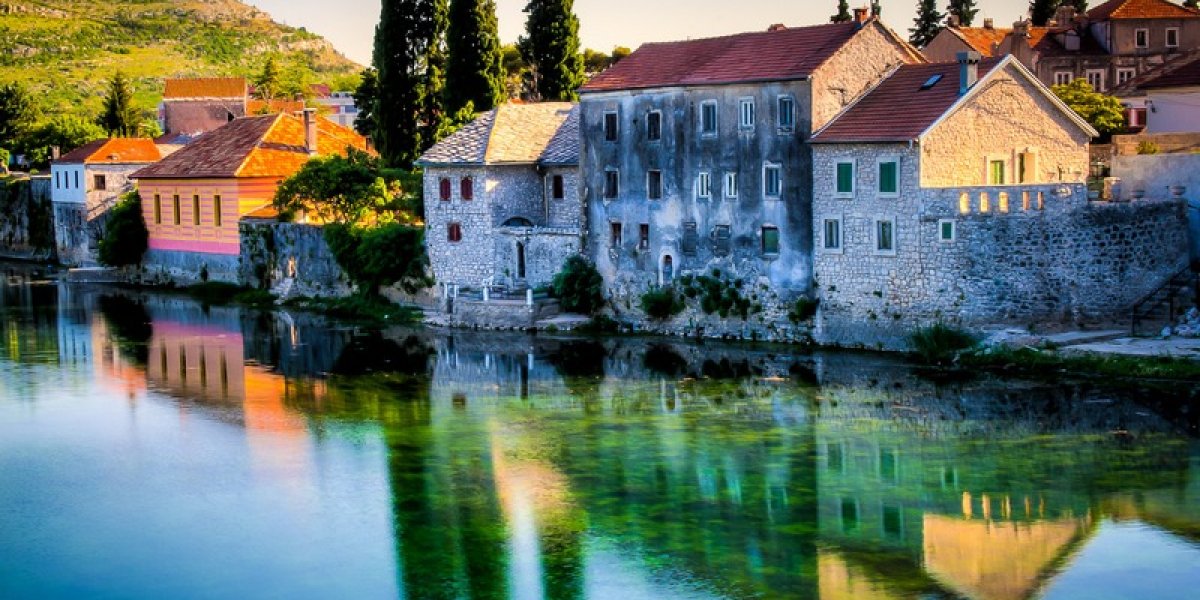
Three minutes east from the bakery, step through the western gate of Stari Grad — Trebinje's walled 18th-century Ottoman core, barely 200 m across, with cobbled lanes, stone houses, and a quiet bazaar of antique shops. The elegant Osman-Pašin Mosque (1726) anchors the southern wall: its slender minaret is the iconic skyline silhouette of Trebinje, and its courtyard is open to all visitors. Loop the southern ramparts on foot — they're walkable — and look down at the Trebišnjica swirling green beneath, the angle painters have framed for 200 years.
Tip: Step into the mosque courtyard between 14:30 and 15:00 — the afternoon sun rakes across the minaret at the perfect angle for the postcard shot, and if you catch the 14:45 call to prayer it becomes the trip's best memory. Modest dress required; women cover heads (a scarf is loaned at the gate). Decline the 'antique Ottoman coin' sellers along the lane — virtually every silver on offer is a modern Turkish reproduction selling for 10x its real worth.
Open in Google Maps →16:00
Park
Exit Stari Grad's north gate and step one minute into a green tunnel: Trg Slobode, paved with smooth white limestone and roofed by century-old plane trees so dense they hide the sky in summer. This is Trebinje's living room — old men at stone chess tables, children on bicycles, the slow korzo (evening passeggiata) gathering from 17:30 onward. Take Bosnian coffee at a western-facing café, settle in, and stay for late golden hour when the low sun shafts through the leaves like a cathedral.
Tip: Order 'Bosanska kafa' (€1.50), not espresso — it arrives in a hammered copper džezva with rahat lokum on the side, and unlocks the local rhythm of unhurried sipping. If your day falls on Saturday, arrive before 11 AM for the green market: honey, kajmak in oil, and Hercegovinian pršut straight from village producers. Best photo: from the eastern end at 17:30, shoot west — the plane leaves filter the sun into amber shafts you can't get anywhere else in the Balkans.
Open in Google Maps →19:00
Food
Walk thirty seconds across Trg Slobode — Platani sits beneath the very plane trees you've spent the afternoon under (its name means 'the plane trees'), and is the table every local in Trebinje sends visitors to. The kitchen is purely Hercegovinian: river trout from the Trebišnjica grilled whole with garlic, lamb peka cooked under embers in an iron bell, and a starter mezze of smoked pršut, sheep cheese, and ajvar. Wines come local — Vranac (full red) and Žilavka (mineral white) — poured by the carafe at €8 a half-litre, all from Vukoje 1982, the town's flagship winery five minutes south.
Tip: Reserve a terrace table on the Trg Slobode side ahead of 19:00 — call the restaurant in the morning, since the four corner seats facing the square go first and never reopen after 18:30. Must-order: whole Trebišnjica trout (€14) with a half-carafe of Vukoje Vranac (€8) — together, it is the meal that explains why people choose Trebinje over Dubrovnik. Tourist-trap warnings before you leave town: skip the 'Bosnian coffee sets' sold along Stari Grad's gates (mass-produced in Turkey, triple the price); for a real gift, walk to Vinoteka Vukoje and buy a bottle of Vranac Reserve directly from the cellar. And ignore the 'free wine tour' touts near the bus station — they're high-pressure sales at marked-up prices, not the real thing.
Open in Google Maps →
Trip builder
Plan this trip around Trebinje
Turn this guide into a bookable rail itinerary with FlipEarth.
Keep exploring
Related cities
More in the same country
FAQ
Frequently asked questions
How many days do you need in Trebinje?
Most travelers enjoy Trebinje in 1 days, with enough time for headline sights and a slower meal or museum stop.
What's the best time to visit Trebinje?
The easiest season for most travelers is May-Oct, especially if you want good weather and manageable crowds.
What's the daily budget for Trebinje?
A practical starting point is about €60 per person per day before hotels, then adjust based on museums, dining, and transport.
What are the must-see attractions in Trebinje?
A good first shortlist for Trebinje includes Arslanagic Bridge (Perovica Bridge).