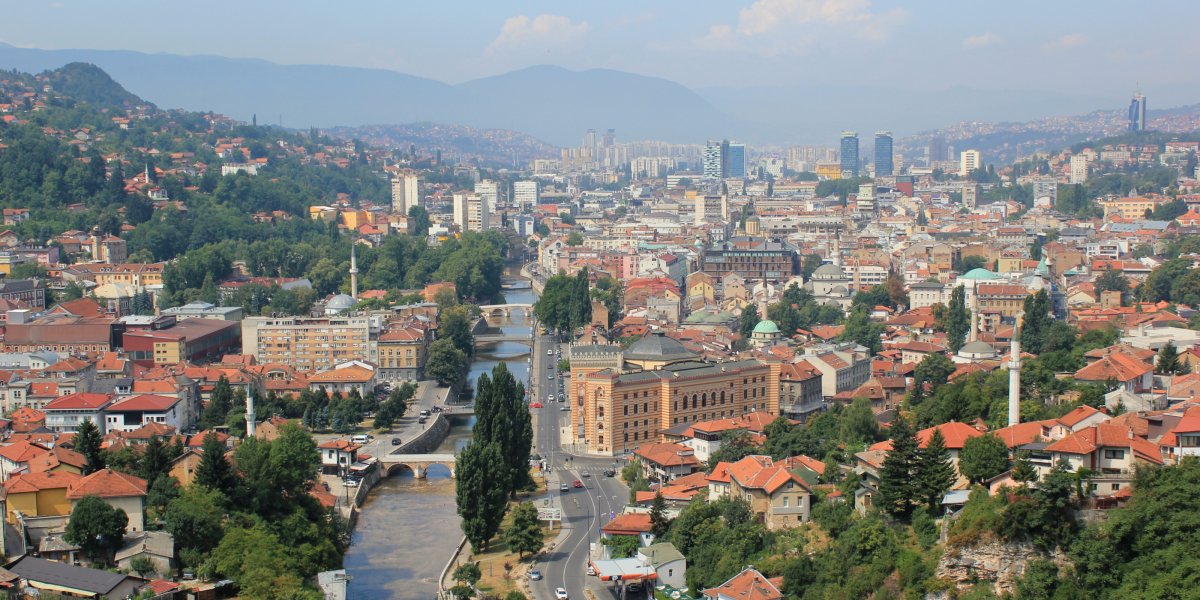
City Guide
Sarajevo
Bosnien und Herzegowina · Best time to visit: Apr-Jun, Sep-Oct.
Day-by-day plan
Choose your pace
Reisedauer
09:00
Religious
Begin at the twin-spired neo-Gothic cathedral — the Catholic anchor in a city of four faiths. At 09:00 the coach groups have not yet arrived, the east-facing bell towers catch the first sunlight, and the small piazza is almost empty. Sit on the stone bench beside the Pope John Paul II statue and watch Sarajevo wake up: a priest crossing the square, old men heading for morning coffee, the bells ringing eastward over the minarets by the river.
Tip: Arrive by 09:00 sharp — after 10:30 the cruise-ship tour groups fill the piazza. The bronze relief panels on the main doors catch the low eastern light perfectly before 10:00 for deep-shadow portrait shots; by noon the sun flattens them. The interior closes for the 09:30 mass, but the facade is what you came for.
Open in Google Maps →10:00
Landmark
From the cathedral piazza, walk east along Ferhadija — Sarajevo's main pedestrian street — for six minutes. You pass the Eternal Flame burning since 1946 for the fallen of World War II, then cross a bronze plaque embedded in the pavement reading 'Sarajevo Meeting of Cultures' — the exact seam where Austro-Hungarian Sarajevo ends and Ottoman Sarajevo begins. Turn right to the river and you reach Latin Bridge: a modest 16th-century stone arch, and on its north corner, on 28 June 1914, Gavrilo Princip shot Archduke Franz Ferdinand and lit the fuse of the 20th century. Stand on the bridge, look back at the corner building, and you are at the point where the century turned.
Tip: The actual assassination spot is NOT on the bridge itself — it is the street corner opposite, where the Sarajevo Museum 1878–1918 now stands. Look for the small inscribed plaque on the museum's corner facade at eye level: that is where Princip fired. Nine out of ten tourists photograph the wrong side. Stand at the museum corner and frame the bridge behind you — that is the photo that tells the real story.
Open in Google Maps →11:30
Food
Walk east along the Miljacka riverbank for four minutes, then duck left into the narrow cobbled Kundurdziluk lane — you smell charcoal and minced lamb before you see the sign. This is where locals eat cevapi: ten finger-shaped grilled meat rolls tucked into warm somun flatbread with kajmak (clotted cream) and raw onion, served in three minutes flat. Say 'deset u somunu sa kajmakom', add a cold Sarajevsko pivo or a salty yogurt drink, and eat standing if the benches are full — the turnover is ruthless.
Tip: There are two Zeljos on this lane — Zeljo 1 (original, No. 19) and Zeljo 2 (No. 12, larger kitchen). Locals argue endlessly; both are excellent, but Zeljo 2 seats faster at peak lunch. Skip the English picture menus and just order 'deset u somunu, sa kajmakom'. AVOID any cevapi shop around Sebilj square with laminated English menus — double the price for worse meat. Real cevapi is never served with fries.
Open in Google Maps →13:00
Neighborhood
Step out of Zeljo and you are already inside the bazaar — walk fifty metres north and Sebilj, the wooden Ottoman fountain, opens in front of you in a square swirling with pigeons. Legend says anyone who drinks from Sebilj returns to Sarajevo; sip, then wander north into Kazandziluk, the coppersmith alley, where craftsmen still hammer cezve coffee pots by hand and the rhythmic clang is the soundtrack of the quarter. Pass the courtyard of Gazi Husrev-beg Mosque (the 1531 masterpiece — study the dome from outside), then slip into Morica Han, the last working Ottoman caravanserai, and settle in its stone courtyard for a Bosnian coffee ceremony: copper dzezva, sugar cube dipped rather than stirred, a square of rahat lokum on the side. This is the moment the city finally slows you down.
Tip: For the coffee ceremony, skip the obvious cafes on Sebilj square (tourist pricing, weak brew) and walk into Caffe Divan inside Morica Han courtyard — the 16th-century caravanserai setting alone justifies the stop, and a full ceremony runs 3–4 euros versus 8 on the square. In Kazandziluk, the coppersmith you want is Kazandzija Ismet Alic, fourth shop on the right — genuinely hand-hammered cezves from 20 euros, not the machine-pressed lookalikes sold at the same price on Sebilj.
Open in Google Maps →16:30
Landmark
From Morica Han, walk north past the Gazi Husrev-beg complex and keep climbing — the streets narrow into Kovaci and then Jekovac, a steady twenty-minute uphill through white-stone Ottoman houses and the hillside martyrs' cemetery of the 1990s siege. Do not turn around until you reach the fortress wall. Then look: the whole of Sarajevo laid out below you in a narrow green valley, ringed by mountains that were snipers' nests thirty years ago and Olympic ski slopes in 1984 before that. Arrive ninety minutes before sunset. As the sun drops behind the western ridge one muezzin begins the call to prayer, then another, then a dozen — voices answering each other across the valley while the minarets turn black against the orange sky. There is no other moment in any European city that feels like this.
Tip: Skip the overpriced cafe at the top; buy a cold Sarajevsko pivo from the kiosk at the fortress entrance and sit on the grass wall to the LEFT of the old cannon — that angle frames the whole old town with minarets silhouetted against the setting sun (the right side is blocked by pine trees). During Ramadan the cannon is fired to announce iftar; be in position fifteen minutes early for the shot of gunsmoke drifting across the valley. Leave within twenty minutes of sunset — the downhill path through the cemetery is unlit and steep in places.
Open in Google Maps →19:30
Food
From the fortress, follow the cobbled path downhill westward through the old Vratnik gate and down Nevjestina — a fifteen-minute descent through a residential Sarajevo that no tour group ever sees. You emerge at the Miljacka directly opposite the striped sandstone facade of City Hall (Vijecnica), floodlit and spectacular after dark, and Inat Kuca — the House of Spite — is the small Ottoman house on your own bank, defiantly facing it. The story: in 1896 the Austro-Hungarians needed this plot to build Vijecnica; the owner refused, so the empire paid him a bag of gold AND dismantled and reassembled his house stone by stone on the opposite bank. Out of spite. Inside: low wooden stools, copper trays, and the slow Bosnian menu your grandmother would have cooked. Order begova corba (the okra-and-chicken soup served at Bosnian weddings for four centuries, 5 euros), then bosanski lonac (slow-stewed beef and vegetables sealed in a clay pot, 14 euros), and finish with tufahije — walnut-stuffed poached apple in rosewater syrup, served in a copper bowl, 4 euros.
Tip: Reserve ahead for a window table — the floodlit Vijecnica across the river is THE view, not a back-room table against the wall. Ask for the a la carte, not the tourist menu propped at the entrance; order bosanski lonac specifically, noting it needs three hours of simmering so it is only available after 19:00. TRAP WARNING for the whole Miljacka riverbank strip between Vijecnica and Bascarsija: the cevapi stalls and 'traditional music' cafes along this stretch charge 2–3x normal Bascarsija prices and push overpriced raki on tourists — Inat Kuca is the one address on this strip worth your money.
Open in Google Maps →Zu Tag springen
09:00
Religious
Start right at the 09:00 non-prayer opening slot, before the cruise-ship day-trippers flood in from Dubrovnik around 11:00. This 1531 mosque is the largest historical mosque in the Balkans; its cool marble courtyard and hand-painted mihrab feel completely different when you have it to yourself. Pay attention to the sadrvan (ablution fountain) at the center — the geometry of its dome against the minaret is the cleanest photograph you will take all day.
Tip: Women must cover their head; scarves are lent free at the door, but the ones provided are nylon — bring your own cotton scarf if you plan to stay long. Remove shoes inside; wear socks you don't mind showing.
Open in Google Maps →10:15
Neighborhood
Exit the mosque, turn right and walk 2 minutes down Sarači street — the moment the cobblestones narrow and you hear the tap-tap of coppersmiths, you are in Bascarsija. The wooden Sebilj fountain is the photograph of Sarajevo: shoot it from the southwest corner at 10:30 when the morning sun lights the copper roof but pigeons still blanket the square. Wander down Kazandžiluk (Coppersmiths' Alley) — this is the only street in Europe where hand-hammered Turkish coffee sets are still made one at a time by the same families who did it 400 years ago.
Tip: Buy a džezva (coffee pot) from Kazandžiluk 1 (the Huseinovic workshop, fourth generation) — it's 30% cheaper than the shops facing Sebilj square and the quality is the real thing. Skip the vendor right next to the fountain; his prices are triple.
Open in Google Maps →12:30
Food
Walk 3 minutes south from Sebilj down Kundurdžiluk — the smell of grilled lamb hits you before you see the door. Every Sarajevan has an opinion on who serves the best cevapi (hand-rolled minced-meat sausages) in the city; Željo, open since 1971, wins by unanimous vote of the city's taxi drivers, which is the only ranking that matters. Order the 10-piece cevapi with somun (puffy flatbread) and kajmak (clotted cream) — €7 — and a bottle of domestic Sarajevsko beer.
Tip: Arrive before 12:30 or after 13:30 to skip the worst line. Ask for it 'na somun' (inside the bread, sandwich-style) rather than 'na tanjir' (on a plate) — it's the local way and the bread soaks up the fat beautifully.
Open in Google Maps →14:00
Museum
Walk 4 minutes west from Željo along the Miljacka river — the pastel Ottoman houses on the far bank make this one of the prettiest short walks in the city. At the north end of the Latin Bridge, a small corner building marks the exact spot where Gavrilo Princip shot Archduke Franz Ferdinand on 28 June 1914 and set off the First World War. The single-room museum inside is tiny but displays the actual pistol, Princip's footprint in the pavement, and the original assassination-day photographs — stand where he stood and the weight of the twentieth century lands on your shoulders.
Tip: The pavement plaque outside the museum marking Princip's footprint is what everyone photographs — cross the bridge and shoot back from the south side to get both the bridge arches and the museum facade in one frame. Entry is cash-only in Bosnian marks (KM); bring €5 in local currency.
Open in Google Maps →16:30
Landmark
Walk 20 minutes uphill northeast from the Latin Bridge area through the Vratnik quarter — the climb through sloping lanes of red-roofed Ottoman houses is the whole point, so take it slow. The Yellow Fortress is an 18th-century cannon bastion that now functions as the city's balcony: the bowl of Sarajevo opens below you, 100 minarets pinned against the mountains that surround it. Time it for 17:30-18:00 in shoulder season when the sun drops behind the western ridge and the muezzin calls to evening prayer rise from every direction at once — there is no sound like it in Europe.
Tip: During Ramadan, a cannon is fired from here at sunset to mark iftar — if your trip falls in that month, be on the bastion by 17:45 and watch the city below begin to eat at the same second. Otherwise bring a light jacket; the wind here is 5°C cooler than downtown.
Open in Google Maps →19:30
Food
Walk 15 minutes downhill from the fortress; the riverside restaurant sits directly across the Miljacka from the City Hall, impossible to miss. The name means 'House of Spite' — when the Austro-Hungarians needed the original plot for the City Hall in 1894, the stubborn owner demanded they dismantle his house brick by brick and rebuild it on the opposite bank, which they did. Order the 'Bosanski lonac' (slow-cooked lamb and cabbage stew, €14) and the 'sogan-dolma' (onions stuffed with meat, €12) — these are dishes you will not find outside Bosnia.
Tip: Reserve a table on the covered riverfront terrace (+387 33 447 867) — the illuminated City Hall across the water is the dinner view, and indoor tables miss it entirely. Trap warning for Bascarsija: avoid the cevapi places clustered around Sebilj with menus in 6 languages and waiters standing outside — they are 40% pricier for tourist-grade meat. Real cevapi places never need to wave you in.
Open in Google Maps →09:00
Museum
Take a taxi from downtown (15 min, €10) — this is the one site outside the center, and morning is right because the small farmhouse entrance jams with group tours from 11:00 onwards. During the 1425-day siege — the longest in modern European history — this 800-meter tunnel under the airport runway was the only lifeline into the city, carrying in food, weapons, and out the wounded. The 25 meters of original tunnel you can walk through are low and damp, and the family who still owns the house shows you the wheelbarrow that carried President Izetbegovic through it. You leave understanding something about Sarajevo that no other museum in the city can teach you.
Tip: Ask your taxi to wait (€10 extra for the round trip — still cheaper than two separate rides) or pre-book through your hotel. The short documentary inside plays in 20-minute loops; arriving at 09:00 means you catch the first showing before any group fills the screening room.
Open in Google Maps →11:30
Landmark
Taxi back to the center and get out at the eastern end of the Miljacka — Vijecnica rises from the riverbank like a pseudo-Moorish mirage in red and yellow stripes. Built in 1896 as the Austro-Hungarian flourish meant to say 'we are here now,' it was shelled and burned by Serb forces in August 1992, taking two million books from the National Library with it. The restoration, completed in 2014, is breathtaking — stand under the central atrium at noon when the stained-glass ceiling scatters color across the marble floor.
Tip: The best photo is not the facade everyone shoots from across the bridge but the view straight up from inside the atrium — tilt your phone against the floor and shoot the ceiling dome. Skip the paid audio guide; the wall panels in English tell the story with more feeling.
Open in Google Maps →12:45
Food
Walk 5 minutes west from Vijecnica back into the edge of Bascarsija — the narrow storefront on Bravadziluk is marked only by a wheel of spiraled dough in the window. Burek is the Bosnian national dish: hand-stretched filo wrapped around meat, spinach-and-cheese (zeljanica), or pumpkin (tikvenica), baked in a wood-fired pan under a metal dome called a sač. Order a quarter-kilo of meat burek (€4) with a dollop of pavlaka (sour cream, €0.50) and a salty yogurt drink — eat standing at the counter like every local on their lunch break.
Tip: They weigh burek by the gram — ask for '200 grama' (enough for one hungry person) or '300 grama' for two sharing. Skip anything labeled 'burek sa sirom' outside Bosnia; only meat is true burek here — the rest are 'pita' by different names. Eat it within 10 minutes; cold burek is a sad thing.
Open in Google Maps →14:00
Neighborhood
Walk west 3 minutes from the burek shop — suddenly the cobblestones give way to flat flagstones and a compass rose in the ground marks 'Sarajevo — Meeting of Cultures.' Turn around: on one side, Ottoman minarets; on the other, Austro-Hungarian neoclassical facades. Continue west along pedestrianized Ferhadija — this was the Vienna of the Balkans in 1900, and the 15-minute stroll past the 1889 Orthodox Cathedral, the Jesus' Sacred Heart Cathedral (1889), and the Eternal Flame war memorial is the compressed religious history of the whole city.
Tip: Stand on the compass rose with one foot east, one foot west — the classic Sarajevo photograph, but shoot it at 14:30 when the sun comes directly down the street with no backlight problems. The Eternal Flame honors WWII anti-fascist victims, not the 1990s siege — a common tourist confusion.
Open in Google Maps →15:45
Landmark
Walk 4 minutes south from Ferhadija — the open-air market backs onto a quiet street where tomatoes, honey, and homemade rakija still change hands as they have for 120 years. On the wall of the adjoining covered hall, a red plaque lists 43 names: civilians killed here by a single mortar shell on 5 February 1994, the massacre that finally pulled NATO into the war. Look down at the pavement — the scattered red-resin-filled shell craters across the city are called 'Sarajevo Roses,' and the one directly in front of the hall is the most visited.
Tip: Buy a jar of wildflower honey (€5) from any of the elderly vendors — it comes from Bjelasnica mountain and is 30% of what you'd pay in an airport shop. The market winds down by 17:00; come before then if you want to see it alive.
Open in Google Maps →19:30
Food
Take a 10-minute taxi up the northern slope (€4) — Park Prinčeva sits on a terrace directly above the city, and the entire bowl of Sarajevo spreads below like a lit map. Bill Clinton and Bono both ate here; the hillside view, not the celebrity wall, is the reason. Order the 'japrak' (stuffed vine leaves, €11) and the grilled trout from the Neretva river (€16) — and stay past 20:30 when the muezzins begin the night call from every minaret simultaneously and the lights of the city flicker up the surrounding ridges.
Tip: Reserve a terrace table at least one day ahead (+387 61 222 708) — request 'terasa, prvi red' (terrace, front row). Trap warning for central Sarajevo: avoid the 'traditional Bosnian restaurants' clustered on Ferhadija with picture menus and costumed hosts outside — they serve frozen cevapi at triple the Old Town price. Also: never change money at the exchange booths inside Bascarsija; their rates are 8-10% worse than any ATM two streets away.
Open in Google Maps →
Trip builder
Plan this trip around Sarajevo
Turn this guide into a bookable rail itinerary with FlipEarth.
Keep exploring
Related cities
More in the same country
FAQ
Frequently asked questions
How many days do you need in Sarajevo?
Most travelers enjoy Sarajevo in 1 days, with enough time for headline sights and a slower meal or museum stop.
What's the best time to visit Sarajevo?
The easiest season for most travelers is Apr-Jun, Sep-Oct, especially if you want good weather and manageable crowds.
What's the daily budget for Sarajevo?
A practical starting point is about €75 per person per day before hotels, then adjust based on museums, dining, and transport.
What are the must-see attractions in Sarajevo?
A good first shortlist for Sarajevo includes Latin Bridge, Yellow Fortress.