City Guide
Strasbourg
France · Best time to visit: Apr-Dec.
Day-by-day plan
Choose your pace
Reisedauer
09:00
Religious
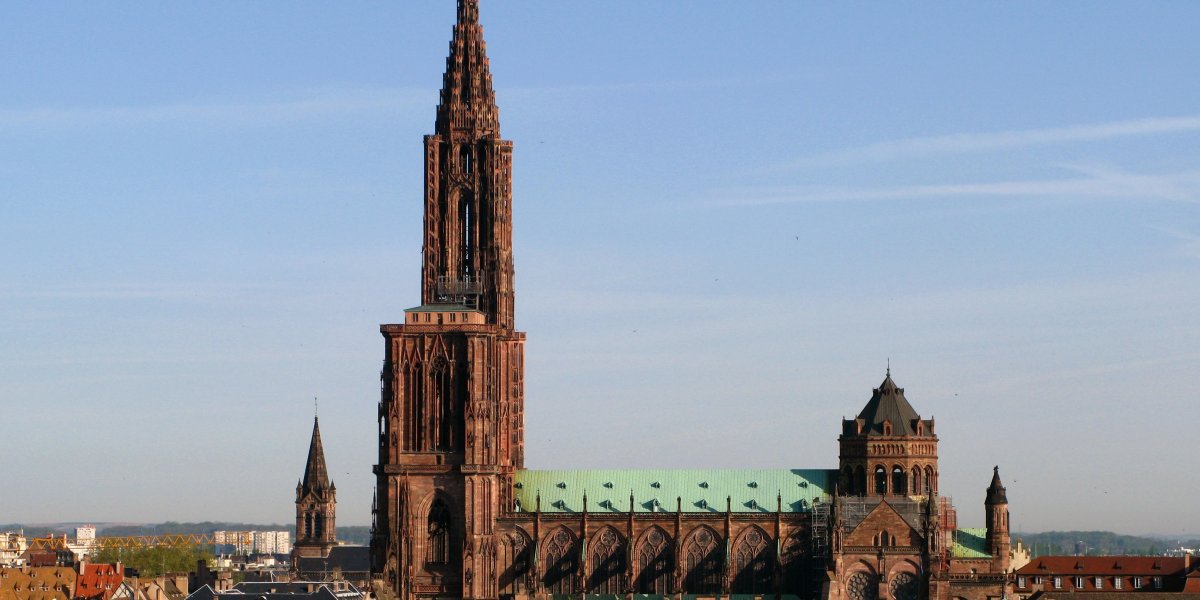
From the Gare de Strasbourg, walk straight along Rue du Maire Kuss and cross into the old town — in 15 minutes the single 142-meter spire appears above the rooftops, pulling you forward like a compass needle. Step into Place de la Cathédrale from Rue Mercière and the entire rose-sandstone west facade fills your vision: 66 meters of Gothic lacework so intricate that Victor Hugo called it a prodigious marvel. Circle the full perimeter to find the Renaissance sundial on the south transept and the ornate Maison Kammerzell next door — the most lavishly carved half-timbered house in all of Alsace, its 1467 facade covered in biblical scenes and grotesques.
Tip: Stand where Rue Mercière meets the square — the narrow medieval street creates a perfect portal framing the full west facade, and this is the single most powerful photograph in the city. At 09:00 you share the square with joggers and pigeons; by 11:00 tour bus groups make a clean shot impossible. Walk around to the south side — most visitors never leave the west facade and miss the delicate 1493 sundial carved into the transept wall.
Open in Google Maps →10:45
Neighborhood
Exit the cathedral square heading west along Grand'Rue, pass the handsome Place Kléber — Strasbourg's central square — and continue through the old market streets; in 15 minutes the stone facades give way to crooked half-timbered houses leaning over canals, and you have entered Petite France. This is the Strasbourg of postcards: 16th-century tanners' houses with steep pitched roofs and geranium-filled window boxes, mirrored in still canal water. Follow Rue du Bain-aux-Plantes — the most photogenic stretch — past the iconic Maison des Tanneurs, then cross to the lock where three waterways converge and water rushes between ancient buildings.
Tip: The most photographed angle is from the lock bridge where Quai de la Petite France meets Rue des Moulins — both canal branches, four half-timbered facades, and the distant cathedral spire all compose into one frame. Come before 11:30: the morning sun lights up the east-facing facades across the water, and tour boats have not yet churned the surface, so reflections are mirror-sharp.
Open in Google Maps →12:30
Food
From the lock bridge, walk one block south along Rue des Moulins — the restaurant's canal-front terrace appears on your right within three minutes. This traditional winstub has the best waterside tables in Petite France. Order the tarte flambée classique (€12) — Alsace's answer to pizza: paper-thin dough fired until the edges char and blister, smothered in crème fraîche, white onions, and smoked lardons — it arrives in under ten minutes and you eat it with your hands, tearing off strips while watching the lock cycle. Add a pression of Météor, the local Alsatian lager (€5), and you are out for under €20.
Tip: Arrive right at 12:30 to grab a canal-side table without waiting — by 13:00 every outdoor seat is taken. Order the classic version only: crème fraîche, onions, lardons, nothing else. The gratinée with melted cheese is for tourists; locals consider it an insult to the original.
Open in Google Maps →14:00
Landmark
Walk south from the restaurant along Rue des Moulins for three minutes — the dark medieval defense towers of the Ponts Couverts rise ahead, still guarding the river channels as they have since the 13th century. Despite the name, the timber roofs vanished centuries ago, but the massive square towers remain, straddling the channels of the River Ill like stone sentinels. Walk the full length of the bridges between all the towers — to the north, Petite France's half-timbered houses line both banks; to the west, the monumental Barrage Vauban dam seals the view; and from mid-span facing northeast, the cathedral spire rises directly above the tanners' rooftops.
Tip: The definitive Ponts Couverts photograph is from the central bridge facing northeast, where the canal, tower, half-timbered houses, and cathedral spire all stack into one composition. After 14:00 the sun is high enough to light both banks evenly without casting one side into deep shadow — earlier morning shots always lose the north bank.
Open in Google Maps →15:00
Landmark
From the last tower of the Ponts Couverts, continue 100 meters west and climb the open staircase on the left side of the stone dam — the Grande Terrasse panoramic rooftop is free and waiting. This 17th-century dam, designed by Vauban to flood the southern approaches during a siege, now houses the finest free viewpoint in Strasbourg. From the rooftop the city unfolds in every direction: the aligned towers of the Ponts Couverts directly below, the half-timbered huddle of Petite France beyond, the cathedral spire piercing the sky to the northeast, and on clear days the Black Forest hills of Germany on the eastern horizon.
Tip: The Grande Terrasse is uncrowded even at peak hours — most tourists never climb up. Stand at the northeast corner railing for the panorama that puts Ponts Couverts, Petite France, and the cathedral spire in one sweeping frame. Afternoon light is ideal: the sun is behind you, illuminating the entire old town without glare.
Open in Google Maps →19:00
Food
Walk back into Petite France along Rue du Bain-aux-Plantes — in five minutes you reach the most photographed building in the quarter, which is also your dinner table. Housed in a 1572 half-timbered tanners' guild building that leans dramatically over the canal, this is where Alsatian cuisine meets the setting it deserves. Order the choucroute royale (€26) — a mountain of sauerkraut slow-braised in Riesling, buried under smoked pork belly, Strasbourg sausages, and a fat knack — or the baeckeoffe (€28), three meats layered with potatoes and sealed in a terracotta pot overnight. A glass of grand cru Alsatian Riesling (€9) is non-negotiable. Budget €35–45.
Tip: Reserve by phone the day before and request 'côté canal' — the canal-side terrace at golden hour, with the half-timbered reflections rippling below your table, is worth the call. Arrive at 19:00 sharp; by 19:30 the terrace is full and the kitchen backs up. Tourist trap warning: avoid any restaurant in Petite France displaying laminated photo menus outside or advertising 'choucroute €9.90' — they serve frozen, factory-made food at inflated prices. If the menu is handwritten on a chalkboard and the waiter greets you in Alsatian dialect, you are in the right place.
Open in Google Maps →Zu Tag springen
09:00
Religious
Step into the nave while the morning crowd is still thin — the 12th-century stained glass catches the first eastern light at this hour, splashing deep reds and blues across the sandstone columns in a way that's impossible to reproduce by afternoon. Head straight for the Pillar of Angels in the south transept, then climb the 332 steps to the viewing platform (opens 9:30) for a panorama stretching from the Vosges Mountains to Germany's Black Forest across the Rhine. At 142 metres, this single spire was the tallest building on earth for over two centuries — standing beside it at the top, you understand why medieval travellers called it the finger of God.
Tip: The platform queue moves fast before 10:00 — after that, expect 20-minute waits. Enter the nave first at 09:00 for photos in near-empty aisles, then climb when the platform opens at 09:30. The astronomical clock performs its famous automata show at exactly 12:30 daily; if you want to catch it, buy the separate ticket (€3) at the south transept entrance by 11:45 and pop back in before lunch.
Open in Google Maps →11:15
Museum
Exit the cathedral's south door and cross Place du Château — the museum is the timbered medieval building thirty metres directly ahead. Inside you'll find the original 13th-century cathedral statues (the ones on the exterior today are copies), the haunting Head of Christ from Wissembourg — the oldest-known figurative stained glass in the world, dating to the 11th century — and luminous paintings by the Rhine Masters of the late Middle Ages. The rooms themselves, with their low vaulted ceilings and stone floors, feel like an extension of the cathedral.
Tip: Most visitors skip this museum entirely, which means you'll often have the ground-floor sculpture hall to yourself. Don't miss the original Foolish Virgins from the cathedral's south portal — their sly, knowing expressions are far more vivid than the weathered copies outside. Budget one hour: the collection is small but every piece earns its place.
Open in Google Maps →12:30
Food
Walk two blocks west from the museum along Rue des Hallebardes, then turn right onto Rue du Sanglier — Chez Yvonne sits behind a modest wooden sign at number 10. This legendary winstub has been serving Alsatian home cooking for over a century and was famously frequented by Jacques Chirac during his political campaigns. Order the choucroute royale (€19.50) — a generous tower of sauerkraut braised in Riesling, piled with smoked pork belly and Strasbourg sausage — or the flammekueche traditionnelle (€14), paper-thin and blistered, spread with crème fraîche and smoky lardons.
Tip: Book a day ahead or arrive by 12:00 sharp — the dining room fills completely by 12:30 on weekdays. Sit downstairs for the full winstub atmosphere: dark wood panelling, checked tablecloths, and a hum of Alsatian dialect from regulars at the bar. Budget €20–30 per person with a glass of local Riesling.
Open in Google Maps →14:00
Neighborhood
Walk south from Chez Yvonne along Grand'Rue for ten minutes — the half-timbered houses grow denser and the streets narrow until you emerge at the canals of Petite France, the old tanners' and millers' quarter. The 16th-century houses lean over the water with steep pitched roofs and window boxes of geraniums, mirrored in the still canal surface below. Follow Rue du Bain-aux-Plantes to its end for the most photographed view in Alsace — the convergence of three waterways beneath a row of pastel façades — then loop back through the quiet lanes on the south bank where most tourists never wander.
Tip: By 14:00 the afternoon sun lights up the canal-side façades from the south — the best photo angle is from the small footbridge at the eastern end of Rue du Bain-aux-Plantes, shooting west toward the Ponts Couverts towers. Walk slowly: the real treasures are in the carved beam-ends, the crooked shutters, and the tiny courtyard passages between houses that most visitors walk straight past.
Open in Google Maps →15:45
Landmark
Continue west through Petite France past the three medieval Ponts Couverts towers — the Barrage Vauban is the broad covered bridge directly ahead, a five-minute walk. Built by Louis XIV's military engineer in the late 17th century, this dam could flood the entire southern approach to the city in wartime. Take the stairs to the open rooftop terrace for the single best panorama in Strasbourg: the aligned Ponts Couverts watchtowers directly below, Petite France's half-timbered roofscape beyond, and the cathedral spire rising pink against the sky in the distance.
Tip: The rooftop terrace is free and uncrowded even in high season — most tourists photograph the towers from below and never climb up. Late afternoon light between 16:00 and 17:00 is ideal: the sun is behind you, the spire glows rose-gold, and the canal water catches fire. Inside the bridge, a small gallery of medieval stone sculptures is worth a five-minute detour.
Open in Google Maps →19:00
Food
Walk eight minutes back east through Petite France along the canal — Maison des Tanneurs is the ornate half-timbered house at 42 Rue du Bain-aux-Plantes, its terrace overhanging the water on wooden stilts. This 1572 tanners' guild building is the most atmospheric dinner setting in Strasbourg. Order the baeckeoffe (€26) — three meats slow-braised with potatoes in a Riesling-sealed ceramic dish for hours until everything melts together — or the filet de sandre au Riesling (€28), the local pike-perch in a velvety wine sauce, the lighter choice that locals swear by.
Tip: Reserve two days ahead and request a canal-side terrace table — it seats only twelve and fills by 19:30. Budget €35–50 per person with wine. Avoid the cluster of tourist restaurants on Place de la Cathédrale and Rue du Vieux-Marché-aux-Poissons — they charge premium prices for frozen-and-reheated choucroute; if the menu is laminated with photos, keep walking.
Open in Google Maps →09:00
Neighborhood
From the cathedral, walk ten minutes north across the Ill via Pont du Faux-Rempart — you'll leave the medieval old town and step into a completely different city. Place de la République is the centrepiece of the Neustadt, the German Imperial Quarter built after 1871 when Kaiser Wilhelm I set out to make Strasbourg a showcase of Prussian power. Circle the square to take in the colossal Palais du Rhin (the former Imperial Palace), the National and University Library, and the broad Haussmann-scale boulevards radiating outward — this entire district earned its own UNESCO World Heritage inscription in 2017, and the contrast with yesterday's medieval lanes is electrifying.
Tip: The Palais du Rhin occasionally opens for free guided tours on weekends — check the Strasbourg tourism office site the day before. The best photo of the square is from the northeast corner, with the palace reflected in the ornamental pool. Morning light is ideal: the eastern sun illuminates the full façade without shadow.
Open in Google Maps →10:45
Museum
Walk twelve minutes south from Place de la République along Rue du Dôme, back across the canal into the Grande Île — the Palais Rohan's elegant classical façade faces the River Ill just behind the cathedral's south side. Built in the 1730s for Strasbourg's prince-bishops, this is where Louis XV, Marie Antoinette, and Napoleon all slept on their visits to Alsace. The ground-floor Musée des Arts Décoratifs is the highlight: walk through the lavishly restored episcopal apartments — the Throne Room, the King's Bedroom, the gilded library — which rival Versailles in ornamentation but receive a hundredth of the visitors.
Tip: A single ticket covers the Arts Décoratifs museum; the combined ticket for all three Palais Rohan museums (add Fine Arts and Archaeology) is €12, but for a focused visit the decorative arts alone justify the stop. Don't skip the palace courtyard — it's free to enter and offers the best view of the cathedral's south transept, a perspective almost no one photographs.
Open in Google Maps →12:30
Food
Exit the Palais Rohan, turn left along the Ill and cross Pont du Corbeau — L'Ancienne Douane sits on the river at 6 Rue de la Douane, a five-minute walk. This 14th-century former customs house is one of Strasbourg's grandest brasseries, with a riverside terrace overlooking the weir and soaring medieval beamed ceilings inside. Order the fleischnaka (€16) — rolled meat and pasta simmered in aromatic broth, a dish unique to Alsace that you won't find outside the region — or the spätzle gratinées au Munster (€14), golden and bubbling from the oven, stringy with mountain cheese.
Tip: Grab a terrace table overlooking the weir if the weather allows — the sound of rushing water and the view of the old customs bridge make this the most scenic lunch setting on the Grande Île. Arrive by 12:15 for terrace seating without a wait. Budget €18–28 per person with a drink.
Open in Google Maps →14:00
Museum
Cross back over Pont du Corbeau and walk one minute south along Quai Saint-Nicolas to number 23–25. This is not a conventional museum but a labyrinth of three interconnected 16th- and 17th-century timber-frame houses linked by creaking staircases and open galleries over a cobbled courtyard. Each room recreates a facet of traditional Alsatian life — a farmhouse kitchen with copper pots over a stone hearth, a potter's workshop, a wine-grower's parlour — filled with real tools, hand-painted furniture, folk costumes, and the ornate moulds for the famous kougelhopf cake.
Tip: The layout is deliberately maze-like — don't fight it, just wander. The top-floor collection of painted Alsatian furniture and hand-carved Easter-egg moulds is the most photogenic section. Allow extra time for the open courtyard gallery, which frames a perfect canal view through the timber beams — one of the most beautiful hidden corners on the Grande Île.
Open in Google Maps →15:45
Park
From the museum, walk northeast through the Neustadt for twenty minutes along Avenue de la Liberté, past grand imperial-era apartment buildings with wrought-iron balconies, until the trees of Strasbourg's oldest park open up before you. First laid out in 1692, the Orangerie is where Strasbourgeois come to decompress after work: rent a rowing boat on the lake (€8), wander through the rose garden in bloom from May to October, or simply sit beneath the ancient plane trees and watch the white storks nesting on the pavilion rooftops — Alsace's iconic bird, once nearly extinct, now thriving here in a free-entry sanctuary.
Tip: The stork enclosure near the northeast corner of the park is home to dozens of nesting pairs from March to September — bring a zoom lens. Late afternoon light filtering through the plane trees is gorgeous for photos. The park café by the lake serves decent coffee but skip the food; save your appetite for dinner.
Open in Google Maps →19:00
Food
Walk twenty minutes back west to the cathedral, or hop on the tram from the nearest stop for a five-minute ride to the centre. Maison Kammerzell stands on Place de la Cathédrale, directly facing the cathedral's western façade — every beam of this building, dating to 1427, is covered in Renaissance carvings of saints, warriors, musicians, and mythical beasts, making it the most ornately decorated half-timbered house in all of France. For your farewell dinner, the coq au Riesling (€26) arrives in a cast-iron cocotte with buttery spätzle, or begin with the foie gras poêlé (€19) before the filet de sandre au Riesling (€28).
Tip: Reserve and request the first floor — the painted ceiling murals from the early 1900s are extraordinary, and most diners in the ground-floor room never know they exist. Budget €40–55 per person with wine. After dinner, step outside for the cathedral façade illuminated against the night sky — the floodlighting turns the rose window into a lantern. Skip the souvenir shops ringing the square: they sell mass-produced goods at inflated prices; for authentic Alsatian gifts, the small artisan shops on Rue du Bain-aux-Plantes in Petite France are where locals actually buy.
Open in Google Maps →
Trip builder
Plan this trip around Strasbourg
Turn this guide into a bookable rail itinerary with FlipEarth.
Keep exploring
Related cities
Nearby cities
More in the same country
FAQ
Frequently asked questions
How many days do you need in Strasbourg?
Most travelers enjoy Strasbourg in 1 days, with enough time for headline sights and a slower meal or museum stop.
What's the best time to visit Strasbourg?
The easiest season for most travelers is Apr-Dec, especially if you want good weather and manageable crowds.
What's the daily budget for Strasbourg?
A practical starting point is about €70 per person per day before hotels, then adjust based on museums, dining, and transport.
What are the must-see attractions in Strasbourg?
A good first shortlist for Strasbourg includes Ponts Couverts, Barrage Vauban.