City Guide
Stockholm
Sweden · Best time to visit: May-Sep.
Day-by-day plan
Choose your pace
Reisedauer
09:00
Landmark
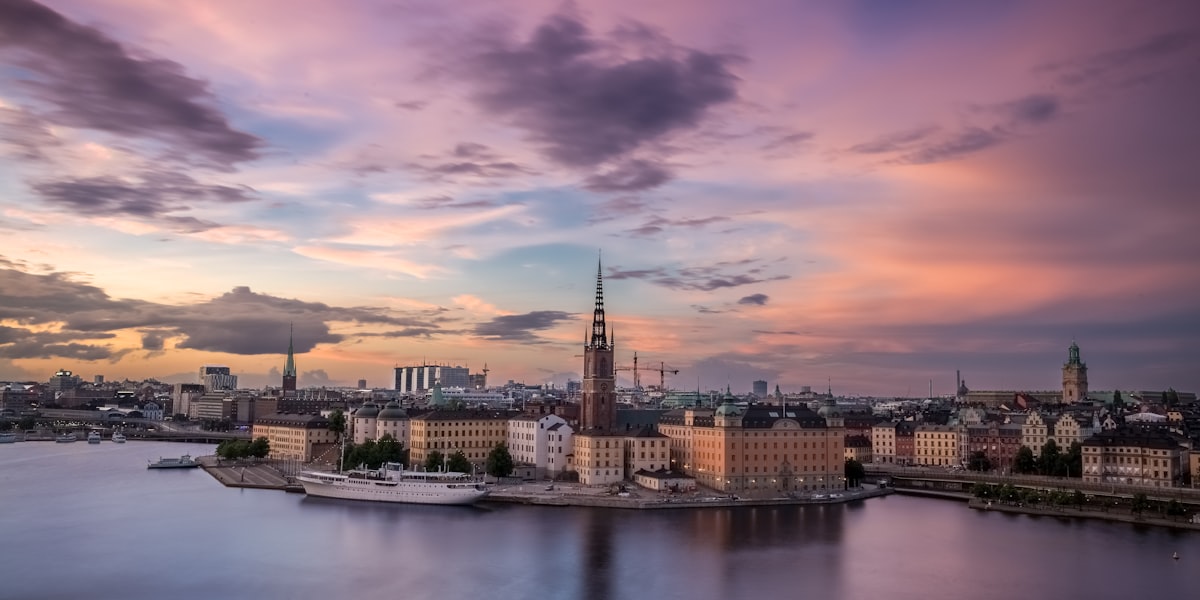
From T-Centralen, walk west along Hantverkargatan for ten minutes — the City Hall's hundred-metre tower topped with three golden crowns will pull you forward like a compass needle. The 1923 building commands the Riddarfjärden waterfront, its eight million red bricks glowing warm copper in the morning eastern light. Walk through the open courtyard arcade and along the waterside terrace for an unobstructed panorama of Riddarholmen's medieval church spire and the ochre rooftops of Gamla Stan — the same view that opens the Nobel Prize broadcast every December.
Tip: Walk down to the southeast corner of the waterside terrace, where the tower aligns with Riddarholmen Church's cast-iron spire — most visitors stay in the courtyard and never find this angle. Arrive before 10:00 and you'll have the terrace nearly to yourself; by mid-morning tour buses unload at the main entrance.
Open in Google Maps →10:15
Neighborhood
Cross Stadshusbron bridge heading east — the twelve-minute walk gives you Riddarholmen Church reflected in still morning water, one of Stockholm's most painted silhouettes. Enter the medieval labyrinth through Munkbron gate and let the narrow cobblestone lanes pull you south into Stortorget, the sunlit square ringed by merchant houses in ox-blood red and mustard gold where Nobel Prize winners are announced each October. Wind through Prästgatan's quiet curves to Mårten Trotzigs Gränd — at ninety centimetres wide and thirty-six worn stone steps, the city's narrowest alley — then emerge north at the Royal Palace's baroque façade, where stone lions guard Europe's largest inhabited royal residence.
Tip: Mårten Trotzigs Gränd hides between Prästgatan 22 and 24 — look for the narrow iron railing descending to your left and photograph from the bottom step looking up for the shot everyone tries to replicate. The Royal Palace guard change happens at 12:15 (April–October), but waiting burns thirty minutes on a tight schedule; the soldiers assembling in the outer courtyard from 11:45 are equally photogenic and free. Skip every restaurant ringing Stortorget — they charge triple for reheated tourist food.
Open in Google Maps →12:00
Food
From the Royal Palace's north side, cross Strömbron — the short bridge where Lake Mälaren's fresh water meets the Baltic's salt, sometimes visible as two different colours in the current below. Walk through Kungsträdgården park and up Sibyllegatan for fifteen minutes to reach Stockholm's legendary food hall, open since 1888 in a cathedral-like red-brick building. Head straight to Lisa Elmqvist's marble counter for a räksmörgås — hand-peeled Skagen shrimp piled generously on sourdough (185 SEK / €16) — or their silky fisksoppa with aioli and rye bread (165 SEK / €14). Eat standing at the counter like every local in the room and you'll be out in twenty minutes.
Tip: Use the standing counter on the left side of Lisa Elmqvist — identical menu, half the wait time of the sit-down tables. If the queue still wraps around, Tysta Mari two stalls down does an equally excellent fish soup for twenty kronor less. Budget 150–220 SEK (€14–20) for a full lunch.
Open in Google Maps →13:00
Neighborhood
Step out of the food hall and walk south on Nybrogatan for five minutes — the harbour opens up at Nybrokajen where white archipelago ferries line the quay. Turn left onto Strandvägen, Stockholm's most opulent boulevard: one and a half kilometres of linden trees, Art Nouveau façades with ornate balconies, and vintage wooden boats moored in the canal below. Walk the full length on the harbour side as the early afternoon sun lights up the ornate building fronts across the water. The boulevard ends at Djurgårdsbron — a bridge flanked by two gilded Norse gods — where the Nordic Museum's fairy-tale tower rises straight ahead and the Gröna Lund rollercoaster silhouette breaks the treeline to the right.
Tip: Stay on the south pavement — the harbour side — for unobstructed water views the entire walk. Near Strandvägen 27, look down at the canal where a line of restored 1920s wooden sailing boats are moored year-round — free to photograph from the quayside and one of Stockholm's most quietly beautiful scenes that bus tourists never see.
Open in Google Maps →14:30
Park
Cross Djurgårdsbron under the gilded bridge sentinels and bear left onto Stockholm's green island — a royal hunting ground since the fifteenth century turned cultural parkland. Follow Djurgårdsvägen along the waterfront past the Nordic Museum's soaring Renaissance tower and the ship-shaped Vasa Museum, both worth returning for if Sweden gives you another day. Continue on the oak-lined paths toward Rosendals Trädgård, where the afternoon light filters through centuries-old oaks and the hum of the city fades to birdsong. Loop back along the southern waterfront for wide-open views across to Södermalm's cliffs — a different Stockholm entirely from the one you walked this morning.
Tip: Rosendals Trädgård is the island's best-kept secret — a biodynamic garden café where pastries are baked with flour milled on-site. The apple cake with vanilla sauce (75 SEK / €7) is the one thing locals would riot over if it left the menu. In May and June the wisteria tunnel in the garden's south corner is Stockholm's most photographed spot that tourists never find.
Open in Google Maps →19:00
Food
Retrace Djurgårdsbron and walk west along Strandvägen — golden-hour light now hits the façades from the opposite angle, worth a second look. Turn right on Grev Turegatan and in five minutes you reach Stureplan, Stockholm's social epicentre since the 1890s. Sturehof has anchored this corner for over a hundred and twenty years — part brasserie, part oyster bar, part living room of the city. Open with Toast Skagen, the dish Sweden gave the world: hand-peeled shrimp, crème fraîche, and dill mounded on crisp bread (189 SEK / €17). Follow with their plankstek or the catch of the day. Budget 400–600 SEK (€35–55) per person with one drink.
Tip: Book an outdoor terrace table online for May through September — it is Stureplan's best people-watching seat in the city. Walk-ins always find room at the long bar counter inside. Tourist trap warning: the restaurant row along Biblioteksgatan between here and NK department store survives on foot traffic alone — overpriced, under-seasoned, and not where a single Stockholmer would spend their money. You already found the right place.
Open in Google Maps →Zu Tag springen
09:00
Landmark
The 9:00 English-language guided tour begins in the Blue Hall — where 1,300 Nobel laureates dine each December beneath an eight-million-brick vault — then moves into the Golden Hall, its walls ablaze with 18 million glass and gold mosaic tiles. Climb the 365-step tower afterward for Stockholm's finest bird's-eye panorama: Gamla Stan's ochre spires, Riddarfjärden's glinting water, and the archipelago dissolving into summer haze.
Tip: Book the 9:00 tour online to guarantee a spot — by 10:00 the cruise-ship groups arrive and the tower queue doubles. The tower is only open June through September; if visiting outside summer, skip the climb and linger in the Golden Hall where the mosaics reward slow looking.
Open in Google Maps →11:00
Landmark
Cross Stadshusbron bridge and walk east along the waterfront past the Parliament building — a 12-minute stroll with ferries gliding beneath you and Gamla Stan's skyline growing ahead. Inside one of Europe's largest working royal palaces, head straight for the Royal Apartments' gilded state rooms and the Treasury, where Erik XIV's 1561 crown and the sword of Gustav Vasa are kept. Time your exit for 12:15 to catch the Changing of the Guard — brass, drums, and cavalry filling the outer courtyard in a ceremony unchanged since the 18th century.
Tip: Enter via the south entrance on Slottsbacken to skip the crowd clustered at the main gate. Buy the combined ticket (Royal Apartments + Treasury + Tre Kronor Museum) — it saves about 30% versus individual entries. The Changing of the Guard runs daily at 12:15 May through August; on Sundays and holidays it shifts to 13:15.
Open in Google Maps →13:00
Food
Walk through the palace's north gate into Stortorget — Gamla Stan's main square with its candy-colored merchant houses is two minutes away. Grillska Huset occupies a vaulted 17th-century cellar right on the square, run by Stockholm's Stadsmission charity; the daily lunch buffet of Swedish husmanskost (home cooking) always features silky meatballs with lingonberry, creamy mashed potato, and freshly baked bread. Head downstairs to the brick-arched cellar dining room for the atmosphere.
Tip: The Dagens Lunch (daily special) at 135 SEK (~13 EUR) includes a main, salad bar, bread, and coffee — the best-value sit-down meal in Gamla Stan. Skip every restaurant on Västerlånggatan with English menus on the sidewalk: they charge double for frozen meatballs.
Open in Google Maps →14:00
Neighborhood
Step outside and you're already in the heart of it — head south along narrow Prästgatan, where medieval buildings lean toward each other overhead and window boxes drip with flowers. Squeeze through Mårten Trotzigs Gränd, Stockholm's narrowest alley at just 90 centimeters wide, then loop back to Stortorget via Köpmangatan for photos in the afternoon light — around 15:00 in summer the western sun paints the ochre and rust facades a deep gold.
Tip: The afternoon sun hits Stortorget's facades from the west around 15:00 — that is the window for the classic Stockholm postcard shot. Photograph from the southeast corner of the square with the Nobel Museum behind you for the cleanest composition.
Open in Google Maps →16:00
Museum
Exit Gamla Stan south via Järntorget, cross the Slussen interchange, and follow the Södermalm waterfront east — a 15-minute walk with the harbor sparkling below. This former 1906 customs warehouse ranks among the world's top photography museums, with two to three major exhibitions rotating at any time. Save energy for the top-floor bar: its panoramic windows frame Djurgården, Gamla Stan, and the waterways in a single sweep — arrive before the after-work crowd claims the window seats.
Tip: The top-floor café has the same view as the restaurant but no reservation or minimum spend — a coffee and kanelbulle (cinnamon bun) at sunset is one of Stockholm's finest cheap thrills. On Thursdays and Fridays the museum stays open until 23:00 and the top floor turns into a gallery-bar scene.
Open in Google Maps →18:30
Food
Walk south along Götgatan for 10 minutes, then turn left into the SoFo district's Nytorgsgatan — vintage shops and specialty coffee roasters line the way. This single-concept restaurant does one thing perfectly: Swedish meatballs in every variation, from the classic beef-and-pork with lingonberry cream sauce to wild boar with chanterelle mushrooms. The stripped-back dining room fills fast; the outdoor tables facing Nytorget square are the ones to fight for on a summer evening.
Tip: Order the Classic (165 SEK / ~16 EUR) with extra cream sauce and pickled cucumber — non-negotiable. No reservation system: arrive by 18:00 or expect a 20-minute wait. Budget 200–280 SEK (~20–27 EUR) per person with a drink. Fair warning: the 'traditional Swedish' restaurants around Götgatan and Medborgarplatsen with sidewalk English menus are tourist traps serving frozen meatballs at twice the price.
Open in Google Maps →09:00
Museum
Take tram 7 from Norrmalmstorg or walk 20 minutes along Strandvägen and across Djurgårdsbron — the bridge frames a postcard view of the island's treeline ahead. Inside this purpose-built hall floats the Vasa, a 64-meter warship that sank in Stockholm's harbor on her maiden voyage in 1628 and was raised nearly intact 333 years later — 98% of what you see is original oak. Circle all six levels to grasp the scale: the 700 carved sculptures on the stern are as intricate as cathedral stonework.
Tip: In summer (June–August) doors open at 08:30 — arrive at 08:15 for a nearly private viewing of the ship before the crowds pour in by 10:30. Head straight to the top level for the stern carvings at eye level, then spiral down; most visitors start low and the upper galleries are deserted for your first 20 minutes.
Open in Google Maps →10:45
Entertainment
Exit the Vasa Museum, turn right on Djurgårdsvägen, and you're at the entrance in two minutes — they share the same stretch of road. Far more than memorabilia behind glass: you sing into a virtual microphone with holographic ABBA, mix a track in the recreated Polar Studios, and try on digital costumes that respond to your dance moves. Even skeptics leave grinning — the story of four Swedes conquering the world from this small city is irresistibly told.
Tip: Tickets must be booked for a specific time slot on their website — walk-ups are rarely available in summer. Book the earliest slot after your Vasa visit and budget a full 1.5 hours; the Polar Studios mixing desk alone can swallow 20 minutes.
Open in Google Maps →12:30
Food
Follow the gravel path east through Djurgården's oak-lined parkland — a 15-minute walk where the canopy dapples the light and city noise drops away entirely. Rosendals is a working biodynamic garden with a greenhouse café beloved by Stockholmers: grab a tray and choose from open-faced shrimp sandwiches, seasonal salads, and the city's finest kanelbulle (cinnamon bun, 55 SEK / ~5 EUR). Sit in the walled apple orchard — the tables among the rose beds are the most coveted outdoor lunch seats in Stockholm.
Tip: Self-service only: pick up food at the counter, pay by card (no cash accepted anywhere), and bus your own tray. A sandwich, coffee, and pastry runs 150–180 SEK (~15–17 EUR). Arrive before 12:30 on weekends or every garden table will be taken.
Open in Google Maps →14:00
Museum
Walk northwest back through the park for 10 minutes — Skansen's hilltop entrance sits just above the main Djurgården road. Founded in 1891, this is the world's first open-air museum: 150 historic buildings transplanted from every corner of Sweden, staffed by costumed interpreters who blow glass, bake flatbread, and forge iron before your eyes. The Nordic Zoo section is home to moose, brown bears, wolverines, and lynx — Scandinavian wildlife you are unlikely to spot on your own.
Tip: Enter via Hazeliusporten (the upper gate) to start at the hilltop and walk downhill through the centuries — you cover the same ground with half the effort. Grab a traditional waffle with jam and cream at Skansen's Stora Gungan café if your energy dips; it's the best mid-afternoon snack on the island.
Open in Google Maps →16:30
Shopping
Exit Skansen and walk west along Djurgårdsvägen, cross Djurgårdsbron, then follow the magnificent Strandvägen boulevard — a 20-minute harbor promenade past moored vintage schooners that is Stockholm at its most elegant. Östermalms Saluhall, painstakingly restored to its 1888 cathedral-like grandeur, is a market hall where fishmongers, charcuteries, and cheese specialists have served the city's finest since before electricity. Browse Lisa Elmqvist's towers of fresh shrimp and pick up reindeer jerky and cloudberry jam — the best edible souvenirs in Sweden.
Tip: Lisa Elmqvist's räksmörgås (shrimp sandwich, 195 SEK / ~19 EUR) is a Stockholm institution — order at the counter and eat standing at the bar for the full local experience. The hall closes at 18:00 on weekdays and 16:00 on Saturdays, so check the day before planning your visit.
Open in Google Maps →18:30
Food
Walk five minutes north to Stureplan, the circular plaza crowned by its iconic mushroom-shaped rain shelter — Sturehof's terrace wraps around the corner like a front-row seat to Stockholm nightlife warming up. Open since 1897, this is the city's quintessential seafood brasserie, where the after-work crowd and visiting dignitaries share the same zinc bar over platters of oysters. Order the Toast Skagen — a generous mound of hand-peeled shrimp, crème fraîche, and dill on crisp bread, invented in Sweden and perfected at this counter.
Tip: Reserve a terrace table via their website for sunset — it is the city's premier people-watching perch in summer. The Toast Skagen (195 SEK / ~19 EUR) and pan-fried herring with mashed potato (185 SEK / ~18 EUR) are the two must-orders; budget 350–450 SEK (~33–43 EUR) per person with wine. One last warning: the 'Viking-themed' souvenir shops around Kungsträdgården sell mass-produced imports at absurd markups — for real Swedish design, Designtorget at Kulturhuset is where locals actually shop.
Open in Google Maps →Zu Tag springen
09:00
Neighborhood
Cross Riksbron from Norrmalm — as Gamla Stan's ochre facades and copper spires rise ahead, you understand why Stockholmers call this 'the city between the bridges.' Wander the medieval lanes from Stortorget square through Mårten Trotzigs Gränd — Stockholm's narrowest alley at just 90 cm — and let yourself get beautifully lost before the tour groups arrive at ten.
Tip: Arrive at Stortorget before 09:30 — cruise ship tour groups flood the square by 10:00. The colorful merchant houses (nos. 18–22) photograph best from the southeast corner, where morning sun hits the facades directly.
Open in Google Maps →10:30
Landmark
From Stortorget, walk 3 minutes north along Trångsund — the Royal Palace's baroque mass fills the sky as the lane opens into Slottsbacken square. With 608 rooms this is one of Europe's largest palaces still in official use; focus on the Royal Apartments and the Treasury, where the crown jewels gleam behind armored glass.
Tip: The Changing of the Guard takes place in the outer courtyard at 12:15 on weekdays and 13:15 on Sundays in summer — time your exit to catch it. The ceremony with full Royal Guard Band is far more impressive than London's version, yet almost no one queues for it.
Open in Google Maps →12:30
Food
Exit the palace's southern gate and stroll 5 minutes down Österlånggatan, Stockholm's oldest merchant street — the doorway at number 51 has welcomed guests since 1722. Listed in the Guinness Book of Records as one of the world's oldest continuously operating restaurants, Den Gyldene Freden is where the Swedish Academy still dines on Thursday evenings debating Nobel Prizes over candlelight.
Tip: Order the Toast Skagen (hand-peeled shrimp on toast, ~175 SEK) followed by Wallenbergare (butter-fried veal patty with lingonberries, ~245 SEK). Budget 280–380 SEK per person. No reservation needed at lunch — walk in before 12:30 to claim a table in the vaulted cellar room, which feels unchanged since the 18th century.
Open in Google Maps →14:30
Park
Walk south through Gamla Stan to Slussen, cross to Södermalm, and climb the steps at Bastugatan — a 10-minute walk rewarded with Stockholm's single greatest panorama. The 500-meter cliffside promenade sweeps across Gamla Stan, City Hall, and Lake Mälaren in one unbroken frame; linger on the benches, then use the remaining time to stroll the quiet hilltop lanes of Mariaberget.
Tip: Between 14:00 and 16:00 in summer, the sun is behind you and the light on Gamla Stan's facades reaches its warmest gold — this is the moment for the definitive Stockholm photograph. Walk to the western end for the widest panorama, or the eastern end to frame the old town more tightly.
Open in Google Maps →19:00
Food
Walk 15 minutes east through Södermalm's Nytorget neighborhood — past vintage shops and locals lingering at sidewalk café tables — until you reach Blekingegatan's unmistakable beer hall entrance. Pelikan is one of Stockholm's great beer halls; the cavernous Art Nouveau dining room with soaring ceilings and marble tabletops is where Stockholmers come for husmanskost — traditional home cooking elevated to an art form.
Tip: Start with the SOS platter (Smör, Ost, Sill — butter, cheese, and three styles of pickled herring, ~175 SEK), then order Raggmunk med fläsk (crispy potato pancake with pork belly and lingonberries, ~205 SEK). Budget 350–450 SEK. Arrive by 18:45 — Pelikan takes no reservations and by 19:30 the wait stretches to 40 minutes. Avoid the restaurants lining Götgatan between Slussen and Medborgarplatsen — they are tourist-priced and forgettable compared to walking five minutes further to Pelikan.
Open in Google Maps →10:00
Museum
Walk east along Strandvägen from Nybroplan for 15 minutes — one of Europe's grandest boulevards, where Art Nouveau facades look out over a harbor of vintage wooden boats — then cross Djurgårdsbron to the museum. Inside, the warship Vasa, which sank on her maiden voyage in 1628 and was raised 333 years later 98% intact, towers five stories above you in a dim blue hall; nothing prepares you for the sheer scale.
Tip: Go straight to the top floor first and spiral down — the ship reveals a new angle at each level, and the upper floors are deserted while everyone crowds the ground floor entrance. The 25-minute documentary (screened hourly) explains the sinking and recovery — catch it on level 4 mid-visit for context. Opens 08:30 Jun–Aug, 10:00 Sep–May.
Open in Google Maps →12:30
Food
Exit the Vasa Museum and walk 5 minutes east along Djurgårdsvägen — Blå Porten's blue wooden gate is unmistakable among the chestnut trees. A Djurgården institution since the 1800s, this is the island's gathering place, with a large garden terrace and a daily-changing lunch buffet leaning on seasonal Swedish ingredients.
Tip: The lunch buffet (~195 SEK) is the best value — warm dishes, fresh salads, and always a fish option with just-baked bread. If you prefer à la carte, order the räksmörgås (open-faced shrimp sandwich, ~175 SEK) piled absurdly high in the Swedish tradition. Budget 200–280 SEK. Sit in the garden if weather holds.
Open in Google Maps →14:00
Museum
Walk 3 minutes south along Djurgårdsvägen past the Gröna Lund amusement park entrance to the Pop House building. This is not a museum behind glass — you sing alongside holographic ABBA members, mix tracks in a replica recording studio, and walk through a recreation of the Polar Music Studio where the albums were born.
Tip: Book your timed-entry ticket online at least a day ahead — walk-up tickets sell out by noon in summer. The interactive stations are what make this visit extraordinary, so budget a full 90 minutes instead of rushing the displays. There is a phone inside connected to a number only the four ABBA members know — if it rings while you are there, answer it.
Open in Google Maps →16:00
Park
Walk 10 minutes northeast through Djurgården's ancient oak grove on the gravel path — the canopy filters afternoon light into soft green dapple. Rosendals Trädgård is a biodynamic garden and greenhouse where Stockholmers come to escape everything; wander the flower beds, apple orchards, and vegetable plots, then sit with a warm cinnamon bun and let the afternoon dissolve.
Tip: The garden is free to enter. Their kanelbulle (cinnamon bun, ~55 SEK) is widely considered the best in Stockholm — get one warm from the bakery window. The greenhouse café is most beautiful in late afternoon when the low sun floods it golden.
Open in Google Maps →19:00
Food
Stroll 8 minutes west back toward Djurgårdsvägen — a yellow wooden villa appears through the trees like a scene from a Bellman poem. Named after a character in 18th-century poet Carl Michael Bellman's drinking songs, this restaurant has occupied this idyllic spot since 1897; in summer the garden terrace under the linden trees is one of Stockholm's most romantic dinner settings.
Tip: Order the Köttbullar (Swedish meatballs with cream sauce, lingonberries, and pickled cucumber, ~245 SEK) — this is the definitive version of Sweden's most famous dish. Finish with the cloudberry sorbet. Budget 400–550 SEK. Reserve a garden table for 19:00 — walk-in waits on summer evenings run long. Skip the overpriced hotdog stands and snack kiosks around Gröna Lund on the walk back — they charge theme-park prices for cafeteria food.
Open in Google Maps →09:30
Landmark
From T-Centralen, walk 10 minutes west along the Kungsholmen waterfront — the City Hall's red-brick tower with its three golden crowns grows larger with every step. Inside, the Blue Hall hosts the annual Nobel Prize banquet for 1,300 guests and the Gold Room shimmers with 18 million gilded mosaic tiles; the guided tour takes you through both, narrating a century of Swedish ceremony.
Tip: English tours run every 30 minutes in summer — join the 09:30 departure to beat the late-morning crush. After the interior tour, pay the extra ~70 SEK to climb the 365-step tower (open May–Sep) for the single best 360-degree panorama of Stockholm.
Open in Google Maps →11:15
Landmark
Walk 10 minutes east back to T-Centralen — you are about to descend into what locals call the world's longest art gallery. Ride the escalator to the blue line platform, a cavern of raw bedrock painted ocean-blue and laced with white vine motifs, then take one stop to Kungsträdgården, where archaeological ruins and vivid red sculptures erupt from the walls.
Tip: At T-Centralen's blue line platform, stand at the far end for the most dramatic perspective of the painted cave ceiling receding into the distance. At Kungsträdgården, look up — the station was carved through the ruins of the Makalös Palace, and fragments are preserved in the design. An SL travel card covers all rides.
Open in Google Maps →12:30
Food
Ride back to T-Centralen, exit toward Hötorget, and walk 4 minutes north — descend the stairs into Hötorgshallen's basement food market. Kajsas Fisk is a no-frills counter serving one legendary dish: a rich, creamy fish soup with unlimited bread that has drawn a loyal lunchtime queue of office workers, taxi drivers, and chefs since the 1980s.
Tip: There is really only one order: the fisksoppa (~145 SEK) with bread, butter, aioli, and unlimited refills — dense with salmon, cod, and prawns in a saffron-cream broth. Budget 160–200 SEK with a drink. The queue moves fast; do not be deterred if the line is out the door at noon — grab a counter stool and eat like a local.
Open in Google Maps →14:30
Shopping
Walk 8 minutes east through Stureplan and south on Humlegårdsgatan — the restored red-brick market hall rises like a cathedral of Swedish gastronomy. Reopened in 2020 after a meticulous four-year restoration, Östermalms Saluhall is Scandinavia's most beautiful food hall; browse stalls of aged cheese, cured reindeer, cloudberry preserves, and smoked Arctic char at whatever pace feels right.
Tip: Lisa Elmqvist's counter at the center of the hall has the finest seafood — their hand-peeled shrimp by weight is what Stockholm's restaurant chefs buy for their own kitchens. Taste a sliver of aged Västerbotten cheese (Sweden's answer to Parmesan) at any cheese stall — free samples and genuinely extraordinary. The upper gallery gives the best view of the hall's restored architecture.
Open in Google Maps →19:00
Food
Walk 5 minutes west along Mäster Samuelsgatan — Prinsen's warm amber light and white tablecloths have welcomed Stockholm's writers, actors, and artists since 1897. This is a restaurant that still serves the kind of Swedish food your grandmother wished she could make; the perfect final table in a city that has likely surprised you.
Tip: Order the Biff Rydberg (diced beef tenderloin with potatoes, onion, and raw egg yolk, ~295 SEK) — a classic Swedish dish that has been on Prinsen's menu since opening day. Pair it with a local craft beer. Budget 400–550 SEK. Reserve by phone for 19:00 — the dining room fills quickly after 19:30. Steer clear of the fast-food chains and tourist restaurants lining Drottninggatan — they exist for foot traffic, not for flavor.
Open in Google Maps →Zu Tag springen
09:00
Landmark
Take the green metro line to Gamla Stan station and surface into the morning quiet of the Old Town — at 9 AM the cobblestones belong to you, not the cruise-ship crowds who arrive after 11. Walk past ochre and rust-red merchant houses to Stortorget, the postcard-perfect square where the 1520 Stockholm Bloodbath unfolded, then duck into Mårten Trotzigs Gränd, the city's narrowest alley at just 90 centimeters wide. End at the Royal Palace — enter from the quieter Slottsbacken side and head straight for the Tre Kronor Museum in the basement, where the medieval fortress foundations feel like a secret the palace keeps from its own visitors.
Tip: Skip the Royal Apartments unless you love baroque furniture — the Tre Kronor Museum and the Treasury (royal regalia) are the two rooms worth your time. Both are underground and rarely crowded even at peak hours. The changing of the guard happens at 12:15 on weekdays; watch from the outer courtyard's south side for the best angle.
Open in Google Maps →12:00
Food
Exit the palace from the southern gate, turn right down Österlånggatan — a two-minute walk past antique shops and the hand-painted sign appears. Tradition is a tiny Swedish kitchen where the meatballs are rolled by hand each morning and the herring comes pickled five different ways. Order the köttbullar with cream sauce and lingonberry (165 SEK / ~14 EUR) — these are the meatballs Stockholm chefs actually eat on their day off — or the pickled herring sampler with crispbread and butter (145 SEK / ~13 EUR).
Tip: Arrive right at noon. By 12:20 the 28 seats are full and they don't take reservations for lunch. If you must wait, browse the vintage map shop two doors down — it's one of the best in Scandinavia.
Open in Google Maps →13:30
Landmark
Walk north through Gamla Stan and cross the Stadshusbron bridge — the 10-minute walk gives you the City Hall tower growing steadily larger against the sky, one of Stockholm's most cinematic approaches. Inside, the Blue Hall (famously not blue — the architect changed his mind but kept the name) hosts the Nobel Prize banquet each December for 1,300 guests. The Golden Hall upstairs detonates with 18 million gilded mosaic tiles depicting Swedish history from the Vikings to the modern age. Entry is by guided tour only.
Tip: Tours run on the hour; the 13:30 slot draws fewer visitors than morning tours. If visiting June through September, buy a separate tower ticket (60 SEK) — the 365-step climb rewards you with the only true 360° panorama of Stockholm, and the queue is shortest right after the 14:00 tour ends.
Open in Google Maps →15:30
Landmark
Retrace your steps back across the bridge and bear left — Riddarholmen is the silent little island attached to Gamla Stan's western edge, overlooked by nearly everyone. The cast-iron spire of Riddarholmskyrkan rises above the burial church of Swedish monarchs dating to the 13th century. But the real reason you're here at this hour is the western tip: face Lake Mälaren, and at 15:30 in summer the sun angles perfectly across the water, painting the City Hall tower in warm gold. This is the most photographed angle of Stockholm, and right now you'll share it with maybe three people.
Tip: The church is open May through September only (entry 60 SEK). Even if it's closed, the island's perimeter walk and the western viewpoint are free and worth every minute. Bring coffee from the kiosk at the Gamla Stan bridge — there are no cafés on the island itself.
Open in Google Maps →19:00
Food
Walk back into Gamla Stan, south along Österlånggatan for five minutes — the entrance hides behind a modest wooden door at number 51. Den Gyldene Freden has served food without interruption since 1722, making it one of the oldest restaurants in the world. The vaulted cellar dining room has hosted Swedish Academy members every Thursday for over a century. Order the Biff Rydberg — diced beef tenderloin with potato, onion, and a raw egg yolk (395 SEK / ~34 EUR) — a dish that belongs to this city the way bouillabaisse belongs to Marseille.
Tip: Reserve at least three days ahead for a cellar table — the ground-floor room is pleasant but the real atmosphere is downstairs beneath the vaults. Avoid the tourist-trap restaurants along Västerlånggatan one block west, where prices are double and the food is microwaved — Österlånggatan is where locals actually eat in Gamla Stan.
Open in Google Maps →09:00
Museum
Take the number 7 tram from Norrmalmstorg or walk across the Djurgårdsbron bridge — on a clear morning the crossing feels like stepping onto an island the city keeps as its private garden. The Vasa Museum houses the world's only preserved 17th-century warship, which sank 1,300 meters into her maiden voyage in 1628 and was pulled from the harbor 333 years later, 98% intact. The ship fills the entire building — four stories of hand-carved oak, 700 sculptures, and a story of royal hubris that reads like a Shakespearean tragedy. Circle the ship from every level; the stern carvings are best appreciated from the third-floor gallery.
Tip: Arrive at opening (08:30 in summer, 10:00 in winter). The English guided tour at 09:30 is the single best way to experience the museum — the guide explains details you'd never notice, like the crew's personal belongings found inside. After the tour, revisit the stern gallery alone for photos without heads in frame.
Open in Google Maps →12:00
Food
Exit the Vasa Museum and walk east along the oak-lined Djurgårdsvägen for 12 minutes, past meadows where locals walk their dogs — the garden appears behind a hedge, signaled by the scent of baking bread before you see the greenhouse. Rosendals is a biodynamic garden café set inside a glass greenhouse where everything is grown, baked, or foraged on site. The open-faced shrimp sandwich on house-baked sourdough (155 SEK / ~13 EUR) is a summer institution, and the cinnamon bun (kanelbulle, 45 SEK / ~4 EUR) is the best in Stockholm — crisp edges, cardamom-heavy, still warm.
Tip: Self-service: order at the counter, claim a seat. On sunny days the garden tables fill fast — drop a jacket on a chair to hold it, then queue for food. Cash is not accepted anywhere in the garden (or nearly anywhere in Stockholm — carry only cards).
Open in Google Maps →13:30
Museum
Walk back west along Djurgårdsvägen for 10 minutes, past the Gröna Lund amusement park — you'll hear the roller coaster before you see the museum's sleek entrance on your left. This is not a passive exhibit behind glass: you step into a holographic fifth member of ABBA, mix their original studio recordings, walk through a replica of the Polar Music studio where 'Dancing Queen' was born, and perform on a stage with their costumes projected beside you. Even if you think you're indifferent to ABBA, the sheer craft of the exhibit and the infectious joy of every visitor around you make this one of Europe's most purely fun museums.
Tip: Buy your ticket online with a timed entry slot — walk-ups often face 45-minute waits in summer. The 'Ring Me' exhibit gives you a phone number that Benny Andersson might call at random — save the number in your phone just in case. Allow a full two hours; most people underestimate how much there is to do.
Open in Google Maps →16:00
Park
Step out of ABBA The Museum, cross the road, and pick up the waterside path heading east — within five minutes the tourist bustle vanishes and you're walking under centuries-old oaks with the Baltic glinting through the branches. This southern shore trail follows the water past Prins Eugens Waldemarsudde, an art museum in a painter-prince's villa worth a glance through the gate, toward Blockhusudden at the island's eastern tip where the Stockholm archipelago opens before you. The afternoon light stretches long across the water, and in summer the air smells of warm pine and sea salt.
Tip: At Blockhusudden, sit on the rocks at the very tip and face east — on a clear day you can count the first islands of the archipelago stretching to sea. The walk back to Djurgårdsbron bridge along the northern shore takes about 20 minutes and passes the charming row of boathouses at Djurgårdsbrunn.
Open in Google Maps →19:00
Food
Walk back across the Djurgårdsbron bridge and continue 15 minutes through the leafy avenues of Östermalm to Stureplan, the city's social epicenter. Sturehof has been Stockholm's definitive seafood brasserie since 1897 — white tablecloths, brass fixtures, and an oyster bar where publishing editors and theater directors crowd after curtain call. Order the Räkmacka — an open shrimp sandwich piled absurdly high with mayonnaise, dill, and lemon (235 SEK / ~20 EUR) — or the pan-fried Baltic herring with mashed potato and lingonberry (265 SEK / ~23 EUR).
Tip: The bar counter seats (no reservation needed) are the most coveted spots — regulars eat their sole meunière here elbow-to-elbow with strangers. Arrive at 18:45 and order a glass of Sancerre at the bar; a counter seat will open by the time your wine is half-gone. Avoid the bottle-service nightclubs flanking Stureplan — they charge 200 SEK for a basic cocktail and cater to tourists who confused Stockholm for Ibiza.
Open in Google Maps →09:00
Landmark
Start at T-Centralen, the hub of the metro system — descend to the Blue Line platform and look up: the raw bedrock ceiling is painted with sweeping blue and white vines by Per Olof Ultvedt, turning a commuter station into an underground chapel. Ride one stop west to Rådhuset, where the station is carved from raw red rock like a spelunker's cathedral with broken classical columns emerging from the stone. Then ride back through T-Centralen to Kungsträdgården, the deepest station, decorated with archaeological fragments and painted in vivid greens and reds. Stockholm calls its metro 'the world's longest art gallery' — for once the marketing isn't exaggerating.
Tip: Buy an SL day pass (165 SEK / ~14 EUR) at the T-Centralen window — it covers all metro, bus, and tram rides for 24 hours and pays for itself by your third ride today. The Blue Line platform at T-Centralen is the most photogenic; shoot looking straight up at the vaulted ceiling with no flash. Avoid 07:30-08:30 when commuters will glare at anyone blocking the platform for photos.
Open in Google Maps →11:00
Landmark
Ride the metro from Kungsträdgården back to T-Centralen, transfer to the green line, and exit two stops north at Odenplan — walk one block north and the library's austere brick cylinder rises above the rooftops, unmistakable. Designed by Gunnar Asplund in 1928, the main reading room is a perfect rotunda lined floor-to-ceiling with 40,000 books in open shelves — no glass, no ropes, just you and a three-story wall of spines in every direction. Stand in the exact center, look up, and feel the geometry close around you like standing inside a kaleidoscope made of knowledge. One of Europe's most photographed interiors, and completely free.
Tip: The rotunda is most photogenic from the top of the entrance staircase looking straight ahead — arrive before 11:30 when midday light floods through the upper windows. The library is a working public space, so keep your voice low. No tripods allowed, but a phone rested on the railing works perfectly.
Open in Google Maps →12:30
Food
Walk five minutes south from the library down Dalagatan — Tennstopet is the dark-wood, leather-booth pub at number 50 that has fed the Vasastan neighborhood since 1897. This is where off-duty nurses, university professors, and retired journalists eat the same Swedish comfort food their grandparents did. Order the stekt strömming — fried Baltic herring with mashed potato and lingonberry (175 SEK / ~15 EUR) — or the Wallenbergare, a veal patty with cream sauce and peas (210 SEK / ~18 EUR) that defines the word husmanskost.
Tip: Sit in the inner room past the bar — it's quieter and the booth seating feels like your own private Swedish living room. Lunch service runs 11:30-14:00; the daily special (dagens rätt, around 145 SEK) includes bread, butter, salad, and coffee — the best-value meal in the neighborhood.
Open in Google Maps →14:00
Museum
Walk 20 minutes south through Vasastan and Norrmalm — down Sveavägen past the Hötorget market, through the shopping streets — or ride the metro from Odenplan via T-Centralen to Kungsträdgården and walk five minutes south to the waterfront. The approach across Strömbron bridge, with the Renaissance facade reflected in the still water, is worth pausing for. Nationalmuseum reopened in 2018 after a five-year renovation: the largest art collection in Scandinavia displayed in rooms flooded with natural light. Carl Larsson's monumental staircase murals, Rembrandt's conspiracy, Anders Zorn's luminous nudes, and a design collection tracing Scandinavian style from Viking metalwork to mid-century modern. Admission is free.
Tip: Head straight to the third floor for the Swedish masters — Zorn, Larsson, Hill — most visitors get stuck in the ground-floor design gallery and never make it up. The small Rembrandt room on the second floor is easy to miss; ask any guard. Closed on Mondays — plan accordingly.
Open in Google Maps →19:00
Food
Walk 10 minutes north from the museum through Kungsträdgården park, past its cherry blossoms in spring, and up Mäster Samuelsgatan — Prinsen occupies the corner building at number 4, warm light spilling through tall windows. Open since 1897, this is the restaurant where Stockholm's writers, actors, and artists have held court for over a century — the walls are hung with portraits of regulars long dead. Order the toast Skagen with hand-peeled shrimp and crème fraîche on brioche (195 SEK / ~17 EUR) or the classic plank steak served on a wooden board with duchess potatoes (345 SEK / ~30 EUR).
Tip: Ask for a table in the main dining room, not the upstairs overflow — the atmosphere lives in the ground-floor room with its century of patina. Reserve for 19:00 to avoid the post-theater rush at 21:00. Steer clear of the 'Swedish tapas' chains along Drottninggatan a few blocks west — tourist assembly lines with microwaved food at inflated prices.
Open in Google Maps →09:30
Park
Take the red line to Zinkensdamm, walk five minutes uphill through a quiet residential street, and suddenly the city falls away beneath you. Skinnarviksberget is Stockholm's highest natural point — a bare granite hilltop where locals come at dawn with coffee and blankets to watch the sun light up Gamla Stan, the City Hall tower, and the water in between. Follow the cliff-edge footpath west to Monteliusvägen, a 500-meter promenade bolted to the hillside with the entire northern skyline at your feet. At 9:30 you'll share this with joggers and dog walkers; by afternoon it fills with picnickers.
Tip: Skinnarviksberget faces north-northeast — morning light behind you means the Old Town and City Hall are perfectly front-lit for photos. Grab coffee from the Pressbyrån at Zinkensdamm station before heading up. The flat rock at the summit's center is the single best seat in Stockholm — worth waiting for.
Open in Google Maps →11:30
Neighborhood
Walk 15 minutes east through Södermalm's residential streets — past tiny bakeries, vinyl record shops, and front gardens bursting with flowers — crossing the island's spine to the SoFo district, south of Folkungagatan. This is Stockholm's most creative neighborhood: independent designers sell from converted apartment storefronts, street art wraps entire building facades, and Nytorget square hums with the energy of a neighborhood that hasn't been gentrified into blandness. Browse the vintage clothing at Judits, the ceramics at local studios, or simply sit on a Nytorget bench and watch Södermalm's artists, writers, and young families pass by.
Tip: Nytorget is the social heart of Södermalm — grab a bench near the playground and you'll see more real Stockholm life in 20 minutes than in a week of museum visits. For the best vintage finds, hit the shops before noon when the afternoon browsers arrive and pick through the racks.
Open in Google Maps →12:30
Food
You're already on the square — Nytorget 6 sits at the corner, its terrace tables facing the park. This neighborhood bistro is the living room of SoFo: freelancers with laptops in the morning, families with strollers at lunch, natural wine and charcuterie at night. The lunch menu changes daily but the grilled salmon with dill sauce and new potatoes (195 SEK / ~17 EUR) appears most weeks, and the cheeseburger with hand-cut fries (185 SEK / ~16 EUR) is quietly one of the best in Stockholm.
Tip: Grab a terrace table facing the square if the weather allows — indoor seating is cozy but you'll miss the neighborhood theater of Nytorget at lunchtime. No reservations for lunch; arrive by 12:30 to beat the 13:00 wave.
Open in Google Maps →14:00
Museum
Walk 15 minutes northeast from Nytorget, downhill through cobbled streets past Maria Magdalena Church, until you reach the waterfront at Stadsgårdshamnen — Fotografiska occupies a massive red-brick Art Nouveau customs house right on the quay. One of the world's largest photography museums, it mounts three to four major exhibitions at any time, spanning war photojournalism, fashion, nature, and experimental art. The building alone rewards the visit: industrial ceilings, concrete floors, and floor-to-ceiling windows framing the harbor where ferries glide past. The top-floor café serves one of Stockholm's best cinnamon buns with a view of Djurgården across the water.
Tip: Check the current exhibitions online before going — quality varies by show, and if a blockbuster photographer is featured (Annie Leibovitz, Sebastião Salgado), buy timed tickets to skip the queue. The top-floor bar stays open late and is a destination in its own right for sunset drinks over the harbor.
Open in Google Maps →19:00
Food
Walk 10 minutes west from Fotografiska, uphill along Götgatan and left onto Blekingegatan — Pelikan's grand beer-hall doors open at number 40. This Swedish ölhall has poured since 1664, and stepping inside feels like falling through a trapdoor in time: soaring ceilings, stained-glass windows, worn wooden benches, and the clatter of plates in a room that seats 300 but somehow feels intimate. Order the SOS — smör, ost, sill: butter, cheese, and herring (165 SEK / ~14 EUR) — the most Swedish thing you can eat, then Janssons Frestelse, a bubbling gratin of potatoes, anchovies, cream, and onion (185 SEK / ~16 EUR) that is pure soul food.
Tip: Order the classic trio: SOS to start, meatballs or Janssons Frestelse as a main, and a shot of aquavit to close — this is how your Swedish friends would do it. Skip the cocktail bars along Götgatan between here and Fotografiska; they target tourists with double prices for half the pour. Pelikan is your farewell to Stockholm — let it be unhurried.
Open in Google Maps →
Trip builder
Plan this trip around Stockholm
Turn this guide into a bookable rail itinerary with FlipEarth.
Keep exploring
Related cities
Nearby cities
More in the same country
FAQ
Frequently asked questions
How many days do you need in Stockholm?
Most travelers enjoy Stockholm in 1 days, with enough time for headline sights and a slower meal or museum stop.
What's the best time to visit Stockholm?
The easiest season for most travelers is May-Sep, especially if you want good weather and manageable crowds.
What's the daily budget for Stockholm?
A practical starting point is about €85 per person per day before hotels, then adjust based on museums, dining, and transport.
What are the must-see attractions in Stockholm?
A good first shortlist for Stockholm includes Stockholm City Hall.