City Guide
Paphos
Zypern · Best time to visit: Mar-Nov.
Day-by-day plan
Choose your pace
Reisedauer
09:00
Landmark
Start at the northern edge of Kato Paphos where a vast underground necropolis is carved straight from coastal limestone. These 3rd-century BC tombs were built for Ptolemaic aristocrats, not kings — but the staggering scale earned the royal name. Head straight to Tomb 3: its sunken peristyle courtyard ringed by Doric columns catches the low morning sun in shafts of gold, and at 9 AM you will have it nearly to yourself.
Tip: Walk directly to Tomb 3 — the underground courtyard with Doric columns is the money shot. Stand at the bottom and shoot upward through the open roof for dramatic framing. The site is fully exposed with zero shade, so the 9 AM start avoids both the tour-bus crowds that arrive after 10:30 and the punishing midday heat.
Open in Google Maps →10:30
Landmark
Exit the Tombs and turn right onto the coastal promenade — a paved seaside path hugging the rocky shoreline past sea caves and wild fennel growing from limestone cracks. In 25 minutes you reach the Archaeological Park entrance near the lighthouse. This open-air UNESCO World Heritage site holds some of the finest Roman floor mosaics in the eastern Mediterranean — the House of Dionysus alone contains dozens of mythological scenes in startlingly vivid colour, viewed from elevated boardwalks directly above.
Tip: Head straight to the House of Dionysus and find the Triumph of Dionysus panel — it is the largest and most intact mosaic on site. Morning light eliminates harsh shadows on the mosaic surfaces, giving you the truest colours for photos. Skip the Saranda Kolones castle ruins near the entrance; they are rubble compared to what lies ahead.
Open in Google Maps →11:45
Religious
Step out of the park's northeast exit and cross Apostolou Pavlou Avenue — the Byzantine ruins appear behind a low stone wall 200 metres ahead, a 5-minute stroll. The marble column in the courtyard is where tradition says St. Paul was bound and lashed 39 times before converting the Roman governor of Cyprus to Christianity. Around it, the stumps and column drums of a vast 4th-century basilica spread under open sky, with a tiny medieval church still holding services inside.
Tip: Walk to the far end of the ruins for the best composition — the pillar framed by fallen columns of the ancient basilica with the small whitewashed church behind. Entry is free and the site rarely draws more than a handful of visitors, so you can take your time without jostling for a shot.
Open in Google Maps →12:30
Food
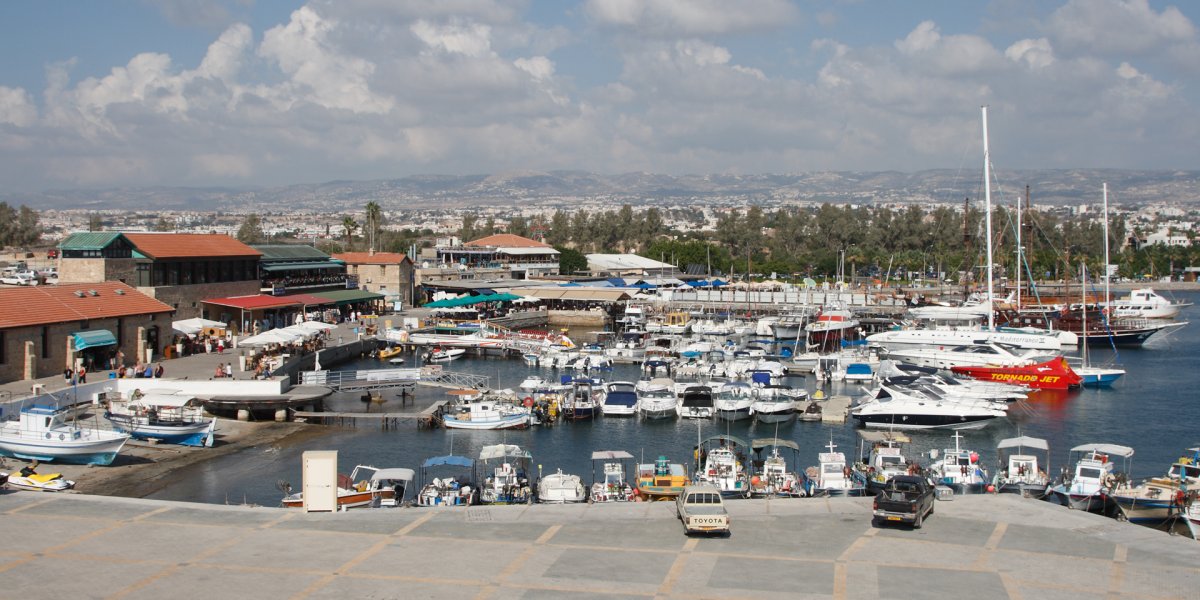
Walk downhill toward the harbor — the medieval castle at the end of the breakwater guides you like a compass point. Turn right along the waterfront promenade to Hondros, a 5-minute stroll. This no-frills taverna has anchored the harbor since the 1970s and still draws more locals than tourists. Order fast, eat well, keep moving.
Tip: Order the grilled halloumi (€6) and a pork souvlaki plate (€10) — both arrive in under ten minutes. Grab a terrace seat facing the castle for the best harbour view. No reservation needed at lunch. Skip the captain's seafood platter specials at neighbouring restaurants — they are frozen fish at triple the honest price.
Open in Google Maps →13:30
Landmark
From Hondros, stroll to the end of the harbor breakwater where fishing boats bob against the pier — the castle stands at the very tip, a 3-minute walk. This compact Lusignan fort rebuilt by the Ottomans in the 16th century guards the harbour mouth like a clenched fist. Climb the single staircase to the flat rooftop for a panoramic sweep: the harbour curving behind you, the Archaeological Park in the distance, and open Mediterranean stretching to the horizon.
Tip: The rooftop is the only reason to enter. Walk to the back-left corner for the best angle — the harbour with its colourful fishing boats curving away from you, the Paphos lighthouse beyond. The climb is one easy staircase, nothing strenuous. In September the castle courtyard hosts the Paphos Aphrodite Festival, an open-air opera worth timing a visit around.
Open in Google Maps →19:00
Food
After the castle the afternoon is yours — walk the coastal promenade south past the Municipal Baths, linger at a harbour cafe, or rest at your hotel. Return to the harbour strip by 19:00 when the western sky turns amber. Watching the sun drop behind the castle silhouette from a waterfront table with a plate of fresh fish is the proper farewell to Paphos. Theo's is one of the few harbour restaurants where you will hear Greek spoken at the next table.
Tip: Reserve a waterfront table by 18:30 in high season (Jun-Sep). Order the grilled sea bass (€18-22) — it is from the morning catch, not the freezer. Pair it with a glass of local Commandaria dessert wine (€5) for the authentic Cypriot finish. Avoid any harbour restaurant with laminated photo menus and staff pulling you in from the sidewalk — that is microwaved tourist food at resort markup, and the locals will not be caught dead inside.
Open in Google Maps →Zu Tag springen
09:00
Landmark
From Kato Paphos, walk south along Apostolou Pavlou Avenue toward the seafront — the park entrance appears where the road meets the Mediterranean. Head straight for the House of Dionysus: its 2nd-century floor mosaics depicting mythological scenes are among the finest in the eastern Mediterranean, their colors still astonishingly vivid after two millennia. Then cross to the House of Theseus for the circular mosaic of Theseus slaying the Minotaur. At this early hour, the low morning sun rakes across the mosaic surfaces at an oblique angle, throwing each tessera into sharp relief — a depth and texture completely lost under the flat midday glare.
Tip: Enter through the main gate and turn right immediately to reach the House of Dionysus before the first tour buses arrive around 10:30. The 'Triumph of Dionysus' panel in the northeast corner photographs best before 10:00 when low-angle sunlight picks out the tesserae. Don't linger at the Saranda Kolones fortress ruins inside the park — they're rubble compared to the mosaics. The House of Aion, smallest but most refined, is the one most visitors skip entirely.
Open in Google Maps →11:15
Religious
Exit the park and walk north along Apostolou Pavlou Avenue for 5 minutes — you'll spot a gnarled terebinth tree draped in hundreds of colorful rags and ribbons on your left, impossible to miss. Descend the worn stone steps into this early-Christian catacomb carved from living rock, where faded 12th-century Byzantine frescoes line the chambers. A sacred well at the deepest point is said to cure eye ailments — locals still tie cloth offerings to the tree above. The cool underground air is a welcome escape from the Cyprus sun.
Tip: Bring your phone flashlight — the deeper chambers have no artificial lighting but contain the best-preserved fresco fragments. The narrow passage to the right of the well leads to a hidden chapel that most visitors walk right past. Spend a few minutes sitting in the lowest chamber — the silence and acoustics are extraordinary.
Open in Google Maps →12:15
Food
Continue north along Apostolou Pavlou Avenue for 3 minutes — Mandra sits just off the main road in a stone courtyard shaded by bougainvillea. This is a taverna where Cypriot families still come for Sunday lunch. Order the sheftalia — hand-rolled pork-and-lamb sausages wrapped in caul fat, smoky and bursting with herbs (€8) — and a plate of grilled halloumi drizzled with carob syrup (€6). Arrive by 12:15 to grab a courtyard table before the lunchtime rush.
Tip: Ask for the mixed grill platter if you're hungry — it includes sheftalia, souvlaki, and loukaniko sausage for €14 and is enough for two. The house red is local Maratheftiko, served in a small carafe for €5 — far better than anything at a harbor restaurant for triple the price. Skip dessert here; save room for the evening.
Open in Google Maps →13:30
Religious
Walk south from lunch for 6 minutes along Stasinou Street toward the sea — the church compound opens up behind a low stone wall on your right. This layered site spans two millennia: a vast 4th-century basilica whose mosaic floor rivals the Archaeological Park, a medieval Frankish church built atop the ruins, and the marble pillar where the Apostle Paul was reportedly tied and given 39 lashes before converting the Roman governor. The early afternoon sun illuminates the basilica's remaining columns beautifully, casting long shadows across the ancient floor mosaics.
Tip: Most visitors beeline for St. Paul's Pillar and miss the basilica floor mosaics entirely — they're under a protective shelter to the left of the entrance and are comparable in quality to the Archaeological Park, with no crowd. The functioning church of Agia Kyriaki beside the ruins hosts services for five denominations; peek inside for a beautifully austere interior.
Open in Google Maps →15:00
Landmark
Walk west for 8 minutes along the coastal path toward the harbor — the squat medieval castle sits at the end of the breakwater like a sentinel guarding the port. Originally a Byzantine fort, rebuilt by the Lusignans, later reinforced by the Ottomans, it's compact but atmospheric. Climb the narrow staircase to the rooftop terrace: the entire harbor sweeps before you, fishing boats bobbing in turquoise water, the Archaeological Park's headland beyond. Time your visit so the afternoon light softens as you descend, then stroll the harbor promenade as waterfront restaurants begin lighting candles.
Tip: The rooftop is the only part worth the entrance fee — go straight up rather than lingering in the bare interior rooms. For the best photograph, stand at the northeast corner of the roof facing the harbor with fishing boats in the foreground. The castle and harbor face due west; golden hour between 17:00 and 18:30 is extraordinary here.
Open in Google Maps →19:00
Food
From the castle, walk 3 minutes along the harbor promenade — Theo's is set back slightly from the waterfront with a covered terrace overlooking the moored boats. A Paphos institution for over two decades, the kitchen works directly with the fishing fleet outside. The whole grilled sea bass, deboned tableside with lemon and olive oil, is the signature order (€22). Start with the taramasalata made from local grey mullet roe — nothing like the pink supermarket paste (€7). Book a terrace table facing the harbor for the last light fading over the water.
Tip: Reserve by phone for a 19:00 table — walk-ins after 19:30 face a 30-minute wait in high season. Avoid the restaurants immediately flanking the castle entrance: they charge double for half the quality and survive entirely on tourist foot traffic. The waterfront strip directly opposite the castle is Paphos's most reliable tourist trap — locals never eat there.
Open in Google Maps →08:30
Landmark
Take Tombs of the Kings Avenue north from Kato Paphos — a 15-minute walk along the coast road with the sea on your left and scrubby Mediterranean wildflowers lining the verge. The site opens at 08:30, and at this hour you'll share these monumental rock-cut tombs with nothing but birdsong and distant waves. Carved from solid limestone in the 3rd century BC for Ptolemaic aristocrats — not actual kings, but the grandeur earned the name — the subterranean chambers feature Doric columns, open-air atriums, and carved niches that feel like miniature underground palaces. Tomb 3, with its peristyle courtyard ringed by columns, is the showpiece.
Tip: Head directly to Tomb 3 (the largest, with the columned courtyard) and Tomb 8 (the deepest, with the most atmospheric descending staircase). Early morning light pours into the open atriums at a steep angle, creating dramatic shadows on the carved rock — by midday the effect is completely gone. Wear sturdy shoes; the paths between tombs are uneven limestone. Budget the full 90 minutes — the site is larger than it first appears.
Open in Google Maps →10:30
Shopping
Walk back south along Tombs of the Kings Avenue, then turn inland onto Ellados Avenue heading uphill toward Ktima — a 30-minute walk that transitions you from the tourist coast into the real Paphos where residents live and shop. The covered market sits at the heart of Ktima's old quarter, a renovated hall buzzing with vendors selling mountain thyme honey, handmade halloumi still warm in its brine, commandaria wine, and lokum studded with local almonds. Mid-morning is perfect: stalls are fully stocked and the shopkeepers have time to chat and offer tastings.
Tip: The honey vendor near the center sells thyme honey from the Akamas Peninsula — buy the smallest jar (€6) as a gift that weighs nothing. The dairy stall on the left has halloumi made that morning; ask for anari (fresh ricotta) to taste — it's not on display but they always have it behind the counter. Skip the mass-produced 'Cyprus Delight' boxes near the entrance; they're imported Turkish delight repackaged for tourists.
Open in Google Maps →12:00
Food
Exit the market from the northeast side onto Agoras Street and walk one block to Makariou Avenue — Kiniras occupies the ground floor of a restored 19th-century townhouse, its dining room opening onto the quiet old-town street. The kitchen serves unreconstructed Cypriot home cooking: the kleftiko — lamb slow-baked for six hours in a sealed clay oven until it falls apart at the touch of a fork — is the dish to order (€14). Pair it with a village salad of rough-cut tomatoes, cucumber, and barrel-aged feta dressed only in olive oil (€6).
Tip: Kleftiko sells out by 13:00 most days — arriving at noon guarantees you get it. For a lighter option, their moussaka has a bechamel so thick it holds its shape when sliced (€11). Ask to sit in the inner courtyard if the weather is warm; the street-facing tables catch passing traffic noise.
Open in Google Maps →13:30
Museum
Walk 2 minutes south from Kiniras along Griva Digeni Avenue — the museum is a modest neoclassical building easy to overlook from the street. Inside, four compact rooms hold finds spanning 9,000 years: Chalcolithic fertility idols, Mycenaean pottery from the Bronze Age settlement at Kouklia, and exquisite Hellenistic terracotta figurines that never made it to the national museum in Nicosia. After the morning's physical exertion at the Tombs, the air-conditioned galleries are a welcome change of pace — the collection is small enough to absorb without museum fatigue.
Tip: Room 2 has a Roman-era hypocaust (underfloor heating) model that explains how the wealthy lived in ancient Paphos — it recontextualizes the mosaics you saw yesterday as floors of heated, plumbed villas. The museum is small enough to see everything properly in 45 minutes, leaving time to rest on the bench in the quiet garden outside.
Open in Google Maps →15:00
Neighborhood
Exit the museum and walk 5 minutes north along Griva Digeni, then turn left into the narrow lanes where Ottoman-era stone houses lean over the streets. Moutallos is Paphos's oldest residential quarter — once the Turkish-Cypriot neighborhood, now a slowly gentrifying maze of restored stone facades, vine-covered doorways, overgrown courtyards, and resident cat colonies. The mid-afternoon light angles gently into the narrow streets, illuminating carved doorframes and bougainvillea-draped balconies. End your walk at Kennedy Square at the bottom of the quarter, where locals gather for afternoon coffee under the plane trees.
Tip: Look for the tiny Church of Agia Marina tucked into a courtyard off the main lane — its medieval frescoes are unsigned and the door is usually unlocked, but almost no tourist finds it. The best light for photography in the quarter falls between 15:00 and 17:00. End at Kennedy Square for a Cypriot coffee (order 'metrio' for medium-sweet) and people-watching before dinner.
Open in Google Maps →19:00
Food
Walk 5 minutes south from Kennedy Square along Nikolaou Nikolaidi Avenue — Pago occupies a converted stone warehouse with high ceilings and an open kitchen. The chef takes traditional Cypriot ingredients and gives them a modern edge without losing their identity: the slow-braised pork cheeks with trahanas, a fermented grain-and-yogurt porridge that is one of Cyprus's most ancient dishes, are extraordinary (€16). Finish with the carob brownie and Commandaria ice cream (€9). The wine list focuses exclusively on small Cypriot producers you won't find outside the island.
Tip: Reserve for 19:00 — the restaurant is small and fills completely by 19:30 on weekends. Ask the waiter to recommend a glass of Xinisteri, the indigenous white grape — this is what you should be drinking in Cyprus instead of imported Chardonnay. Avoid the generic 'international cuisine' restaurants ringing Kennedy Square: identical menus, inflated prices, and not a single local eats there.
Open in Google Maps →
Trip builder
Plan this trip around Paphos
Turn this guide into a bookable rail itinerary with FlipEarth.
Keep exploring
Related cities
More in the same country

FAQ
Frequently asked questions
How many days do you need in Paphos?
Most travelers enjoy Paphos in 1 days, with enough time for headline sights and a slower meal or museum stop.
What's the best time to visit Paphos?
The easiest season for most travelers is Mar-Nov, especially if you want good weather and manageable crowds.
What's the daily budget for Paphos?
A practical starting point is about €70 per person per day before hotels, then adjust based on museums, dining, and transport.
What are the must-see attractions in Paphos?
A good first shortlist for Paphos includes Tombs of the Kings, Paphos Archaeological Park, Paphos Castle.