City Guide
Matera
Italien · Best time to visit: Apr-Jun, Sep-Oct.
Day-by-day plan
Choose your pace
Reisedauer
09:00
Landmark
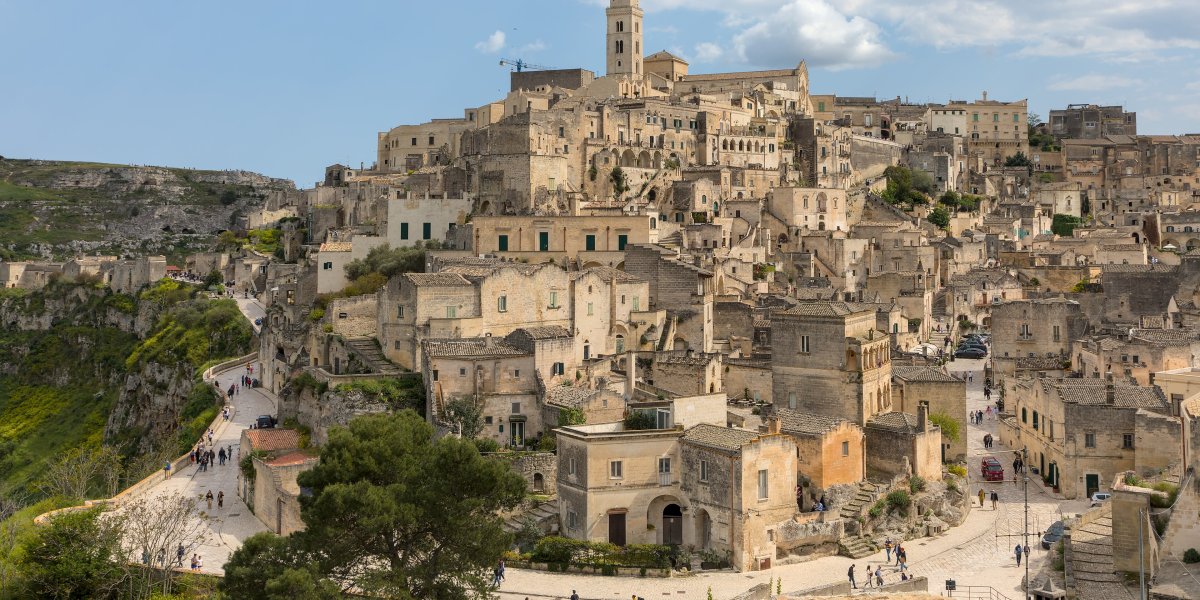
Begin at Matera's main square — grand but unhurried at this hour — and walk straight to the eastern balcony railing where the ground falls away and both Sassi districts suddenly appear below, a cascade of honey-colored cave dwellings tumbling into a ravine. The morning sun strikes the tuff stone from the east, turning the entire panorama warm gold. Stand here and let the scale register: this is one of the oldest continuously inhabited settlements on Earth, and your entire day will unfold inside it.
Tip: Walk to the far-right corner of the terrace for the widest angle that captures both Sasso Barisano on the left and Sasso Caveoso on the right with the cathedral spire in between — this is the postcard shot. Before 09:30 you will have it almost to yourself.
Open in Google Maps →10:15
Neighborhood
From the Belvedere terrace, take the stone staircase descending to the left — within thirty seconds the modern city vanishes and you are inside a labyrinth of cave facades, arched doorways, and staircases that seem to lead into the rock itself. Follow Via Fiorentini as it curves downhill past converted cave hotels with linen curtains in their doorways and tiny balconies spilling geraniums. Sasso Barisano is the more polished of the two Sassi — gently gentrified but still raw enough to feel ancient. Let yourself get lost; every wrong turn leads to another courtyard or a sudden viewpoint across the ravine.
Tip: Halfway down Via Fiorentini, look for a narrow alley on your right marked by a faded blue door — it leads to a tiny terrace overlooking the Gravina gorge that most tourists walk right past. Watch for the rupestrian cave churches carved directly into the cliff face; their frescoed interiors are visible through iron gates even without entering.
Open in Google Maps →11:45
Religious
Climb the worn stone steps from Sasso Barisano up to the Civita ridge — a five-minute ascent through a narrow passage that opens suddenly onto the cathedral piazza, the highest point between the two Sassi. The 13th-century Romanesque-Apulian facade faces you with its sixteen-petalled rose window and bell tower rising 52 meters above the ravine. Walk around the full perimeter: the north side gives you a plunging view back down into Sasso Barisano, while the south parapet reveals Sasso Caveoso cascading below in even more dramatic fashion, with the Murgia plateau and the gorge beyond.
Tip: The south-facing parapet behind the cathedral apse is the single best vantage point in Matera — you see the full depth of Sasso Caveoso with the gorge behind it and not a single modern building in the frame. At midday the light is directly overhead and the shadows in the cave doorways are at their deepest, creating extraordinary contrast for photos.
Open in Google Maps →12:30
Food
Descend the cathedral steps southward into Via Ridola — a three-minute walk past pottery workshops and a small bookshop brings you to this beloved local bakery tucked into a vaulted stone room. Order the focaccia materana ripiena stuffed with sun-dried tomatoes and cacioricotta cheese (€3.50) and a slice of their torta rustica with wild greens (€4). Eat standing at the marble counter or take it to the stone bench outside — this is fuel, not a sit-down, and you will be moving again in thirty minutes.
Tip: Ask for whatever just came out of the oven — the staff rotates savory and sweet throughout the day and the freshest item is always the best. Pair it with a caffè leccese (espresso over ice with almond milk, €1.50) for a quick energy hit. Skip anything in the display case that looks like it was designed to photograph well; the plainest-looking focaccia is the one the locals grab.
Open in Google Maps →13:30
Landmark
Continue south from Via Ridola and descend into Sasso Caveoso — immediately rougher and more untamed than its northern twin. The cave dwellings here are stacked more steeply, some barely accessible, some with doors opening onto sheer drops. Follow Via Bruno Buozzi as it zigzags downhill to the Chiesa di San Pietro Caveoso perched at the cliff edge, then loop back up to Piazzetta Pascoli, a small terrace that delivers the most dramatic viewpoint in the city: the entire Sasso Caveoso amphitheater below you, the Gravina gorge cutting deep across the middle ground, and the wild Murgia plateau beyond. In the afternoon the western sun rakes across the cave facades and every window and doorway casts a long shadow.
Tip: At Piazzetta Pascoli, stand at the iron railing on the left side for the most unobstructed shot — the right side has a tree that blocks part of the gorge. Late afternoon light (after 15:00 in spring and autumn) turns the stone a deep amber. This is the photo that will make people ask where you went.
Open in Google Maps →19:00
Food
Walk back up Via Bruno Buozzi toward the lower edge of the Civita — ten minutes of gentle climbing past cave doorways now glowing with warm interior light as evening settles in. This family-run trattoria serves the flavors of Basilicata with zero pretension: start with the strascinati con peperoni cruschi e mollica — hand-rolled pasta with crispy dried peppers and breadcrumbs (€12) — the peppers crack like chips and the crumb soaks up olive oil in a way that is unreasonably satisfying. Follow with the agnello alla contadina, slow-braised lamb with potatoes and local herbs (€16). The cave dining room seats about thirty; the stone walls and candlelight make it feel like eating inside the mountain.
Tip: Arrive at 19:00 sharp — by 19:30 every table is taken and they do not take reservations. Ask for a table in the back room where the original cave ceiling is exposed. Order the local Aglianico del Vulture red by the quarter-liter (€5) — far better than the house wine and built to stand up to the lamb. Avoid the cluster of restaurants near Piazza San Pietro Caveoso with hawkers outside and laminated photo menus — they serve frozen food at triple the price and exist solely because tourists are tired and hungry after the descent.
Open in Google Maps →Zu Tag springen
09:00
Religious
Begin at the highest point of the ancient city — climb the stairway from Piazza Duomo to the cathedral terrace, where all of Matera unfolds below you. This 13th-century Apulian Romanesque church crowns the Civita ridge between the two sassi; step inside for the haunting Byzantine Madonna della Bruna fresco, then circle behind the apse to a hidden terrace where the entire Sasso Barisano tumbles in a cascade of honey-colored tufa toward the Gravina gorge.
Tip: Follow the narrow alley to the left of the main entrance to reach the unmarked terrace behind the apse — this hidden balcony gives you the most dramatic overhead shot of Sasso Barisano with the gorge behind, and before 10 AM the low sun rakes golden light across every cave facade.
Open in Google Maps →10:00
Museum
Walk downhill from the cathedral through Piazza Duomo and past the stone archway into Recinto Cavone — Casa Noha is two minutes away, tucked into a quiet courtyard on your left. This FAI-managed palazzo screens a 25-minute immersive film projected onto bare walls and ceilings across four rooms, tracing Matera's extraordinary arc from prehistoric cave settlement to national disgrace to UNESCO World Heritage Site. It transforms every stairway, cistern, and cave you will encounter for the rest of the trip.
Tip: In the final room, stand in the exact center and look straight up — the ceiling projection shows a time-lapse of the sassi across centuries, and it is the emotional climax that puts everything you are about to see into perspective.
Open in Google Maps →11:00
Landmark
Exit Casa Noha and walk north through the narrow alleys of the Civita ridge, emerging onto the broad Piazza Vittorio Veneto — the entrance is a modest staircase on the piazza's southern edge, a seven-minute walk. Beneath Matera's main square lies one of Europe's largest hand-carved underground cisterns: a cathedral-sized water reservoir hewn from living rock, its vaulted ceiling soaring 15 meters above a still pool that mirrors the stone in perfect symmetry. The brief guided tour descends narrow stairs into a cool, silent chamber that feels like entering the city's secret heart.
Tip: Hold your phone just above the iron railing at water level for the mirror-reflection shot — the symmetry of the vaulted ceiling doubled in the water is Matera's most underrated photo opportunity. Guided groups depart every 30 minutes; the 11:00 slot is typically the least crowded.
Open in Google Maps →12:15
Food
Step back onto Piazza Vittorio Veneto and walk east down Via Fiorentini into the heart of Sasso Barisano — La Lopa is five minutes downhill on your left, set into the rock with a handful of tables in a vaulted stone room. Order the crapiata (€7), Matera's ancient legume-and-grain soup that has barely changed in centuries, then follow with orecchiette con cime di rapa (€9) and a glass of Aglianico del Vulture. This is where off-duty shopkeepers eat lunch, and the honest, unadorned Lucanian cooking is exactly why.
Tip: Arrive by 12:15 — the tiny cave dining room fills by 12:30 with locals, and there are no reservations. Budget €15-20 per person. Skip the tourist menus posted outside restaurants further up Via Fiorentini; La Lopa does not need one.
Open in Google Maps →14:00
Religious
From La Lopa, continue down Via Fiorentini for three minutes, passing cave dwellings with wild capers spilling from their walls — the church's modest stone facade appears on your right, almost indistinguishable from the surrounding rock. Matera's largest rupestrian church conceals an extraordinary crypt beneath its 17th-century interior: descend the narrow stairs to find stone niches where monks once seated their dead to drain, a macabre medieval practice that makes this one of the most haunting underground spaces in all of southern Italy.
Tip: Ask the attendant to point out the 'sedili di scolatura' (draining seats) in the dimly lit crypt — they are easy to walk past but once you understand their purpose, they are impossible to forget. After visiting, spend the late afternoon wandering the stepped alleys of Sasso Barisano at your own pace; this is when the light turns amber and the day-trippers leave.
Open in Google Maps →19:30
Food
Walk back uphill through Sasso Barisano toward Via Bruno Buozzi, about ten minutes through stepped alleys now glowing in lamplight as evening settles over the gorge. This cave restaurant takes Basilicata's peasant cuisine and elevates it without pretension — start with peperone crusco (crispy fried Senise pepper, €8), which shatters like glass and tastes of concentrated summer, then follow with agnello alla brace con erbe selvatiche (grilled lamb with wild herbs, €16). The vaulted tufa ceiling and candlelight make this the most atmospheric table in the Barisano quarter.
Tip: Reserve for 19:30 and request the terrace table overlooking the alley — as darkness falls, the illuminated sassi become a canyon of golden light. Budget €35-45 per person with wine. Warning: the restaurants lining Piazza Vittorio Veneto look inviting but charge tourist premiums for underwhelming food and aggressive table-side upselling — you have chosen wisely by eating down here instead.
Open in Google Maps →09:00
Museum
From the Civita ridge, descend the stone stairway into Sasso Caveoso — MUSMA is housed in Palazzo Pomarici on Via San Giacomo, about an eight-minute walk through alleys that grow quieter and more raw with each step. This museum places contemporary sculptures inside a labyrinth of hypogean caves and Renaissance palace rooms, creating an uncanny dialogue between ancient carved rock and modern bronze and marble. The deeper you descend, the more the boundary between gallery and geological formation dissolves entirely.
Tip: Most visitors spend their time on the upper palazzo floors and miss the highlight — follow the signs to 'ipogei' and give yourself at least 20 minutes in the raw rock chambers on the lowest level, where sculptures emerge from the darkness as if they have been there for centuries.
Open in Google Maps →10:45
Religious
Exit MUSMA and descend through the stepped alleys of Sasso Caveoso for five minutes — ahead, the cone-shaped Monterrone rock rises dramatically above the surrounding cave rooftops, with the church perched on its summit like a stone crown. Climb the worn stairway carved into the rock face, then pass through the narrow tunnel connecting it to the older San Giovanni in Monterrone behind, where fragmentary 12th-century Byzantine frescoes glow in the half-light. The entrance terrace commands a 270-degree panorama of the gorge, the ravine, and the wild Murgia plateau beyond.
Tip: The interior of San Giovanni in Monterrone (through the tunnel at the back of Santa Maria de Idris) has the better frescoes — particularly the Christ Pantocrator on the rear wall. Visit before 11 AM while morning light still enters the tunnel opening and illuminates the apse naturally.
Open in Google Maps →11:45
Museum
Descend from Monterrone back to the main path through Sasso Caveoso and walk three minutes east toward Piazza San Pietro Caveoso — Casa Grotta is on the lower level, marked by a simple hand-painted sign. Step into a faithfully reconstructed cave dwelling to understand how Materan families actually lived until the 1950s: a single room shared with livestock, a cistern collecting rainwater through the ceiling, a manger beside the bed doubling as an infant's cradle. The visceral detail — worn tools, straw mattresses, a donkey's feeding trough an arm's length from the dining table — makes the sassi's history achingly real.
Tip: Look for the rainwater collection system carved into the ceiling — a series of channels that funneled every drop into the underground cistern below the floor. This ingenious engineering is why these caves were inhabitable for millennia, and most visitors walk right past it without noticing.
Open in Google Maps →12:30
Food
Walk two minutes downhill to Piazza San Pietro Caveoso — Il Terrazzino sits just above the piazza with a terrace cantilevered over the gorge. Claim a terrace seat and order the orecchiette con peperoni cruschi e mollica di pane (pasta with crispy Senise peppers and toasted breadcrumbs, €12) — the single most Lucanian dish in Matera, sweet and smoky and impossibly simple. The view from your table — the Gravina gorge, rupestrian churches carved into the far cliff, hawks circling below — is the best lunch panorama in the city.
Tip: Ask for the lower terrace — the upper level has the wider view, but the lower puts you at eye level with the rock churches across the gorge, which is far more dramatic for photos. Budget €18-25 per person. Arrive by 12:30; by 13:00 every terrace seat is taken.
Open in Google Maps →14:30
Religious
From Il Terrazzino, walk west along the lower path of Sasso Caveoso for four minutes, past crumbling cave facades draped in wild capers and prickly pear — the church entrance is cut into the cliff face on your left, easy to miss if you are not looking for it. Matera's oldest rupestrian church, once a Benedictine convent for women, preserves some of the finest medieval frescoes in southern Italy across three naves hollowed entirely from the limestone cliff. The 8th-century Madonna del Latte in the left aisle — a nursing Madonna whose expression carries a tenderness that Byzantine art rarely achieves — is alone worth the visit.
Tip: Use your phone flashlight to illuminate the frescoes in the left nave — the overhead lighting is kept deliberately dim to preserve the ancient pigments, and without extra light you will miss the Madonna del Latte entirely (second niche on the left wall). After visiting, the rest of your afternoon is yours — wander back through the quieting alleys of Sasso Caveoso as the golden hour light transforms every stone surface into a photograph.
Open in Google Maps →19:00
Food
Walk back through Sasso Caveoso toward the Civita ridge, then follow Via Sant'Angelo north for about twelve minutes through the most photogenic stepped alleys in the city, now bathed in warm lamplight as dusk settles. Your farewell dinner is in a restored cave whose vaulted tufa ceiling and candlelight feel like dining inside the earth itself. Begin with burrata on a bed of lampascioni (wild hyacinth bulbs, €10) — bitter, creamy, and profoundly local — then the strascinati con salsiccia lucana e funghi cardoncelli (hand-pulled pasta with Lucanian sausage and cardoncelli mushrooms, €14), earthy and rich and the perfect farewell to Basilicata.
Tip: Reserve and request the back cave room — a single vaulted chamber of raw tufa lit by candles, the most intimate table in the house. Budget €35-45 with a bottle of local Primitivo. After dinner, take the five-minute walk up to Piazzetta Pascoli for one final look at the illuminated sassi reflected in the dark gorge below. Warning: avoid the souvenir shops on Via Ridola selling mass-produced 'Sassi' ceramics at inflated prices — if you want an authentic cuccù (Matera's traditional clay whistle), buy it from a workshop in the lower Sasso Caveoso alleys where you can watch them being made.
Open in Google Maps →
Trip builder
Plan this trip around Matera
Turn this guide into a bookable rail itinerary with FlipEarth.
Keep exploring
Related cities
More in the same country
FAQ
Frequently asked questions
How many days do you need in Matera?
Most travelers enjoy Matera in 1 days, with enough time for headline sights and a slower meal or museum stop.
What's the best time to visit Matera?
The easiest season for most travelers is Apr-Jun, Sep-Oct, especially if you want good weather and manageable crowds.
What's the daily budget for Matera?
A practical starting point is about €55 per person per day before hotels, then adjust based on museums, dining, and transport.
What are the must-see attractions in Matera?
A good first shortlist for Matera includes Piazza Vittorio Veneto & Belvedere Terrace, Sasso Caveoso & Piazzetta Pascoli.