City Guide
Inverness
Vereinigtes Königreich · Best time to visit: May-Sep.
Day-by-day plan
Choose your pace
Reisedauer
09:00
Landmark
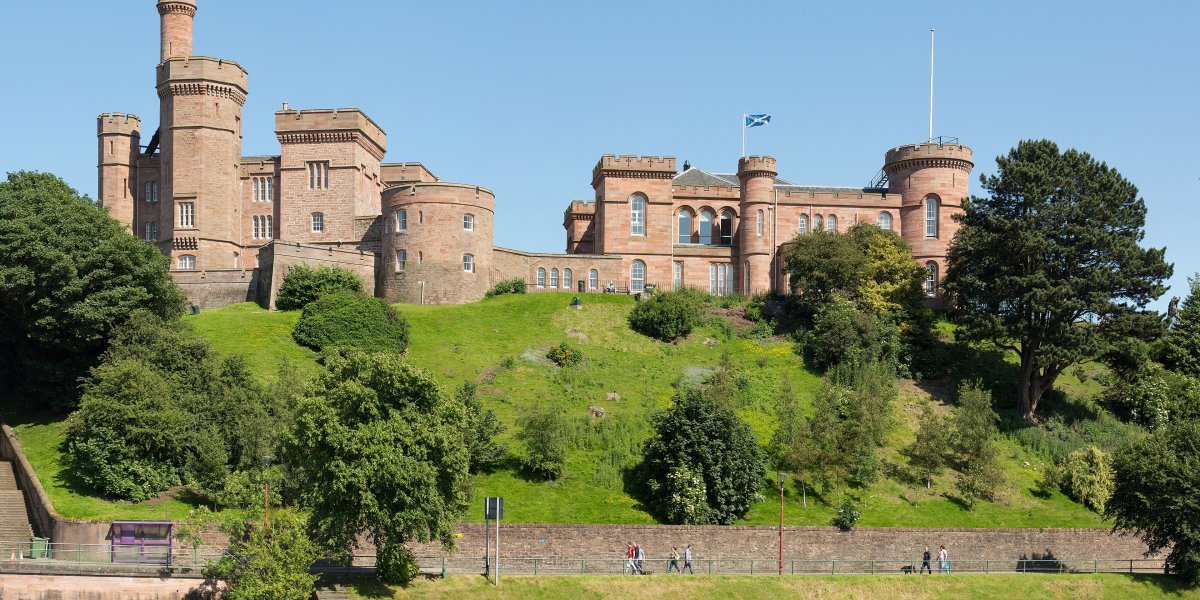
Walk uphill along Castle Street from the city center — the red sandstone fortress reveals itself above the rooftops like a Highland storybook cover. The 19th-century castle perches on a cliff where fortifications have stood since the 11th century, and its terrace viewpoint delivers the defining Inverness panorama: the River Ness below, the Kessock Bridge framing the Beauly Firth, and the blue-grey Highland hills beyond. Morning light from the east sets the red sandstone aglow while the terrace is still empty of tour groups.
Tip: Stand at the Flora MacDonald statue on the castle terrace facing north — this is the classic composition with river, bridge, and firth in a single frame. The light is ideal before 10:00; after that the sun climbs above the buildings behind you and flattens the contrast.
Open in Google Maps →10:15
Park
Descend from the castle, turn left, and follow the east bank of the River Ness south along Ness Walk — a 15-minute stroll past elegant Victorian townhouses with the river glinting alongside you. Ness Islands is a chain of small wooded islands in the middle of the river, connected by Victorian suspension bridges whose cables creak softly in the breeze. Mid-morning light filters through the canopy of Scots pine and oak into dappled patterns on the bridges — the air smells of pine and river water, and the only sound is the current rushing below. Walk the full loop from the east bank entrance, through all the islands, and exit on the west bank.
Tip: On the second island, stop at the bench facing upstream — the suspension bridge cables frame the river perfectly for photos. Exit on the west bank to continue the route north without backtracking; the east bank exit sends you back toward the castle.
Open in Google Maps →11:45
Religious
From the west bank exit of Ness Islands, walk north along the river path for 15 minutes — you'll pass Bught Park's open lawns with the river widening beside you, and the cathedral's twin spires gradually rise ahead on Ardross Street. This pink sandstone Scottish Episcopal cathedral was completed in 1869 and is one of the most graceful buildings in the Highlands. Late morning light catches the facade from the south and makes the stone glow almost salmon-pink; the quiet churchyard behind offers a moment of stillness before you plunge back into the city.
Tip: The best exterior photo angle is from across Ardross Street, slightly south of the main entrance, where both spires and the full facade fit the frame without obstruction. If you have five spare minutes, walk behind the cathedral to the riverbank — the view back toward the castle with the cathedral spires in the foreground is a composition most visitors miss entirely.
Open in Google Maps →12:30
Food
Walk two minutes north from the cathedral to Greig Street Bridge — a Victorian pedestrian suspension bridge with wooden planks that flex underfoot. Pause here for a photo looking south along the river, then cross to the east bank and turn right onto Church Street. Hootananny has occupied this 1740s building for decades and is the beating heart of live music in the Highlands. The walls are plastered with gig posters, the bar is honest, and at lunchtime a session musician might be playing fiddle in the corner — a free concert with your haggis. Order at the bar: haggis, neeps and tatties (£12.50) or the Highland venison burger (£14). Budget £12–16 per person.
Tip: Grab a table upstairs on the balcony for more space and better acoustics. This is the real Highlands experience — skip the tourist pipers busking outside the castle and listen to actual local musicians here instead.
Open in Google Maps →13:45
Shopping
Exit Hootananny, turn left on Church Street and walk one minute — the Victorian Market entrance is on your right, in the covered passage between Church Street and Academy Street. This market arcade has operated since 1890; its original wrought-iron framework and glass roof feel like stepping into a sepia photograph. Independent shops sell tartan, whisky, Highland crafts, and Scottish silver jewelry — this is where Inverness locals actually shop, not the tourist strip on the High Street.
Tip: Head straight to The Whisky Shop inside the market — they offer free dram tastings and the staff will recommend a single malt from a nearby distillery (Dalmore or Glen Ord) at better prices than airport duty-free. The better independent stalls are deeper inside toward the Academy Street end; skip the generic Scottish-gift shops clustered near the Church Street entrance.
Open in Google Maps →19:00
Food
From the Victorian Market, walk west along Church Street then turn south onto Fraser Street — a 5-minute stroll back toward the River Ness. The Mustard Seed occupies a beautifully converted church building overlooking the water, with high ceilings, stained glass fragments, and candlelight that make it feel like a proper Highland farewell. The kitchen sources obsessively locally: pan-seared Scottish salmon with crushed new potatoes (£18) or slow-braised Highland venison with root vegetables (£22). Two courses with a glass of wine: £30–38.
Tip: Book online for 19:00 and request a window table overlooking the river — the late Highland sunset reflecting off the water is the last image you want from Inverness. End with the sticky toffee pudding (£8): Medjool dates, proper toffee sauce, best dessert in town. Avoid the cluster of restaurants directly below the castle on Bank Street — they're priced for tour-bus tourists and the quality does not match.
Open in Google Maps →Zu Tag springen
09:00
Landmark
Start your Highland journey at the city's highest point. The castle above the River Ness has been transformed into an immersive visitor experience celebrating Highland culture, with a rooftop viewing platform offering a 360-degree panorama — the Moray Firth to the north, the Great Glen stretching southwest, and the red sandstone city below. At opening time you will have the platform nearly to yourself while morning light catches the river.
Tip: Head straight to the rooftop viewing platform before the exhibitions — by 10:30 tour groups arrive and the terrace crowds up. Face north toward the Moray Firth for the best morning light and scan the water on clear days: bottlenose dolphins are frequently spotted even from this distance.
Open in Google Maps →10:45
Religious
Walk down Castle Hill, cross the Ness Bridge, and turn right along tree-lined Ness Walk — a five-minute riverside stroll. This pink granite cathedral, completed in 1869, is the northernmost on the British mainland, with carved pillars, Pre-Raphaelite stained glass, and gilded angel figures copied from a Copenhagen church. Step into the Chapter House garden for a moment of perfect Highland quiet.
Tip: The finest stained glass window is above the west door — stand directly beneath it mid-morning when sunlight floods the nave with colour. The cathedral sometimes locks outside posted service hours, so check the noticeboard at the main entrance before walking around the building.
Open in Google Maps →12:00
Food
Cross back over the river and walk two minutes up Castle Street to this local institution housed in a bright, high-ceilinged former bank. The menu leans Scottish-Mediterranean — try the Cullen skink, a smoked haddock chowder that is the Highlands in a bowl (£8.50), or the Highland venison burger with red onion marmalade (£14.95). The lunch crowd is locals and office workers, not tourists.
Tip: Arrive by noon sharp — the ground floor fills by 12:15 on weekdays. If it is packed, head upstairs where there is more seating and the same menu. The Cullen skink alone justifies the stop.
Open in Google Maps →13:30
Shopping
Walk two minutes down Castle Street and turn right onto Academy Street — the arched entrance is on your left. Built in 1870 and largely unchanged, this covered market is a time capsule of Victorian commercial architecture with its original ironwork and glass roof, housing Highland tweeds, single malt whisky, handmade jewellery, and local cheeses. The arcade connects through to Union Street, making a satisfying loop.
Tip: Duncan Chisholm & Sons inside the market is the real deal for tartan and Highland dress — this is where locals buy their kilts, not a tourist shop. The specialist whisky stall stocks unusual Highland bottlings at better prices than the shops on High Street.
Open in Google Maps →15:00
Park
Walk south along the river for fifteen minutes, following Young Street to the riverside path as the city grows quieter with every step. The Ness Islands are a chain of wooded islands connected by elegant Victorian suspension footbridges, where Scots pine, beech, and Douglas fir form a canopy so thick the city vanishes completely. At three o'clock the light filters through the trees at its most photogenic angle, and you may spot herons, dippers, or a red squirrel.
Tip: Take the west-bank path going south, cross onto the islands via the first footbridge, then loop back on the east bank for the best variety of views. The third island has a quiet bench facing upstream — perfect for a photo of the river curving toward the hills. Paths can be muddy after rain, so sturdy shoes are essential.
Open in Google Maps →19:00
Food
Walk back north along the river for twelve minutes to Fraser Street. The Mustard Seed occupies a converted nineteenth-century church right on the River Ness, with floor-to-ceiling windows and the finest riverside table in the city. The pan-seared Scottish salmon (£18.95) and slow-braised Highland lamb shank (£19.95) are both superb — two courses with wine come to about £35.
Tip: Book a window table and request the left side as you enter for the best river view. The early evening prix fixe (before 19:00) offers two courses for £16.95 — an exceptional deal if you arrive on time. Avoid the cluster of restaurants around Bank Street bridge: they are tourist-priced with mediocre food.
Open in Google Maps →09:00
Museum
Take the Stagecoach number 5 bus from Inverness bus station — departures every thirty minutes, twenty-five minutes through suburbs into open moorland. On this bleak heath in 1746, the last major battle on British soil ended the Highland way of life forever. The National Trust visitor centre tells the story with an immersive 360-degree battle film, and then you walk the battlefield itself, where clan grave markers stand in silent rows on the moor.
Tip: Watch the battle immersion film first, then walk the full battlefield loop (45 minutes). Red and blue flags mark the Jacobite and Government lines — stand between them at the centre of the field to grasp the impossible scale of the charge. Arrive at opening: by 11:00 coach tours fill the centre.
Open in Google Maps →11:15
Landmark
Walk east from the Culloden car park along a signposted country lane — a flat, peaceful fifteen-minute stroll through farmland. Three Bronze Age burial cairns ringed by standing stones, over four thousand years old and aligned with the midwinter sunset, stand here in a natural cathedral of ancient trees. This was one of the inspirations for the standing stones in Outlander — and standing here you will understand why.
Tip: Stand inside the central ring cairn and look southwest through the passage — the alignment is breathtaking even outside the solstice. You will likely have the entire site to yourself in the morning. There is no entrance fee or ticket booth; just walk in from the lane.
Open in Google Maps →12:30
Food
Bus back to Inverness and walk three minutes from the bus station along Church Street to this taproom of the beloved Highland organic brewery. The space is industrial-chic with communal tables and rotating taps — try the Goldfinch IPA alongside the smoked haddock fishcake with tartare sauce (£9.50) or the Black Isle burger with hand-cut chips (£13.95). Exactly the hearty, unpretentious refuelling you need after a morning on the moor.
Tip: Order a taster flight of four beers for £8 — the Hibernator oatmeal stout and the Red Kite amber ale are both excellent and almost impossible to find outside the Highlands. Grab the window seats on Church Street for the best people-watching.
Open in Google Maps →14:00
Shopping
Step out of the brewery and walk thirty seconds along Church Street. Scotland's largest secondhand bookshop fills the nave of a converted eighteenth-century Gaelic church — towering shelves, a wood-burning stove crackling in the centre, and a mezzanine gallery reached by a spiral staircase. Maps, Scottish history, rare editions, and glorious chaos from floor to rafters.
Tip: The Scottish history and local interest section on the mezzanine is the richest — you will find out-of-print Highland titles here that are impossible to source online. Budget your time carefully: people routinely lose an hour without noticing.
Open in Google Maps →15:15
Park
Walk west to Huntly Street, then south along the river for ten minutes until you reach the Caledonian Canal towpath. Follow Thomas Telford's masterwork south for twenty minutes to Tomnahurich — the 'Hill of the Fairies' — a hauntingly symmetrical drumlin draped with a Victorian cemetery rising above the canal. Climb to the summit for a sweeping panorama of Inverness, the canal, and the Highland hills.
Tip: Climb to the very top of Tomnahurich for the finest panoramic view of Inverness — on a clear day Ben Wyvis is visible to the north. The cemetery paths are steep but paved. This is a locals' evening walk, not a tourist site: expect dog-walkers and joggers, not coach groups.
Open in Google Maps →19:00
Food
Walk fifteen minutes north along the canal and river to Greig Street. River House is Inverness's finest seafood restaurant, a cozy riverside spot where the menu changes with the boats — the hand-dived Orkney scallops with black pudding (£14.95) are legendary, and the whole roasted lemon sole with brown butter (£24.95) is what locals tell visitors to order. Two courses with wine: about £40–50.
Tip: Book ahead — River House seats only about thirty covers and locals fill it fast, especially on weekends. Request the window table for a farewell view of the River Ness at dusk. Skip the chippy franchises on Young Street nearby — they serve frozen fish to tourists at inflated prices.
Open in Google Maps →
Trip builder
Plan this trip around Inverness
Turn this guide into a bookable rail itinerary with FlipEarth.
Keep exploring
Related cities
More in the same country
FAQ
Frequently asked questions
How many days do you need in Inverness?
Most travelers enjoy Inverness in 1 days, with enough time for headline sights and a slower meal or museum stop.
What's the best time to visit Inverness?
The easiest season for most travelers is May-Sep, especially if you want good weather and manageable crowds.
What's the daily budget for Inverness?
A practical starting point is about €80 per person per day before hotels, then adjust based on museums, dining, and transport.
What are the must-see attractions in Inverness?
A good first shortlist for Inverness includes Inverness Castle.