City Guide
Honfleur
Frankreich · Best time to visit: May-Sep.
Day-by-day plan
Choose your pace
Reisedauer
09:00
Landmark
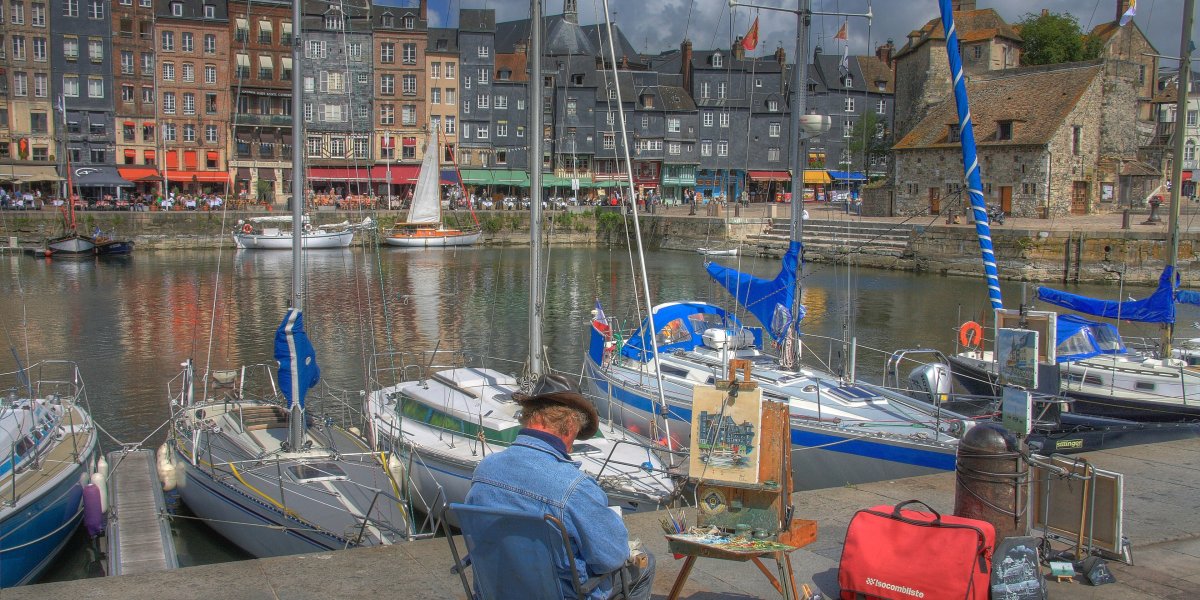
Start where every painter started: the slate-clad houses of Quai Sainte-Catherine leaning into their own mirror-still reflections. Walk a full slow lap of the basin — from La Lieutenance gate at the harbor mouth, past the fishing boats on the north quay, around to the tall narrow façades on the south side. The harbor changes mood every twenty paces, which is exactly why Monet, Boudin, Jongkind, and Courbet all kept coming back to paint the same patch of water.
Tip: Stand on the eastern quay near La Lieutenance between 09:00 and 09:30 — that's the one window when the morning sun lights the Quai Sainte-Catherine façades head-on, with the water still glass-flat before the breeze picks up. By 11:00 the day-trip coaches arrive from Paris and the postcard angle has thirty phones in front of it.
Open in Google Maps →10:30
Religious
Leave the harbor via Place Hamelin and walk one block inland through Honfleur's oldest cobbled streets — three minutes on foot. Norman shipbuilders raised this church after the Hundred Years' War using the only material they had on hand: oak from the surrounding forest, joined with the same techniques they used to build hulls. The result is the largest wooden church in France, with a roof shaped like two inverted boats and a detached bell tower standing apart across the square because the timber couldn't carry the weight of the bells.
Tip: Entry is free. Walk straight in, then immediately look up — the double nave is literally two upside-down ship hulls. The detached bell tower (Clocher Sainte-Catherine) on the south side of the square is often overlooked; cross over and walk around its base for the most photographed Honfleur composition after the harbor itself.
Open in Google Maps →12:00
Food
Sixty seconds from the church door, on the corner of Place Hamelin. This is the galette house Honfleur residents eat at — not the harbor-front creperies aimed at day-trippers. Buckwheat galettes are made to order with proper Norman ingredients, served on enamel plates with local farmhouse cider poured into ceramic cups (the only correct way to drink it). Quick, honest, and unmistakably Norman.
Tip: Order the galette andouille de Vire (12€) — the smoked tripe sausage most foreign visitors avoid, which is exactly why it's the most Norman thing on the menu. Pair with a bolée of brut cider (4€). Arrive at exactly 12:00 or after 13:30; the 12:30 wave fills every seat in twenty minutes and they don't take reservations for lunch.
Open in Google Maps →13:30
Religious
From Place Sainte-Catherine, head north up Rue du Puits past the Eugène Boudin Museum exterior, then follow the white-cross signs onto the Côte de Grâce path — twenty minutes of steady climb through orchards and stone-walled cottages where the Paris painters used to rent summer studios. Sailors built this small chapel in 1606 to thank the Virgin for safe returns, and weather-beaten ex-voto ship models still hang from the rafters. Walk thirty paces left to the Mont-Joli orientation table and the entire Seine estuary opens up: Le Havre on the far shore, the Pont de Normandie sweeping across the river to the east, and the slate roofs of Honfleur stacked below.
Tip: Skip the chapel-front car park view that the coach tours use. Walk left of the chapel to the wooden Calvary cross at Mont-Joli — the orientation table there identifies every cape and channel marker. Mid-afternoon light (around 15:00) lights the Pont de Normandie cables silver from the west; in the morning the bridge is into the sun and photographs flat.
Open in Google Maps →16:00
Park
Descend the western slope of the Côte de Grâce via Rue Adolphe Marais — fifteen minutes through quiet residential lanes lined with the slate villas that Boudin's wealthier students used to rent. Plage du Butin itself is a narrow strip of dark sand, but the point is the long seawall promenade east of it: Pont de Normandie suspended across your horizon, container ships sliding into Le Havre, and the cliffs of the Pays d'Auge falling away to the west. Walk the dike east toward the lock, then trace Quai des Passagers back along the river mouth — this is the long evening stretch that takes the day past 15 km on foot.
Tip: The beach itself is unremarkable — locals don't swim here. The walk is the experience. Time your return for 18:30-19:00 so the descending light catches the slate roofs of Honfleur head-on as you approach the harbor from the west — the same angle Boudin painted from a hundred and fifty years ago.
Open in Google Maps →19:30
Food
Walk back along Quai des Passagers, cross the lock at the harbor entrance, and turn up Rue du Puits — ten minutes hugging the water. Le Bréard is where Honfleur's residents go when they actually want to eat: refined Norman cooking by chef Fabrice Sébire, white tablecloths and stone walls, two streets back from the harbor and a different planet from the tourist menus on the quay. Seasonal, ingredient-driven, and the cleanest expression of Normandy on a plate within walking distance.
Tip: Order the Saint-Jacques de Normandie in saffron cream (in season Oct-May, around 32€) or the 3-course set menu at 45€ which is the best value in town. Reserve at least two days ahead in summer. Pitfall warning: every restaurant directly fronting Quai Sainte-Catherine with a multilingual menu and a hawker outside is a tourist trap — their 'seafood platters' run 55-70€ for frozen shellfish defrosted that morning. The serious kitchens are all one street back from the harbor, never on it.
Open in Google Maps →
Trip builder
Plan this trip around Honfleur
Turn this guide into a bookable rail itinerary with FlipEarth.
Keep exploring
Related cities
More in the same country
FAQ
Frequently asked questions
How many days do you need in Honfleur?
Most travelers enjoy Honfleur in 1 days, with enough time for headline sights and a slower meal or museum stop.
What's the best time to visit Honfleur?
The easiest season for most travelers is May-Sep, especially if you want good weather and manageable crowds.
What's the daily budget for Honfleur?
A practical starting point is about €105 per person per day before hotels, then adjust based on museums, dining, and transport.
What are the must-see attractions in Honfleur?
A good first shortlist for Honfleur includes Vieux Bassin (Old Harbor).