City Guide
Grasse
Frankreich · Best time to visit: May-Jun.
Day-by-day plan
Choose your pace
Reisedauer
09:00
Landmark
From Grasse SNCF station, walk 6 minutes north up Avenue Thiers — Provence's red-tiled rooftops cascade down the hillside as the cream-and-blue facade of the Fragonard factory appears. Operating since 1782, this is the oldest still-active perfumery in Grasse; even from the street, the air outside smells faintly of orange blossom and rose. The historic facade with its ochre walls and blue shutters is the most photographed building in the city.
Tip: Arrive at 9:00 sharp — the first free factory tour starts at 9:15 and is the only slot without coach groups; if you're skipping the interior, shoot the facade from across Boulevard Fragonard at the corner with Rue Tracastel, where the eastern morning light catches the full curve of the building. By 10:30 the sun is overhead and the shutters lose their depth.
Open in Google Maps →10:30
Religious
Exit Fragonard, turn right and climb Rue Mirabeau into the medieval core — a 10-minute uphill walk through narrow lanes lined with soap shops and ochre walls. This 12th-century Romanesque cathedral hides three Rubens paintings on its right wall (free to view) and one rare religious work by Jean-Honoré Fragonard, who was born five minutes away. Step onto the south terrace for the first sweeping view of the Provençal valley.
Tip: The three Rubens in the right transept were saved from the Revolution by a local priest who whitewashed over them — they're the most underrated Rubens in France and you'll have them to yourself before 11:30. From the south terrace, the line of cypress trees points directly toward Cannes; on a clear May morning you can see the sliver of Mediterranean glinting beyond.
Open in Google Maps →12:00
Food
Descend Rue Mougins-Roquefort north for 3 minutes through alleys barely wide enough for two — Maison Venturini has been the bakery where perfume workers eat lunch since 1953. Order one fougassette à la fleur d'oranger (€2.50), the orange-blossom flatbread invented in Grasse, and one slab of pissaladière (€4) with slow-caramelized onion and anchovy. Eat standing at the marble counter the way the locals do.
Tip: Don't sit at the two outdoor tables — they're aimed at tourists and the bread cools fast. The fougassette is best between noon and 12:30 while still warm from the morning bake; after 13:00 they switch batches and the orange-blossom aroma fades. Ask for it 'tiède' if it looks like it's been sitting.
Open in Google Maps →13:00
Neighborhood
Step out of Venturini and walk one minute west into Place aux Aires — an irregular square shaped like a tilted bowl, ringed by 18th-century arcades and centered on a three-tiered fountain. From here lose yourself in the warren of Rue de l'Oratoire, Rue de la Lauve, and Rue du Sauveur, where every turn reveals stone staircases, vaulted passages, and forgotten public washhouses. This is the medieval Grasse the tour buses never see.
Tip: The lower fountain on Place aux Aires faces north, so the ochre arcades photograph best between 14:00-15:30 when sunlight bounces off the opposite wall. Hunt down the hidden Tour Sarrasine, a Saracen-era watchtower swallowed by a residential wall on Rue du Sauveur — locals call it the city's smallest secret, and only one street sign points to it.
Open in Google Maps →16:00
Landmark
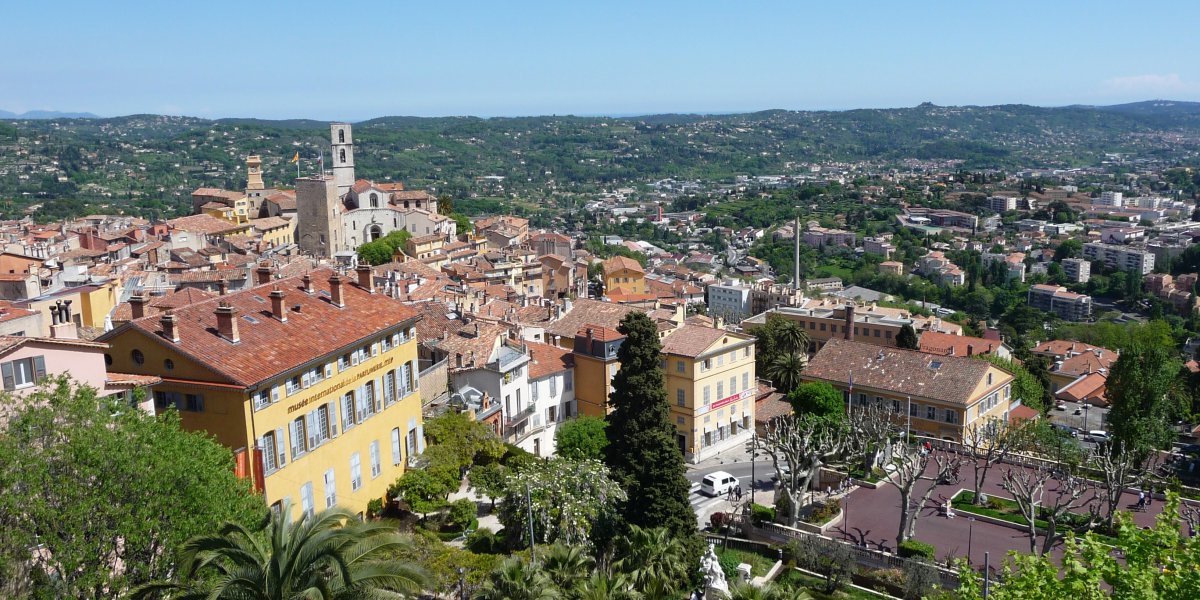
Walk south from Place aux Aires down Rue de l'Évêché for 5 minutes, passing the former bishop's palace before emerging onto Boulevard du Jeu de Ballon. The International Perfume Museum's modern glass cube grafted onto an 18th-century mansion is striking from the outside; skip the interior and continue around to Place du Cours Honoré Cresp behind it. From this stone balcony hanging over Provence, the valley sweeps south toward the Estérel massif and the Mediterranean beyond.
Tip: The terrace railing at Cours Honoré Cresp catches golden hour from 18:30 onward in May-June — western light turns the red tile roofs of Grasse into a furnace, and 17:30 onward is far better than midday when the valley is hazy. The bench at the far western end is the best photo spot and almost always empty; the central viewpoint near the carousel is where tour groups cluster.
Open in Google Maps →19:30
Food
Walk 4 minutes north from the viewpoint, climb Rue Jean Ossola and turn onto Rue Thouron — La Voûte sits beneath a 16th-century stone vault in the deepest pocket of the old town. Order the daube provençale, beef slow-braised eight hours in local red wine and orange peel (€19), or the petits farcis niçois, garden vegetables stuffed with veal and herbs (€17). The dining room holds only 24 seats and feels like eating inside a hollowed-out cave.
Tip: Reserve at least 24 hours ahead for the 19:30 seating — they only do two services a night and the second is reserved for regulars. PITFALL: avoid every restaurant fronting Place aux Aires with English chalkboard menus and photo-illustrated dishes — they charge €25 for the same daube La Voûte serves at €19 and use packaged demi-glace. The real Grasse kitchens are always one street back from the obvious squares.
Open in Google Maps →
Trip builder
Plan this trip around Grasse
Turn this guide into a bookable rail itinerary with FlipEarth.
Keep exploring
Related cities
More in the same country
FAQ
Frequently asked questions
How many days do you need in Grasse?
Most travelers enjoy Grasse in 1 days, with enough time for headline sights and a slower meal or museum stop.
What's the best time to visit Grasse?
The easiest season for most travelers is May-Jun, especially if you want good weather and manageable crowds.
What's the daily budget for Grasse?
A practical starting point is about €100 per person per day before hotels, then adjust based on museums, dining, and transport.
What are the must-see attractions in Grasse?
A good first shortlist for Grasse includes Fragonard Historic Perfumery, International Perfume Museum & Cours Honoré Cresp.