City Guide
Erfurt
Deutschland · Best time to visit: May-Sep.
Day-by-day plan
Choose your pace
Reisedauer
09:00
Landmark
Begin where every Erfurt postcard begins — the broad cobbled square with the twin Gothic giants of the Mariendom and Severikirche rising on the Domberg hill above seventy stone steps. The east-facing facades catch the full morning sun at this hour, and the square is still empty of the lunchtime tour buses. Climb the Domstufen slowly: each landing offers a new angle, and the medieval bell-house between the two churches frames the photo most travelers fail to notice.
Tip: Shoot from the seventh step looking up at 09:15 — the sun is at exactly the right height to light both facades at once without flaring; the bratwurst stand to the left of the steps doesn't open until 10:30, so the foreground is still clean.
Open in Google Maps →11:00
Landmark
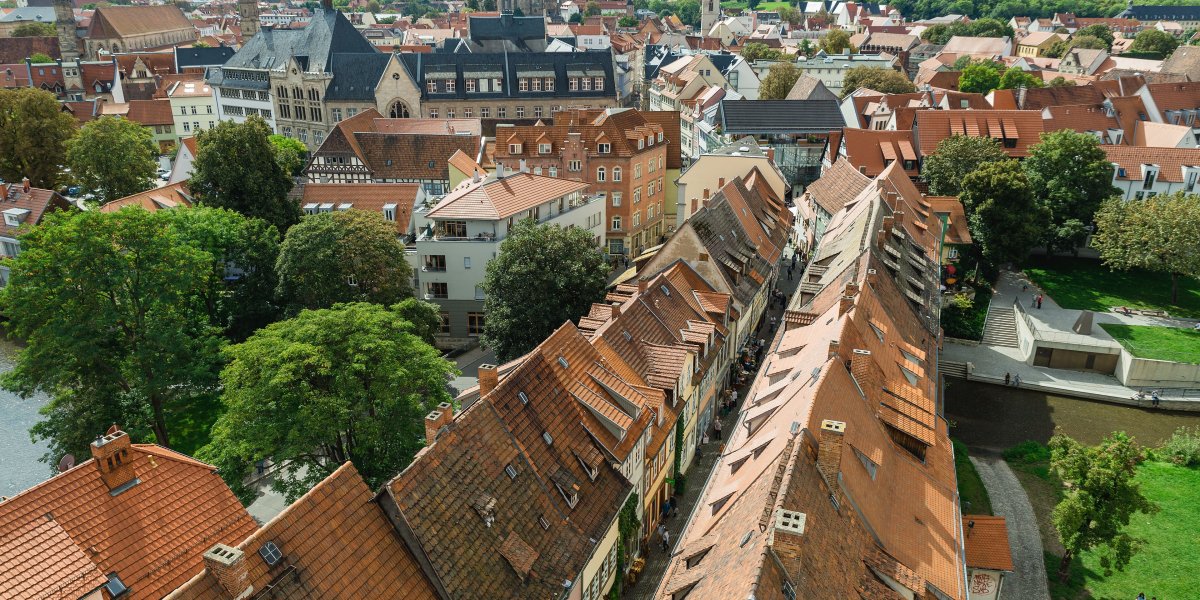
Exit Domplatz east down Marktstraße — eight minutes of half-timbered houses, then a quick crossing of Fischmarkt past the neo-Gothic Rathaus and the Roland statue before the bridge appears almost camouflaged inside the streetscape. This is the only fully inhabited bridge in Europe north of the Alps: thirty-two timber-framed houses still occupied above artisan workshops selling Thuringian blue-glaze pottery, honey-mead, and hand-bound notebooks. The two churches at either end (Ägidienkirche east, the ruins of Benediktikirche west) once acted as toll gates.
Tip: Enter from the Wenigemarkt (east) side and climb the small staircase inside Ägidienkirche to the church tower (€2) for the only down-the-spine view of the bridge with the Mariendom in the distance — almost no one knows this access exists.
Open in Google Maps →12:30
Food
Three minutes back to Marktstraße 13 — a modern fast-casual run by a young Erfurt couple who treat the regional bratwurst with the seriousness Italians give pasta. Order the Original Thüringer Rostbratwurst in a Brötchen (€5.50) with the dark mustard, and add a Thüringer Rostbrätel (€8) — a marinated pork neck steak grilled in front of you. The bratwurst here is sourced from a single butcher in Greußen and grilled over real beechwood; the chain places on Krämerbrücke use gas.
Tip: Counter service, no reservations — arrive at 12:25 exactly; by 12:45 the queue runs out the door. Take your tray to the small standing tables on the cobbles outside, not the cramped interior.
Open in Google Maps →13:30
Religious
Walk north up Augustinerstraße for ten minutes, past the prettiest stretch of half-timbered townhouses in the city. This is the Augustinian monastery where Martin Luther entered as a monk in 1505 and was ordained two years later — the cloister where he paced reading the Psalter is still here, almost untouched. The Gothic church and the quiet inner courtyard are open to walk through without a ticket; you don't need to enter Luther's cell to feel the weight of the place.
Tip: Enter through the small wooden door on Augustinerstraße (not the main visitor entrance) — it leads straight into the cloister courtyard, the most photogenic angle, with no ticket desk and almost no other visitors mid-afternoon.
Open in Google Maps →16:00
Landmark
Fifteen minutes west back along Andreasstraße, then up the long sloping ramp behind the cathedral — the climb is gentle, no stairs. The Petersberg is the largest preserved baroque city fortress in Central Europe, a massive star-shaped earthwork crowning the hill north of the old town. The grass-covered bastions are free to roam at any hour, and from the southeast corner the whole medieval skyline lays itself out below — Mariendom, Severikirche, Krämerbrücke, Rathaus tower — backed by the rolling Thuringian Forest.
Tip: Stand on the southeast bastion at 17:45 — golden hour lights the Mariendom facade dead-on while you watch from above; the underground tunnel tours are a tourist-trap upsell for a day-tripper, skip them and stay on the grass. Avoid the so-called 'Thüringer Spezialitäten' restaurants clustered around Krämerbrücke on your way back — they double the price for microwave-grade food and target departing day-trippers in the evening rush.
Open in Google Maps →19:00
Food
Twelve minutes downhill from the citadel to Michaelisstraße 9 — a 19th-century half-timbered brewhouse where the locals come for the regional benchmark dish. Order the Thüringer Klöße mit Rinderroulade (€18.50): two pale, dense potato dumplings made from raw and cooked potato, with a slow-braised beef roulade in dark red-wine gravy — the dish every Thuringian grandmother is judged on. Pair it with their own unfiltered Schwanen Hell (€3.80), brewed in copper kettles you can see from the front room.
Tip: Call ahead the same morning for a 19:00 table and ask specifically for the front Stube (the wood-paneled brewing room) — the modern back hall has the same food but none of the soul; the brewer himself often passes through between 19:30 and 20:00.
Open in Google Maps →Zu Tag springen
09:30
Landmark
Begin at Domplatz square and climb the 70-step open-air staircase rising onto Cathedral Hill — the postcard view that has defined Erfurt for 800 years. Inside the Gothic nave hangs the Gloriosa, the world's largest free-swinging medieval bell, while the 14th-century choir stalls are carved with caricatures of student life from Luther's university years. Arriving at the 09:30 opening puts you in front of the stained glass an hour before the first coach tours funnel up the steps.
Tip: Climb the staircase from the south corner of Domplatz — the two spires reveal themselves frame by frame, the single most photographed angle in Thuringia. Inside, ask the verger to point out the Romanesque Wolfram candelabra (1160) in the side chapel — almost no visitor finds it unassisted.
Open in Google Maps →11:00
Religious
Walk thirty seconds to your right after leaving the cathedral — Severikirche shares the same hilltop platform and forms the second of Erfurt's twin spires. Its rare five-aisled hall layout shelters a 14th-century pink-sandstone sarcophagus of St. Severus that glows when the south windows catch the late-morning sun. Together with the Dom, this is the silhouette every Thuringia postcard frames.
Tip: Don't shoot the two churches from Domplatz below — the spires foreshorten into one shape. Step onto the small terrace between the two entrances and frame diagonally from the eastern corner where the steps begin: both spires stand cleanly apart with the red rooftops of the old town descending behind.
Open in Google Maps →12:00
Food
Descend the cathedral steps and walk six minutes east onto Michaelisstraße — the medieval university lane Luther walked daily between his monastery and his lectures. This timber-frame inn pours Köstritzer black beer from the tap and serves the regional flagship Thüringer Rostbrätl (charcoal-grilled marinated pork neck, €17) and the original Thüringer Bratwurst (€8, mustard only — ketchup is heresy here). The dark-wood Stube is locals' lunch territory, not a tourist canteen.
Tip: Arrive by 12:00 sharp — by 12:45 the office crowd from Anger fills the front room and you'll be queuing at the door. Order the Rostbrätl over the bratwurst if you can only choose one; it's the dish Thuringers travel from Leipzig to eat. Pair it with the unfiltered Schwarzbier, never a lager.
Open in Google Maps →14:00
Landmark
Walk eight minutes back west across Domplatz to the ramp climbing the citadel's eastern flank — Erfurt's only surviving Baroque fortress and the highest point in the old town. Trace the star-shaped walls past the silent Romanesque Peterskirche, then descend into the underground Horchgang listening tunnels carved into the bastions to spy on besiegers. Settle finally at the southwest panorama point where the Dom, Severikirche, and the red-tiled rooftops of the entire medieval city spread beneath you.
Tip: The afternoon sun strikes the cathedral spires from the southwest — between 15:00 and 16:00 the light is golden and the spires cast their longest shadow across Domplatz. Walk the ramparts counter-clockwise so the panorama opens as your final view rather than your first; it makes the climb feel earned.
Open in Google Maps →16:30
Neighborhood
Descend the citadel's northern slope and follow Andreasstraße into a half-timbered quarter the GDR condemned for demolition — reunification rescued it just in time. Wander Schildgasse and Großer Hirschgarten where laundry still hangs from upper windows and you'll pass exactly zero souvenir shops. The 12th-century Andreaskirche anchors a small square at the quarter's heart — duck inside if the door is open for one of Erfurt's quietest church interiors.
Tip: Look up at the carved sandstone door lintels on Schildgasse — most are dated 1480-1550 with original owners' guild marks still legible. The bakery on the corner of Andreasstraße and Allerheiligenstraße sells Thüringer Schmalzkuchen (lard-pastry) until 17:00 — a 200-year-old recipe almost gone from the rest of Germany.
Open in Google Maps →19:00
Food
Walk five minutes south through the quarter back onto Michaelisstraße — Erfurt's oldest brewery has occupied this gabled house since 1380. The unfiltered Schwanenbier comes straight from the copper kettles visible through a side window, paired with Thüringer Klöße (regional potato dumplings) and Sauerbraten (€19) marinated five days in red wine. Locals nurse their second beer here until 23:00 — this is the room where Erfurt actually lives.
Tip: Reserve 24 hours ahead and request a window seat on the Allerheiligenstraße side; the alley view beats the inner courtyard. Order one Klöße mit Soße as a side — single biggest mistake visitors make is skipping the dumplings for fries. Pitfall warning for this area: skip any restaurant on Domplatz with multilingual menus on a sandwich board — they exist solely for cathedral day-trippers, charge double, and the bratwurst arrives microwaved.
Open in Google Maps →09:30
Landmark
Start at the eastern arch of the Krämerbrücke before the souvenir crowds arrive — the only fully inhabited bridge north of the Alps, thirty-two timber-framed houses sitting on stone arches over the Gera river since 1325. Walk it slowly: jewelers, chocolatiers, and a still-working medieval pottery workshop occupy ground floors that have never been anything else in seven centuries. Climb the Ägidienkirche tower at the eastern end for the only elevated view of the bridge's red rooftops aligned like a single long house.
Tip: The bridge is one-sided — you can't see the river while walking it. Descend to the Gera footpath via Rathausgasse on the south bank for the actual postcard angle (timber houses cantilevered above the water). Buy Goldhelm chocolate at Krämerbrücke 12 — single-origin Madagascar bean-to-bar made on site, the only chocolatier in central Germany roasting their own.
Open in Google Maps →11:15
Religious
Walk eight minutes northeast along Augustinerstraße to the working monastery where Martin Luther lived as a friar from 1505 to 1511 — his actual cell is preserved, plain as a confession. The English guided tour (€10, departures 11:00 and 14:00) takes you through the cloister, the Bibliothek of medieval manuscripts, and the Augustinerkirche where Luther was ordained priest in 1507. The chant book he studied from sits open under glass, and first-edition Luther Bibles line the gallery downstairs.
Tip: Book the English tour the day before by email — walk-ins are turned away on weekends. Skip the audio guide and take the human tour; the friar's anecdotes about Luther's monastic depression are not in any printed material. The Bibliothek's eastern window shows a fragment of original 13th-century stained glass — ask the guide to point it out.
Open in Google Maps →13:00
Food
Walk eight minutes back west along Augustinerstraße to Fischmarkt — Erfurt's central square framed by the Renaissance Rathaus and merchant houses with frescoed facades. Übersee occupies the ground floor of the gabled Haus zum Breiten Herd and serves modern Thuringian: Klöße mit Soße (the regional dumpling-with-gravy dish, €15) and seasonal Wild-Ragout (€21) from the Hainich forest. Take a window seat — the Roland statue has stood watch on this square since 1591.
Tip: Ask for the day's Mittagstisch — a two-course lunch menu locals order (€14-16) that never appears on the printed menu and is gone by 14:00. The kitchen does the Klöße with green-sauce variant (Frankfurter Grüne Soße style) only on Tuesdays — worth the trip if you land that day.
Open in Google Maps →14:30
Museum
Walk two minutes east of Fischmarkt down Waagegasse to the Old Synagogue — at over 900 years standing, the oldest synagogue surviving in Central Europe and UNESCO-listed since 2023. The mikveh ritual bath in the basement is the original 1250 stone chamber, and the upstairs vault displays the Erfurt Treasure: 3,000 silver coins and a 14th-century Jewish wedding ring buried during the 1349 pogrom and unearthed by accident in 1998. The wedding ring alone is worth crossing a continent for.
Tip: Enter the treasure vault first (upstairs left) — the wedding ring's gold tower-shaped bezel is in the third case, near a window where the natural light catches the engraving. Most visitors do the synagogue main hall first and rush the vault; do the opposite. The mikveh is closed on Mondays — confirm Tue-Sun before going.
Open in Google Maps →15:30
Neighborhood
Leave the synagogue and follow Bahnhofstraße south to Anger — Erfurt's grand commercial boulevard, three times wider than any old-town lane and lined with art nouveau facades the GDR never bulldozed. Pause at the Bartholomäusturm, a leaning brick belfry whose church was bombed in WWII and now stands alone like an exclamation point at the boulevard's edge. The Anger Museum's exterior carries expressionist frescoes by Erich Heckel — one of the Brücke movement's founders — visible free from the sidewalk.
Tip: Detour into the courtyard of Anger 37-38 (Bürgerhaus zum Stockfisch) — the inner half-timbering is original 1607 and almost no visitor enters. The Bartholomäusturm leans 1.4 meters off vertical; stand at its northwest corner to feel the tilt against the building line behind it. Most-photographed but skippable: the modern fountain at Anger plaza — backtrack thirty meters for the original frescoed facades instead.
Open in Google Maps →19:00
Food
Walk three minutes north from Anger to the Kaisersaal courtyard — Clara occupies the same building where Napoleon hosted Goethe at the Erfurt Congress of 1808. The Michelin-recommended kitchen serves chef-driven seasonal Thuringian: a 4-course tasting menu (€78) built around Hainich-forest venison, Wildkräuter (foraged wild herbs), and Saale-Unstrut wines from vineyards forty minutes north. This is Erfurt's most quietly proud meal, and the right last memory of the city.
Tip: Reserve a week ahead minimum and request the small back room overlooking the Kaisersaal's inner courtyard — the main dining room is louder and faces the street. The wine pairing (€48) is worth taking; the sommelier pours Saale-Unstrut Silvaner that doesn't leave the region. Pitfall warning for this area: avoid the bratwurst stands directly on Krämerbrücke — they charge €8 for what costs €3 at any Domplatz stand during the Mon-Sat farmers' market hours.
Open in Google Maps →
Trip builder
Plan this trip around Erfurt
Turn this guide into a bookable rail itinerary with FlipEarth.
Keep exploring
Related cities
More in the same country
FAQ
Frequently asked questions
How many days do you need in Erfurt?
Most travelers enjoy Erfurt in 1 days, with enough time for headline sights and a slower meal or museum stop.
What's the best time to visit Erfurt?
The easiest season for most travelers is May-Sep, especially if you want good weather and manageable crowds.
What's the daily budget for Erfurt?
A practical starting point is about €80 per person per day before hotels, then adjust based on museums, dining, and transport.
What are the must-see attractions in Erfurt?
A good first shortlist for Erfurt includes Domplatz with Erfurt Cathedral and St. Severi Church, Krämerbrücke, Petersberg Citadel.