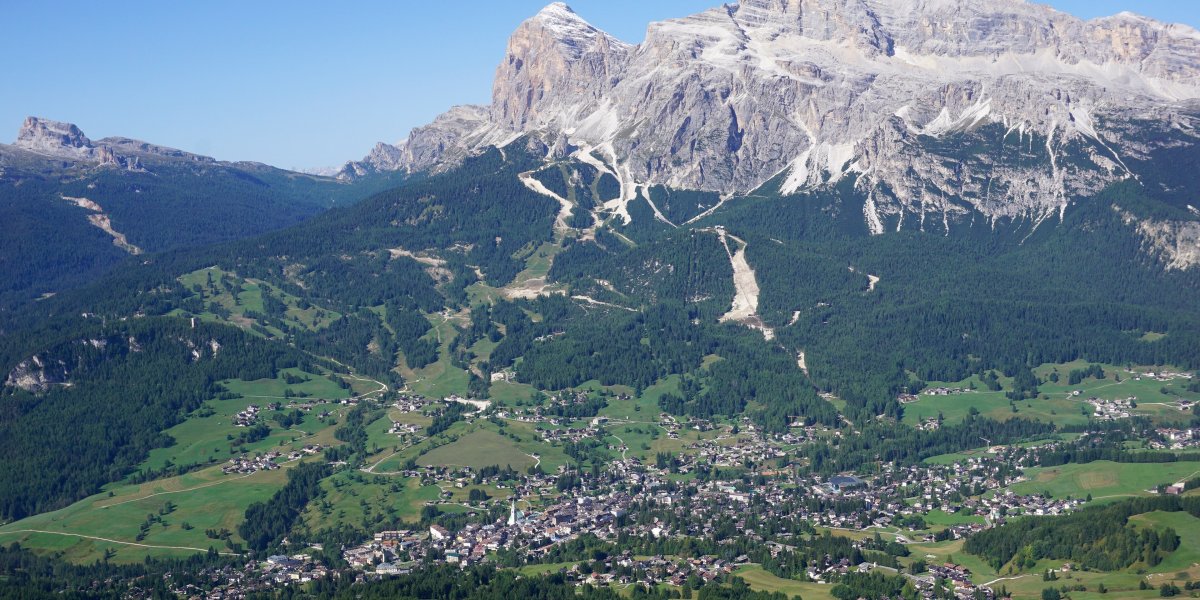
City Guide
Cortina d'Ampezzo
Italien · Best time to visit: Jun-Sep, Dec-Mar.
Day-by-day plan
Choose your pace
Reisedauer
09:00
Landmark
Start at the Freccia nel Cielo base station, a 10-minute walk west of Corso Italia along Via Marconi past the 1956 Olympic ice stadium — the bell tower will be at your back the whole way. The three-stage cable car climbs to Tofana di Mezzo at 3,244 m, the highest publicly accessible summit in the Dolomites, and the wrap-around terrace opens 360 degrees onto Marmolada's glacier, the Tre Cime di Lavaredo, and the distant Pale di San Martino. Why now: the lift opens at 09:00 and the morning air is crystal-clear before convective clouds build over the ridges by midday.
Tip: Buy the full Tofana di Mezzo round-trip ticket at the base, not the cheaper Ra Vales mid-station option — the third leg is a vertical shaft drilled inside the mountain and is the experience you came for. Even in July the summit hovers near freezing; bring a windbreaker and grip-soled shoes for the icy iron-grate platforms.
Open in Google Maps →11:45
Religious
Ride back down and walk 12 minutes east along Via Marconi — downhill the whole way, with the slate-roofed bell tower rising over the rooftops as your guide. The 18th-century Basilica anchors Cortina's heart, and the freestanding 70-metre campanile beside it (1858) is the tallest bell tower in the Dolomites, designed so its bells could ring across the entire valley.
Tip: The campanile chimes on the hour — time your photo for 12:00 from the corner of Largo delle Poste, where Tofana di Mezzo lines up directly behind the spire. It is the only spot in town where you frame both the peak you just stood on and Cortina's icon in one shot.
Open in Google Maps →12:30
Food
Two doors east of the Basilica on Largo delle Poste — under a minute on foot. Run by the Alverà family since 1956, this is where Cortina locals refuel between morning runs and afternoon strolls. Order a panino with Alto Adige speck and aged Asiago (8 EUR) and split a krapfen, the cream-filled Tyrolean doughnut that is the house specialty (4 EUR), eaten standing at the marble counter the way the regulars do.
Tip: Pay first at the cassa, then take the receipt to the bar — that is how locals jump the line. The seated terrace out front adds a 2 EUR cover charge per person and slows your service by 15 minutes; the standing counter is free and twice as fast.
Open in Google Maps →13:45
Neighborhood
Step out the door onto the corso — Cortina's traffic-free spine, lined with century-old hotels, jewelers, and the bronze 1956 Olympic flame monument at Largo delle Poste. Walk its full length north, then drop down to the Sentiero del Boite, a flat riverside path along the milky-blue Boite River where the limestone walls of Pomagagnon fill the eastern sky and the afternoon sun lights the Tofane behind you.
Tip: The shop windows here are pricier than Milan's Quadrilatero — but Co.Bi. on Corso Italia 90 sells the original ceramic Bombardino mug (12 EUR) used in every rifugio. Better souvenir than any keychain, and you will actually use it once you are back home in winter.
Open in Google Maps →15:30
Landmark
Follow the Boite path 10 minutes south to the Faloria cable car base — look for the squat red gondolas climbing the spruce slope across the river. The eight-minute ride lifts you from 1,224 m to 2,123 m on the opposite side of the valley, and from Rifugio Faloria's terrace the entire western horizon snaps into one frame: Tofane, Cristallo, and Pomagagnon together. The same peaks you stood on this morning, seen from the angle every Cortina postcard uses.
Tip: Late-afternoon light hits the Tofane head-on and turns the limestone pink — the alpine 'enrosadira' glow Italians cross continents for. Order a Bombardino at the rifugio bar (8 EUR), then walk the easy 15-minute ridge trail east toward Tondi for the unobstructed panoramic angle without the terrace crowd in your shot.
Open in Google Maps →19:30
Food
Take the cable car back down (last summer run is typically 17:30 — confirm at the base in the morning), then walk 10 minutes north through Corso Italia to Largo delle Poste 13. A Cortina mainstay since the 1960s, the dining room sits a stone's throw from the Basilica and has fed locals, ski racers, and visiting royalty for three generations. Order the casunziei all'ampezzana (red-beet ravioli with browned butter, poppy seeds, and smoked ricotta, 18 EUR) and the cervo in salmì (slow-braised venison with polenta taragna, 26 EUR) — both pure Ladin mountain cooking you will not find south of the Alps.
Tip: Reserve before 14:00 if you want any seating after 19:30 — the room has only 12 tables and turns over once an evening. And ignore the chalkboard 'Dolomiti tasting menus' propped outside the tourist restaurants near the cable car bases: same dishes, doubled prices, and the giveaway is pre-cooked beet pasta dyed an unnatural fuchsia instead of the deep earthy red of the real thing.
Open in Google Maps →Zu Tag springen
08:30
Landmark
From Cortina's Autostazione, catch the early Dolomiti Bus line 30 — 25 minutes west along the Great Dolomites Road, climbing through pine forest until the rock walls of Mount Lagazuoi rise like a fortress over Passo Falzarego. The bright yellow cable car carries you 650 vertical meters in five minutes to a balcony at 2752m, where the western Dolomites unfold in one uninterrupted sweep. Going at the very first run means you ride before the day-tripper coaches arrive and reach the summit while the morning shadows are still long across the Tofane massif.
Tip: Take the 08:30 first cable car — you'll have the summit terrace to yourself for fifteen minutes before the 09:00 buses unload. Check wind status the night before at lagazuoi5torri.dolomiti.org; closures are common in afternoon thunderstorms but rare at dawn. Bring a windproof layer regardless of valley weather — at 2752m it is typically 12°C colder than Cortina.
Open in Google Maps →09:30
Museum
Walk 200 meters from the cable car top station along the wooden plank trail to a discreet opening in the limestone — the entrance to the actual WWI Italian assault tunnel, hand-cut for 1.1km through the mountain in 1917 to plant 33 tons of explosives beneath the Austrian position above. You descend by steel rungs and ladders through eight levels of original galleries before emerging near Forcella Travenanzes with the Tofane facing you head-on. Doing it now, with full morning energy, means you tackle the 700+ rungs before lunch rather than after.
Tip: Rent a helmet and headlamp at the top station kiosk for 5 euros — mandatory, and not all sections are lit. Wear ankle-supporting boots and bring gloves; the steel handrails stay icy even in July. Allow 90 minutes one-way and arrange to return via the Falzarego-side chairlift back up rather than retracing — the tunnel is one-directional in spirit.
Open in Google Maps →12:30
Food
Ride the small Lagazuoi chairlift back up from the tunnel exit to the rifugio terrace — the most cinematic lunch spot in the Dolomites, perched right on the cliff edge at 2752m with the Marmolada glacier filling the southern horizon. Order the casunziei all'ampezzana (beetroot-stuffed half-moon ravioli with poppy seeds and smoked ricotta, 16 euros) — the dish that defines this valley — and the venison polenta (18 euros) from Cadore deer hunted within sight of your table. Eating here at midday means the sun is full on the Marmolada opposite, and the view becomes the meal.
Tip: Reserve a terrace table two to three days ahead via rifugiolagazuoi.com — without one you eat indoors and miss the entire point. Budget 35-45 euros for primo + glass of Lagrein + coffee. Skip dessert here; the panna cotta is honest but the cheese cellar tour (free, ask the waiter) is the real finale.
Open in Google Maps →14:30
Landmark
Cable car back down to Falzarego, then a 10-minute shuttle hop east to Bai de Dones, where the Cinque Torri chairlift carries you in eight minutes up to Rifugio Scoiattoli at 2255m. Five massive limestone spires rise straight out of the alpine meadow — the Dolomites in their most postcard form, and the rock that taught Reinhold Messner to climb. In afternoon light the towers glow orange against the Tofane behind them, and the gentler terrain rewards legs already taxed by the morning tunnel.
Tip: Walk the circular trail (sentiero 439) around the base counterclockwise — the towers stay lit from the right the entire loop, which matters for photos. Climbers will be active on the south walls; binoculars from Rifugio Scoiattoli are loaned free at the bar. The last descending chairlift leaves at 17:00 sharp — set a phone alarm at 16:40.
Open in Google Maps →16:00
Museum
From Rifugio Scoiattoli, walk 10 minutes south along the marked path 440 — you cross open meadow with the towers always at your right shoulder — to the open-air museum: a fully reconstructed Italian front-line sector with restored trenches, observation posts, gun emplacements and underground barracks dug into the rock. Coming at this hour means the late-afternoon shadows fall directly into the trenches the way Italian sentries would have seen them at sundown a century ago. Free, unstaffed, just respect.
Tip: Pick up the free trail map at Rifugio Scoiattoli before you walk down — four distinct sectors (Italian command post, frontline trench, barracks, observation deck) and without the map you'll miss half. By 16:00 the morning tour buses are long gone and you'll often have the whole site to yourself. Pitfall warning: the 'panorama prints with the towers' sold cheap along Corso Italia are mass-produced knock-offs — for the genuine work buy directly from photographer Diego Gaspari Bandion's small shop near Largo Poste, his name and signature on every print.
Open in Google Maps →19:30
Food
Last chairlift down, shuttle back to Cortina, then 3km east to Località Alverà where chef Riccardo Gaspari's Michelin-starred SanBrite occupies a working dairy farm — every cheese, cured meat and herb on your plate comes from within walking distance of the kitchen. The name means 'holy alpine pasture' in Ladin, and the 6-course mountain tasting menu (95 euros) is the unrepeatable Cortina dinner. The smoked-trout tartare from the farm's own stream and the year-aged Malga Federa cheese are the dishes you'll still be describing on the plane home.
Tip: Reserve two weeks ahead via sanbrite.it — only 30 covers and the kitchen closes at 21:30. Take the wine pairing (45 euros, all Alto Adige and Veneto) rather than ordering by the glass; sommelier Ludovica is the chef's wife and pairs with intent. Ask before sitting for the cheese-cellar tour — five minutes underground that reframe everything you then eat.
Open in Google Maps →09:00
Landmark
From the centre of town walk 10 minutes south along Via Marconi to the Freccia nel Cielo base station — the new three-stage lift system (Col Drusciè → Ra Valles → Tofana di Mezzo) completed in 2023 for the 2026 Olympics. In 18 minutes total you rise from 1224m to 3244m, the highest accessible summit in the entire Cortina basin and Italy's most photographed alpine viewpoint. Going first thing means you reach the top while the morning air is still glass-clear, before the afternoon clouds boil up from the valley.
Tip: Buy your round-trip ticket online the night before at freccianelcielo.com — the 09:00 ticket queue can reach 30 minutes in high season. The summit terrace faces north: the Marmolada glacier sits dead ahead, and on clear days the three peaks of Tre Cime di Lavaredo are visible to the far right above Misurina. Skip the Ra Valles intermediate stop on the way up to save 40 minutes — visit it on the way down when light is softer.
Open in Google Maps →12:00
Food
Back at the cable car base, walk 10 minutes north along Via Cesare Battisti into the pedestrian zone — you'll pass the old wooden chalets of the historic center before arriving at Largo Poste, the small square dominated by the cathedral bell tower. Ristorante 5 Torri sits on the corner, family-run since the 1956 Olympics, the address where Cortina locals actually eat their own cuisine. Order the casunziei rossi (the beetroot ravioli, 15 euros) and the pastin con polenta (Belluno-style ground veal sausage, 18 euros) — both dishes you can find nowhere outside this valley.
Tip: Arrive at 12:00 sharp — by 12:30 the lunch tables are full and the kitchen pushes you to a 14:00 second seating. No reservation needed for early lunch. Pair with a glass of Prosecco di Valdobbiadene Superiore di Cartizze (8 euros) — locally insisted upon over heavier reds at altitude. Skip the tiramisu, ask for the strudel di mele with cinnamon cream instead.
Open in Google Maps →13:30
Religious
Walk literally 50 meters across Largo Poste — the basilica is the building whose bell tower you've been seeing from every direction all morning. Cortina's parish church was rebuilt in 1775 and the 70-meter campanile that defines the town skyline went up in 1858, the tallest in the Dolomites. The interior is restrained alpine baroque with carved larchwood altars by local sculptor Andrea Brustolon. Coming after lunch means the early-afternoon light slants through the south rose window directly onto the high altar — the one moment of the day the gilding catches fire.
Tip: Climb the bell tower if it's open — limited summer hours (14:00-17:00, 3 euros) but the 360° view of Tofane, Pomagagnon and Sorapiss from the belfry is the photo you actually came to Cortina for. Look in the small chapel left of the entrance for the painted votive plaques left by WWI soldiers and 1956 Olympic athletes — entirely unmarked but the most touching thing in the church.
Open in Google Maps →14:30
Museum
Walk 80 meters along Corso Italia to Ciasa de ra Regoles, the timber-and-stone building of the Regole d'Ampezzo (the medieval communal land cooperative that still governs the surrounding forests). Hotelier Mario Rimoldi spent his life trading rooms for paintings with the artists who came to ski here, and bequeathed Cortina the most surprising modern art collection in the Alps — De Pisis, Sironi, Campigli, Music, Guttuso, all hung as if in a private apartment. Visiting now keeps you indoors during the warmest hour and you're back on the street for the golden-light passeggiata.
Tip: Buy the combined Regole ticket (12 euros) — the same building houses the paleontology museum on the upper floor with Triassic marine fossils literally pulled out of the surrounding peaks, the proof that these Dolomites were once a coral seabed. The De Pisis self-portrait on the second floor (room 3) is the masterpiece nobody mentions — find it before leaving.
Open in Google Maps →16:30
Neighborhood
Step straight out of the museum into Cortina's pedestrian spine — 600 meters of cobblestone running from Piazza Roma to Piazza Venezia, lined with the chic boutiques (Loro Piana, Fendi, Bottega), the historic confectioners (Pasticceria Embassy since 1953) and the wood-paneled aperitivo bars where Cortinesi still do the passeggiata at this hour. Going now means you catch the golden hour on the surrounding peaks — the Pomagagnon east, the Tofane west, and the entire valley lit copper for about 40 minutes. Stop at Bar Lovat or LP26 around 18:00 for a Hugo spritz (elderflower, Prosecco, mint) — the Dolomite-region cocktail, not the Aperol tourist standard.
Tip: Photograph the corso looking south from Piazza Roma at 17:30 — the bell tower frames perfectly against Antelao with the cobblestones still warm-toned. Skip the Mercato di Cortina pop-up stalls (overpriced 'local cheese' that is supermarket Asiago repackaged) — the real cheese is in the Salumeria Pellegrini on Largo Poste 1. Buy a piece of malga half-aged Ampezzano cheese (around 35 euros/kg) to take home.
Open in Google Maps →19:30
Food
Take a 5-minute taxi west to Località Lacedel where chef Graziano Prest's Michelin-starred Tivoli sits on a hillside terrace facing the entire Tofane massif — the dining room is built so every table looks straight at Tofana di Mezzo, the peak you stood on this morning. The 7-course 'Dolomiti' tasting (130 euros) closes the trip with chef Prest's signature dishes: tagliolini with white truffle from the Marmolada foothills (35 euros à la carte), and the wood-pigeon en croûte from the local hunting reserve. Watching the alpenglow fade on Tofana di Mezzo through the window over your wine glass is the farewell Cortina actually deserves.
Tip: Reserve four to five days ahead via ristorantetivolicortina.it and specifically request a window table on the right side of the dining room — those are the seats with the Tofane view, and the staff seat tourists to the left by default. The wine pairing (60 euros) is heavy on Veneto whites that complement the dishes better than reds at this altitude. Pitfall warning: the row of brightly-lit pizzerias along the SS51 between Cortina and Pocol target departing tourists with inflated 'Olympic menu' prices — anything more than 22 euros for a margherita is a red flag, eat in town center instead.
Open in Google Maps →
Trip builder
Plan this trip around Cortina d'Ampezzo
Turn this guide into a bookable rail itinerary with FlipEarth.
Keep exploring
Related cities
More in the same country
FAQ
Frequently asked questions
How many days do you need in Cortina d'Ampezzo?
Most travelers enjoy Cortina d'Ampezzo in 1 days, with enough time for headline sights and a slower meal or museum stop.
What's the best time to visit Cortina d'Ampezzo?
The easiest season for most travelers is Jun-Sep, Dec-Mar, especially if you want good weather and manageable crowds.
What's the daily budget for Cortina d'Ampezzo?
A practical starting point is about €165 per person per day before hotels, then adjust based on museums, dining, and transport.
What are the must-see attractions in Cortina d'Ampezzo?
A good first shortlist for Cortina d'Ampezzo includes Freccia nel Cielo Cable Car to Tofana di Mezzo, Funivia Faloria & Rifugio Faloria Viewpoint.