City Guide
Coimbra
Portugal · Best time to visit: Apr-Jun, Sep-Oct.
Day-by-day plan
Choose your pace
Reisedauer
09:00
Landmark
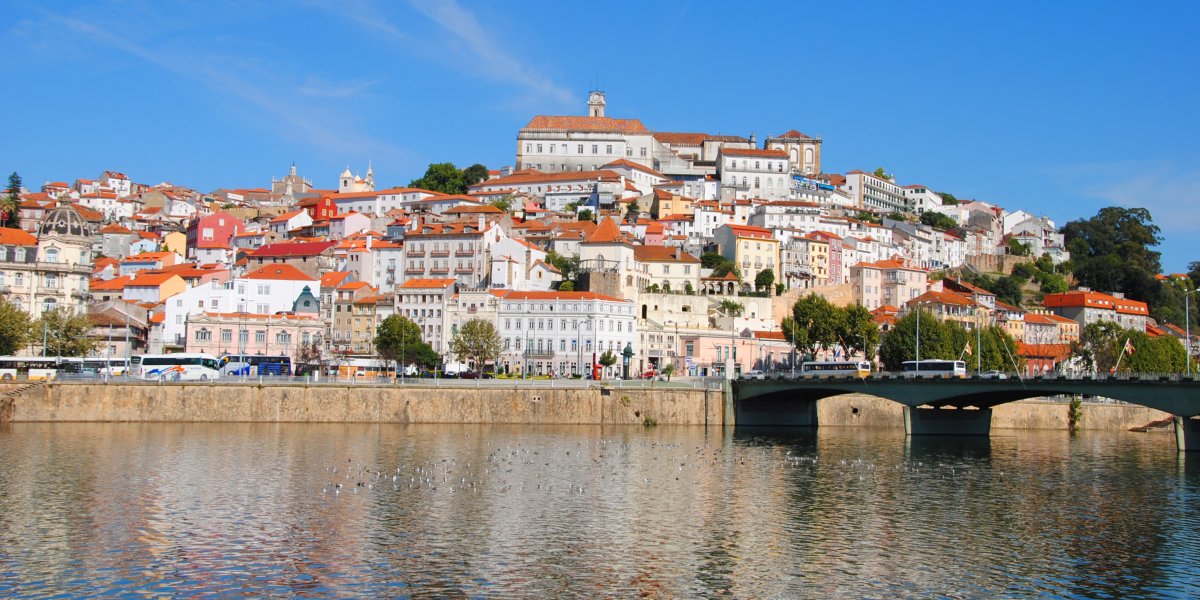
Begin your day on the south bank of the Mondego, where all of Coimbra reveals itself at once — a cascade of terracotta rooftops climbing toward the baroque university tower. Walk onto the Pedro e Inês pedestrian bridge, a sleek modern footbridge named after Portugal's most tragic love story, and pause at its midpoint for the definitive photograph: the entire medieval skyline reflected in the still morning river.
Tip: Stand at the bridge's midpoint facing northeast around 09:15 — the low morning sun backlights the university tower and the Mondego is still glassy before the wind picks up. Shoot with the colored glass panels of the bridge railing in your foreground for a layered composition no one else gets.
Open in Google Maps →10:15
Religious
Cross the bridge to the north bank and walk straight up Rua Ferreira Borges, Coimbra's main commercial artery — a handsome 19th-century arcade of tiled facades and iron balconies — for about twelve minutes until you reach Praça 8 de Maio and the ornate Manueline facade of Santa Cruz. This is where Portugal began: the tombs of the nation's first two kings, Afonso Henriques and Sancho I, lie inside. The exterior portal is a riot of carved stone ropes, armillary spheres, and maritime motifs from the Age of Discovery.
Tip: The facade is best photographed before 11:00 when the sun is still on it. Look up above the main portal for the intricate Manueline window — most visitors fixate on the door and miss the finest carving entirely. The small garden cloister to the left, Jardim da Manga, is free to enter and almost always empty.
Open in Google Maps →12:00
Food
Step directly next door into what may be Portugal's most beautiful café — built inside the vaulted stone nave of a former church, with soaring arches and stained glass overhead. Order a sandes de leitão (suckling pig sandwich, ~€6) with a galão (Portuguese latte, ~€1.50) and finish with a pastel de Santa Clara (local almond-and-egg yolk pastry, ~€2). This is where Coimbra fado is sometimes performed in the evenings, but at midday it is simply a stunning, unhurried place to refuel.
Tip: Sit at the tables furthest from the entrance, near the stone columns — fewer tourists drift that deep and the acoustics are church-like. Budget €8–12 per person. No reservation needed at lunch; just walk in.
Open in Google Maps →13:00
Religious
From the café, walk up Rua Quebra Costas — literally 'Back-Breaker Street,' a steep medieval stairway lined with fado bars and azulejo-clad walls. In five breathless minutes you emerge at Coimbra's Old Cathedral, built in 1139, the year Portugal declared independence. It does not look like a church — it looks like a fortress, with crenellated walls, arrow-slit windows, and a fortified entrance. This is Romanesque military architecture at its most uncompromising, and the finest surviving example in Portugal.
Tip: The best photo angle is from the small terraced steps directly across the front entrance — you can capture the full fortified facade with the narrow old-town alley framing it below. Walk around to the left side for a view of the massive apse and buttresses that most visitors never see.
Open in Google Maps →14:30
Landmark
Continue uphill five minutes from the cathedral along Rua de Sub-Ripas, passing through the 16th-century Porta Férrea (Iron Gate), and suddenly the city drops away beneath you. You are standing in the Paço das Escolas, the ceremonial courtyard of one of the world's oldest universities, founded in 1290. The baroque clock tower — the Torre da Universidade — rises above you, and from the courtyard's stone balustrade you get a sweeping 180-degree panorama over the Mondego valley. The ornate exterior of the Biblioteca Joanina is directly behind you.
Tip: The courtyard is free to enter — you only pay if going inside the library or tower. Walk to the far end of the balustrade terrace for the widest river view; in the afternoon the sun is behind you, making this the ideal light for photos facing the valley. The statue of King João III in the center of the courtyard is the single most photographed spot in Coimbra.
Open in Google Maps →19:00
Food
Walk back downhill from the university along Rua Borges Carneiro toward the Arco de Almedina — a ten-minute descent through medieval alleys where laundry hangs between stone walls. Duck into Beco do Forno, a narrow alley just above the arch, and find this legendary twelve-seat tavern whose walls are covered floor-to-ceiling in handwritten poems and love notes. Order the chanfana (goat slow-braised in Dão red wine, ~€10) and arroz de bucho (tripe rice, ~€8). This is the taste of deep inland Portugal that you will not find in Lisbon.
Tip: No reservations, no credit cards — arrive at 18:45 or face a 40-minute wait in the alley. Twelve seats means every service fills instantly. Budget €12–18 per person with wine. Avoid the restaurant touts on Rua Ferreira Borges who intercept tourists walking downhill — they steer you toward overpriced places with river views and frozen fish. The real Coimbra eats in alleys like this one.
Open in Google Maps →Zu Tag springen
09:00
Landmark
From the Baixa, climb the worn stone steps of Rua Quebra Costas — graffiti-covered walls and crumbling facades earning you the summit at the Porta Férrea. Pass through the iron gate into the Paço das Escolas courtyard where the Mondego Valley spreads below, then enter the Joanine Library: three gilded Baroque halls sheltering 300,000 volumes, guarded nightly by a colony of bats that protect the books from insects. Next door, the Chapel of São Miguel hides azulejo-lined walls and a Baroque organ worth lingering over.
Tip: Book your Joanine Library time slot online at least one day ahead — entry is capped at tiny groups every 20 minutes and the 09:00 slots vanish first. If you didn't prebook, join the ticket queue by 08:45. The tower climb (184 steps) rewards you with the city's best aerial photo — shoot facing south toward the river.
Open in Google Maps →11:15
Museum
Exit the university through the Porta Férrea and turn right — the museum entrance is a two-minute walk north across Largo Dr. José Rodrigues. Built atop a 1st-century Roman cryptoporticus, the underground stone corridors where Coimbra's Roman foundations lie exposed are the visceral highlight — then work upward through medieval sculpture, Renaissance painting, and Flemish tapestries. Finish on the rooftop terrace for the city's finest panorama: red rooftops cascading to the Mondego with the Serra da Lousã on the horizon.
Tip: Start in the cryptoporticus on the lowest level while your legs are fresh — it's poorly signed, so grab the free floor plan at reception and head straight down. The rooftop terrace café does excellent espresso for €1; linger here before tour groups arrive around noon. Closed Mondays — if your trip falls on a Monday, swap this with the Botanical Garden.
Open in Google Maps →12:45
Food
Exit the museum and head south down narrow Rua de Sub-Ripas past the Sé Nova — five minutes downhill through alleyways that smell of charcoal and grilled sardines. This legendary 12-seat tavern has walls plastered with handwritten notes from decades of grateful eaters — order the chanfana, goat slow-braised in red wine in a black clay pot (€11), or the arroz de pato, duck rice baked golden with chouriço (€10). House red is €2 a glass and better than it has any right to be.
Tip: No reservations, cash preferred, 12 seats. Arrive by 12:30 sharp — by 13:00 the queue snakes down Beco do Forno and you'll wait 30 minutes. If the chanfana is gone by the time you sit (it sells out by 13:30), the cozido à portuguesa is the fallback.
Open in Google Maps →14:00
Religious
Step out of the alley and walk two minutes east on Rua do Corpo de Deus — the cathedral's crenellated roofline appears above, looking more fortress than church. Built in 1164 on the frontier between Christians and Moors, this is Portugal's best-preserved Romanesque church: arrow-slit windows, battlements, and an austere nave leading to a gilded Flemish altarpiece. The 13th-century Gothic cloister — hushed, intimate, and overlooked by most visitors — is where the weight of eight centuries presses in around you.
Tip: Pay the €2.50 cloister entry — most visitors skip it entirely and it's the hidden masterpiece. Between 14:00 and 15:00 the afternoon sun cuts through the Gothic arches at a low angle that makes every photo effortlessly dramatic. The main nave is free; only the cloister requires a ticket.
Open in Google Maps →15:15
Park
From the cathedral, descend southeast through steep lanes past centuries-old tiled facades to the garden's upper entrance — ten minutes downhill with glimpses of the valley through the rooftops. Founded in 1772 during the Marquis of Pombal's Enlightenment reforms, these 13 hectares terrace down the hillside through bamboo forests, 200-year-old cedars, and a tranquil Victorian greenhouse. Enter from the top and let gravity pull you through the shaded paths to the wild lower Mata, where the city noise vanishes entirely.
Tip: Always enter through the upper gate near the university and walk downhill — this route lets gravity do the work and reveals the garden's best visual sequence. The bamboo tunnel in the lower Mata is the most photogenic spot; late-afternoon light filtering through the canopy is extraordinary. Skip the greenhouse unless tropical plants genuinely excite you.
Open in Google Maps →19:30
Food
From the garden, climb back up through the university quarter to Rua Quebra Costas — twelve minutes uphill, but the golden evening light on tiled facades makes it scenic rather than punishing. This intimate wine bar on the steep lane whose name means 'break your back' does creative Portuguese tapas: the polvo à lagareiro with smashed potatoes (€14) and the tábua de queijos da Serra with cured sheep's cheese from the nearby hills (€9) are the order. The Dão reds on the wine list come from vineyards you can almost see from the terrace.
Tip: Reserve for 19:30 — the place is small and fills with university professors by 20:00. After dinner, walk down to Fado ao Centro (Rua Quebra Costas 7) for a 50-minute live Coimbra fado session at 21:30 (€15 with a glass of port) — the singers are male, cloaked in black academic capes, and the sound is more melancholic than Lisbon fado. Avoid the 'fado dinner' packages hawked near the university gate — overpriced tourist traps with canned performances and microwave food.
Open in Google Maps →09:00
Religious
From Praça 8 de Maio in the heart of the Baixa, the monastery's ornate Manueline facade rises directly ahead — no walk needed if your hotel is central. Inside lie the tombs of Portugal's first two kings, Afonso Henriques and Sancho I — the men who carved a nation from Moorish Iberia — surrounded by a sacristy and cloister bursting with azulejo panels and Manueline stonework so intricate it resembles frozen lace. Stand before Afonso Henriques' tomb and absorb the weight: this is where Portugal's founding story rests.
Tip: The church nave is free, but pay €3 for the sacristy and Cloister of Silence — the azulejos depicting the life of Saint Augustine are among the finest in Portugal. Morning light floods the nave through the rose window between 09:00 and 10:00; by afternoon the interior goes flat. Don't confuse this with the nearby parish church — you want the monastery entrance directly on Praça 8 de Maio.
Open in Google Maps →10:15
Neighborhood
Exit the monastery and walk south along elegant Rua Ferreira Borges for five minutes to the Arco de Almedina, the sole surviving gate of the medieval walls. Duck through the arch and you're at the threshold of the old Moorish medina — above, steep lanes climb to the university; around you, Praça do Comércio buzzes with the rhythms of Portugal's oldest commercial square. Browse the traditional ceramic shops and climb the 16th-century Torre de Almedina for a bird's-eye view back down into the Baixa.
Tip: Praça do Comércio is the city's most authentic square — no tourist restaurants, just local commerce unchanged for centuries. The ceramic shops along Rua Ferreira Borges sell hand-painted Coimbra pottery (blue-and-yellow, distinct from Lisbon's blue-and-white) at fair prices — €15-25 for a beautiful tile. Skip the souvenir stands near the university; the Baixa shops are cheaper and more genuine.
Open in Google Maps →12:00
Food
From Praça do Comércio the restaurant is steps away on the square's edge — you've been circling it for the past hour. This stylish petiscos bar in a converted old-town grocery draws a loyal local crowd for small plates and natural wines: order the pataniscas de bacalhau, crispy salt-cod fritters that shatter on the bite (€6), and the tábua mista with Serra da Estrela cheese and presunto (€12). A glass of house Bairrada white cuts through the richness perfectly.
Tip: Arrive right at noon for a terrace seat overlooking the square — by 12:30 every table is taken and there's no reservation system. Ask for the petisco do dia (daily special); it's always the best value on the board. If they have pudim de laranja (orange pudding) on the dessert list, don't leave without ordering it.
Open in Google Maps →13:30
Landmark
Walk south to Largo da Portagem and cross the Ponte de Santa Clara — ten minutes with the river glittering below and the university hill receding behind you. This Gothic monastery, founded by Queen Isabel in 1314, spent centuries drowning as the Mondego flooded relentlessly, burying it in silt until only the roofline remained — excavated and reopened in 2009, the roofless ruins are hauntingly beautiful with soaring stone arches framing nothing but sky. The interpretive center inside brilliantly reconstructs the monastery's original splendor before the river claimed it.
Tip: Don't rush past the multimedia displays in the interpretive center — they show what the monastery looked like before the floods and make the ruins far more powerful. The best photograph is from the raised walkway looking down the nave, where roofless Gothic arches frame open sky. Budget 45 minutes inside and 15 for the peaceful garden outside.
Open in Google Maps →15:00
Park
Continue south along the riverbank path from Santa Clara-a-Velha — eight minutes through plane trees with views across to the old town skyline. This romantic estate is where Portugal's most devastating love story ended: in 1355, Inês de Castro was murdered here on the king's orders, and her lover Prince Pedro, upon becoming king, allegedly exhumed her corpse, crowned it queen, and forced the entire court to kiss its hand. Seek out the Fonte dos Amores deep in the forest where the red iron stains on the rocks are said to be her blood, and let the ancient sequoias and medieval aqueduct complete a story that still defines Portuguese saudade.
Tip: The Fonte dos Amores is in the forest at the back of the gardens — follow signs for 'Fonte dos Amores,' not the hotel reception. Late-afternoon light through the canopy of ancient trees is exactly why this is the right hour to visit. The estate is now a luxury hotel but the gardens are fully open to the public; allow the complete hour — rushing past the fountain without sitting with the story would be the real loss.
Open in Google Maps →19:00
Food
Walk back across the Ponte de Santa Clara to the Baixa — fifteen minutes along the river at golden hour, with the university hill lit amber above you. This contemporary Portuguese restaurant near Largo da Portagem bridges tradition and invention: the polvo grelhado com puré de batata-doce, grilled octopus with sweet-potato purée (€16), is flawless, and the secretos de porco preto, Iberian pork secretos with roasted vegetables (€15), rivals anything in Lisbon at half the price. A fitting farewell dinner for a city that earns far more love than its modest fame suggests.
Tip: Reserve for 19:00 — popular with Coimbra's young professionals and full by 20:00 on weekends. Order a bottle of Dão Reserva from the wine list (€18-25) — you're in the heart of Dão wine country and won't find these small-producer labels abroad. Steer clear of the tourist restaurants clustered around Largo da Portagem — they serve frozen fish at twice the price and survive entirely on foot traffic from the bridge.
Open in Google Maps →
Trip builder
Plan this trip around Coimbra
Turn this guide into a bookable rail itinerary with FlipEarth.
Keep exploring
Related cities
More in the same country
FAQ
Frequently asked questions
How many days do you need in Coimbra?
Most travelers enjoy Coimbra in 1 days, with enough time for headline sights and a slower meal or museum stop.
What's the best time to visit Coimbra?
The easiest season for most travelers is Apr-Jun, Sep-Oct, especially if you want good weather and manageable crowds.
What's the daily budget for Coimbra?
A practical starting point is about €40 per person per day before hotels, then adjust based on museums, dining, and transport.
What are the must-see attractions in Coimbra?
A good first shortlist for Coimbra includes Ponte Pedonal Pedro e Inês, Universidade de Coimbra — Paço das Escolas.