City Guide
Cluj-Napoca
Rumänien · Best time to visit: May-Sep.
Day-by-day plan
Choose your pace
Reisedauer
09:00
Landmark
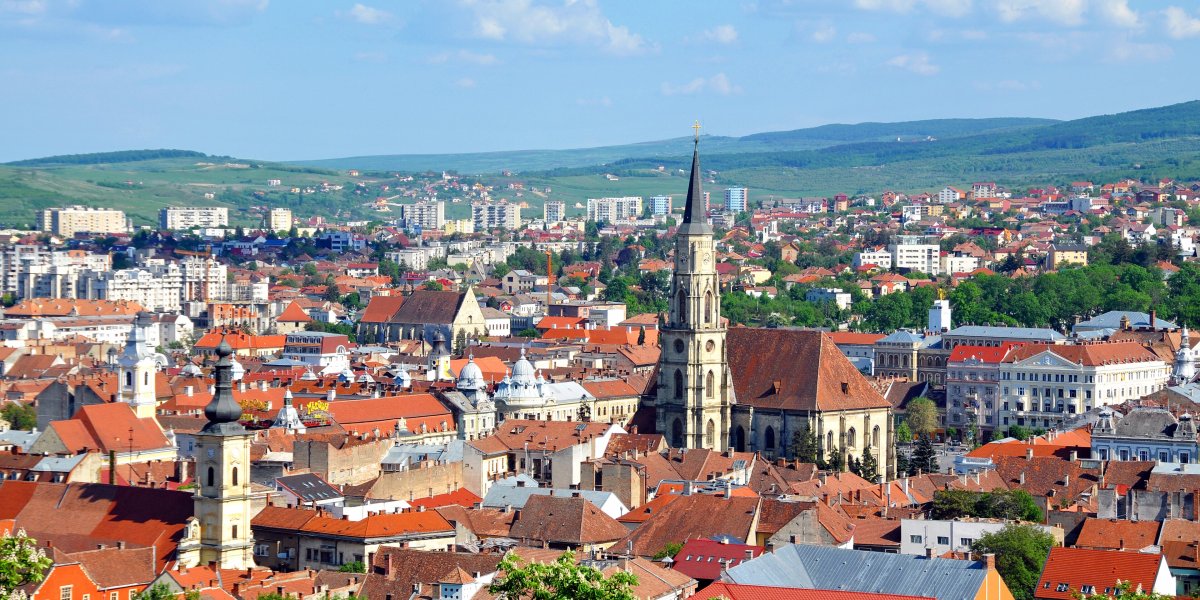
From the old town, head southwest on Strada Cetățuii — the 15-minute climb up the forested switchback wakes your legs as the city drops away below. From the hilltop terrace you get Cluj's single best panorama: St. Michael's Gothic spire rising from a carpet of orange rooftops, the Someșul Mic river curving through the valley, and the Apuseni foothills filling the horizon. Morning light rakes east-to-west across the rooftops, turning the whole scene gold — by afternoon the city falls into its own shadow and the contrast flattens.
Tip: The upper terrace near the old citadel wall fragment gives the clearest vantage with no tree obstructions — stand at the iron railing for the widest angle. Bring a lens wider than 35mm to capture the full sweep from river to mountains.
Open in Google Maps →10:15
Religious
Descend from Cetățuia on the eastern path through a canopy of chestnut trees, emerging at the bottom of Strada Cetățuii — Piața Unirii opens up five minutes ahead. The 14th-century Gothic church dominates Romania's largest medieval square, its 80-meter spire flanked by the massive Matthias Corvinus equestrian statue and the pastel Baroque façade of Bánffy Palace. Circle the full perimeter of the square to photograph the Gothic-versus-Baroque contrast — this single frame is the defining image of Cluj.
Tip: Stand at the northwest corner of the square around 10:30 for the shot that captures the sunlit church façade, the Corvinus statue in profile, and Bánffy Palace together — the mid-morning light angle is perfect and the square is still uncrowded before the tour buses arrive at noon.
Open in Google Maps →12:00
Food
Walk one block west from the church to Strada Matei Corvin, the narrow cobblestone lane between the square and the old city wall remnants. Grab a fresh kürtőskalács (chimney cake, ~3€) straight off the rotating spit — still warm and crackling with cinnamon and crushed walnut — and pair it with a portion of mici (grilled spiced meat rolls, 5 pieces ~4€) with sharp mustard and torn bread from an adjacent grill cart. This standing-up, hands-dirty combo is the fastest and most authentically Romanian lunch you can have.
Tip: Order the kürtőskalács with walnut and cinnamon, not Nutella or Oreo — the tourist toppings mask the dough's own buttery caramel flavor. Eat the mici the moment they come off the grill; they lose their crispy snap within minutes.
Open in Google Maps →13:00
Neighborhood
Walk three minutes north through the passageway at the top of Strada Matei Corvin — it opens directly into Museum Square, Cluj's oldest and most intimate plaza. The 15th-century Matthias Corvinus House, where Hungary's greatest Renaissance king was born, anchors the southeast corner with its Gothic stone façade still intact. The cobblestoned square is ringed by painted medieval townhouses in ochre and terracotta — quieter and more atmospheric than the grand Unirii, this is the Cluj that existed before the Habsburgs arrived.
Tip: The café terrace on the west side of the square offers the best composition — you face the Corvinus House with medieval rooflines stacked behind it. The square is nearly empty between 13:00 and 14:00 when the lunch crowd clears, giving you unobstructed photos of the full medieval ensemble.
Open in Google Maps →14:30
Park
Walk 12 minutes east from Museum Square along Strada Bariţiu, passing the restored Tailors' Bastion — a bright-red medieval tower worth a quick photo stop mid-route. Central Park opens around a glassy lake with the Casino reflected in the still water — an elegant confection of stucco arches, Corinthian columns, and Art Nouveau ironwork. Walk the full lake perimeter for the best angles; the Casino's reflection sharpens in the afternoon calm when the morning tour groups have moved on.
Tip: The small bridge on the south side of the lake frames the most symmetrical reflection shot of the Casino — shoot between 14:00 and 16:00 when the water surface is calmest and the afternoon sun backlights the building through the tree canopy.
Open in Google Maps →19:00
Food
Walk 10 minutes west from the park along Bulevardul Eroilor — the boulevard is lined with grand Austro-Hungarian façades that glow amber in the evening light. Roata ('The Wheel') is Cluj's most beloved traditional restaurant, a wood-paneled room hung with Transylvanian folk textiles where locals outnumber tourists three to one. Order the sarmale (cabbage rolls with polenta and sour cream, ~7€) and finish with papanași (fried doughnuts with sour cream and forest berry jam, ~5€) — budget 12–16€ per person including a local beer.
Tip: Arrive at 19:00 sharp or reserve ahead — every table fills by 19:30, especially Thursday through Sunday. Skip the restaurants lining Piața Unirii itself: they charge double for half the quality and survive on tourist foot traffic alone.
Open in Google Maps →Zu Tag springen
09:00
Religious
Begin your morning on the south side of Piața Unirii — at this hour the early sun rakes across the 14th-century Gothic façade in warm gold, the square is near-empty, and the 80-meter spire rises with nothing to compete against it. Step inside for the vaulted nave, the original 15th-century stone pulpit, and the largest organ in Transylvania. Outside, the equestrian statue of Matthias Corvinus — Renaissance king born one block from here — stands guard before the entrance, framing the most photographed composition in Cluj.
Tip: Climb the church tower (separate ticket, ~5 RON/€1) right at 09:00 when the booth opens — the spiral staircase delivers the single best aerial view of the square and rooftops, and by 10:30 a queue forms. Shoot from the south-facing window for the composition that captures both the square below and the Apuseni hills behind.
Open in Google Maps →10:15
Museum
Walk 30 meters across the square to its northwestern corner — the grand Baroque Bánffy Palace is unmistakable with its carved stone balconies and pastel-yellow façade. Inside, five centuries of Romanian art unfold: the highlight is the first-floor gallery of Romanian Impressionists, where Nicolae Grigorescu's luminous peasant scenes and Ștefan Luchian's flower studies feel like discovering a secret school of painting the rest of Europe never noticed. The second floor holds rotating contemporary exhibitions — usually worth a quick pass through.
Tip: The inner courtyard of the Bánffy Palace is free to enter even without a museum ticket and hosts summer evening concerts with superb acoustics — check the poster by the entrance. Museum is closed Mondays; on weekday mornings you will often have entire rooms to yourself.
Open in Google Maps →12:00
Food
Exit the palace and walk 2 minutes north on Strada Universității, past the bookshops and student cafés — the traditional eateries cluster on the left side before the street bends. Sit down for a bowl of ciorbă de burtă (tripe soup with sour cream and a sharp hit of vinegar and hot pepper, ~18 RON/€3.60) and a plăcintă cu brânză (flaky cheese pie baked in a wood oven, ~12 RON/€2.40). This is the Transylvanian power lunch: fast, filling, and under €7 — the same meal locals have eaten here for generations.
Tip: If ciorbă de burtă sounds too adventurous, ask for ciorbă de legume (vegetable sour soup) — equally authentic, lighter, and available everywhere. Arrive by 12:00 to beat the university lunch rush that peaks at 12:30. Pair with a fresh-baked covrigi (Romanian pretzel, ~3 RON) from the bakery next door.
Open in Google Maps →13:00
Neighborhood
Walk 3 minutes north through the passageway at the top of Strada Matei Corvin — it opens directly into Museum Square, Cluj's oldest and most intimate plaza. The 15th-century Matthias Corvinus House, where Hungary's greatest Renaissance king was born, anchors the corner with its original Gothic stone façade still intact — a brass plaque marks the spot. The cobblestoned square is ringed by painted medieval townhouses in ochre and terracotta, quieter and more atmospheric than grand Piața Unirii — this is the Cluj that existed before the Habsburgs reshaped the city.
Tip: The café terrace on the west side offers the best framing — you face the Corvinus House with layered medieval rooflines stacked behind it. Between 13:00 and 14:00 the lunch crowd clears and you get the square nearly empty for photos. Peek inside the small Pharmacy Museum (Muzeul de Farmacie) on the square's north side — one of the oldest apothecaries in Europe, entry ~5 RON.
Open in Google Maps →14:30
Park
Walk 12 minutes east from Museum Square along Strada Barițiu, passing the restored Tailors' Bastion — a bright-red medieval tower worth a quick photo stop mid-route. Central Park opens around a glassy lake with the Casino building reflected in still water: an elegant confection of stucco arches, Corinthian columns, and Art Nouveau ironwork built in 1897. The afternoon light at this hour backlights the willow trees along the water's edge and warms the Casino's white façade — rent a rowboat (20 RON/€4 for 30 minutes) or find a bench and buy a fresh kürtőskalács from the cart near the main path.
Tip: The kürtőskalács vendor near the Casino building bakes them continuously on the spit — always get a fresh one. Choose the walnut (nucă) or cinnamon (scorțișoară) coating at ~12 RON/€2.40; skip the Nutella version, which drowns the dough's own buttery caramel flavor. The small bridge on the south side of the lake frames the most symmetrical reflection shot of the Casino.
Open in Google Maps →19:00
Food
Walk 10 minutes west from the park along Bulevardul Eroilor — the boulevard is lined with grand Austro-Hungarian façades that glow amber in the evening light. Roata ('The Wheel') is Cluj's most beloved traditional restaurant: a wood-paneled dining room hung with Transylvanian folk textiles where locals outnumber tourists three to one. Order the sarmale cu mămăligă și smântână (cabbage rolls with polenta and sour cream, ~35 RON/€7) and finish with papanași (fried doughnuts with sour cream and forest berry jam, ~25 RON/€5) — budget €12–16 per person with a local beer.
Tip: Arrive at 19:00 sharp or reserve ahead — every table fills by 19:30, especially Thursday through Sunday. Order a glass of Fetească Neagră (Romanian red wine, ~20 RON/€4) if you prefer wine over beer. Avoid the restaurants lining Piața Unirii itself for dinner: they charge double for half the quality and survive on tourist foot traffic alone — the best food in Cluj is always one street back from the main square.
Open in Google Maps →09:00
Landmark
From Piața Unirii, walk north on Strada Regele Ferdinand, cross the Someșul Mic river — morning mist often sits on the water — and follow the marked switchback trail uphill through chestnut trees for 15 minutes. From the hilltop terrace you get Cluj's definitive panorama: the entire old town spreads below, St. Michael's spire rising from a carpet of red rooftops, with the Apuseni Mountains sketched along the horizon. The 18th-century Austro-Hungarian star-fortress at the summit is now partly a hotel, but the stone ramparts are freely accessible and give a full 360-degree sweep of the city.
Tip: The east-facing rampart has the best morning light — arrive before 10:00 when the sun is still low and warm, raking across the rooftops below. Follow the path past the hotel entrance and bear left for a hidden terrace with benches where almost no one goes. Wear proper shoes; the trail is packed earth and gets slippery after rain.
Open in Google Maps →11:00
Museum
Descend the hill on the same trail, cross back over the river, and walk south through the old town to Strada Constantin Daicoviciu — 20 minutes total, all downhill. This museum tells the story of Transylvania from Dacian gold to Habsburg rule, housed in a dignified 19th-century building on the quiet edge of Museum Square. The Dacian gold and silver collection is breathtaking: spiraling arm bracelets and ritual vessels that predate the Roman conquest by centuries — and the medieval room holds guild seals, weaponry, and a reconstructed wooden church interior that smells of centuries-old oak.
Tip: The Dacian treasure room on the ground floor is small but is the single most impressive display in Cluj — do not rush past it. If weather allows, spend 15 minutes in the courtyard lapidarium with its Roman-era stone inscriptions and sarcophagi. Closed Mondays; temporary exhibition hall on the upper floor often has excellent photography shows worth checking.
Open in Google Maps →12:45
Food
Step out of the museum and walk 3 minutes south to Strada Memorandumului — the eateries and grill terraces appear on both sides of the street. Sit down for a bowl of supă de fasole cu afumătură (Transylvanian smoked bean soup, ~16 RON/€3.20) followed by a plate of mici — five skinless spiced-pork sausages charred on the grill, served with sharp mustard and torn white bread (~22 RON/€4.40). This is Romania's unofficial national dish, and you eat it the way locals do: with your hands, a cold Ciuc draft beer (~10 RON/€2), and zero ceremony.
Tip: Mici must be eaten the moment they come off the grill — they lose their crispy snap within minutes. Pair with Ciuc or Ursus draft, never bottled; the correct pairing is the unwritten Romanian law of summer. If a terrace is full of locals in work clothes at lunchtime, sit there — that is your quality signal.
Open in Google Maps →14:00
Park
Walk south on Strada Republicii for 15 minutes — the street narrows past university buildings and the entrance appears on the left behind a wrought-iron gate. This 14-hectare garden is Cluj's breathing space: a Japanese garden with a red bridge and koi pond, a Roman garden modeled on Pompeian courtyards, and a vast greenhouse complex sheltering tropical orchids and towering palms. In the afternoon the light filters through the old-growth canopy in the arboretum section, and you will have most paths to yourself while the city hums just beyond the wall.
Tip: Enter through the main gate and turn right immediately for the Japanese garden — it photographs beautifully in afternoon light with almost no visitors. The greenhouses close 30 minutes before the garden gates, so visit them first if you arrive after 15:00. The rose garden peaks in June; the arboretum is spectacular in autumn color.
Open in Google Maps →16:00
Religious
Exit the garden and walk northeast on Strada Republicii, then turn right on Strada Emil Isac — 15 minutes brings you to the grand open expanse of Piața Avram Iancu. The Orthodox Cathedral dominates with its twin domed towers: completed in 1933 in Romanian-Byzantine style, the interior is entirely covered in gold-ground frescoes and the late-afternoon light through the western windows sets the iconostasis ablaze. This is the emotional counterpoint to yesterday's Gothic church — two faiths, two architectures, two faces of Transylvania in one weekend.
Tip: Enter between 16:00 and 17:00 when the west-facing windows fill the nave with warm golden light — later the interior dims and you lose the effect entirely. Women should bring a light scarf for shoulders, though enforcement is gentle. The square outside gives a clean view back toward St. Michael's spire — your last framing shot of the city skyline.
Open in Google Maps →19:00
Food
Walk 8 minutes west through the old town to Strada Eroilor — past lit café windows and the evening promenade crowd that fills the pedestrian streets after sundown. Baracca is where Cluj's young professionals come for a proper night out: the brick-and-wood interior buzzes without being deafening, and the open kitchen adds theatre. Order the truffle tagliatelle (paste cu trufe, handmade daily, ~45 RON/€9) or the grilled duck breast with plum sauce (~55 RON/€11), and finish with a glass of Fetească Neagră from Budureasca (~25 RON/€5) — a farewell dinner that feels like the city itself: modern, confident, and distinctly Romanian.
Tip: Reserve a table for 19:00 on weekends — the wait after 20:00 stretches to 40 minutes. Ask the waiter for the Romanian wine recommendation rather than defaulting to Italian; the local bottles are half the price and twice the discovery. Avoid the terrace restaurants ringing the Central Park lake — they are scenic but priced for tourists and the kitchens are unremarkable compared to what you are eating right now.
Open in Google Maps →
Trip builder
Plan this trip around Cluj-Napoca
Turn this guide into a bookable rail itinerary with FlipEarth.
Keep exploring
Related cities
More in the same country
FAQ
Frequently asked questions
How many days do you need in Cluj-Napoca?
Most travelers enjoy Cluj-Napoca in 1 days, with enough time for headline sights and a slower meal or museum stop.
What's the best time to visit Cluj-Napoca?
The easiest season for most travelers is May-Sep, especially if you want good weather and manageable crowds.
What's the daily budget for Cluj-Napoca?
A practical starting point is about €40 per person per day before hotels, then adjust based on museums, dining, and transport.
What are the must-see attractions in Cluj-Napoca?
A good first shortlist for Cluj-Napoca includes Cetățuia Hill.