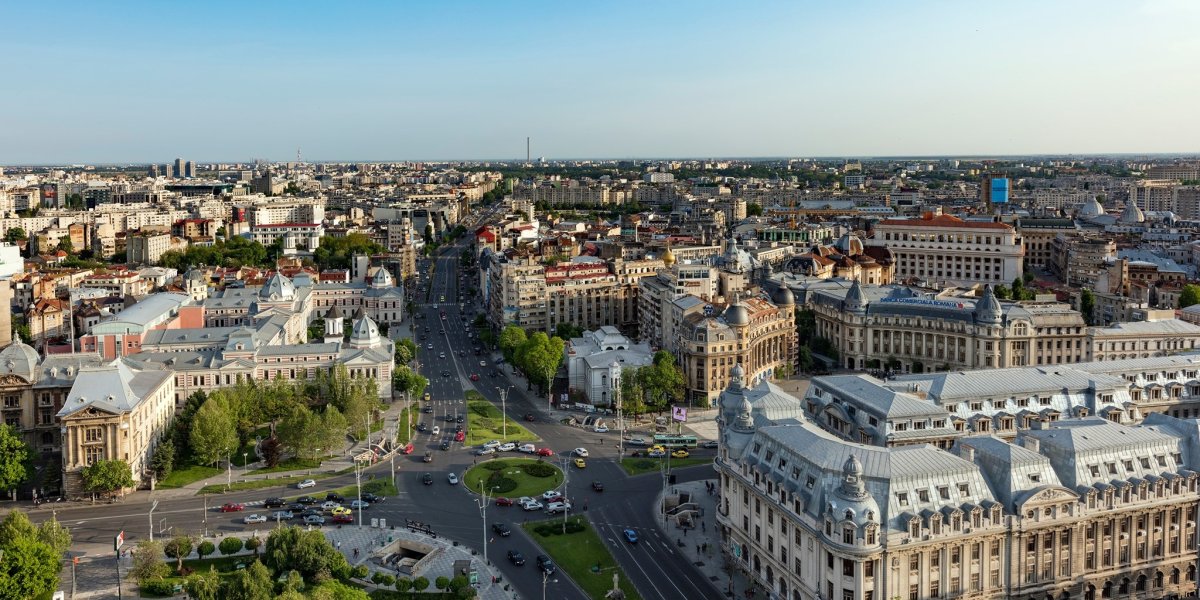
City Guide
Bucharest
Rumänien · Best time to visit: Apr-Jun, Sep-Oct.
Day-by-day plan
Choose your pace
Reisedauer
09:00
Landmark
Take a taxi or walk 10 minutes west from Aviatorilor metro through the leafy embassy quarter. Romania's 27-meter triumphal arch stands alone in a traffic roundabout, its carved reliefs narrating the nation's story from Dacian wars to World War I — morning sun strikes the eastern face cleanly for a sharp, shadowless photograph. Circle to the garden island on the northeast side for the only full-frame angle free of passing traffic.
Tip: The interior staircase opens only on December 1st (National Day) — don't waste time looking for an entrance. All the sculptural detail worth seeing is on the exterior panels facing Kiseleff Boulevard.
Open in Google Maps →10:45
Landmark
Walk 50 minutes south along Șoseaua Kiseleff into Calea Victoriei, Bucharest's grandest axis — past the art-nouveau Cantacuzino Palace, faded belle-époque mansions, and elegant shopfronts that make the walk itself prime sightseeing. The Athenaeum appears behind a rose garden: a neoclassical dome with Ionic columns so perfect Romania printed it on the 50-lei banknote. Continue 200 meters south to Revolution Square, where Ceaușescu delivered his final speech from the Communist Party balcony in December 1989 — bullet holes still scar the stone facade.
Tip: Shoot upward from the base of the Athenaeum steps for a vertical frame capturing both the colonnade and dome. At Revolution Square, face the former Party headquarters and look right of the balcony — the bullet scars from 1989 are still there, and most visitors walk past without noticing.
Open in Google Maps →12:00
Neighborhood
Walk 12 minutes south on Calea Victoriei — pause at the CEC Palace for one shot of its ornate glass-and-iron dome — then turn left into the cobblestoned pedestrian streets of the Old Town. Strada Lipscani and Strada Covaci form the medieval merchant core: crumbling art-deco facades patched with street art, wine bars spilling onto the cobbles. Halfway through, duck into Stavropoleos Monastery (1724) on the street of the same name — its intricately carved stone loggia and silent courtyard are the most beautiful architectural moment in Bucharest, hidden two steps from the bar noise.
Tip: The monastery courtyard is through the gate to the left of the church entrance — most visitors miss it entirely. Inside, 18th-century tombstones and stone fragments line the walls like a secret open-air museum. Photograph the carved columns from the far corner for the best symmetry.
Open in Google Maps →13:00
Food
Exit Old Town at its southern end and you're standing in the courtyard of Bucharest's oldest inn (1808), with two-story wooden galleries wrapped around an open-air terrace. Order mici — Romania's signature grilled skinless sausages, smoky and fiercely garlicky, served with mustard and fresh bread (25 RON / €5). Add a bowl of ciorbă de burtă, the tangy tripe soup with sour cream and hot chili that locals swear by (22 RON / €4.50). Fifteen minutes from order to plate.
Tip: Eat in the courtyard, not inside — the wooden galleries are the real attraction. Mici lose their magic once they cool, so eat them the moment they hit the table. Budget 30 minutes, photograph the galleries, and move.
Open in Google Maps →14:30
Landmark
Walk south through Piața Unirii and west along Bulevardul Unirii — the boulevard Ceaușescu demolished 7,000 homes to build, deliberately one meter longer than the Champs-Élysées — 20 minutes total. The Parliament materializes at the western end: 350,000 square meters, 1,100 rooms, twelve stories above ground and eight below — the heaviest building on the planet at 4.1 billion kilograms. Afternoon light rakes across the neoclassical facade at an angle that reveals the building's absurd scale in a way flat midday sun never could.
Tip: The best exterior shot is from the center median of Bulevardul Unirii, about 200 meters east, where the fountains and lampposts frame the full facade. Walk around to the southwest corner via Strada Izvor to grasp the building's terrifying depth from the side — the perspective shift is genuinely disorienting.
Open in Google Maps →19:00
Food
Walk 20 minutes back north through Izvor Park to Old Town — the afternoon gap is perfect for a terrace beer on Strada Lipscani or browsing vintage shops on Strada Covaci. At 19:00, head to Strada Stavropoleos 5, where a carved wooden doorway opens into Bucharest's most legendary beer hall, pouring since 1879 — Neo-Gothic stained glass, painted ceilings, carved wood columns. Order the sarmale: cabbage rolls stuffed with spiced pork on a bed of mămăligă polenta crowned with sour cream (48 RON / €10). Finish with papanași — fried doughnuts the size of your fist, drenched in sour cream and wild berry jam (32 RON / €6.50).
Tip: Reserve ahead — walk-ins after 19:00 on weekends face a 30-minute wait. Ask for a ground-floor table near the central column for the best ceiling view. The tourist trap to avoid in this area: any Strada Lipscani terrace where someone stands outside waving a laminated photo menu at you — those places charge double for half the quality.
Open in Google Maps →Zu Tag springen
09:30
Landmark
Take the M3 metro to Izvor station — as you exit, the northern façade of the world's heaviest building fills your entire field of vision before you even cross the road. Book the Standard Tour online at least one day ahead and bring your passport for the mandatory security screening. Inside, a guide walks you through salons of marble, chandeliers, and floor-to-ceiling curtains weighing over a tonne each — room after room designed to prove that no expense was too great for one dictator's ego.
Tip: Book the 'Standard Tour' online (around 40 RON) — it covers the most jaw-dropping rooms at half the price of the Complete Tour. Ask your guide to open the second-floor balcony facing north: the view down Bulevardul Unirii — Ceaușescu's boulevard built deliberately one metre longer than the Champs-Élysées — is the single best photograph inside the building.
Open in Google Maps →12:00
Food
Walk north through Piața Constituției and across Splaiul Independenței into the cobblestone maze of Old Town — a 15-minute stroll that fast-forwards you from communist megalomania to belle-époque charm. Caru' cu Bere has occupied this neo-Gothic beer hall since 1879; the stained-glass ceiling, painted murals, and carved wood columns make the interior itself a sight. Order the sarmale — cabbage rolls stuffed with spiced pork on a bed of mămăligă polenta (45 RON / €9) — or the ciorbă de burtă, Romania's beloved tangy tripe soup with sour cream (18 RON / €3.50), which tastes far better than it sounds.
Tip: Arrive right at noon — by 12:30 a queue forms and waits can hit 30 minutes on weekends. Sit on the ground floor under the painted ceiling, not upstairs. The mici (grilled skinless sausages with mustard, 25 RON / €5 for five) are the locals' go-to order here — unpretentious, smoky, and best eaten the second they hit the table.
Open in Google Maps →13:15
Religious
Step out of Caru' cu Bere and cross to the opposite side of Strada Stavropoleos — the monastery entrance is literally 30 seconds away. This tiny 1724 church hides one of Bucharest's most exquisite spaces: intricately carved stone columns in the Brâncovenesc style, a courtyard lined with Ottoman-era tombstones, and a hush that feels impossible given you are surrounded by nightlife bars. The afternoon light filtering through the jasmine and ivy in the courtyard turns the carved stone golden.
Tip: The courtyard is through the gate to the left of the church entrance — most visitors miss it entirely. If you visit on a Sunday before noon, you may catch the Orthodox choir — the acoustics in this tiny space are transcendent. Photography is allowed but switch off your flash and shutter sound.
Open in Google Maps →14:15
Neighborhood
Turn right from the monastery courtyard and wander east along Strada Lipscani — Bucharest's oldest commercial street, now a patchwork of cafés, vintage bookshops, and crumbling pastel façades with wrought-iron balconies. Duck into Curtea Veche (the Old Princely Court) to stand in the ruins where Vlad the Impaler once held court — there is a bronze bust of him at the entrance that makes a darkly compelling photograph. Loop through Strada Covaci and Strada Blanari to find the best street art, hidden courtyards, and the golden glass tunnel of Macca-Vilacrosse Passage.
Tip: Macca-Vilacrosse Passage — the yellow glass-covered arcade that splits into two arms — is best photographed in the early afternoon when sunlight turns the tunnel molten gold. Curtea Veche charges a nominal 5 RON entry but takes only 10 minutes. Skip the souvenir shops on Strada Lipscani; the prices are triple what you'd pay at the Village Museum gift shop tomorrow.
Open in Google Maps →16:00
Landmark
Walk north along Calea Victoriei — Bucharest's most elegant boulevard, lined with ornate 19th-century façades and fashion boutiques — for about 12 minutes until the Athenaeum's neoclassical dome and Ionic colonnade appear through the trees. Step inside the circular concert hall to see the enormous painted fresco spiralling above you, depicting two millennia of Romanian history in vivid colour. The late-afternoon light through the dome, the hush of the empty hall, and the sheer ambition of that fresco make this the building Bucharest loves most — a temple the city built for itself, not one imposed upon it.
Tip: Interior visits are possible most days when there is no rehearsal — check the posted schedule at the entrance. If you are here on a Thursday or Friday evening, buy a concert ticket (from €5) for what many regard as the finest acoustics in Southeast Europe. The rose garden in front is the best angle for a wide shot of the full colonnade.
Open in Google Maps →19:00
Food
Walk south from the Athenaeum along Calea Victoriei for five minutes, then turn left — the restaurant's candlelit entrance appears behind a wrought-iron gate. Lacrimi și Sfinți (Tears and Saints) reimagines Romanian peasant dishes with fine-dining precision: slow-cooked lamb with smoked aubergine purée (65 RON / €13), aged cheese served with truffle honey and walnut bread (35 RON / €7). Pair with a glass of Fetească Neagră, Romania's best indigenous red — it rivals a good Pinot Noir at a fraction of the price.
Tip: Reserve a table for 19:00 — this is one of Bucharest's most sought-after kitchens and walk-ins after 20:00 are unlikely. Ask for the courtyard if weather allows. Avoid the restaurants along Strada Șelari back in Old Town — most are tourist traps with touts waving laminated photo menus, charging double for half the quality.
Open in Google Maps →09:30
Landmark
Take the M2 metro to Aviatorilor and walk five minutes west along the tree-lined Șoseaua Kiseleff — the 27-metre triumphal arch appears through the canopy ahead, morning sun striking its eastern reliefs in sharp detail. Built in 1936 to honour Romania's World War I reunification, the carved panels narrate the nation's story from Dacian wars to the modern era. Circle to the garden island on the northeast side for the only full-frame photograph free of passing traffic.
Tip: The interior staircase opens only on December 1st (National Day) — don't waste time looking for an entrance on other days. The sculptural detail worth seeing is entirely on the exterior panels facing Kiseleff Boulevard, and the morning light between 09:00 and 10:00 gives you the crispest shadows on the carvings.
Open in Google Maps →10:15
Museum
Walk south from the arch for five minutes along Șoseaua Kiseleff and enter through the museum's main gate on your left. Spread across 14 hectares of parkland, over 270 authentic farmhouses, churches, windmills, and carved wooden gates have been transplanted here from every region of Romania — Maramureș timber churches, Danube Delta reed huts, Transylvanian painted homesteads. Walking through is like road-tripping the entire country in 90 minutes, and the late-morning light makes the weathered wood glow amber.
Tip: Enter from the southern gate (closest to the arch) and bear right to start with the Maramureș wooden churches — they are the most photogenic structures and emptiest in the first hour. The small pottery workshop near the eastern exit sometimes has live demonstrations; a hand-painted ceramic plate (€5-8) makes the most authentic souvenir in all of Bucharest.
Open in Google Maps →12:00
Food
Exit the Village Museum through the northern gate and walk five minutes east along the edge of Herăstrău Lake — Berăria H's enormous lakeside terrace appears on your right. This is Bucharest's most beloved beer garden: 1,500 seats, live bands on weekends, and a menu of hearty Romanian grill dishes that locals treat as a weekend ritual. Order the platter of mici cu muștar — five smoky grilled sausages with sharp mustard and fresh bread (28 RON / €5.50) — with a cold draft Ursus (10 RON / €2), and add the jumări (crispy pork cracklings, 20 RON / €4) if you want to eat exactly like a local.
Tip: On weekends, arrive before 12:15 or you will wait 20 minutes for a lakeside table. Sit on the upper terrace for the best view over Herăstrău Lake. Skip the pizza and burgers — they are fine but you are here for the Romanian grill menu, which is what the kitchen does best.
Open in Google Maps →13:30
Park
Walk north from Berăria H along the lakeside promenade — the path curves through weeping willows and past rowing-boat docks into Bucharest's largest and most beautiful park, still called Herăstrău by every local. The western shore between the Village Museum and the small island is the most scenic stretch, with chestnut trees lining the avenue and the lake reflecting the sky. In spring the horse chestnuts are in full bloom and the entire park smells of honeysuckle.
Tip: Rent a rowing boat at the dock near the park's central island (20 RON / €4 per hour) — it is the most relaxing hour you will spend in Bucharest, and the view back toward the Village Museum from the water is postcard-perfect. Avoid the overpriced lakeside cafés near the main entrance; the small kiosks further north along the path sell the same coffee for half the price.
Open in Google Maps →15:30
Museum
Walk south from the park along Șoseaua Kiseleff for about 20 minutes — the tree-lined boulevard itself is one of Bucharest's finest walks, modelled on the Champs-Élysées, with Art Nouveau villas visible through the linden canopy. The museum occupies a handsome red-brick building and holds Romania's greatest collection of folk art: hand-woven textiles, painted icons, carved wooden gates, and embroidered costumes from every historical province. The reconstructed peasant house in the basement — transplanted brick by brick from a Moldavian village — is the highlight most visitors miss.
Tip: Head straight to the basement for the reconstructed village interior — the entrance is poorly signed, so ask at the front desk. The small gift shop sells hand-embroidered blouses and carved wooden spoons made by village artisans — far more authentic and far cheaper than anything in Old Town souvenir shops.
Open in Google Maps →19:00
Food
Walk two minutes south from the museum — Casa Doina sits behind a garden entrance on Kiseleff Boulevard that feels like stepping into a 19th-century country estate. This storied restaurant has served Romanian cuisine since 1892 and remains a favourite of Bucharest's well-dressed locals celebrating family occasions. Order the sarmale de porc — slow-cooked cabbage rolls with pork, sauerkraut, and a crown of sour cream (50 RON / €10) — and finish with papanași, fried doughnuts drenched in sour cream and wild berry jam (30 RON / €6), two Romanian classics done at their absolute peak here.
Tip: Reserve a garden table if the weather holds — the wisteria-draped terrace at dusk is quietly magical. A full dinner with wine runs 120-170 RON (€24-34) per person. Beware of unlicensed taxi drivers cruising Kiseleff Boulevard at night — use Bolt or Uber, which is standard practice for locals and costs a fraction of a street hail.
Open in Google Maps →
Trip builder
Plan this trip around Bucharest
Turn this guide into a bookable rail itinerary with FlipEarth.
Keep exploring
Related cities
More in the same country
FAQ
Frequently asked questions
How many days do you need in Bucharest?
Most travelers enjoy Bucharest in 1 days, with enough time for headline sights and a slower meal or museum stop.
What's the best time to visit Bucharest?
The easiest season for most travelers is Apr-Jun, Sep-Oct, especially if you want good weather and manageable crowds.
What's the daily budget for Bucharest?
A practical starting point is about €45 per person per day before hotels, then adjust based on museums, dining, and transport.
What are the must-see attractions in Bucharest?
A good first shortlist for Bucharest includes Arcul de Triumf, Romanian Athenaeum & Revolution Square, Palace of the Parliament.