City Guide
Cannes
Frankreich · Best time to visit: May-Sep.
Day-by-day plan
Choose your pace
Reisedauer
09:00
Landmark
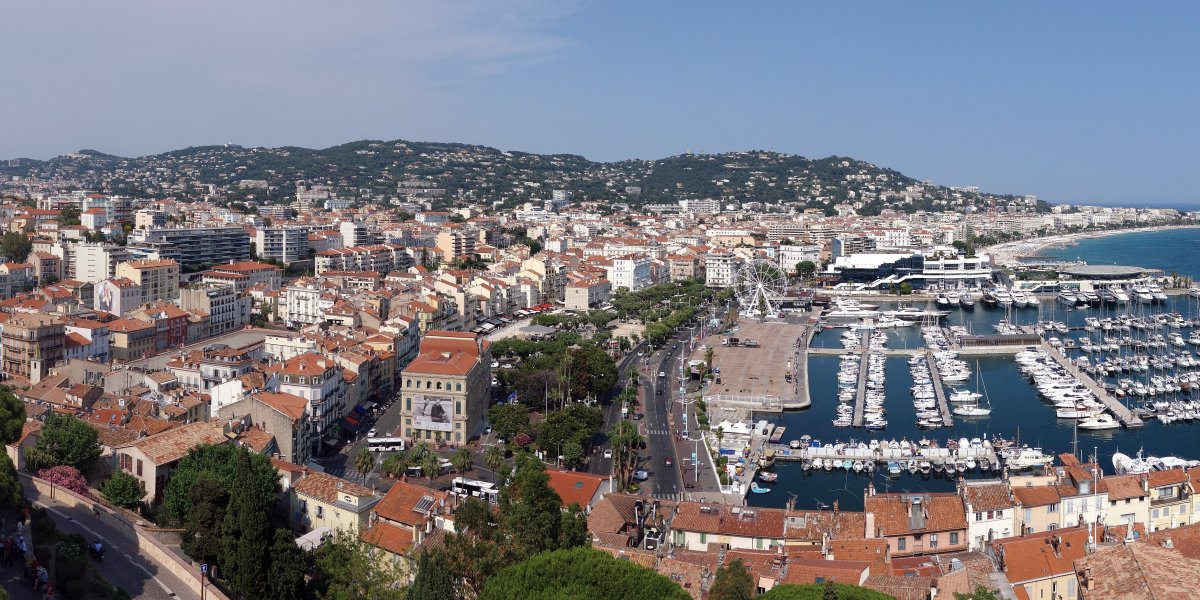
From the train station, walk west 10 minutes along Rue Meynadier — the morning air still smells of fresh bread from the bakeries on the pedestrian street. Climb the cobbled lanes of Le Suquet to the 12th-century watchtower and the church of Notre-Dame de l'Esperance for the only viewpoint where you see the entire Bay of Cannes, the Lerins Islands, and the red-tile roofs of the old town in a single frame. Before 10:30 is the only moment you'll have this terrace nearly to yourself — by noon, tour groups from Nice and Monaco arrive in waves.
Tip: Climb via Rue Saint-Antoine (in shade, cooler) and descend via the stone staircase of Rue du Bivouac Napoleon — the postcard shot is from the lower steps with the bell tower framed by the ochre houses of Le Suquet.
Open in Google Maps →11:00
Shopping
Walk down the hill 5 minutes — the smell of the market reaches you before the awnings come into view. Marche Forville is the daily covered food market where Cannes chefs shop at dawn: Provence olives, socca chickpea pancakes, candied fruits from Apt, and Mediterranean fish still wet from the boat. Late morning is the sweet spot — vendors are relaxed and willing to let you taste, but the produce hasn't been picked over.
Tip: Skip the prepared sandwiches; ask the porchetta stall in the eastern aisle for a slice on country bread (€6) — it's what the market sellers eat themselves. The market is closed on Mondays and switches to a flea market that day.
Open in Google Maps →12:30
Food
Two minutes from the market on Rue Meynadier, look for the queue and the hand-painted sign — Pizza Cresci has been the locals' lunch counter since 1959. Order the Pissaladiere (€7, caramelized onions and anchovies on a thin crust) and the Pizza Cresci slice with anchovies and olives (€6), eaten standing at the counter or on the pedestrian street with a paper cone of rose from the bar next door. This is what Cannes does at lunch when it doesn't want a two-hour sit-down.
Tip: Arrive by 12:30 sharp — the queue triples after 13:00 and the pissaladiere sells out first because the chef only makes one tray each morning. Cash speeds the line; the card terminal is slow.
Open in Google Maps →13:30
Landmark
Walk east 8 minutes along the Vieux Port — yachts on your right, Le Suquet's bell tower behind you over your shoulder. The Palais des Festivals is the squat concrete building where the Cannes Film Festival happens every May, and the famous red-carpet steps can be climbed by anyone, any day of the year, for free. At this hour the western facade is in full sun — the only time of day the red carpet photographs without harsh shadow across the steps.
Tip: The real celebrity handprints are on the eastern walkway facing the bay, not the front entrance — most tourists photograph the wrong row of plaques. Look for Catherine Deneuve (1995), De Niro, and Scorsese near the corner closest to the sea.
Open in Google Maps →15:30
Landmark
From the red steps, the Croisette begins at your feet — turn east and walk the palm-lined promenade. In the next 2 km you'll pass the cream-colored Carlton (the Grace Kelly balcony from 'To Catch a Thief'), the Majestic, and the Martinez — Cannes' three legendary hotels, all on your left; private beach clubs and the Mediterranean on your right. Reach Pointe Croisette by 18:30 for the moment the sun drops behind the red Esterel cliffs — the whole bay turns copper and the Lerins Islands float on a sheet of gold.
Tip: At Carlton (no. 58) cross to the sand and walk the beach for the next stretch — it's cooler, faster, and the hotel facades look twice as grand from below. Refuse the 'free rose' or 'free photo' hustlers near the Palais who then demand €20 — same scam on every Riviera promenade, ignore and keep walking.
Open in Google Maps →19:30
Food
Walk back westward along the Croisette for 15 minutes — by now the hotel facades are lit gold against the dark sea, and the promenade is at its most cinematic. Vesuvio at no. 68 has been the Croisette's Italian institution since 1959, the kind of place where Belmondo used to dine after filming and where the maitre d' still remembers regulars by name. Order the Spaghetti aux Palourdes (€26, clams in white wine and parsley) and the Pizza Vesuvio (€19, mozzarella di bufala and San Daniele ham), with a glass of Bandol rose.
Tip: Reserve the terrace 24h ahead — eating indoors defeats the entire purpose. Avoid the Croisette beach restaurants with English-only menus and €30 'Nicoise' salads — they're tourist traps that triple prices in summer; Vesuvio still has Italian-speaking waiters and the same menu it had thirty years ago.
Open in Google Maps →Zu Tag springen
09:00
Religious
Start your morning with the climb up Rue Saint-Antoine — a quiet cobbled path lined with shuttered Provençal houses, ten cool minutes from the harbor. At the top of Le Suquet, the 16th-century Notre-Dame de l'Espérance stands on the spot of the original Roman castrum, beside the medieval Tour Carrée. From the terrace, the whole bay opens up: red roofs tumbling to the sea, the Croisette curving east, and the two green Lérins Islands floating in the blue.
Tip: Be on the terrace by 9:15 — by 11 the cruise-ship groups arrive and the lookout edge gets impossible. The best photo angle is from the western corner of the terrace by the bell tower, with the Croisette sweeping away to the right and the two islands visible behind.
Open in Google Maps →11:00
Museum
Cross thirty steps from the church to the museum, housed in the former Cistercian monastery just beside it. The collection of pre-Columbian masks, Himalayan instruments and Mediterranean antiquities was donated by a 19th-century Dutch baron who circled the globe collecting whatever caught his eye. Save fifteen minutes at the end to climb the 109 steps of the Tour du Suquet — the view is even wider than the church terrace, and almost no one bothers.
Tip: The Tour du Suquet climb is included in the €6 ticket but most visitors miss it because the staircase is tucked at the far end of the courtyard. The museum is closed Mondays and free the first Sunday of each month.
Open in Google Maps →13:00
Food
Walk down Rue Saint-Antoine and turn right into Rue Meynadier — the old butcher's street, now lined with cheesemongers and patisseries that locals still use. Aux Bons Enfants has been running on a single chalkboard menu since 1935: no phone, no website, no cards — just twenty seats, two daughters in the kitchen, and the smell of garlic confit drifting onto the pavement. Order the daube provençale (€18), beef braised four hours in red wine, with the petits farcis (€16) to start.
Tip: Cash only. No reservations, ever. Arrive at 12:30 sharp or after 13:30 — the room fills the moment locals leave their offices. If the chalkboard says daube, do not hesitate.
Open in Google Maps →15:00
Landmark
Six-minute walk east along the Vieux Port, the boats getting bigger as you go. The Palais is closed to the public outside festival weeks, but the real attraction is the Allée des Étoiles winding around it — over 400 handprints of Cannes laureates pressed into the pavement, from Jean Gabin to Sophia Loren to Tarantino. Time it for mid-afternoon: the morning light shines straight into the camera lens here, but by 15:00 the sun is behind you and the red-carpet steps photograph cleanly.
Tip: Look for Hitchcock's print at the base of the eastern staircase — most tourists wander straight past it. The red-carpet steps are open for photos year-round; no need to wait for festival week, and from 16:00 the staircase falls into shade so faces don't squint.
Open in Google Maps →16:30
Landmark
From the Palais, step directly onto the Boulevard de la Croisette — two kilometers of palm trees, Belle Époque hotels, and a curved beach below. Walk east in the late afternoon: the sun is at your back, the bay turns turquoise, and every grand façade becomes a postcard. The Carlton's twin domes (modeled, legend says, on the breasts of La Belle Otero, a courtesan who summered here) mark the halfway point — the perfect place to turn around as the light goes gold.
Tip: The free public beach is the strip of sand between two private clubs at Plage Macé, with showers and clean changing rooms. The matelas-loungers on the private beaches start at €30 per chair plus €18 for an umbrella; skip them unless you want a champagne afternoon.
Open in Google Maps →20:00
Food
Five-minute walk back west along the harbor, past the yachts to a corner café where the oyster shuckers work behind a window onto the pavement. Astoux et Brun has been Cannes's seafood institution since 1953 — every table within sight of the ice towers piled with the day's catch. Order the Plateau Royal (€89 for two: oysters from Cap Ferret, prawns, langoustines, sea snails and crab) or the grilled loup de mer (€32) if shells aren't your thing.
Tip: No reservations after 19:30 — show up at 19:00 sharp or wait at the small bar across the street with a glass of rosé. Avoid the restaurants on the upper part of Rue Saint-Antoine in Le Suquet at all costs: most have laminated 'menu touriste' boards in five languages and serve the same frozen bouillabaisse at €35 a head, and the touts at the door who 'recommend' the place to passing tourists are paid to do so.
Open in Google Maps →08:30
Food
Begin your second day five minutes inland from the Vieux Port — a covered market that opens at 7:30 and reaches full pitch by 9. Provençal grandmothers haggling over Camargue tomatoes, fishmongers shouting the morning's catch, a goat-cheese stall with sixty varieties along a single counter. Buy a slice of pissaladière (€4), a peach from Cuers, and a wedge of brebis cheese for an on-the-go breakfast before the boat.
Tip: Closed Mondays. The cheese aisle is on the south side, the fish aisle on the north. Asking for a 'goutte' (taste) before buying is normal — every stall offers it; bargaining, however, is not, and trying will get you a frown.
Open in Google Maps →10:00
Religious
Three-minute walk south to Quai Laubeuf — the Saint-Honorat ferry is the small white boat with the gold cross on its prow (Planaria, €18 round-trip). The fifteen-minute crossing drops you on an island where Cistercian monks have farmed grapes since the year 410, and where the only sounds today are wind in the pines and church bells. Walk the perimeter path (about 40 minutes around) past the vineyards to the fortified medieval monastery rising from the sea — and step into the abbey church for the 11:25 chant, the moment everyone remembers.
Tip: Catch the 10:00 ferry exactly — the 11:00 boat misses the morning chant at 11:25, the moment you came here for. Buy the monks' wine and Lérinade liqueur from the boutique by the pier on arrival rather than leaving it for the return; both sell out by mid-afternoon in summer.
Open in Google Maps →13:00
Food
Five-minute walk back along the shore path to La Tonnelle, the only restaurant on the island, run by the abbey itself under a canopy of century-old pines facing the mainland. The ravioles de homard (lobster ravioli in shellfish bisque, €32) is the signature; pair it with a glass of the monks' Clos Saint-Lambert white (€11) — the same wine you saw growing on the slopes an hour ago. End with the Lérinade liqueur (€7) made from 44 herbs gathered on the island, a closing ritual the monks have kept for centuries.
Tip: Reservation essential 48 hours ahead in summer (+33 4 92 99 54 08, mention the 13:00 service). Ask for a table on the lower terrace facing west — the upper deck is shadier but blocks the view of the mainland. Lunch only; the kitchen closes at 15:30, and the last ferry off the island matters more than dessert.
Open in Google Maps →15:30
Museum
Take the 15:00 Saint-Honorat ferry back to Quai Laubeuf, then transfer directly to the Sainte-Marguerite boat thirty meters along the quay (Trans Côte d'Azur, €16 round-trip with museum). The larger neighboring island has a different mood entirely — eucalyptus forests instead of vineyards, hidden coves, and at its eastern point Fort Royal, where the Man in the Iron Mask was held from 1687 to 1698. His cell still has the bars he could not bend; the Musée de la Mer next door holds the Roman shipwreck cargo divers pulled from the bay below.
Tip: Skip the Étang du Batéguier signpost loop — it adds 45 minutes for a marsh that is mostly mosquitoes in summer. Go straight along the northern path to Fort Royal: the Musée de la Mer closes at 17:45 and the last ferry off the island leaves at 18:00 in summer (17:00 in winter).
Open in Google Maps →18:30
Park
Ten-minute walk from the ferry pier along the harbor to Allées de la Liberté, a plane-tree-shaded square right beside the Hôtel de Ville. This is where Cannes locals come to play pétanque after work — the click of metal boules on gravel, an Orangina at the kiosk, kids feeding pigeons under the trees. The flower market spreads here in the mornings, but the evening atmosphere is purely local, a chance to feel the city emptied of cruise crowds.
Tip: Sit at the Le Croco kiosk on the western edge for the best people-watching seat (€4 espresso, €6 pastis). The pétanque tournament starts at 18:30 — you can watch from the bench but never walk between active players, or you'll get scolded in Niçard.
Open in Google Maps →20:00
Food
Eight-minute walk inland to Rue Frères Pradignac, two streets back from the Croisette. La Mère Besson is Cannes's oldest Provençal kitchen, opened by Mère Besson herself in 1947 and still cooking the same regional dishes she set on a weekly rotation — estouffade Monday, daube Tuesday, soupe au pistou Wednesday, aïoli garni Friday. Begin with the pissaladière (€14, caramelized onions, anchovies and black olives on slow-baked dough); finish with the tarte tropézienne (€9), the orange-blossom cream brioche invented an hour up the coast.
Tip: Reservation strongly advised — only 32 seats and locals fill them by 19:30. Avoid the restaurants strung along the Boulevard de la Croisette with menus printed in eight languages and photographs of the dishes outside; they charge €35 for a Caesar salad with iceberg lettuce and €28 for a frozen Margherita pizza. The same money buys you a real Provençal meal two streets back.
Open in Google Maps →
Trip builder
Plan this trip around Cannes
Turn this guide into a bookable rail itinerary with FlipEarth.
Keep exploring
Related cities
More in the same country
FAQ
Frequently asked questions
How many days do you need in Cannes?
Most travelers enjoy Cannes in 1 days, with enough time for headline sights and a slower meal or museum stop.
What's the best time to visit Cannes?
The easiest season for most travelers is May-Sep, especially if you want good weather and manageable crowds.
What's the daily budget for Cannes?
A practical starting point is about €100 per person per day before hotels, then adjust based on museums, dining, and transport.
What are the must-see attractions in Cannes?
A good first shortlist for Cannes includes Le Suquet & Notre-Dame de l'Esperance, Palais des Festivals & Allee des Etoiles, La Croisette to Pointe Croisette.