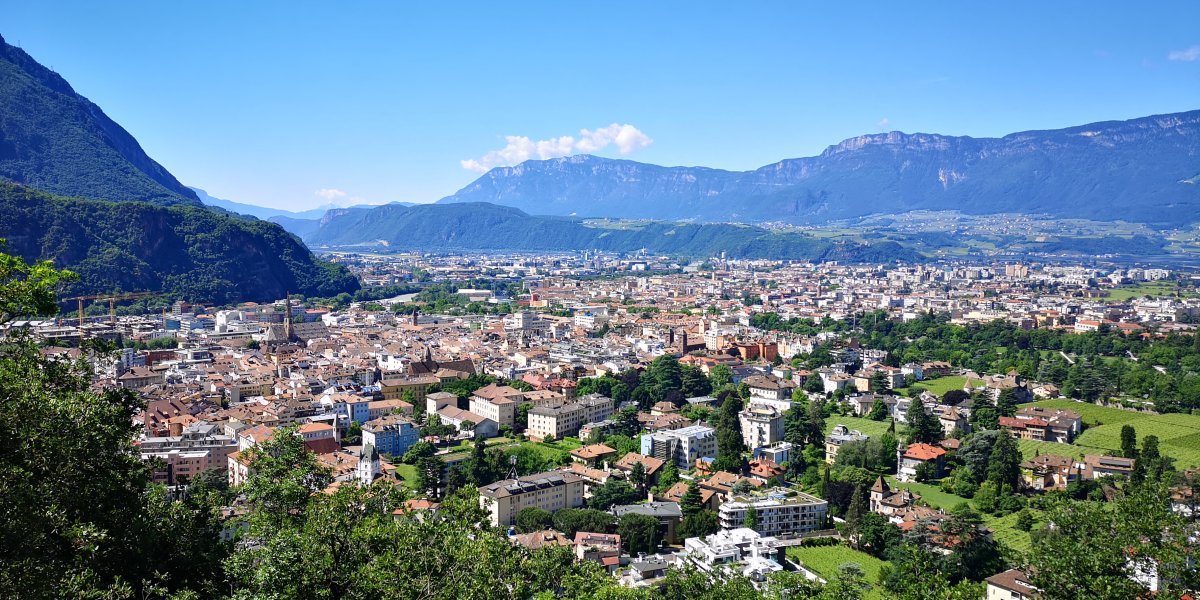
City Guide
Bolzano
Italien · Best time to visit: May-Oct, Dec.
Day-by-day plan
Choose your pace
Reisedauer
09:00
Landmark
Arrive at the Renon cable car station for the first cabin of the morning — twelve silent minutes lift you 950 m above vineyards and apple orchards before the Schlern massif suddenly fills the window. From Oberbozen, board the 1907 wooden Rittner Bahn narrow-gauge train to Collalbo and walk 25 minutes through larch forest to the Earth Pyramids of Mittelberg — eerie geological spires capped with boulders that look engineered but were carved by rain. Catch the train back, ride the cable car down, and reach old-town lunch before the heat builds.
Tip: Buy the combined cable-car + Renon-train day pass at the bottom-station counter (~€25) — it's roughly half what separate tickets cost and lets you skip the train ticket queue at Oberbozen. Sit on the right side going up and the left side coming down for unobstructed Dolomite views through the cabin glass.
Open in Google Maps →12:30
Food
Walk 500 m west from the cable car station along Via Renon to Via Perathoner — Pur Südtirol is the South Tyrol producers' cooperative, with a quick counter behind the cheese fridges. Order a speck-and-mountain-cheese sandwich on Schüttelbrot (the audibly crispy rye flatbread, ~€8) and a glass of Lagrein, the indigenous dark red (~€4). Eat standing at the high tables alongside locals doing their grocery run — you are in and out in 30 minutes.
Tip: Grab a vacuum-sealed 200 g pack of speck and a small jar of dandelion honey on your way out — both survive a transatlantic flight and are 30% cheaper here than at the airport. The Schüttelbrot also packs flat in a carry-on and stays fresh for two weeks.
Open in Google Maps →13:30
Landmark
Cross Via Perathoner and Piazza Walther opens out in front of you, framed by pastel Habsburg facades and the Duomo's astonishing diamond-tiled roof. Those green-yellow-black majolica tiles were laid in 1518 in a pattern unique to South Tyrol — best photographed from the southeast corner of the square with the bell tower running diagonal. The statue at the center is Walther von der Vogelweide, the 13th-century minnesinger turned local symbol of German-language identity during the Mussolini-era Italianization.
Tip: Walk to the cathedral's south wall and look up at eye level — the sandstone is carved with grotesques including a tiny devil playing bagpipes, easy to miss but a 14th-century stonemason's signature joke. Skip the cathedral interior unless you want a five-minute look at the pulpit; the roof is the whole point and it's outside.
Open in Google Maps →14:30
Neighborhood
Leave Piazza Walther at its northwest corner — Via dei Portici begins under low arcades and runs 300 m perfectly straight to Piazza delle Erbe, every house plot exactly 5 m wide since Otto II's medieval planning of 1180. Browse the produce market that's run continuously on Piazza delle Erbe since 1295, then detour one block north on Via Museo to glimpse the sandstone facade of the South Tyrol Museum of Archaeology — Ötzi lives inside, but the queue eats two hours; the storyline plus the shop window of Iceman-tattoo replicas tell enough. Notice that every business sign is bilingual, but the order varies: Italian on top in some streets, German on top in others — a quiet record of where each language community settled.
Tip: Stop at Stand No. 4 on Piazza delle Erbe (the cheese stall) and ask to sample three South Tyrolean mountain cheeses — Graukäse (sharp, almost ammoniated), Stilfser DOP (the nuttiest), and a young Zigerkäse. €2 buys all three; refusing a sample is fine, but locals always taste before they buy.
Open in Google Maps →16:30
Park
Exit Piazza delle Erbe at its northwest corner and walk five minutes to the Talferbrücke — turn right onto the riverside path and you have 4.5 km of car-free Alpine promenade with the Dolomites floating to your east. Pass Castel Mareccio, a 13th-century moated castle still surrounded by working vineyards inside the city limits, and continue toward the Talferwiesen meadow where locals jog with strollers and Haflinger horses graze on the far bank. Turn back at the wooden footbridge near Ponte Roma — the late-afternoon light from the west sets the Rosengarten massif glowing literally rose-pink, which is exactly how it got its name.
Tip: Time your turnaround to 17:45-18:15 (summer) or 16:00-16:30 (winter) for Enrosadira — the alpenglow that ignites Dolomite limestone fiery pink for roughly 15 minutes at sundown. The Rosengarten is the easternmost massif visible from here, slightly to your right as you walk back south.
Open in Google Maps →19:00
Food
Backtrack from the Talfer bridge five minutes east into Piazza delle Erbe — Hopfen & Co. occupies a 700-year-old townhouse at Obstplatz 17, with a copper-vat brewery glowing behind glass at the back of the dining room. Order the Schlutzkrapfen (spinach-ricotta ravioli with brown butter and chives, ~€14) and the Speckknödel in brodo (bacon dumplings in clear broth, ~€13), then a small Bozner Bier Spezial drawn metres from your table (~€4.50). The room hums with regulars greeting the waitstaff by first name in alternating Italian and German — this is what Bolzano sounds like off the postcard.
Tip: Reserve a day ahead by phone (+39 0471 300 788) for a Friday or Saturday table after 19:00 — they hold a few walk-in seats at the bar but the dining room books out by noon. Avoid the chalkboard 'menu turistico' boards in the surrounding lanes, where pre-cooked goulash and rubbery Wiener schnitzel sell for €25 to travelers who don't know that any Tyrolean kitchen serving the same dish hot would charge half that — Hopfen included.
Open in Google Maps →Zu Tag springen
09:00
Religious
Begin in Piazza Walther — Bolzano's bilingual heart, named for the medieval poet Walther von der Vogelweide whose statue holds the center — where the cathedral's filigree green-and-sandstone Gothic spire rises over cafés just stirring to life. Step inside right at 09:00: you'll have the dim 14th-century nave and its faded frescoes to yourself for fifteen minutes before the first tour groups arrive. The east-facing rose window catches morning light through colored glass — locals call this 'Bozen's morning blessing.'
Tip: Light a small candle in the side chapel (Cappella di Santa Croce) — the local tradition is to do it for safe passage through the Alps. The cathedral closes for lunch 12:00-14:30, so the morning window matters.
Open in Google Maps →10:00
Museum
Exit the cathedral's west door, cross Walther Square diagonally and turn onto Via Museo — five minutes through the old town to the modest beige building that holds Ötzi the Iceman, your 5,300-year-old neighbor. Arrive five minutes before the 10:00 opening: the queue starts forming by 10:15 and the climate-controlled Ötzi chamber on the third floor — where you see the actual mummy through a small refrigerated window — fills with people within an hour. The dim chamber and the silence around the glass feels like meeting someone older than the pyramids.
Tip: Buy tickets online the night before — the door queue runs 45 minutes in summer. Head straight to the third floor (Ötzi) first, before the artifact floors; the chamber is most peaceful in the first 30 minutes after opening, when most arrivals are still working through floor one.
Open in Google Maps →12:30
Food
Exit the museum and walk three minutes northeast onto Via Andreas Hofer — Bolzano's oldest surviving inn, Batzenhäusl (known in Italian as Ca' de Bezzi), has poured beer to monks, miners, and writers since 1404. The vaulted ground-floor Stube has dark wood booths and a tile stove; locals on lunch break fill it between 12:30 and 13:30. Order the Speckknödel in brodo (smoked-ham dumpling in clear broth, €11) and a Tiroler Gröstl (skillet of beef, potatoes, onions, fried egg, €17) with a half-liter of house Forst on tap.
Tip: Ask for the wood-paneled Stube on the right of the entrance — staff seat regulars there first, but if you arrive at 12:25 they'll usually offer it. The bread basket is not free; politely decline if you want to keep the bill under €30.
Open in Google Maps →14:00
Landmark
Leave Batzenhäusl, turn right, and walk two minutes east — Piazza delle Erbe opens up as a long, narrow market square humming under green canopies, where the same families have sold mountain cheese, speck, and stone fruit for generations. Come now: by 14:00 the morning crush is gone but stalls run until 18:30 (Mon-Fri), and the Neptune fountain at the south end catches the angled afternoon sun against pastel facades. Walk the full length tasting samples — speck slivers, alpine honey, dried apple rings — then circle back to the stall that pulled you in.
Tip: Stall 'Speck Stocker' on the south side has the area's best cured ham — ask for a 50g slice of 'Bauernspeck' (€4) over industrial speck. The market closes at 13:00 on Saturday and is shut Sunday, so this is a strict weekday-afternoon stop.
Open in Google Maps →15:30
Neighborhood
Step out the west end of Piazza delle Erbe and Via dei Portici begins immediately — a 300-meter arcaded street that has been Bolzano's commercial spine for 800 years. Late afternoon light slants under the porticos at a low angle that turns the painted house facades — ochre, rose, smoke-green — into something out of a Tyrolean postcard. The street empties of cars and fills with locals between 16:00 and 18:00; this is the passeggiata hour, when old men nod from doorways and bakery windows put out the day's last Apfelstrudel.
Tip: At Via dei Portici #39, step into Antica Macelleria Siebenförcher — the oldest butcher in town since 1886; even without buying, the smell of speck rooms behind the counter is the smell of South Tyrol itself. The real shops cluster between #20 and #60 — skip the chain-store stretch closest to Walther Square, where prices double for the same Loden coats sold one block deeper.
Open in Google Maps →19:30
Food
Walk back east along Via dei Portici and slip south one block to Piazza Dogana — Löwengrube sits inside a vaulted 16th-century building that was once a customs house. The candlelit cross-vaults and the wine bottles racked behind glass make this Bolzano's most atmospheric dinner room; locals reserve a corner table for anniversaries. Order the Knödel trio (three large dumplings — speck, spinach with butter-sage, and South Tyrolean grey-cheese, €19) and the slow-braised venison goulash with red cabbage and potato Schmarrn (€26); finish with a glass of Lagrein from the Bolzano valley vines.
Tip: Reserve at least two days ahead by phone (+39 0471 970032); walk-in tables open only at 19:00 sharp and after 21:30. Hard pitfall warning for the day: ignore the chalkboard 'menù tipico tirolese' €25 tasting menus posted outside restaurants on Via Goethe and around Walther Square — these are frozen Knödel and microwaved schnitzel aimed at coach groups; the real local kitchens never advertise on a sidewalk chalkboard.
Open in Google Maps →09:00
Entertainment
From Walther Square it's a four-minute walk east along Via Renon to the valley station of the Funivia del Renon — Europe's longest single-span gondola, opened in 2009, lifting you 950 vertical meters in 12 quiet minutes to Oberbozen on the plateau. Take the 09:00 lift before midday haze rises off the Adige valley: cars detach in the station and you board singles or pairs with no wait, while the south-facing glass gives you a slow panorama of the Catinaccio massif unfolding as you climb out of the fog. The temperature drops 8°C on the way up — bring a light jacket even in August.
Tip: Buy the combined Funivia + Rittnerbahn day-pass at the valley station (€18) — it includes the historic plateau train you'll need next, and is €4 cheaper than separate tickets. Sit on the right-hand side going up for the best receding view of Bolzano's red roofs and the Lagrein vineyards.
Open in Google Maps →10:30
Landmark
At the Oberbozen top station, walk straight onto the platform of the Rittnerbahn — South Tyrol's last narrow-gauge mountain railway, running open-window wooden carriages since 1907. The 18-minute ride east through alpine meadows drops you at Collalbo (Klobenstein); from there it's a signed 25-minute downhill walk through larch forest to the most dramatic erosion formation in the Alps — slender clay pillars up to 20 meters tall, each capped with a single balanced boulder, sculpted over centuries by Renon's heavy rain. Mid-morning light is best: by noon shadows flatten the columns and the textures vanish.
Tip: The viewing terrace at Lengmoos is what tour buses photograph — but walk five minutes further down the marked path to the wooden bridge crossing the gorge below: you'll be eye-level with the tallest pillar and have it entirely to yourself. The return uphill walk takes 35 minutes; pace yourself for the Rittnerbahn back, which runs only on the hour.
Open in Google Maps →13:30
Food
Ride the Rittnerbahn back from Collalbo to Oberbozen, then walk 15 minutes north along the marked Signato signposts to Patscheiderhof — a working farm and inn since 1561, with low ceilings, a tile stove burning even in summer, and mountain meadows visible through six small windows. Ask for the south terrace if the weather is clear; the Dolomite peaks of the Schlern massif fill the view across your plate. Order the Schöpsernes (slow-braised mountain mutton with juniper, €18) and the Strangolapreti (spinach gnocchi in brown butter, €14); finish with house Apfelstrudel still warm from the kitchen oven (€7).
Tip: Reservations essential — the farmhouse seats only 40 and locals fill it for Sunday lunch (+39 0471 345 532). If the terrace is full, ask for the small Stube on the left of the entrance — it's the original 1561 wood-paneled room and almost no tourists ask for it. Patscheiderhof is closed Wednesdays; if you arrive on a Wednesday, Gasthof Tannerhof in Mittelberg is the next-best plateau lunch.
Open in Google Maps →16:00
Landmark
Walk 15 minutes back to Oberbozen, ride the cable car down (12 minutes), then walk 25 minutes north along the Talvera promenade — a flat tree-lined path tracing the river out of town — to Castel Roncolo, the 'illustrated manor' clinging to a porphyry cliff above the gorge. Inside, the courtyard and three upstairs rooms hold the largest cycle of secular medieval frescoes in Europe — knights, hunts, Tristan and Isolde — painted in 1390 and still vivid enough to read like a comic strip. Late-afternoon light through the courtyard windows is when the colors come alive; the castle closes at 17:00 (last entry 16:30) so you arrive with just enough time.
Tip: Skip the audio guide — pick up the free fresco-room map at the entrance and head straight upstairs to the Sommerhaus where the Tristan cycle is painted; most groups start in the courtyard and you'll have the upper rooms to yourself. The castle is closed Mondays, and wear flat shoes — the courtyard cobbles are slippery.
Open in Google Maps →17:30
Landmark
From Castel Roncolo, walk back along the Talvera promenade toward town for 20 minutes — Castel Mareccio rises suddenly out of vineyards on your left, a 13th-century moated tower surrounded by working Lagrein vines that produce wine for the city's own table. The interior is now an events center (usually closed to walk-ins), but the rose-pink walls glow at golden hour against the vine rows; this is the photograph of Bolzano you'll take home. The castle vineyard belongs to the municipality and is the only urban vineyard left in Italy.
Tip: Stand on the wooden footbridge over the Talvera 50 meters south of the castle — the angle catches Mareccio's pink walls with the Dolomites stacked behind it and the river leading the eye in. Don't pay the €15 'wine tour + castle' offered by street touts loitering near the bridge — it's not run by the city and the 'tour' is a stranger walking you through a public lane to a souvenir shop.
Open in Google Maps →19:30
Food
Walk south along the Talvera into the old town — fifteen minutes through the back lanes brings you to Wirtshaus Vögele on Via Goethe, a five-story inn that has fed Bolzano since 1277. Each floor is a different Stube room: ask for the second-floor Hofbräuhausstube with its painted ceiling and corner tile stove — the heart of the building. Order the Bozner Saure Suppe (Bolzano's sour-pickled tripe soup, a 700-year-old recipe, €10) and the Tiroler Schöpsernes Ragout (mutton ragout with polenta and herb dumplings, €24); pair with a half-liter of Schiava from the Bolzano hills.
Tip: Reservations close by 17:00 each day — phone +39 0471 973 938 in the morning or use the online form by 14:00. Final pitfall warning: avoid every restaurant facing directly onto Piazza Walther — the prime square is now the most overpriced corner of town, with €18 plates of supermarket spaghetti aimed at tour groups. The locals always eat one street back.
Open in Google Maps →
Trip builder
Plan this trip around Bolzano
Turn this guide into a bookable rail itinerary with FlipEarth.
Keep exploring
Related cities
More in the same country
FAQ
Frequently asked questions
How many days do you need in Bolzano?
Most travelers enjoy Bolzano in 1 days, with enough time for headline sights and a slower meal or museum stop.
What's the best time to visit Bolzano?
The easiest season for most travelers is May-Oct, Dec, especially if you want good weather and manageable crowds.
What's the daily budget for Bolzano?
A practical starting point is about €110 per person per day before hotels, then adjust based on museums, dining, and transport.
What are the must-see attractions in Bolzano?
A good first shortlist for Bolzano includes Funivia del Renon & Renon Plateau Earth Pyramids, Piazza Walther & Bolzano Cathedral.