City Guide
Bansko
Bulgarien · Best time to visit: Dec-Mar, Jun-Sep.
Day-by-day plan
Choose your pace
Reisedauer
09:00
Landmark
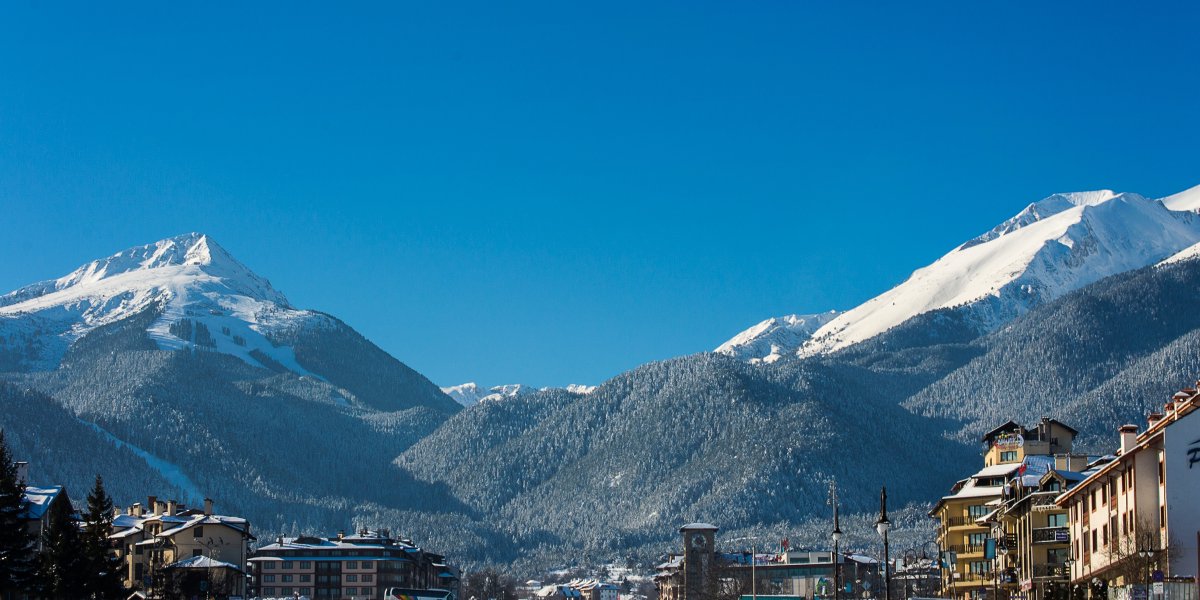
Begin where every Bansko story begins — the squat stone-and-glass cabin shed at the foot of the Pirin range, with the eight-seater gondola humming overhead. At 9 a.m. the morning sun rakes across Vihren and Todorka peaks behind the station, lighting the snowfields (winter) or pine ridges (summer) in a clean side-light no afternoon photo can match. You won't ride up — the iconic shot is from the plaza below, gondola cabin frozen mid-air against the white peaks.
Tip: Stand on the wooden viewing deck to the right of the ticket booths and shoot upward — the cables converge into the peaks and frame the cabin perfectly. Skip the queue line; the picture is from outside, not inside.
Open in Google Maps →10:00
Park
From the gondola plaza, follow the paved lane south past the parking field — in ten minutes the asphalt dissolves into a soft pine-needle track and you cross into UNESCO-listed Pirin National Park. The marked Bansko Eco-Trail loops along the Glazne River through 200-year-old Macedonian pines, with two clearings opening onto the full sweep of the Pirin ridge. The forest is silent except for water and woodpeckers; you'll likely meet no one.
Tip: Take the right fork at the first wooden signpost (marked 'Banderitsa' in red) — it climbs to a clearing at ~1,200 m where the entire Vihren wall reveals itself. Looping back via the river adds about 7 km but returns you straight onto Pirin Street toward town.
Open in Google Maps →12:30
Food
Walk down Pirin Street straight into the old town — 25 minutes downhill, the Holy Trinity bell tower in view the whole way. Duck into this 150-year-old wood-beamed tavern for the fastest authentic plate in Bansko: kapama (slow-cooked pork, sauerkraut and rice baked in a clay pot, 14 BGN / €7) or a half-portion of cheverme lamb (12 BGN / €6) with a warm pita. Budget €8–12. Order by pointing at the chalkboard inside the door — it's faster than the menu.
Tip: Sit at the back room near the open hearth (cooler in summer, warmer in winter) and ask for the kapama — it's pre-cooked since morning so it arrives in 5 minutes, unlike the 40-minute clay-pot dishes on the front menu.
Open in Google Maps →13:15
Religious
Step out the mehana door, cross the cobbles — the church gate is 60 seconds away. The 1835 Holy Trinity is the largest stone church in Bulgaria and its 30-metre clock tower is the symbol locals stamp on every postcard. Early afternoon light hits the south façade dead-on, with the Pirin peaks rising behind the bell tower for the postcard composition. Step inside (free) for the smoke-blackened iconostasis, then circle the churchyard wall once — the carved stone reliefs are eye-level on the eastern side.
Tip: Stand at the southwest corner of Vazrazhdane Square (by the Vaptsarov bronze) — from there the bell tower lines up with Vihren peak in a single frame. Tower is closed for climbs, so don't bother circling for an entrance.
Open in Google Maps →14:45
Neighborhood
From the church gate, head north up Pirin Street into the warren of stone-walled lanes — three minutes and you're in the 19th-century town. Wander past the 1835 Velyanova House (exterior only — the painted wooden eaves and stone-block walls are the photograph; the interior is a small museum you'll skip), then loop east to Nikola Vaptsarov Square and the poet's birth-house façade. The whole quarter is fortress-walled houses with timber upper storeys hanging over the cobbles. Late afternoon (16:30–17:30) the low sun turns the river-stone walls gold — this is the hour locals come out to walk dogs, and it's the one window when the lanes are both lit and uncrowded.
Tip: The corner of Yane Sandanski and Pirin Street has the most photographed wall in town — three stone houses with timber balconies in a tight cluster. Best shot is at 17:00 from the eastern end, with the sun behind you.
Open in Google Maps →19:30
Food
Five minutes south through the lanes — the inn sits behind a low stone wall on Aleksandar Buynov Street. A 200-year-old former merchant house, low ceilings hung with copper pots, an open log fire even in summer, and the only mehana in Bansko where the recipes haven't been adjusted for tourists. Order the Pene's plate of slow-roasted lamb shank with mashed potato and roasted peppers (28 BGN / €14) and start with the cold sheep-yoghurt tarator (5 BGN / €2.50). Add a 200 ml carafe of homemade rakia (8 BGN / €4). Budget €18–25.
Tip: Reserve by phone the day before for an upstairs window table — the ground floor by the fire fills with tour groups after 20:00. PITFALL: the strip of tavernas along the gondola road (south of Tsar Simeon St) charge double, push 'special' menus in English-only, and serve frozen lamb — never eat dinner near the lift base, always come north into the old town.
Open in Google Maps →Zu Tag springen
09:00
Religious
Begin at Bansko's spiritual centerpiece — the largest Revival-era church in Bulgaria, built in 1835 inside a fortress wall the Ottomans demanded as the price of permission. The 30-meter bell tower added in 1850 became a symbol of Bulgarian national awakening, and the dim, gold-flecked interior is lined with icons of the Bansko School — locally painted saints with vividly human faces.
Tip: Enter from the eastern stone gate, not the main south door — the morning light at 9 AM hits the bell tower from the southeast, giving you the postcard shot of the cross silhouetted against snow-capped Pirin. After 11 AM tour groups arrive and the courtyard fills; at 9 you'll have the entire compound to yourself.
Open in Google Maps →10:30
Museum
Exit Holy Trinity Church through the north gate and cross the convent courtyard 50 meters to the stone gallery. This unassuming building holds the world's finest collection of Bansko School icons — the 18th-19th century tradition that fused Byzantine technique with Bulgarian folk emotion. Look for Toma Vishanov's 'Last Supper': he broke church convention by giving Christ's disciples the cheekbones of his Bansko shepherd neighbors.
Tip: Ask the keeper to show you the icon painter's tools displayed in the side room — they're not on the main route. The 5 BGN ticket is cash-only and the nearest ATM is 200 meters west on Pirin Street, so bring small bills.
Open in Google Maps →12:30
Food
From the icon exhibition, walk south on cobblestone Pirin Street for 3 minutes — Mahaloto is in the second stone courtyard on the right, marked by a hand-painted wooden sign half-hidden by grapevine. Sit in the sunny inner courtyard and order banski starets — smoked dried pork from Pirin pigs sliced paper-thin (8 BGN / 4 EUR) — with chomlek, lamb slow-cooked in a sealed clay pot until it falls apart (16 BGN / 8 EUR), and a glass of red Melnik wine. This is where Bansko locals actually eat lunch; budget 20-25 EUR per person.
Tip: Don't be tempted by the larger Mehana Banski Han next door — it's where tour buses dump groups and the kapama is reheated. At Mahaloto, the grandmother still kneads banitsa dough by hand at the back kitchen; ask her for a warm slice if you see her working — it's not on the menu.
Open in Google Maps →14:30
Museum
Exit Mahaloto, turn right and walk uphill 4 minutes on cobblestone — the corner house with the brilliant blue painted exterior is Velyanova Kashta. This was the home of Velyan Ognev, the master fresco painter who decorated Holy Trinity Church; he covered his own walls floor-to-ceiling with cherubs, Constantinople skylines, and an imagined Eiffel Tower he had never seen. Behind the chimney is a hidden chamber that sheltered Bulgarian revolutionaries from Ottoman patrols.
Tip: The upstairs bedroom holds the best-preserved painted ceiling — ask the guide to switch on the warm lights briefly to see the gilded beams properly. Don't miss the carved wooden sun rosette above the bed; locals say it brings fertility, and the wood is rubbed smooth from a century of newlyweds touching it.
Open in Google Maps →16:30
Museum
From Velyanova House, walk 5 minutes east along Pirin Street into Nikola Vaptsarov Square — the museum is the modest stone house with the metal star above the door. This was the childhood home of Bulgaria's most beloved 20th-century poet, executed by firing squad at 32 for resisting fascism in 1942. The rooms are preserved as he left them — the wooden bed, his father's klarino flute, the desk where he wrote 'Faith' the night before his execution.
Tip: Read 'Faith' (Вяра) in the English translation on the back wall before you leave — it's a two-minute poem that will reframe everything you've seen in Bansko. Look for the museum's resident black tomcat, descendant of the family pet — he usually naps on the windowsill of Vaptsarov's bedroom in late afternoon.
Open in Google Maps →19:30
Food
From Vaptsarov Square, walk 3 minutes south on cobblestone — Dedo Pene is the largest stone-and-wood house with carved wooden balconies wrapping three sides. Set in a 1820s Revival mansion with five stone-vaulted rooms, low oak ceilings, and an open hearth, this is the most legendary mehana in all of Bulgaria. The must-order is kapama — cabbage leaves wrapped around pork, lamb, chicken, sausage and rice, sealed in a clay pot and slow-cooked overnight (28 BGN / 14 EUR) — paired with a half-liter of dark Pirin beer from their cellar. Budget 30-40 EUR per person.
Tip: Reserve at least 24 hours ahead and ask specifically for the 'fireplace room' (Стая с огнището) — it's the original 1820s kitchen with the working hearth, and the staff don't offer it unless requested. PITFALL: avoid the half-dozen 'authentic mehana' signs in laminated English on Tsar Simeon Street — they serve factory-reheated kapama at triple the price. Real mehanas have hand-carved wooden signs and menus written in Bulgarian with prices added in pen.
Open in Google Maps →08:30
Entertainment
Walk south from the old town for 12 minutes — or take the free shuttle from Vaptsarov Square — to the Doppelmayr gondola base station on the city's southern edge. The 6.3-km cable ride climbs from 990m to 2000m in 28 minutes, soaring over pine forests as Pirin's marble peaks rise from the haze. By 9 AM you're stepping out at Banderishka Polyana, the alpine meadow that serves as the gateway to UNESCO-listed Pirin National Park.
Tip: Arrive at the base station by 8:15 — the first cabins fill with ski school groups in winter and hikers in summer, and after 9 AM the queue can stretch to 45 minutes. Buy your round-trip ticket at the ground-floor kiosk (the upstairs counter only sells ski passes). Sit on the right side of the cabin going up for the unobstructed view of Vihren's marble face.
Open in Google Maps →10:00
Park
From the Banderishka Polyana gondola exit, follow the wooden boardwalk south for 15 minutes through the spruce forest — the giant tree stands alone in a small fenced clearing, unmistakable. This 1300-year-old Bosnian pine is one of Europe's oldest living trees, older than the First Bulgarian Empire itself, with a trunk 7.8 meters in circumference and 26 meters tall. Stand at its base and look up: Byzantine emperors, Ottoman invasions, and the entire Bulgarian Revival all happened during its lifetime.
Tip: Touch the trunk on the southern side — that's where locals have rubbed the bark smooth for a century, believing it transfers longevity. Arrive between 10:30 and 11:00 when the sun crosses directly behind the canopy, creating a halo through the branches; later in the day the clearing flattens into shadow.
Open in Google Maps →12:30
Food
From Baikushev's Pine, follow the red-marked trail downhill for 25 minutes — the wooden hut sits beside the Banderitsa River where two glacial valleys meet. This original 1942 mountain hut has fed climbers for eight decades; the dining room is wood-paneled with mounted ibex horns and yellowed photos of Soviet-era expeditions to Vihren. Order bob chorba (bean soup with smoked Pirin pork, 6 BGN / 3 EUR) and patatnik (grated-potato cake baked in the wood oven with sheep cheese, 8 BGN / 4 EUR), washed down with mountain herbal tea brewed from wild thyme growing outside. Budget 12-18 EUR per person.
Tip: Cash only — no card reader works at this altitude, so bring at least 40 BGN per person from town. The terrace tables by the river fill first; if they're taken, the indoor table next to the wood stove is the warmest spot and the keeper Petar (excellent English) will tell you exactly which trails are safe today.
Open in Google Maps →14:30
Park
From the hut, take the green-marked trail uphill for 30 minutes to the Vihren Hut viewpoint at 1950 meters — you don't need to summit Vihren itself to feel its scale. Vihren is Pirin's tallest peak at 2914m, a wedge of white marble that looks more like the Dolomites than the Balkans, and the panorama loop passes the deep-blue Banderitsa Lake and the Sleeping Giant rock formation. In summer the meadows are carpeted with edelweiss and Pirin poppy; in winter the ridge becomes a ski-touring highway.
Tip: Stop at the rock cairn 200 meters before the Vihren Hut — that's the spot local photographers use to capture Vihren's marble face glowing orange in afternoon light, with the lake in the foreground. The ridge wind picks up sharply after 3 PM; bring a windbreaker even in July, and start your descent no later than 15:30 to catch the last gondola.
Open in Google Maps →17:30
Neighborhood
Take the gondola back down — the last cabin descends at 17:00 in summer, 16:30 in winter — and walk 10 minutes north on Tsar Simeon Street to the square. This is Bansko's heart, where locals gather at sunset to drink rakia and crack sunflower seeds on the stone benches, dominated by the bronze statue of Vaptsarov with his coat flying. The 19th-century clock tower chimes every hour, its mechanism still hand-wound by the same family for four generations.
Tip: Stand at the northeast corner next to the wooden honey-seller's stall at exactly the hour — you'll capture the clock tower, Vaptsarov's bronze, and the snow-capped Pirin peaks aligned in a single frame, with the bell sound as a memory you'll carry home. The honey-seller (Ivanka, the woman in a red headscarf) sells real Pirin acacia honey for 12 BGN a jar — half the price of the souvenir shops.
Open in Google Maps →19:30
Food
From the square, walk east on Hristo Botev Street for 4 minutes — Baryakova is the smaller stone house on the corner, marked only by a hand-painted wooden plaque (no neon). The Baryakov family has run this mehana for four generations, and the recipes haven't changed since their great-grandmother's wood-fired kitchen. The must-order is sach Banski — a sizzling cast-iron pan of pork, lamb, sausage, mushrooms and Pirin sheep cheese brought flaming to the table (22 BGN / 11 EUR); start with shopska salata and a glass of their homemade rakia (3 BGN / 1.5 EUR — twice as smooth as the bottled stuff). Budget 25-30 EUR per person.
Tip: Reserve same-day by phone before 5 PM — they hold tables until 8 PM but walk-ins fill the small dining room fast. Ask owner Ivan for the homemade rakia rather than the bottled, and request the table beside the kitchen window so you can watch the sach come off the fire. PITFALL: any 'mehana' on Tsar Simeon Street between the gondola and the main square with laminated English menus and waiters greeting you in English first is a tourist trap charging 3x normal prices for factory-prepared food — real mehanas are tucked one street off the main drag, with menus in Bulgarian and a wood-smoke smell hitting you at the door.
Open in Google Maps →
Trip builder
Plan this trip around Bansko
Turn this guide into a bookable rail itinerary with FlipEarth.
Keep exploring
Related cities
More in the same country
FAQ
Frequently asked questions
How many days do you need in Bansko?
Most travelers enjoy Bansko in 1 days, with enough time for headline sights and a slower meal or museum stop.
What's the best time to visit Bansko?
The easiest season for most travelers is Dec-Mar, Jun-Sep, especially if you want good weather and manageable crowds.
What's the daily budget for Bansko?
A practical starting point is about €60 per person per day before hotels, then adjust based on museums, dining, and transport.
What are the must-see attractions in Bansko?
A good first shortlist for Bansko includes Bansko Gondola Lower Station.