City Guide
Stein am Rhein
Switzerland · Best time to visit: May-Sep.
Day-by-day plan
Choose your pace
Trip length
09:00
Landmark
From the train station, walk five minutes down Bahnhofstrasse and through the stone Obertor archway — the moment you pass under it, the entire painted square unfolds in front of you with no warning. Every building on Rathausplatz wears a different sixteenth-century fresco: the Weisser Adler shows Roman legionaries, the Roter Ochsen shows a wine harvest, and the Sonne shows the planets. You are standing inside a Renaissance picture book, and at this hour you have it almost to yourself.
Tip: Stand in front of the town hall facing east — from this exact angle the morning light catches Weisser Adler and Roter Ochsen at the same time, the only window of the day when both top-tier facades glow simultaneously. The first Schaffhausen boat lands at 10:45, so finish your photos by 10:30 or you'll be shooting around tour-group selfie sticks.
Open in Google Maps →10:30
Landmark
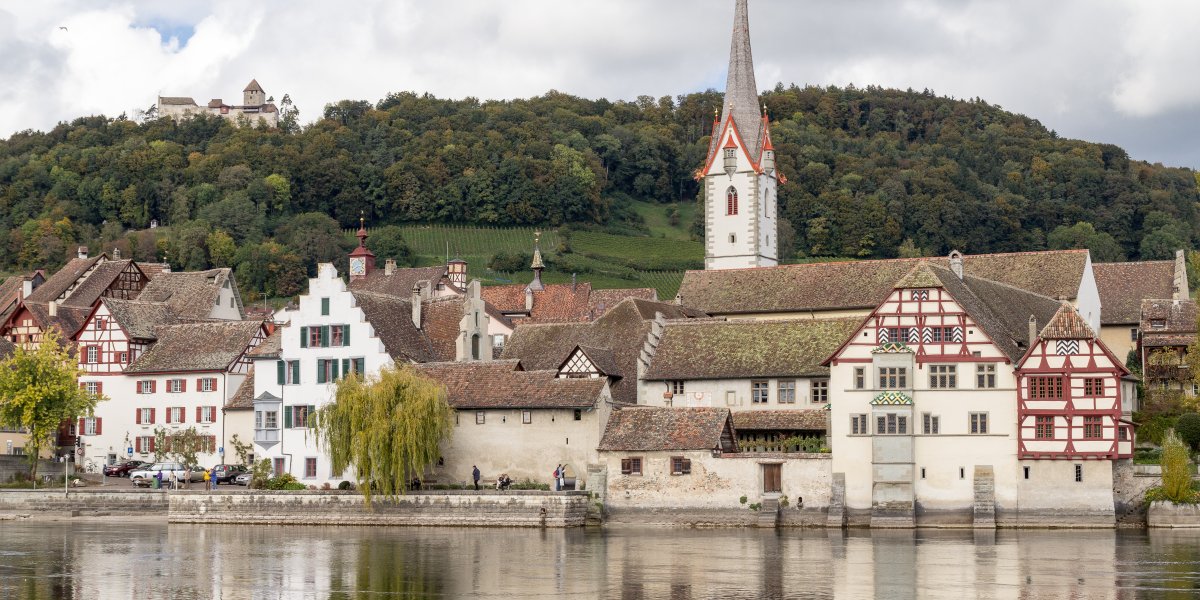
Walk east from the square along Understadt for three minutes — the painted backs of the Rathausplatz houses face you, less famous but somehow more honest, with laundry hanging from oriels. Pass through the Untertor (the lower town gate, half-timbered and crooked) and step onto the wooden Rhine bridge. This is the postcard view: the town wall, the painted houses, and Hohenklingen Castle on the green ridge above, all stacked into one frame, with the pale-jade water of the Untersee gliding underneath.
Tip: The classic shot is from the third wooden plank from the south bank, not from the middle — the angle compresses the castle directly above the painted facades. Lean over the upstream railing and you'll often see big carp holding station against the current; locals feed them from the riverside benches.
Open in Google Maps →11:45
Food
Walk back through the Untertor and ninety seconds along Understadt brings you to Reber, the village bakery the locals actually use — you'll see schoolchildren and old men in equal measure. Order a warm Schinkengipfeli (ham croissant, CHF 4.80) and a Bürli roll split with Greyerzer cheese (CHF 6), or a bowl of the daily soup if the wind is up off the Rhine. Eat fast on the bench outside; this is fuel for the climb, not a sit-down meal.
Tip: Skip the pastries in the front window and ask for a Nussgipfel from the back tray — they're baked twice daily and the second batch comes out around 11:30, still warm. Pay cash, CHF only; the card reader is theoretical.
Open in Google Maps →13:00
Landmark
From the bakery, follow the small brown wooden signs pointing 'Burg' up Brodlaubegasse — the lane narrows, climbs past the last gardens, and within ten minutes you are walking through actual vineyards with the town shrinking behind your shoulder. The path is steady, never brutal, and takes about forty minutes to the castle gate. The reward is the platform on the east tower, where the entire bend of the Rhine, the orange roofs of Stein am Rhein, and on a clear day the white peaks of the Alps all line up in one panorama. We are doing exteriors and the rampart walk only — no need to pay for the museum.
Tip: Take the vineyard path up (signposted via Hemishofer Weg) and the forest path down — the forest is shaded and easier on knees, the vineyard gives you the view you came for. The terrace of the castle restaurant is open to the public even if you only order a single espresso (CHF 4.50); that buys you the best seat above the Rhine in all of Switzerland.
Open in Google Maps →16:30
Religious
Descend the forest path back into town and walk two minutes west along the riverbank — Kloster St. Georgen sits right on the water, its half-timbered abbot's house leaning slightly over the Rhine. We don't enter the museum; the magic is the free outer cloister courtyard and the riverside garden behind it. Wander the arched corridor, then follow the promenade west under the chestnut trees: this is when the day-trippers have left on the 16:30 boat and the town belongs to its residents again, fishermen casting from the wall, children eating ice cream on the steps.
Tip: Slip through the small wooden door on the river side of the cloister into the herb garden — most visitors miss it because it's signed only in German ('Klostergarten'). The light at 17:30 turning the abbot's house gold against the dark green Rhine is the most photogenic moment of the entire day, better than anything on Rathausplatz.
Open in Google Maps →19:00
Food
Walk one minute up from the cloister and you're back on Rathausplatz — Adler is the building with the legionary fresco, and yes, you are eating inside one of the painted facades you photographed this morning. The dining room has low wooden ceilings and the same family has run it for generations. Order Zürcher Geschnetzeltes mit Rösti (veal in cream sauce with potato cake, CHF 38) — Adler's version uses local veal and the cream is reduced down properly, not poured cold. Pair with a half-litre of Hallauer Pinot Noir from the next valley (CHF 24). Budget CHF 55-80 per person with one drink.
Tip: Reserve by phone before you climb the castle — by 18:00 the few window tables on the square are gone. Pitfall warning for the whole square: any restaurant on Rathausplatz with menus prominently displayed in four languages and laminated photos of the food is charging 30-40% over the village rate and serving microwaved Rösti to day-trippers — Adler keeps a paper menu in German only on the wall, which is how you know.
Open in Google Maps →
Trip builder
Plan this trip around Stein am Rhein
Turn this guide into a bookable rail itinerary with FlipEarth.
Keep exploring
Related cities
More in the same country

FAQ
Frequently asked questions
How many days do you need in Stein am Rhein?
Most travelers enjoy Stein am Rhein in 1 days, with enough time for headline sights and a slower meal or museum stop.
What's the best time to visit Stein am Rhein?
The easiest season for most travelers is May-Sep, especially if you want good weather and manageable crowds.
What's the daily budget for Stein am Rhein?
A practical starting point is about €120 per person per day before hotels, then adjust based on museums, dining, and transport.
What are the must-see attractions in Stein am Rhein?
A good first shortlist for Stein am Rhein includes Rathausplatz, Untertor and the Rhine Wooden Bridge, Hohenklingen Castle.