City Guide
Split
Croatia · Best time to visit: May-Oct.
Day-by-day plan
Choose your pace
Trip length
08:00
Landmark
Enter through the Silver Gate on the east side — step over 1,700-year-old limestone slabs worn glass-smooth and suddenly you are standing in a Roman emperor's private courtyard. At 08:00 the Peristyle is nearly empty and the morning sun hits the Egyptian black granite sphinx (one of thirteen Diocletian shipped from Luxor) at exactly the angle that separates it from the marble columns in a photo. By 10:00 three cruise ships have emptied into this square and every column has a selfie stick in front of it — this hour is non-negotiable.
Tip: Sit on the red stone steps below the cathedral and order a coffee from Luxor Café, which opens at 08:00. The waiters place red cushions directly on the ancient imperial steps — 5 EUR for an espresso sipped on a Roman altar is the best deal in Split, and it buys you front-row seats before the crowds flood in.
Open in Google Maps →09:15
Landmark
Twenty metres from your café cushion — the tower entrance is the small door to the right of the cathedral. The climb is 183 narrow steel steps that zigzag through open stonework; your feet are sometimes visible through the grid, so this is not the move for anyone with vertigo. Do it at 09:15 before the sun turns harsh and before the 10:30 bell-tower queue forms — from the top the entire terracotta-roofed palace looks like a single living chessboard, with Marjan's pine ridge to the west and the islands of Brač and Šolta floating on the Adriatic.
Tip: Buy the tower-only ticket (7 EUR), not the combined one — the cathedral interior is tiny and backs up into a 40-minute queue by 10:30, and you don't need it. On the upper stairs only two people fit abreast; step aside for climbers coming down at the landings, otherwise the whole column seizes up.
Open in Google Maps →10:30
Landmark
Exit the bell tower and walk north through the palace along Dioklecijanova — the Roman cardo maximus, now lined with lace-seller stalls and medieval archways tucked into 4th-century walls. The Golden Gate spits you out into a small park where Ivan Meštrović's giant bronze bishop, Grgur Ninski, stands with one enormous toe rubbed mirror-gold by a century of hands. Rub it — every local from Split will tell you it grants one wish, and on a layover day you'll want at least one.
Tip: The photo angle that makes the bishop look truly monumental is from ground level, three metres in front, shooting up so his robe fills the frame with the stone Golden Gate behind. Don't stand next to him — it flattens the scale and gives you a tourist snapshot. While you're here, the tiny Church of St. Martin is built into the north palace wall above the gate: free entry, almost always empty, and it's a 1,500-year-old chapel inside the old Roman guard corridor.
Open in Google Maps →12:15
Food
Walk back south through the palace and exit via Narodni Trg (People's Square) — five minutes past the medieval town hall. Kantun Paulina is a hole-in-the-wall grill with no indoor seating, just a counter, a smoking grill and a queue of local workers on lunch break. Order the ćevapi — ten grilled minced-meat logs in a warm somun flatbread with raw onion and ajvar — and eat it standing on the marble pavement of the square; this is the taste of Dalmatia in the hand.
Tip: Arrive at 12:15 exactly, before the 13:00 local lunch rush doubles the queue. Ask for 'ćevapi u somunu, velika' (10 pieces, large) — the small version is a tease and you'll regret it by 14:00. Pair with a Karlovačko beer from the neighbouring kiosk (3 EUR). Cash only — ATMs are two blocks away on the Riva.
Open in Google Maps →14:00
Park
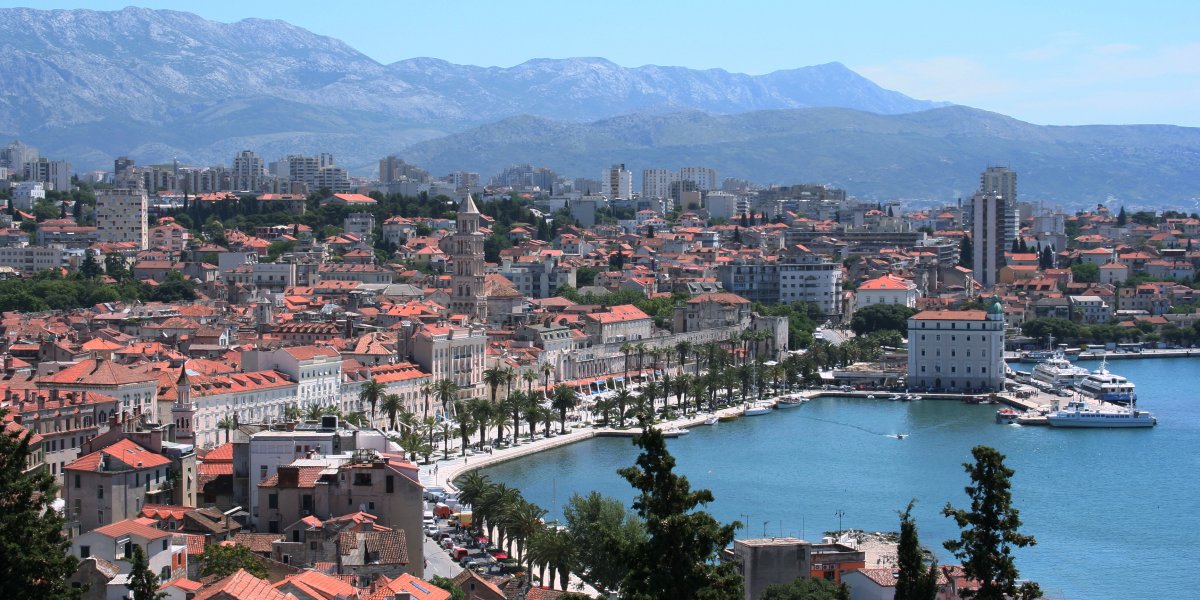
Walk 200 metres south from Paulina and the full Adriatic hits you at once — palm trees, white marble pavement, the masts of the ferry terminal: this is the Riva. Follow the waterfront west past the fishermen's harbour of Matejuška for fifteen minutes, then begin climbing the Marjan stairs at Varoš — 314 stone steps through pine forest and old Dalmatian stone houses. The first viewpoint, Vidilica, opens up at the top: the entire palace spread beneath you, terracotta roofs against a cobalt Adriatic, Brač and Hvar on the horizon. Time it for 16:00–17:30 when the light goes soft and gold, and the palace walls begin to glow amber.
Tip: Order a glass of local Plavac Mali red at Café Vidilica (6 EUR) and take the west-facing low stone wall — it is the sunset seat of Split, and everyone who knows knows. Do NOT continue up to the Telegrin cross unless you have 90 extra minutes; Vidilica gives you 90% of the view for 20% of the climb. The staircase has zero shade — bring a full water bottle and do not attempt it in flip-flops (the stones are polished slick).
Open in Google Maps →19:30
Food
Walk back down the Marjan stairs the way you came — ten minutes, easier on the knees than the climb up — then cut into the fishermen's lane behind the harbour. Konoba Matejuška has four tiny tables inside and a handful more in the stone alley, and it is where Split eats fish. Order the whole grilled catch of the day (usually sea bass or gilt-head bream, 25–30 EUR by weight), a black cuttlefish risotto to start (18 EUR), and a carafe of house Pošip white from Korčula (15 EUR). The fish comes head-on, dressed with nothing but Dalmatian olive oil, lemon and fleur de sel — this is what Croatia actually tastes like when nobody is performing for tourists.
Tip: Reserve two days ahead by phone (+385 21 355 152) or walk in at 19:00 sharp when they open — by 19:30 every table is gone. Point at the fish you want from the ice tray at the door; they weigh it and price it in front of you, no surprises. Pitfall warning for the whole evening: do NOT sit at any restaurant with tables directly on the Riva waterfront — every single one is a tourist trap serving frozen fish at triple markup, and the giveaway is always the same (laminated menus with photos of the food, and a host standing outside with a clipboard). The real konobas are one street back in Varoš, Matejuška and Bačvice.
Open in Google Maps →Jump to day
09:00
Landmark
Enter through the Silver Gate (Porta Argentea) on the east side — you'll walk past the open-air Pazar morning market, crates of figs, cherries and Dalmatian olives spilling onto the stones, before stepping into the colonnaded heart of the palace. Morning sunlight strikes the red Egyptian granite columns at exactly the right angle, and for one golden hour before the cruise-ship crowds arrive you may share this 1,700-year-old courtyard with only a few locals crossing to work. The black sphinx in the square is original — Diocletian himself brought it from Egypt in 297 AD.
Tip: Enter via the Silver Gate, not the Golden — the market outside is part of the experience and you can buy fruit for later. The cruise-ship tour groups flood Peristyle after 10:30, so you have a 90-minute window of near-silence. Sit on the Cathedral steps for the best photo angle back toward the vestibule dome.
Open in Google Maps →10:30
Religious
Five steps from where you're sitting — simply turn toward the octagonal tower you've been staring at. The building was originally Emperor Diocletian's mausoleum; the irony that a persecutor of Christians now rests beneath a cathedral named after his own victim, the local bishop Saint Domnius whom he executed, is not lost on Splićani. Climb the bell tower's narrow open-grilled iron staircase for the single best aerial view of the terracotta-tiled palace rooftops with Marjan Hill beyond.
Tip: Buy the 'green' combined ticket (cathedral + bell tower + crypt + treasury + baptistery) at the kiosk on Peristyle for €10 — only €3 more than the tower alone and the Jupiter-temple baptistery across the square is worth it for the 11th-century Baptismal Font. The tower stairs are steep and open-grilled — not for vertigo sufferers. Best shot: from the third-level opening, face west.
Open in Google Maps →12:30
Food
Walk 90 seconds north out of Peristyle along Kraj Sv. Marije onto Matošićeva — you'll smell the charcoal grill before you see the tiny counter. No tables inside, just locals eating standing up on the street. This is what working Splićani eat when they don't want to pay tourist prices 200 metres away on the Riva, and the ćevapi here are regularly voted the best in the city.
Tip: Order 'deset ćevapa u somunu' (10 grilled ćevapi in warm somun flatbread) for around €7, served with kajmak cream and ajvar pepper relish. Eat standing on Domaldova street rather than carrying it back to Peristyle — the stones there get crowded and the seagulls are aggressive by noon.
Open in Google Maps →14:00
Landmark
From Kantun Paulina, wander south through the limestone alleys for 4 minutes — aim for the Riva and you'll find the entrance set into the palace's southern wall. These cavernous Roman basement halls once supported the emperor's private apartments directly above; they are the best-preserved Roman substructures anywhere in the world, and Game of Thrones filmed Daenerys's dragon scenes here. Afternoon is right: the damp vaults stay cool when the Dalmatian sun is brutal above.
Tip: Buy tickets at the eastern entrance near the Silver Gate, not the southern one opening onto the Riva — the south queue backs up with cruise tours. The east wing (turn left as you enter) is unticketed and usually empty, a 10-minute walk-through that most visitors miss entirely.
Open in Google Maps →15:30
Neighborhood
Exit the substructures and you're already on the Riva — turn right and walk west beneath the palm trees with the harbour's white yachts on your left and the palace's 1,700-year-old southern wall on your right. Drift inland up Marmontova, Split's white-stone shopping street, then circle back through Narodni Trg (People's Square) and tiny Voćni Trg (Fruit Square), where Venetian-era palaces lean over café tables. This is Split's golden-hour slow-walk; a long coffee is mandatory.
Tip: For the coffee stop, avoid anything ON the Riva itself — cut two streets inland to Luxor on Peristyle or Caffe Teak on Majstora Jurja. A macchiato costs €1.80 rather than €4.50 at the waterfront tables, and you'll be sitting where the locals do at the end of the workday.
Open in Google Maps →19:30
Food
A three-minute walk north from Peristyle through a narrow palace alley brings you to Petra Kružića — a postage-stamp tavern with maybe 20 seats and no written menu. The daily catch and a few pastas are chalked on a board in Croatian; the waiter translates with a grin. This is the restaurant Split residents send their visiting parents to, and the antidote to every laminated-menu place on the Riva.
Tip: They do NOT take reservations. Arrive at 19:15 exactly, put your name on the list, walk five minutes back to the Riva for a drink, return at 19:40. Order whatever white fish is on the board — 'orada' (gilthead bream) grilled whole is around €18 and perfect. PITFALL: the restaurants with laminated picture menus on the Riva and inside Peristyle are 3x overpriced and cook frozen seafood — the simple rule in Split is: if the menu has photos, walk away.
Open in Google Maps →09:00
Park
From your hotel in the old town, walk ten minutes west along the Riva to the end of Senjska, then up the famous Marjan Stairs. The pine-scented climb passes the first viewpoint (Prva Vidilica) after fifteen minutes and continues up the stone spine to Telegrin, Marjan's 178-metre summit, with a 360-degree sweep over the palace, Brač, Šolta and the Kaštela bay. Morning is non-negotiable — by 11 the white limestone throws heat back like an oven and the shade disappears.
Tip: Bring 1.5 litres of water — there's a drinking fountain at Prva Vidilica but nothing higher. After that first viewpoint the path forks; take the right-hand trail, it's shadier and far less travelled than the main ridge road. Best photo: stand at the summit cross facing southeast — palace rooftops in the foreground, islands behind.
Open in Google Maps →11:30
Museum
Walk back down Marjan's south slope for twenty minutes — a gentle descent through pine and cypress with the Adriatic always on your left. The gallery is the former seaside villa of Ivan Meštrović, Croatia's greatest sculptor, who designed the house specifically to display his own work. The garden's bronze figures silhouetted against the sea are more moving than anything in the main rooms. Your ticket also opens Kaštelet chapel 300 metres east — do not skip it; the wooden Life of Christ relief cycle carved inside is his masterwork.
Tip: The gallery is CLOSED MONDAYS year-round — plan accordingly. Enter the Kaštelet chapel quietly; if you're the only visitor (often true before noon), the caretaker will sometimes switch on the full lighting so you can actually see the wood carvings in detail.
Open in Google Maps →13:30
Food
Walk fifteen minutes east along Šetalište Ivana Meštrovića, hugging the sea back toward the old town, until you reach Matejuška — Split's working fishermen's harbour with its cluster of blue-painted wooden boats. Fife sits right at the harbour's edge, red chequered tablecloths, no frills, the kind of place where fishermen eat before selling the rest of their catch. Order pašticada — slow-braised beef in a prune-and-wine sauce with homemade gnocchi — Split's signature Sunday dish.
Tip: Pašticada is €14 and a single portion easily feeds two — share it and add a grilled squid (€12). They don't take reservations; arrive by 13:30 or you'll queue 20 minutes on the harbour wall. The house red (Plavac Mali from Pelješac) at around €3 a glass is exactly what a local would order with this dish.
Open in Google Maps →15:30
Neighborhood
Walk two minutes uphill from Fife into the tangle of stone lanes directly behind Matejuška — this is Veli Varoš, the old fishermen's and stonemasons' quarter, built in the 17th century when the palace could no longer contain Split's growing population. The houses are whitewashed and barely two metres apart, with steep stone staircases and climbing bougainvillea. Climb up to the small Chapel of Our Lady of Health (Gospe od Zdravlja) for a silent pause and a beautifully framed view back down over the terracotta roofs to the harbour.
Tip: There is no 'main route' — just wander slowly. If you get lost, head downhill and you'll always hit the Riva within minutes. The most atmospheric lane is Senjska; look at the house numbers carved directly into the stone lintels — some are original 18th-century markings, still perfectly legible.
Open in Google Maps →17:00
Park
From Veli Varoš, walk fifteen minutes west along the harbour's southern arm to Sustipan — a pine-shaded promontory that was Split's old cemetery until the 1950s, now a quiet park with benches set along the cliff edge. This is where locals come for sunset, not the crowded Riva. Face west: the sun drops directly behind Šolta island, and for twenty minutes the palace limestone behind you glows pink. Bring a bottle — this is an unofficial BYO viewpoint.
Tip: The correct sunset bench is on the western edge, just left of the small neoclassical pavilion — arrive at least 30 minutes before sunset on summer weekends, as only about eight benches face the right way. No cafés inside the park; buy a bottle of Pošip white and a burek slice beforehand at Bobis bakery on Marmontova.
Open in Google Maps →20:00
Food
A twelve-minute walk east along the harbour brings you back near Matejuška to Tomića Stine, a steep narrow lane just inland from the fish market. Fetivi is family-run — maybe ten tables, whitewashed walls and a chalk board of the day's catch. This is the other 'locals send their parents here' address, a sister in spirit to Villa Spiza but with a heavier seafood focus — they buy directly from the fishermen you watched unload at Matejuška that afternoon.
Tip: Reserve 2 days ahead by phone — they refuse walk-ins on most summer nights. Order 'brudet' (Dalmatian fish stew with polenta, around €22) if it's on the board — only a handful of Split restaurants still make it the traditional way. PITFALL: the bars and restaurants around Bačvice Beach to the east charge full tourist rates for mediocre food and pull tourists in with loud music — skip them entirely. After dinner, for a nightcap, walk back to Matejuška's open-air stone steps where locals sit on the seawall with bottles from the nearby Konzum; that, not Bačvice, is Split's real nightlife.
Open in Google Maps →
Trip builder
Plan this trip around Split
Turn this guide into a bookable rail itinerary with FlipEarth.
Keep exploring
Related cities
More in the same country
FAQ
Frequently asked questions
How many days do you need in Split?
Most travelers enjoy Split in 1 days, with enough time for headline sights and a slower meal or museum stop.
What's the best time to visit Split?
The easiest season for most travelers is May-Oct, especially if you want good weather and manageable crowds.
What's the daily budget for Split?
A practical starting point is about €90 per person per day before hotels, then adjust based on museums, dining, and transport.
What are the must-see attractions in Split?
A good first shortlist for Split includes Peristyle of Diocletian's Palace, Cathedral of Saint Domnius Bell Tower, Golden Gate and Grgur Ninski Statue.