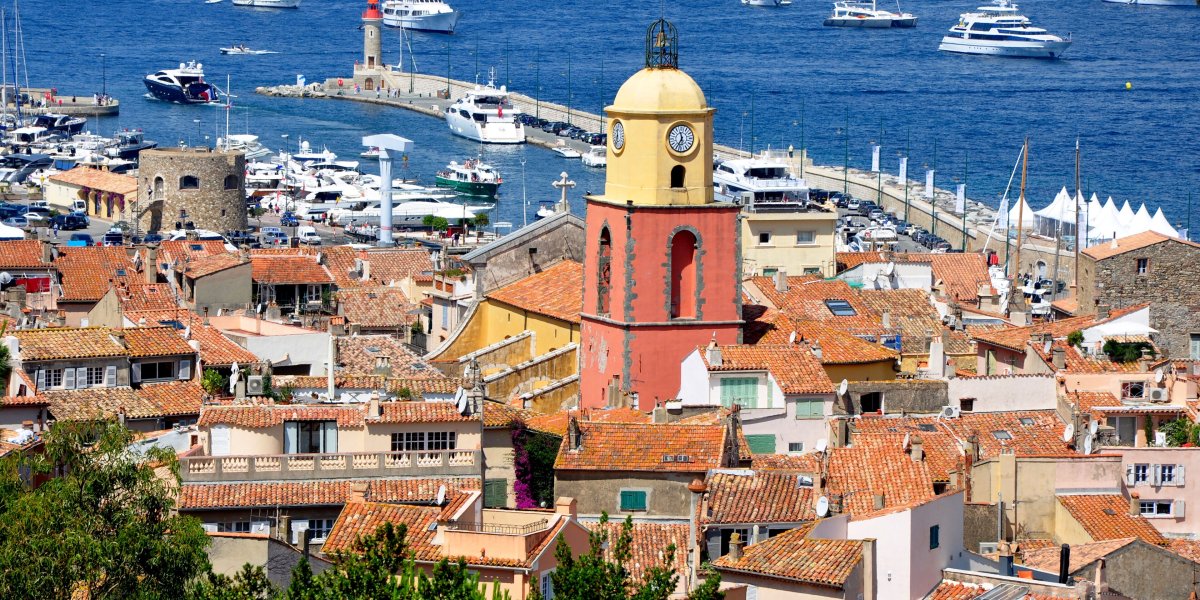
City Guide
Saint-Tropez
France · Best time to visit: May-Sep.
Day-by-day plan
Choose your pace
Trip length
09:00
Landmark
From the Place du XVème Corps bus stop or parking, head up Montée de la Citadelle — a 15-minute climb through quiet stone lanes lined with shuttered villas, your first hint that this town was a fortress long before it was a playground. The 16th-century star-shaped citadel sits on the highest hill in town; the maritime museum stays closed to you today, but the full ramparts circuit is yours, and at 9:00 you have it almost entirely alone. The morning light angles in from the east, gilding the red-tiled roofs below, the masts of the Vieux Port glowing white, the Massif des Maures hills rolling green behind you.
Tip: On your descent, take the side path through Cimetière Marin behind the citadel — five extra minutes, and you'll find Roger Vadim's grave (the director who put Saint-Tropez on the world map with And God Created Woman in 1956). The sea-facing tombs with their fresh flowers are among the most photographed in France, and at this hour you'll have them to yourself.
Open in Google Maps →11:00
Neighborhood
Walk down Rue de la Citadelle for 8 minutes — the pavement shifts from rough stone to polished cobbles as you cross into the old fishing village. La Ponche is where Saint-Tropez actually began: pastel ochre, salmon-pink, and dusty-yellow cottages crammed along Rue des Remparts and Place de l'Hôtel de Ville, three medieval watchtowers (Tour Jarlier, Tour du Portalet, Tour Vieille) still guarding the lanes. Plage de la Ponche is the tiny crescent where fishermen once dragged their boats ashore; it's still here, twenty meters of sand between two stone walls, the most quietly cinematic spot in town.
Tip: Climb onto the rocky shoulder beside Tour du Portalet (free, no fence) and frame your photo with the medieval stone in the foreground, the open Mediterranean behind, and the pink-and-yellow bell tower of Notre-Dame-de-l'Assomption rising across the bay. This composition costs nothing and beats every paid viewpoint in town.
Open in Google Maps →12:30
Food
From La Ponche, cut south through Rue Allard and Rue Étienne Berny — 8 minutes through the cleanest stretch of the old town, no souvenir stalls, just stone arcades and closed wooden shutters. This is the original 1955 bakery where Polish baker Alexandre Micka created the pastry on set with the cast of And God Created Woman, and Brigitte Bardot herself gave it its name. Get the savory side too: the saumon-fenouil sandwich (€9) and the original individual Tarte Tropézienne (€5.50) to go, then carry it two minutes east to a bench under the plane trees of Place des Lices.
Tip: Two locations exist in town — make sure you're at the Boulevard Louis Blanc original, not the satellite branch on Rue Clemenceau. The line moves fast (most people order takeaway); skip the seated café area and join the to-go queue on the right. Order the individual size, not the slice — the proportions of brioche to cream are calibrated for the small one.
Open in Google Maps →13:30
Landmark
Walk east through Place des Lices and down Rue Gambetta, 6 minutes — you exit behind the Mairie and the entire port opens at your feet. This is the photograph of Saint-Tropez: 60-meter superyachts moored stern-to along Quai Jean Jaurès, painters at their easels copying the same pastel facades that have stood here since the 1600s, the red awnings of Sénéquier framing the corner where every fashion shoot has been staged for sixty years. Walk slowly along the quay, then out onto Môle Jean Réveille, the long stone breakwater that arcs around to the lighthouse.
Tip: Walk to the very tip of the Môle (10 minutes out, most tourists turn back at the halfway point). From the lighthouse you get the only single-frame composition that captures the full pastel facade line, the yacht masts, and the citadel hill stacked behind it. The light at 14:30-15:00 hits the facades head-on — golden, no shadows on the buildings.
Open in Google Maps →15:30
Park
Double back from the Môle and pick up the coastal path at Tour du Portalet, 5 minutes. The Sentier du Littoral wraps the entire peninsula in a thread of red-earth trail through umbrella pines, past hidden coves and stone steps cut into the rocks, glimpses of secret villas behind walls of cypress and bougainvillea. The first cove is Plage des Graniers (20 minutes in); push on to Plage des Canebiers at the 45-minute mark — Brigitte Bardot's villa La Madrague is here, glimpsed only through the pines from the path, never from the sand. By 17:30 the afternoon light angles low across the water and every rocky inlet turns honey-gold.
Tip: Do not try to reach Pampelonne Beach on foot — it's 8 km one way and you will not make it back before dark. Plage des Canebiers at the 45-minute mark is the sweet spot: you've seen Bardot's bay, you can dip your feet, and you can turn around with three hours of daylight to spare. Wear closed-toe shoes — the trail has loose stones.
Open in Google Maps →19:30
Food
Walk back along the Sentier and into the old town, 25 minutes, to Rue du Docteur Boutin — the lane is so narrow two people can barely pass, and the doorway is set in a stone arch you'd walk past without noticing. L'Auberge des Maures has been family-run for forty years; the inner courtyard, with its plane trees, hanging lanterns, and string lights, is where Saint-Tropez locals come on summer evenings when the tourist places on the port get unbearable. Order the stuffed zucchini flowers (€18) and the bourride de loup, a saffron-fennel Provençal fish stew with aïoli (€42) — these are the two dishes that have not left the menu in three decades.
Tip: Reserve at least three days ahead in July-August; in May-June or September you can usually walk in at 19:30 but never at 20:30. When you book, specifically request 'la cour' (the courtyard) — the indoor room is fine but the courtyard is the experience. Pitfall warning for the port: avoid every restaurant directly on Quai Jean Jaurès with a photo menu propped outside — they charge €45 for mediocre pasta and €18 for a glass of house rosé. The good restaurants in Saint-Tropez are always one street back from the water.
Open in Google Maps →Jump to day
09:00
Landmark
Start at the highest point in the village before the cruise tenders disembark. The 16th-century hexagonal fortress crowns Saint-Tropez, and the Musée d'Histoire Maritime inside traces the village's life as a working sailor town centuries before Bardot. From the ramparts the panorama sweeps from the Vieux Port across the Gulf to the Maures hills — keep your wide-angle ready and your back to the eastern sun.
Tip: Take the small staircase from Rue de la Citadelle (not the main paved road) — it's shaded, shorter, and ends at the lower gate with zero queue. By 11:00 the tour buses arrive from Saint-Raphaël; you want to be walking down by then.
Open in Google Maps →11:30
Neighborhood
Descend the citadel's western slope via Rue de la Citadelle, then turn right into Rue d'Aumale — five minutes and you've crossed an invisible line into the old fishermen's quarter, untouched by the yacht crowd a hundred meters away. Pastel cottages line lanes too narrow for cars, fishing nets still hang on a few doors, and this is what Saint-Tropez looked like before Vadim's film crew arrived in 1956.
Tip: Find Rue des Commerçants and walk all the way to the tiny Plage de la Ponche — a stone-walled fishermen's cove where locals still gather. Around 11:30 the morning sun lights the ochre walls head-on; the wide alley between Place de l'Hôtel de Ville and the cove is the photographer's gold.
Open in Google Maps →13:00
Food
Walk south through Rue des Commerçants and Rue Allard, eight minutes — you'll catch the boulangerie smell three doors before you arrive. This is the original 1955 shop where Alexandre Micka invented the tarte tropézienne for Brigitte Bardot's film crew. Order the namesake brioche (€5.50) and a savory niçoise tartine or a piece of pissaladière (€12), then eat at the small Place des Lices terrace.
Tip: The Place des Lices flagship has the full counter — the port branch is touristy and the queue is double. Order before 13:15 to slip ahead of the lunch rush, and grab an extra mini-tarte (€2.80) for the 16:30 dip in energy. Skip the imitation 'tropéziennes' sold on the quay; only this address has the original cream recipe.
Open in Google Maps →14:30
Landmark
Walk north from the bakery down Rue Sibille and you're at the port in three minutes. The afternoon sun lights the pastel pink, ochre and yellow facades head-on between 15:00 and 16:30 — this is THE Saint-Tropez postcard frame, with mega-yachts ranked stern-in like Cannes cars and the famous red-awning Sénéquier café anchoring the right edge.
Tip: Walk out to the Môle Jean Réveille (the stone breakwater opposite Sénéquier) between 15:30 and 16:00 — you get the full pastel-houses-plus-superyachts composition with the sun behind you and zero crowds. Avoid the giant cocktail bars along the quay: a Coke is €14 and the views are identical from the public benches.
Open in Google Maps →16:30
Park
Backtrack via Rue Gambetta — five minutes — into the village's social heart. The square is canopied by 100-year-old plane trees and the pétanque under them has not changed since Bardot's day; old Tropéziens in straw hats still play the late afternoon games while the mansions of the surrounding cafés watch. This is the village's living room.
Tip: Buy a glass of Provençal rosé from Café des Arts (€8) and sit on one of the green wooden benches facing the southwest end of the square — those teams are the serious players, often locals who've competed for decades. If your weekend overlaps a Tuesday or Saturday, come back at 08:30 for the legendary Provençal market that fills the whole square.
Open in Google Maps →20:00
Food
Walk back to the port — three minutes via Rue Allard. Le Girelier has held the bouillabaisse crown on the Quai Jean Jaurès since 1959, on the exact stretch of quay where fishermen actually unloaded the rascasse and saint-pierre. Order the bouillabaisse for two (€96 per person — once-in-a-trip, served in two acts) or the grilled loup de mer flambéed in pastis (€48). A glass of Domaine Ott rosé (€18) is non-negotiable.
Tip: Reserve 3–4 days ahead online or at +33 4 94 97 03 87, and specifically request terrace table 1 through 6 for the port view. PITFALL: ignore the Rue de la Citadelle 'Saint-Tropez tasting menu' restaurants with photo menus outside — €120 for frozen fish from Rungis market. The real port restaurants don't post photos.
Open in Google Maps →10:00
Museum
The museum sits on the quay three minutes from anywhere in the old town. Housed in a deconsecrated 16th-century chapel, the collection is small but staggering — Signac, Bonnard, Matisse, Dufy, Vlaminck and Vuillard all painted Saint-Tropez and left major works here. Be at the door for the 10:00 opening to have the upstairs Pointillist rooms entirely to yourself for the first twenty minutes.
Tip: CLOSED TUESDAYS — if your weekend straddles a Tuesday, swap this with Day 1. The natural light through the chapel's high windows hits the Signac room best between 10:00 and 11:00; later, the canvases are lit only by hard spots and the color shifts. Skip the audio guide — the wall texts are excellent.
Open in Google Maps →11:45
Landmark
Leave the museum, walk east along the harbor and up Rue Cavaillon — twelve minutes climbing past the La Ponche cove to the eastern headland. The Cimetière Marin looks straight out to sea; Roger Vadim is buried here, alongside generations of fishermen with simple white tombs. Almost no tourist ever climbs this far; you'll likely have it to yourself, and the silence after the village hum is the entire point.
Tip: Walk to the far eastern corner — there's a low stone wall facing the open Mediterranean with no fence and no railing. Best non-touristy view in Saint-Tropez. Bring water from the village; nothing is sold up here and the climb back in summer heat is steeper than it felt going up.
Open in Google Maps →13:00
Food
Walk back to the port taxi rank and take a cab to Pampelonne (€25, 20 minutes) or the no. 7 minibus toward Ramatuelle. Club 55 has been a Pampelonne institution since 1955, when Vadim's film crew ate here daily during 'And God Created Woman.' The legend is the crudités platter (€28), the grilled catch of the day (€60–90), and the people-watching from wooden tables under tamarisk trees with your feet already in the sand.
Tip: Reservations are MANDATORY in season — call +33 4 94 55 55 55 or book through club55.fr two weeks ahead. Request a 'second row' table: the front-row terrace gets stared at by everyone walking past, while the second row sees everyone for free. On Sundays order the gigot d'agneau de Sisteron — it's the locals' worst-kept secret.
Open in Google Maps →15:30
Landmark
Walk straight out from the Club 55 terrace — your feet are already in the sand. Pampelonne is 5 km of white sand split between the public stretches and the legendary beach clubs (Nikki Beach is 1 km north). Walk south for fifteen minutes and you'll reach a quieter public section where the water is shallow, turquoise, and almost Caribbean.
Tip: The public stretch between Club 55 and Tahiti Beach is free and beautiful — bring a towel from your hotel and skip the €45-per-bed loungers unless you're settling in for the day. Best swimming and photo light is 15:30–17:00, when the sun is still high but the harshness has dropped from the water's surface.
Open in Google Maps →17:30
Religious
Take a taxi back toward town (€25) and ask the driver to drop you at the Chapelle Sainte-Anne rather than the village — the road climbs the wooded headland west of Saint-Tropez. The small ochre Provençal chapel sits on a knoll above the bay; the path up takes ten minutes through umbrella pines that smell like the entire south of France in one breath, and emerges onto a terrace that overlooks the whole village and gulf.
Tip: The eastern terrace catches the late sun on the entire village rooftops and Gulf of Saint-Tropez — golden hour falls around 18:30–19:00 in summer. The chapel itself opens only weekday mornings and during the patronal feast (26 July), but the terrace and the view are accessible all day. Walk down via the wooded path on the north side; it ends at Avenue Paul Roussel, ten minutes from the old town.
Open in Google Maps →20:00
Food
Continue down Avenue Paul Roussel into the village — a fifteen-minute easy descent. Tucked into a tiny lantern-lit alley off Rue du Docteur Boutin, Auberge des Maures has been the inverse of port-side bling since 1947: Provençal aristocracy and reclusive movie stars have eaten here quietly for seventy years. Order the gros aïoli (€42) on a Friday or the daube provençale (€38) any night, with a glass of Bandol red (€15) under the fig tree in the garden.
Tip: Reserve at least three days ahead at +33 4 94 97 01 50 and specifically request a table in the lantern-lit interior garden, not the dining room. PITFALL: in the same narrow lane two neighboring places have posted near-identical green signs — the real Auberge des Maures is at 4 Rue du Docteur Boutin; double-check the address before you sit down or you'll pay tourist prices for a tribute act.
Open in Google Maps →
Trip builder
Plan this trip around Saint-Tropez
Turn this guide into a bookable rail itinerary with FlipEarth.
Keep exploring
Related cities
More in the same country
FAQ
Frequently asked questions
How many days do you need in Saint-Tropez?
Most travelers enjoy Saint-Tropez in 1 days, with enough time for headline sights and a slower meal or museum stop.
What's the best time to visit Saint-Tropez?
The easiest season for most travelers is May-Sep, especially if you want good weather and manageable crowds.
What's the daily budget for Saint-Tropez?
A practical starting point is about €120 per person per day before hotels, then adjust based on museums, dining, and transport.
What are the must-see attractions in Saint-Tropez?
A good first shortlist for Saint-Tropez includes Citadelle de Saint-Tropez, Vieux Port & Quai Jean Jaurès.