City Guide
Rennes
France · Best time to visit: May-Sep.
Day-by-day plan
Choose your pace
Trip length
09:00
Landmark
Start where Rennes itself started — at the only surviving fragment of the medieval city wall. The twin towers of the Portes Mordelaises, recently restored with a new oak drawbridge in 2023, were the ceremonial gate every Duke of Brittany passed through to be crowned. Two minutes on foot east brings you to Cathédrale Saint-Pierre — a neoclassical facade hiding a thunderously gilded Baroque interior, but we are exterior-only today. The cobbled square in front is photogenic and empty at this hour.
Tip: The best photo of Portes Mordelaises is from the Place du Bas-des-Lices side looking back east — the towers frame the morning sun. Cross under the gate and look up: the ducal coat of arms above the arch is the original 15th-century stone.
Open in Google Maps →11:00
Neighborhood
Exit the cathedral square and turn east onto Rue du Chapitre — within five paces you have stepped into pre-1720 Rennes, the part of town the great fire did not eat. The houses lean into each other at impossible angles, their painted timbers in ox-blood red, mustard, and aged green. Continue through Place du Champ-Jacquet (the postcard square — five houses, all crooked, all original) and end on the wide expanse of Place Sainte-Anne with its neo-Gothic basilica.
Tip: Number 6 Rue du Chapitre is the single most photographed house in Rennes — corner of Rue de la Psalette, the corbelled overhang almost touches the building opposite. Shoot from below at a low angle; morning side-light makes the timber grain pop.
Open in Google Maps →12:30
Food
Walk 4 minutes north from Place Sainte-Anne onto Rue de Penhoët — a quiet stone canyon that locals actually use. La Rozell is the no-fuss Breton crêperie Rennais bring their own parents to: stone walls, paper menus, granite plates, cider served in earthenware bolées you drink from like a soup bowl. Order the galette complète (buckwheat, ham, egg, Emmental) at €9.50 and the galette-saucisse rennaise (a fat grilled Breton sausage rolled inside a plain galette) at €10 — the latter is the local street food, civilized.
Tip: Arrive at 12:15 sharp — by 12:45 there is a queue down the street. Ask for cidre brut (not doux); the dry version cuts through the andouille. Skip dessert here, save room — you are eating again tonight.
Open in Google Maps →13:45
Landmark
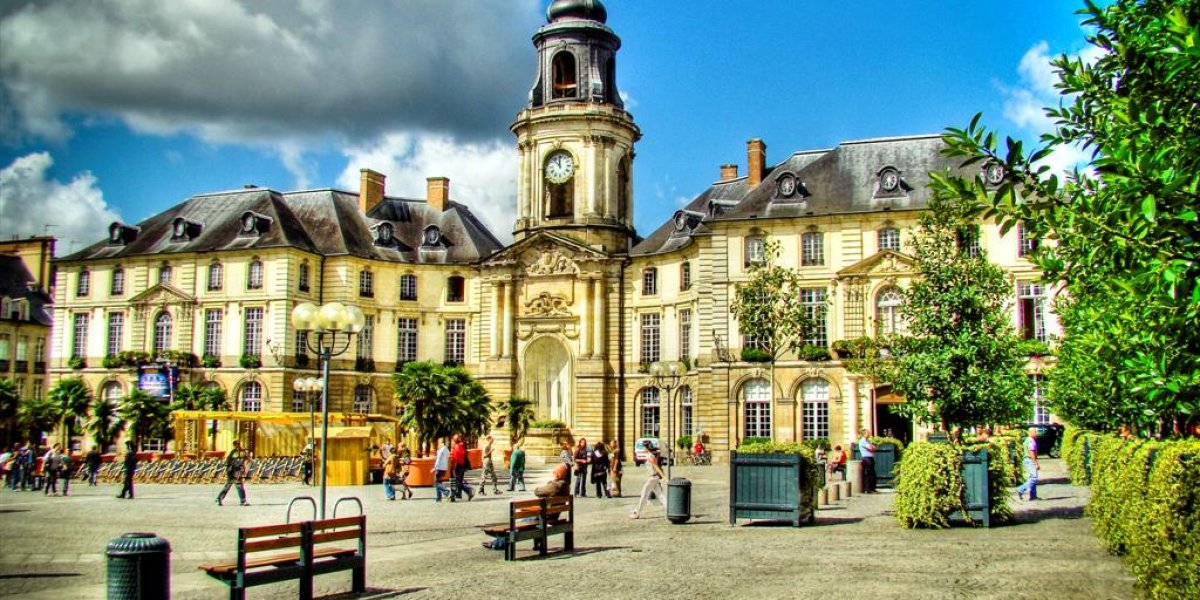
From La Rozell head south on Rue Le Bastard for 8 minutes; the square opens suddenly and the building hits you all at once. The Parlement de Bretagne is the most lavishly Baroque civic facade in northwest France — gold-veined slate roof, tall windows in twos, allegorical statues along the cornice. It burned to a shell in February 1994 during a fishermen's protest and was rebuilt over a decade so faithfully you cannot tell. Today the early-afternoon sun lights the south face full-on.
Tip: Shoot from the southeast corner of Place du Parlement with the fountain in the foreground — the symmetry of the eleven bays only works from that exact spot. Interior tours run Tuesday only; you are correctly skipping them.
Open in Google Maps →15:00
Park
Walk east on Rue de Paris and Rue Saint-Mélaine for about 12 minutes through the bourgeois 19th-century quarter — handsome stone buildings, almost no tourists, a quieter Rennes. The park opens through monumental gates at the top of Rue Saint-Mélaine: ten hectares of French parterre, English landscape, a rose garden of 2,000 varieties, an iron-and-glass aviary, and a bandstand. The afternoon light is exactly right.
Tip: Stop at Pâtisserie Le Daniel at 14 Rue Saint-Mélaine on the way — Laurent Le Daniel is a Meilleur Ouvrier de France and his kouign-amann (€3.80) is the best in the city; eat it on a bench in the rose garden. The south terrace of the park has the only elevated view over Rennes rooftops you will get today.
Open in Google Maps →19:30
Food
From Parc du Thabor walk west back through the half-timbered lanes for 15 minutes as they light up at dusk — different town at this hour. Crêperie Saint-Georges on Rue du Chapitre is a Rennes institution: every galette on the menu is named after a famous Georges (Brassens, Clemenceau, Sand) — except the one signature exception, the Brigitte Bardot. Stone walls, candlelight, locals filling every table by 20:00. Order the Georges Brassens galette (andouille de Guéméné, caramelized apple, cider reduction, €13.50) and the Brigitte Bardot (smoked salmon, dill cream, lemon, €14). With a bolée of cidre fermier and a salted-butter caramel crêpe to finish: €30-35.
Tip: Reserve 48 hours ahead minimum via their website — walk-ins after 20:00 are turned away nightly. Pitfall warning: do NOT eat dinner on Rue Saint-Michel (la rue de la Soif) — it looks atmospheric but it is a student bar street where the kitchens are afterthoughts; food is overpriced, slow, and by 22:00 you cannot hear yourself think over the drinking crowds spilling onto the cobbles.
Open in Google Maps →Jump to day
08:30
Landmark
Begin in Rennes' most photographed square, ringed by half-timbered houses that survived the great fire of 1720. On Saturday mornings (7:30–13:30) it explodes into the second-largest market in France — 280 stalls of Cancale oysters, Breton charcuterie, farmer-cheese and the legendary galette-saucisse. On any other day the cobbled square is yours alone — circle the perimeter to spot the Maison Ti-Koz and the leaning timber facades from the late 1500s.
Tip: If your trip falls on Saturday, arrive by 9:00 — by 11:00 every Parisian weekend tourist will be elbowing you for galette-saucisse. Order one straight from a stall (€4) and eat it walking; the buckwheat crepe wrapped around a grilled sausage is THE Rennes street food. Skip the covered Halles Centrales nearby until lunch — the morning energy is in the open square.
Open in Google Maps →11:00
Landmark
Exit Place des Lices south — a 3-minute walk delivers you to a narrow alley where the medieval city gates appear unexpectedly between two squat 15th-century towers, the only surviving fragment of Rennes' ramparts. Pass through and you enter the densest pocket of half-timbered houses in northern France: Rue Saint-Sauveur, Rue de la Psalette, ending at Place du Champ-Jacquet where five timber houses lean dramatically over the cobbles. Look up — the upper floors overhang the street, a deliberate medieval design that maximized living space within the walls.
Tip: The two best photo angles: stand inside the Mordelaises gate looking outward, framed by the twin towers; then on Rue du Chapitre with the timber facades catching the late-morning light. Skip the 'medieval costume' rentals at the gate — €25 for a polyester smock that ruins your photos. The lean of the Champ-Jacquet houses is real, not perspective distortion: 17th-century timber settling.
Open in Google Maps →12:45
Food
5-minute walk east along Rue du Chapitre — the crêperie sits among the very 16th-century timber houses you've just been admiring, behind a discreet stained-glass door. Each galette is named after a different 'Georges' (Sand, Clooney, Brassens) and arrives plated like a stage set; the 'Eve' (€13) — buckwheat crepe with andouille de Guéméné, apple, and a flambéed shot of calvados — is the local benchmark. Wash it down with a bowl of cidre brut from Bolazec served in a Breton ceramic bolée.
Tip: Reserve 2-3 days ahead — only 24 covers and locally beloved. If full, Crêperie La Rozell at 12 Rue Saint-Georges is the honest backup. Order your cider in 'bolée' (the wide ceramic bowl) — never glass. It looks rustic but it's how Bretons drink, and the wide opening releases the apple aromatics that a wineglass traps.
Open in Google Maps →14:30
Landmark
Walk 8 minutes northeast through Place de la Mairie, where the curved facade of the Hôtel de Ville and the neoclassical Opéra face each other in dramatic dialogue. The Parliament's Baroque facade dominates Place du Parlement — but the real shock is inside. The 1994 fire (sparked by a fishermen's protest flare) gutted the building; its restoration is one of Europe's great heritage projects. Noël Coypel's painted ceilings of the Grande Chambre — allegorical figures of Brittany — were repainted from surviving 17th-century engravings, and the gilt is breathtaking.
Tip: You can ONLY enter via guided tour booked through the Office de Tourisme on Rue Saint-Yves — book 48+ hours ahead at tourisme-rennes.com (€9, ~75 min). English-language tours run Saturdays at 14:30; weekday tours are French-only but the printed English brochure is excellent. Skipping the interior would be the single biggest regret of your weekend — the exterior alone gives you nothing.
Open in Google Maps →16:45
Religious
Walk 6 minutes west back through Rue du Chapitre — the cathedral's massive neoclassical facade looms unexpectedly between the timber houses, almost too big for its narrow square. Step inside and the contrast is staggering: a cavernous gold-and-marble interior with late-afternoon sun pouring through the western windows, lighting the high altar in amber. The carved 16th-century Flemish altarpiece in the south aisle (the Life of the Virgin in painted oak, brought here from Antwerp) is the hidden masterpiece almost no guidebook mentions.
Tip: Reopens at 15:00 after the lunch closure — arrive by 16:30 for the western light through the rose window onto the marble floor. Photographers: stand in the central nave 30 minutes before sunset for the warmest light on the gilt capitals. Walk down to the crypt entrance on the right of the choir — usually open, almost always empty, and one of the few surviving fragments of the older 14th-century cathedral.
Open in Google Maps →19:30
Food
Stroll 4 minutes south to Rue Jules Simon — the half-timbered streets begin to glow under the lampposts as evening falls. Racines is a 26-cover bistro where chef David Etcheverry cooks one of Rennes' quietly excellent menus: the slow-cooked Bigouden pork shoulder (€22) and the brown-butter scallops with cauliflower purée (€26) are why locals book a month ahead. The wine list leans Loire and natural — ask the sommelier for a 'cuvée du moment' and trust them.
Tip: Reserve 5-7 days ahead by phone — they don't take walk-ins or web bookings. PITFALL WARNING: avoid the wall of tourist-trap creperies along Place Sainte-Anne and Place du Parlement — €18 microwaved galettes, watered cider, and 'service charge' surprises on the bill are standard. The honest test: if the menu is in English-only with photos of every dish, walk past.
Open in Google Maps →09:00
Park
Enter through the wrought-iron gates at Place Saint-Mélaine — the morning light slants east-to-west across the formal French gardens, lighting the boxwood topiary like a stage set. Climb to the central bandstand for the city's best skyline, then descend through the English garden to the rose garden — 2,000 varieties at peak in early June, perfumed enough to taste. The aviary at the eastern edge keeps peacocks that wander the lawns at dawn, and the 200-year-old catalpa on the northern lawn is where locals picnic in summer.
Tip: Arrive at 9:00 for the rose garden — by 11:00 it fills with strollers and photographers. Best photo: from the bandstand staircase looking down onto the rose parterre with the spire of Église Notre-Dame-en-Saint-Mélaine framing the background. Free public toilets are at the southwest entrance — last clean ones for the next two hours of walking.
Open in Google Maps →11:00
Museum
Exit the Thabor's southern gate and walk 10 minutes south down Rue Hoche to Quai Émile Zola — the canalised Vilaine cuts through the city's spine here. Inside, Georges de La Tour's 'Le Nouveau-Né' (one of only ~40 paintings he ever made) hangs in a small dim room with a single spotlight — it stops everyone in their tracks. Don't miss the Egyptian cabinet on the upper floor, or the Pont-Aven school room with works by Sérusier and Émile Bernard that catch the same Breton light you're standing in.
Tip: Closed Tuesdays. Free first Sunday of every month. The La Tour 'Newborn' is in Room 5 — go there FIRST, before the 11:30 tour groups arrive. Skip the temporary exhibitions on the ground floor unless something specific draws you; the permanent collection is what you came for, and 1.5 hours is exactly enough.
Open in Google Maps →13:00
Food
Walk 10 minutes west along Quai Émile Zola, then north into Rue Nantaise — you re-enter the medieval streets from an angle Day 1 didn't show you. Café Breton has been Rennes' beloved galetterie for decades; the 'Bretonne' (egg, ham, gruyère, mushroom) at €11 is the comfort-food gold standard, and the maison-made caramel beurre salé crepe (€8) is the local dessert religion. Two flat ciders to choose: Coat-Albret demi-sec or Sehedic brut, both poured in bolées.
Tip: Walk-ins only, no reservations — arrive at 12:45 to claim a table before the 13:15 office rush. The 'salade bretonne' is a hidden secret on the menu (smoked mackerel from Concarneau, apples, walnut oil) — only the locals order it. Tipping is not expected; round the bill up to the nearest euro and that's already generous.
Open in Google Maps →15:00
Museum
Walk 12 minutes south down Rue d'Isly — Christian de Portzamparc's glass pyramid appears beside the train station, deliberately dropped into the modern quarter. Three institutions share the building: the Musée de Bretagne (Breton history, ground floor), the Espace des Sciences (interactive science museum with planetarium), and a vast public library with a panoramic top-floor reading room. The Musée de Bretagne's room on the Dreyfus Affair — Captain Dreyfus was retried here in Rennes in 1899 — is historically essential and rarely visited.
Tip: Closed Mondays. Combined ticket €9 covers Musée de Bretagne + Espace des Sciences. Take the elevator to the 6th-floor library — the panoramic reading room with sweeping city views is FREE and open to all (no library card needed) and almost no tourist finds it. Skip the planetarium unless you read French — the show is French-only with no subtitles.
Open in Google Maps →17:30
Neighborhood
Walk 12 minutes north back through the old town — you'll cross Place de la Mairie one last time and emerge at Place Sainte-Anne, dominated by the soaring Gothic spire of Église Saint-Aubin. From the square, Rue Saint-Michel runs west: nicknamed 'Rue de la Soif' (Thirst Street), it's a 200m strip of student bars where Rennes' 60,000 university students gather Thursday-Saturday from 19:00 onward. Order a 'Coreff' (Breton blonde brewed in Morlaix) or a chouchen (Breton honey wine) and watch the street fill up.
Tip: Sweet spot: arrive 17:30-18:30 — the bars are filling up but you can still claim a sidewalk table at L'Étrange, La Cité d'Ys, or Le Mokus. By 21:00 it's standing room only, by 22:00 it's a crowd. The chouchen at La Cité d'Ys is the real thing — sweet, dangerously drinkable, served in tiny glasses for a reason.
Open in Google Maps →20:00
Food
Walk 8 minutes east along Rue Saint-Mélaine — you skirt the Thabor's western wall as evening falls and the streetlamps catch the granite. Holen is chef Pierre-Yves Lorgeoux's intimate 30-cover dining room (Bib Gourmand) celebrating Brittany's terroir: line-caught Saint-Malo bar with samphire (€32), salt-marsh lamb from Mont-Saint-Michel bay (€34), and a kouign-amann ice cream with caramelised cider that's worth the trip alone. The 4-course tasting menu at €58 is the way to do it.
Tip: Reserve 7-10 days ahead by phone — it's the hardest table in Rennes after Origines (the city's Michelin star). PITFALL WARNING: never accept a 'discount tour' or 'free shot' invitation from anyone approaching you on Rue Saint-Michel earlier — those bars overcharge €15 for follow-up cocktails and the 'free' shot ends up on your bill. Genuine Breton bars don't recruit on the street; they don't have to.
Open in Google Maps →
Trip builder
Plan this trip around Rennes
Turn this guide into a bookable rail itinerary with FlipEarth.
Keep exploring
Related cities
More in the same country




FAQ
Frequently asked questions
How many days do you need in Rennes?
Most travelers enjoy Rennes in 1 days, with enough time for headline sights and a slower meal or museum stop.
What's the best time to visit Rennes?
The easiest season for most travelers is May-Sep, especially if you want good weather and manageable crowds.
What's the daily budget for Rennes?
A practical starting point is about €120 per person per day before hotels, then adjust based on museums, dining, and transport.
What are the must-see attractions in Rennes?
A good first shortlist for Rennes includes Portes Mordelaises & Cathédrale Saint-Pierre, Parlement de Bretagne.