City Guide
Quimper
France · Best time to visit: May-Sep.
Day-by-day plan
Choose your pace
Trip length
09:00
Religious
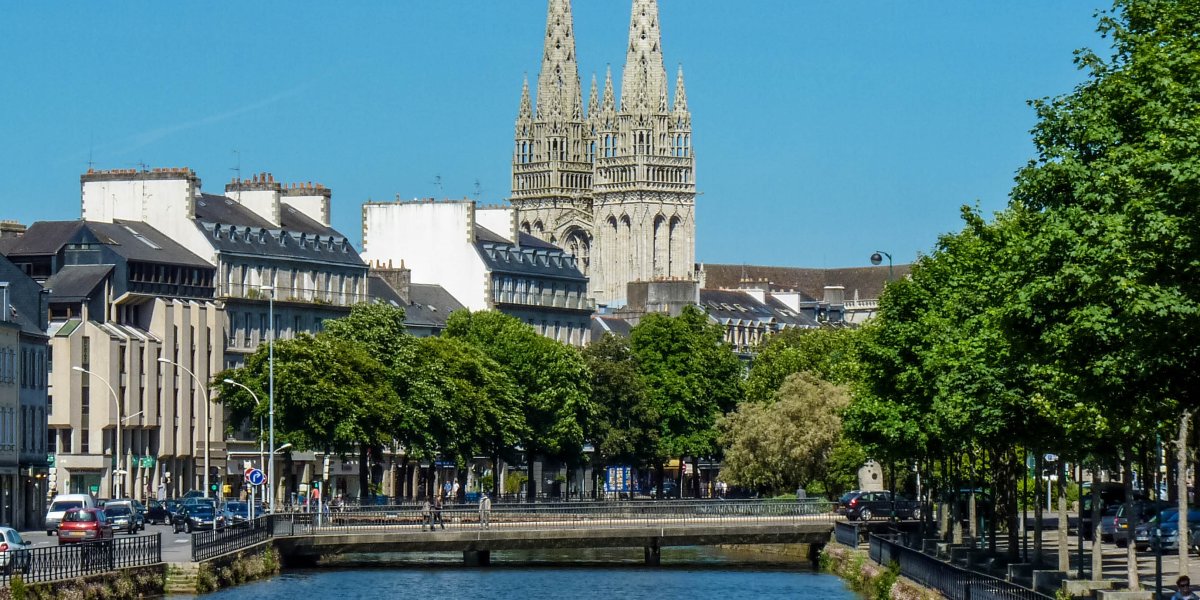
Start where Quimper begins. Brittany's most expressive Gothic cathedral, its twin granite spires rising 76 m above the slate rooftops, the choir famously bent 8 degrees off-axis from the nave — as if the medieval masons aimed the altar at a saint and missed. Morning light hits the western façade head-on, locals stream in for the daily 9:30 mass, and you have the place to yourself before the first coach tour rolls in around 10:30.
Tip: Don't shoot the façade from the front — everyone does that. Walk to Rue du Roi Gradlon along the south flank and look back: from there the famous 'crooked' bend between nave and choir is dramatically visible. King Gradlon on horseback sits between the two spires — zoom in, you'll miss him otherwise.
Open in Google Maps →10:00
Neighborhood
Exit the cathedral's north transept and you're already inside it — Rue Kéréon is the spine, leading away from the spires through a tunnel of leaning half-timbered houses, some over 500 years old. Branch off through Rue du Guéodet, Rue des Boucheries, and end at Place au Beurre, the small triangular square where 16th-century butter merchants once traded and where today's crêperies line up shoulder to shoulder. Shops are just opening, awnings going up, no tour groups yet — this is the hour Quimper smells like fresh bread and salt cider.
Tip: The single best photo of Quimper is from the western end of Rue Kéréon looking back: the half-timbered houses frame the cathedral spires perfectly. Stand there before 11:30 — after that the sun moves behind the spires and the shot turns to silhouette. Look up at the corner houses — the carved oak figures (saints, devils, merchants) on the beams are 15th century originals.
Open in Google Maps →12:00
Food
Two-minute walk down Rue Verdelet — you'll smell the buckwheat batter on the griddle before you see the door. The most-loved old-school crêperie in town, in a 15th-century house with low beams and stone walls, serving the real Cornouaille classics: galettes made from local Mil'Anjou buckwheat, cider from Fouesnant 8 km south. Order the Galette Complète (ham, egg, Emmental — €9.50) and a Crêpe Caramel au Beurre Salé (€6.50), washed down with a pitcher of brut cider (€8). Quick, hearty, the local lunch.
Tip: Walk in at 11:55 — they open at 12:00 and the queue forms by 12:15. Ask for a table upstairs under the original oak beams, not the modern back room. Order the cider in a bolée (the traditional Breton ceramic cup), not a glass — staff respect tourists who know to ask.
Open in Google Maps →13:30
Shopping
Walk 15 minutes west along the Quai de l'Odet, the river on your left, the slate rooftops of old Quimper receding behind you — you'll pass the squat Romanesque Église Notre-Dame de Locmaria on your right, the oldest church in the city. The Henriot atelier has been making faience here since 1690, hand-painting every single piece on-site; the boutique is the actual factory shop, with the workshop visible through interior windows. The painters work by natural north light in the afternoon — you can watch their brushes move from two metres away.
Tip: Anything stamped 'HB-Henriot' with the painter's signature on the back is the real Quimper faience — the small 12 cm 'petit Breton' plate (€32-40) is the one local souvenir worth the suitcase space. Everything stamped just 'Quimper' or sold on Rue Kéréon for €15 is mass-produced in Portugal. The factory ships internationally for free over €100 — better than carrying.
Open in Google Maps →16:00
Park
Backtrack 10 minutes along the south quay, cross the iron Pont Sainte-Catherine, and the trailhead is hidden right behind the tourist office. A switchback path under chestnut and beech trees climbs 70 m in about 15 minutes — the only real exertion of the day. The summit opens to the postcard view of Quimper: the cathedral's twin spires piercing the slate rooftops, the bend of the Odet curling away west toward the sea. Late afternoon puts the sun behind you, lighting the spires gold — the single best photograph you'll take in Brittany.
Tip: The first viewpoint platform is not the one — too many trees in frame. Keep walking 5 more minutes to the upper clearing with the wooden bench; from there the spires sit clean above the rooftops with the river in the foreground. Carry water — there's no fountain on the trail. Descend by the eastern path (signed 'Cathédrale') to land you directly back into the old town in 8 minutes.
Open in Google Maps →19:00
Food
Descend Mont Frugy via the eastern path, cross Pont Maximilien Berthou, and you're 8 minutes from Rue Elie Fréron, where chef Gilbert Guyon's Michelin-starred dining room has quietly anchored Quimper's table for 30 years. Twelve tables, stone walls, white linen, no spectacle — just precise Breton cooking at the level the city deserves. Order the Saint-Pierre rôti aux algues (John Dory roasted with seaweed, €38) and the tarte aux fraises de Plougastel (€14) for dessert; the 65€ four-course menu is the smarter move. A proper farewell to Cornouaille.
Tip: Call to reserve the same morning — 02 98 95 00 02 — twelve tables go fast in summer. Ask for the small corner table by the window onto Rue Elie Fréron, it's the quietest in the room. Pitfall warning: avoid the 'menu touristique' chalkboards on Rue du Frout and the riverside terraces along Quai du Steir — they're three operations under one kitchen, microwaved, €25 for what should cost €12. Any place advertising menus in three languages with photos of the food is the trap.
Open in Google Maps →Jump to day
09:00
Religious
Arrive at Place Saint-Corentin just as the heavy wooden doors swing open — Quimper's twin spires lean visibly to the east, a deliberate kink the medieval builders accepted to follow the curve of the original chapel underneath. Walk slowly down the central aisle past the kneeling statue of King Gradlon between the towers, then stand under the rose window where Saint Corentin himself appears in 15th-century stained glass. The first hour after opening is the only window with no coach groups — by 10:30 the riverside cruise tours have arrived.
Tip: Climb the spiral stair off the south transept (free, easy to miss — the door is marked 'tribune') for the elevated nave view almost no visitor finds. Skip the audio-guide kiosk; the laminated free pamphlet inside the right door has more useful detail.
Open in Google Maps →10:45
Museum
Exit the cathedral's south door and the museum entrance hides under the stone arch on Rue du Roi Gradlon — thirty seconds' walk through the former Bishop's Palace courtyard. This is the single best place in Brittany to understand Quimper itself: room after room of bridal headdresses from every Breton parish, carved wooden box-beds from the bigouden coast, and a top-floor gallery of antique Quimper faience tracing the blue-and-yellow style from 1690 to today. Go straight to the top floor first — most groups never reach it, leaving you alone with the rarest pieces.
Tip: Closed Mondays year-round. Skip the modern-art mezzanine and double your time in the costumes hall — the bigouden coiffes (tall lace tubes worn by fishermen's wives from Pont-l'Abbé) are the museum's quiet masterpiece.
Open in Google Maps →12:45
Food
Cross back through the cathedral plaza and wind two minutes into the narrow Rue Verdelet — this is where Quimper locals eat lunch, not the riverside tourist row. Au Vieux Quimper has served buckwheat galettes from the same half-timbered front room since 1860; the slate plates and bottle-bottom windows are original. Order the Complète Bigouden (ham, egg, Emmental and andouille de Guéméné, 12 €) with a glass of cidre brut fermier from Fouesnant (4 €) — a single-farm cider, not the bottled commercial stuff. Average lunch 18-22 €.
Tip: Arrive by 12:45 sharp — by 13:15 every seat is taken and they don't accept walk-ins. Skip dessert crêpes here and save room for a kouign-amann from Maison Larnicol two streets over.
Open in Google Maps →14:15
Neighborhood
Leave the crêperie and step directly into Rue Kéréon — Quimper's main medieval artery, lined with leaning half-timbered houses and perfectly framed by the cathedral spires at the eastern end. Stop in the middle of the street and look back east: the spires sit exactly centered between the rooftops, a sightline the 14th-century builders engineered on purpose. Drift left into Place au Beurre (the former butter market), then through Rue du Guéodet to find the Maison des Cariatides — six carved stone caryatids on the corner — and circle back via the covered medieval passages.
Tip: The best photo of the half-timbered façades is from the foot of Rue du Sallé looking up toward the cathedral around 15:00, when the western sun lights the front timbers. On Saturday afternoons a small flower market spills onto Place Terre au Duc.
Open in Google Maps →16:30
Park
Cross the Odet on the Pont du Steir — the wooden bridge with painted railings — and the trail head sits directly across the street, signed 'Sentier de Mont-Frugy'. Twelve minutes uphill through chestnut and oak brings you out on a flat belvedere directly facing the cathedral, with the whole medieval old town spread below like a map. The 16:30-18:00 window is the only time the western sun hits the twin spires head-on across the river — pure golden hour from May to September, and the local students reading on the benches are the only company you'll have.
Tip: Take the right-hand path at the first fork (signed 'belvédère') — it climbs straight to the view. The left fork loops through the woods and adds 20 minutes for the same panorama.
Open in Google Maps →19:30
Food
Walk down Mont Frugy's switchbacks and back across Pont Saint-Corentin — five minutes door to door. Fleur de Sel sits on Quai Neuf with windows over the Odet, a small 28-cover dining room where Quimper celebrates anniversaries. Chef Hubert Jan's seafood comes off the Audierne boats that morning — order the Saint-Jacques de la Baie de Saint-Brieuc snacquées (pan-seared Brittany scallops, 28 €) and the Kig Ha Farz revisité (Breton pot-au-feu with buckwheat dumpling, 24 €). Three-course menu 42 €, wine pairings 25 €.
Tip: Reserve at least a day ahead — 28 covers fill on weekends; ask for a riverside window when booking ('la salle quai'). Tourist trap warning: avoid the row of identical-menu crêperies on Place Terre au Duc near the cathedral — they cater to coach tours, charge 30% more, and reheat the galettes. Locals call them 'les crêperies coach'.
Open in Google Maps →09:30
Landmark
Start at Pont Saint-Corentin and walk south down Quai de l'Odet — fifteen minutes of slow waterside walking past the old leather-tannery façades and painted river barges, then a sign points right into Allées de Locmaria. Henriot has fired pottery on this exact site since 1690 — the last unbroken link in a 335-year line of Quimper faïenciers, and the only one still hand-painting every piece. The 10:00 factory tour (10 €, one hour, French with English handouts) walks you through the throwing room, the painters' atelier where every petit Breton figurine is signed on the base, and ends at the live kiln.
Tip: Book online at henriot-quimper.com — Friday 10:00 has the smallest groups. Buy nothing in the factory shop except a piece stamped 'HB Henriot' on the base — anything else is imported and resold. Ask if you can watch the master painter at the back bench (often Sandrine, three decades in).
Open in Google Maps →10:45
Museum
Fifty meters back up Allées de Locmaria — the museum is the white building with blue shutters, run privately by the Verlingue family. Over 5,000 pieces from 1690 to the Belle Époque are arranged chronologically, showing how the early blue 'à la bérainesque' patterns gave way to the famous yellow-rimmed petit Breton figures around 1880. Climb straight to the 18th-century 'décor au chinois' room on the first floor — almost nobody finds it, and it holds the rarest pieces in the building.
Tip: Closed Sundays and from early November to mid-March — a May-September weekend only. Combined tickets with the Henriot tour save 3 € — buy at the Henriot reception, not the museum desk.
Open in Google Maps →12:30
Religious
Turn left out of the museum and walk three minutes east along Allées de Locmaria — a stout granite Romanesque church appears on the right, founded in 1022 and the oldest stone building in Quimper by a thousand years. Step inside the dim nave to see the carved Romanesque capitals (only twelve such churches survive in all of Brittany), then exit the side door into the walled Jardin du Prieuré — a medieval cloister garden of knot-pattern boxwood and herbs the Benedictine monks once cultivated. The garden is free and almost always empty at lunch hour, the south wall under the linden tree the warmest spot in Quimper on a cool day.
Tip: Look for the half-erased Latin inscription above the south porch — ANNO MILLESIMO XXII dates the founding to 1022 AD. The garden's north corner has a wooden bench locals use for quiet lunch breaks; pick up a kouign-amannig from the bakery on Rue Haute beforehand if you want company.
Open in Google Maps →13:30
Food
Walk Quai de l'Odet back north toward the old town — the same waterside path in reverse, but the afternoon light has crossed to the south bank and the barges have shifted position. Twelve minutes brings you to Rue du Sallé; La Krampouzerie is the stone-walled room with one long shared table under exposed beams. Order the signature galette Pierre (smoked Breton ham, melted Tomme de Rhuys, caramelized onions, 13 €) with cidre fermier from Pleyber-Christ (5 €), and finish with the salted-butter caramel crêpe (8 €) — a Brittany essential you don't argue with.
Tip: Lunch service ends 14:30 sharp — be seated by 13:30. They mill their own organic buckwheat from farms in the Monts d'Arrée; ask the server if a 1 kg sack is available to take home (5 €, irregular weeks only).
Open in Google Maps →15:30
Shopping
Two minutes up Rue Astor from La Krampouzerie — Les Halles Saint-François is Quimper's covered market, busiest on Saturday afternoons. Walk the central aisle past the Concarneau fish counters (that morning's catch still gleaming), the raw-milk Tomme de Trégor cheese stalls, and the charcuterie selling saucisse de Molène smoked over Atlantic seaweed. Exit toward Quai du Steir and walk thirty seconds to Maison Larnicol on Rue du Parc — the city's master pâtisserie for kouign-amann, the salted-butter pastry Brittany invented.
Tip: Buy the kouign-amannig (individual size, 2.20 €) — full-size kouign-amann oxidizes within four hours and won't survive travel. Larnicol's salted-butter caramel chocolate box (12 pieces, 14 €) is the souvenir to take home; skip the chouchen honey-liqueur in the souvenir shops by the cathedral — same producer sells direct at the market for half the price.
Open in Google Maps →19:30
Food
Five minutes' walk north up Rue Élie Fréron from the market — a quiet residential street with painted shopfronts; L'Ambroisie occupies a 17th-century townhouse behind a discreet front door. Inside: candlelight, eight tables, hushed conversation. Chef Gilbert Guyon worked at Lasserre in Paris before returning home to Cornouaille — order the langoustines rôties au beurre d'algues (roasted langoustines in seaweed butter, 38 €) and the agneau de pré-salé du Mont Saint-Michel (salt-meadow lamb, 36 €); tasting menu 78 €, wine pairing 45 €.
Tip: Reservation three days ahead minimum — 18 seats total. Request the corner table by the fireplace ('la cheminée'). Tourist trap warning: the riverside restaurants on Quai Neuf with cheap fixed-menu boards in English use frozen seafood — Quimper locals never eat there. Real Cornouaille cuisine is always one block back from the water.
Open in Google Maps →
Trip builder
Plan this trip around Quimper
Turn this guide into a bookable rail itinerary with FlipEarth.
Keep exploring
Related cities
More in the same country
FAQ
Frequently asked questions
How many days do you need in Quimper?
Most travelers enjoy Quimper in 1 days, with enough time for headline sights and a slower meal or museum stop.
What's the best time to visit Quimper?
The easiest season for most travelers is May-Sep, especially if you want good weather and manageable crowds.
What's the daily budget for Quimper?
A practical starting point is about €120 per person per day before hotels, then adjust based on museums, dining, and transport.
What are the must-see attractions in Quimper?
A good first shortlist for Quimper includes Cathédrale Saint-Corentin, Old Town: Rue Kéréon & Place au Beurre, Crêperie Au Vieux Quimper.