City Guide
Positano
Italy · Best time to visit: Apr-Oct.
Day-by-day plan
Choose your pace
Trip length
08:00
Park
Catch the 07:25 SITA bus 5070 from Chiesa Nuova to Amalfi, transfer to the Agerola line — by 08:30 you're at Piazza Paolo Capasso in Bomerano, where a faded blue arrow points down the alley that becomes Italy's most famous balcony trail. For 7.8 km the path holds at 500 m above the sea, threading lemon terraces and goat pastures while Praiano, Furore, and finally Positano unspool beneath your feet like a hand-painted scroll. The morning light fires the cliffs amber, and you finish with 1,700 stone steps from Nocelle straight down into town — the order is deliberate, because climbing those steps the other direction has broken better travelers than you.
Tip: Wear real hiking shoes — the polished limestone shrugs off flat sandals. Refill at the church fountain in Nocelle (the last water until Positano). If you arrive by ferry too late for the 07:25 bus, take a taxi straight to Bomerano (€55 from Sorrento, €40 from the Amalfi pier). Start the trail by 08:45 sharp — after 11:00 the day-tour groups from Naples flood it and the western face loses shade.
Open in Google Maps →13:00
Food
Nocelle's 1,700 steps deliver you onto Via Cristoforo Colombo — turn right past Hotel Marincanto, then duck left onto Via del Saracino, 8 minutes downhill past cascading bougainvillea. Vini e Panini is a six-stool hole-in-the-wall where the Falcone brothers have torn fresh mozzarella since 1986: their 'Caprese Speciale' (€8) layers buffalo mozzarella from Tramonti, San Marzano tomatoes still warm from the truck, and garden basil onto a sesame-crusted roll. Pair it with a chilled glass of Furore Bianco (€4) — the same Costa d'Amalfi white the fishermen drink at Marina Grande.
Tip: Order at the counter, pay first, then carry the panini fifty paces uphill to the stone bench under the bougainvillea on Via Trara Genoino — a private box seat above the majolica dome. Avoid the deli queue 13:30–14:00 when the boat-tour crowds descend; before 13:15 you walk straight up. Ask for the prosciutto-fig roll only if it's on the chalkboard — it means the figs came in that morning from Sant'Agnello.
Open in Google Maps →14:15
Religious
Five minutes back down Via Trara Genoino into Piazza Flavio Gioia — the green-and-yellow dome rises directly ahead, scales of majolica catching the high sun like fish skin. Positano's only true landmark is also one of Italy's most photographed church domes: 1,300 enameled tiles in alternating green, yellow, and blue, set in the 18th century and visible from every cliff in town. Inside (free, ten minutes) hangs a 13th-century Byzantine Black Madonna that, legend says, washed ashore when pirates' sails refused to fill — the fishermen heard her command 'Posa, posa' ('lay me here'), and the town took its name.
Tip: For the postcard frame, slip into the Hotel Palazzo Murat garden behind Piazza dei Mulini (walk past reception with confidence — they don't check unless you sit) — the dome aligns with the cliff houses behind it like a painting. Skip the church-step souvenir kiosks; the same lemon-print ceramics sell 40% cheaper inside the Via Pasitea boutiques fifty meters uphill.
Open in Google Maps →15:00
Landmark
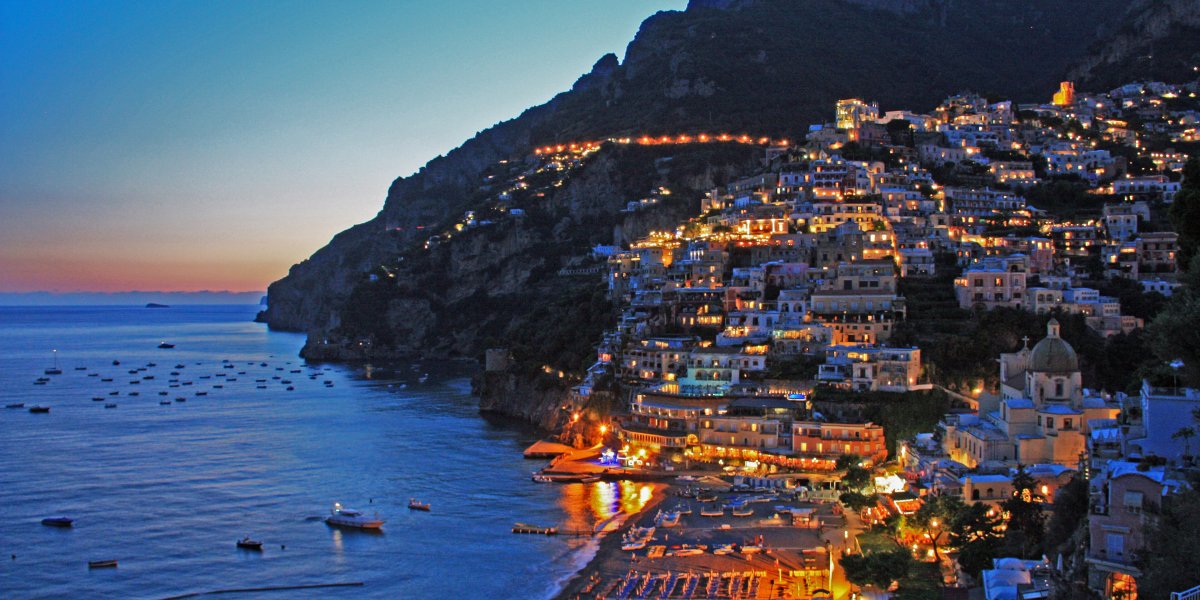
Exit the church, descend the wide ramp of Via Marina Grande — sixty seconds and you're standing on dark volcanic pebbles with the full amphitheater of pastel houses rising behind you exactly as on every postcard ever printed. Spiaggia Grande is 300 m of charcoal sand framed by 'gozzi' — the carnival-painted fishing skiffs that have ferried tourists, watermelons, and lovers since the 1950s. Behind the beach, Via Pasitea's Moda Positano boutiques sell the hand-loomed linens that reinvented Italian resortwear in the 1960s — La Bottega di Brunella is the original, still cut and dyed by hand.
Tip: Walk to the far western end of the beach where the fishermen mend their nets — that angle catches every pastel house, the dome, and the gozzi in a single frame, and it's the photo your friends will steal. The lido bartenders will wave you off their loungers if you sit uninvited; the free public ribbon is the unmarked stretch between the orange umbrella row (Lo Stellato) and the yellow one (Lucibello), about thirty meters wide.
Open in Google Maps →16:30
Landmark
From Spiaggia Grande's western end, climb the stone stairs past the Torre Trasita watchtower — Via Positanesi d'America begins here, named for the Positanese who emigrated to America and never stopped sending money home. This 600 m cliff path is the most beautiful pedestrian shortcut in Italy: a single-file ribbon of bougainvillea-draped stone hung between two beaches, with the open Mediterranean falling away on your left and Saracen towers above. It empties onto Spiaggia di Fornillo — smaller, quieter, locals-only at this hour, where the water drops to four meters within ten paces and stays glass-clear into October.
Tip: Arrive at 17:00 — by 18:30 the sun drops behind Punta del Capo to the west, throwing fire-orange light onto Positano's pastel facade across the bay, the reverse-sunset view Positano itself never gets. Bring small bills: Da Ferdinando's kiosk pours the only proper caffè freddo on this beach (€2.50, cash only — no signal for cards here).
Open in Google Maps →19:30
Food
Retrace Via Positanesi d'America east — three minutes back along the same cliff path and Lo Guarracino's terrace lights appear over the parapet to your right, suspended above the water like a ship's deck. The favorite of Positano's old families since 1958, the vine-shaded terrace cantilevers over the rocks where you eat with the sea breathing six meters below. Order the scialatielli ai frutti di mare (€22, hand-cut pasta with mussels, clams, and the morning's catch from Marina Grande) and the grilled pezzogna (€28, whole local sea bream with lemon from the owner's grove in Praiano) — two courses, a half-liter of Greco di Tufo, and dessert run €55 per person.
Tip: Reserve 48 hours ahead and request table 14 or 15 on the cliff railing — those terrace-edge seats go to repeat guests by 7 PM otherwise; tell them you want to watch the lights come on across the bay and they'll seat you facing west. PITFALL — avoid the seafront restaurants directly on Spiaggia Grande: they charge €38 for the same pasta with frozen seafood, push the 'menu turistico' onto anyone who can't read Italian, and tack on €6 'coperto' per head. Lo Guarracino has no tourist menu and no surprise charges, which is the entire reason locals still eat here.
Open in Google Maps →
Trip builder
Plan this trip around Positano
Turn this guide into a bookable rail itinerary with FlipEarth.
Keep exploring
Related cities
More in the same country
FAQ
Frequently asked questions
How many days do you need in Positano?
Most travelers enjoy Positano in 1 days, with enough time for headline sights and a slower meal or museum stop.
What's the best time to visit Positano?
The easiest season for most travelers is Apr-Oct, especially if you want good weather and manageable crowds.
What's the daily budget for Positano?
A practical starting point is about €120 per person per day before hotels, then adjust based on museums, dining, and transport.
What are the must-see attractions in Positano?
A good first shortlist for Positano includes Spiaggia Grande, Spiaggia di Fornillo via Via Positanesi d'America.