City Guide
Portofino
Italy · Best time to visit: May-Sep.
Day-by-day plan
Choose your pace
Trip length
09:00
Landmark
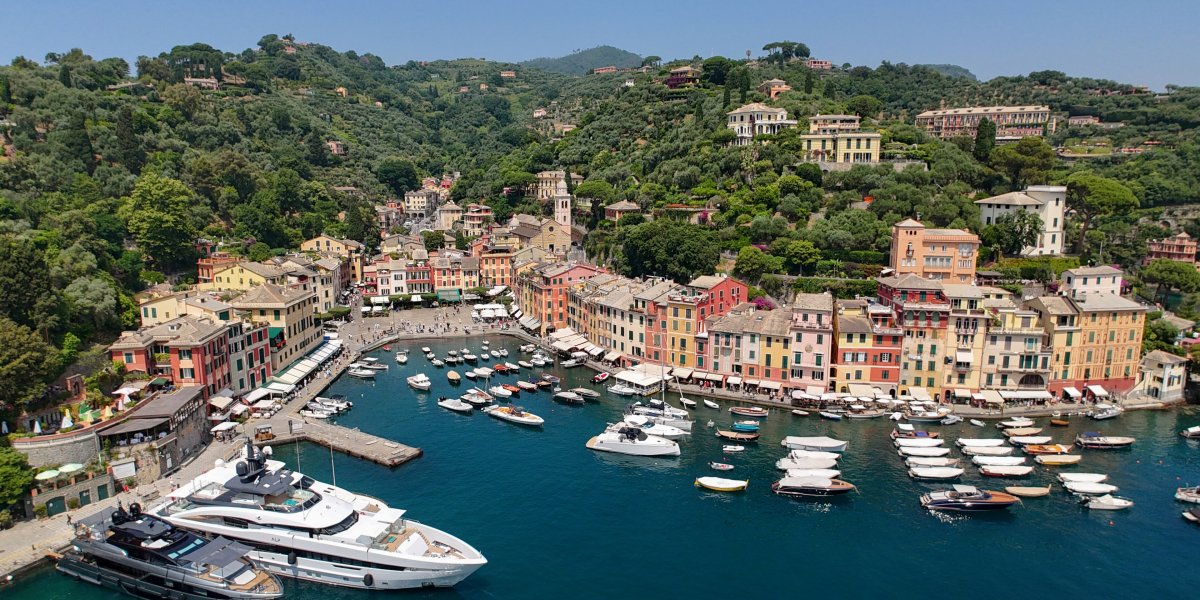
Step off bus 82 at Calata Marconi and the Piazzetta opens before you like a stage — pastel facades catching the eastern light, fishing boats and superyachts moored shoulder to shoulder. Walk the curve of the harbor wall counterclockwise, then duck into the narrow vicoli behind the church where locals are wheeling crates of mussels into the alimentari. At this hour the cafés are setting tables but the day-trippers haven't arrived; you have the postcard to yourself.
Tip: Stand on the eastern arm of the harbor (toward Molo Umberto I) and shoot the village with the cliffs behind — the western light hasn't reached the façades yet, so they glow apricot rather than washing out. Bus 82 from Santa Margherita Ligure (€3, 15 min, every 20 min) drops you here; the boat is prettier but doesn't sail before 09:30.
Open in Google Maps →10:30
Landmark
Climb the marble salita beside Chiesa di San Giorgio — eight minutes of cypress-shaded switchbacks, each turn revealing more of the harbor below. The 12th-century fortress (later home to a British consul, where Yeats slept in 1933) has a small interior exhibit, but the real prize is the terraced garden: a wisteria pergola framing what is arguably the most photographed view in Liguria. Skip the indoor rooms unless time allows — the view is the museum.
Tip: Walk straight to the upper terrace (left after the ticket booth) — most visitors stop at the first viewpoint and miss the cleaner angle from the top, where the lighthouse path is visible in the distance. The wisteria blooms late April through May; in summer the bougainvillea on the lower wall is in full magenta and frames the harbor just as well.
Open in Google Maps →12:00
Landmark
Exit the castle gate and follow the paved cliff path south — fifteen minutes through pine and holm oak, with the sea dropping away on both sides until the peninsula narrows to a single ridge. The lighthouse itself is plain, a stubby white tower at land's end, but the moment you walk past it onto the rocks beyond is when Liguria opens completely: open Mediterranean to the west, the Gulf of Tigullio curving north, San Fruttuoso's monastery hidden in the next cove. This is the geographic and emotional climax of the day.
Tip: There's a tiny bar at the lighthouse (Il Faro) — order one Negroni (€10) and you've earned a seat on the most dramatic terrace on the Riviera. Don't try to scramble past for a viewpoint further south; the path ends here, the rocks beyond are loose, and people fall every season.
Open in Google Maps →13:45
Food
Retrace the lighthouse path back down to the Piazzetta — twenty-five minutes, almost entirely downhill, and after the climb your legs will thank you for the descent. Take a stool at the marble bar (not the harbor-front tables) and order a slice of focaccia di Recco (€6 — thin sheets of pastry around molten stracchino cheese, a Ligurian invention from the village next door) with a glass of Vermentino (€5). Standing al banco you eat the same focaccia for a quarter of the table price, surrounded by skippers in deck shoes ducking in for an espresso between charters.
Tip: Order "al banco" — Italian café law sets a fixed lower price for standing-bar service, and in Portofino the difference between bar and table can be €15 for the same panino. If you want to sit by the water, walk three minutes to the alimentari on Via Roma, take focaccia to go for €4 a slice, and eat on the harbor wall.
Open in Google Maps →15:30
Park
Pick up Strada Provinciale 227 heading north out of Portofino — thirty minutes along the cliff road, traffic thin in the afternoon, every curve framing a different angle of pine, rock, and impossible blue. Paraggi appears suddenly: a curved cove of milky turquoise water tucked between two pine-covered headlands, the green so saturated it looks tinted. The famous private beach clubs (Eden, Beach Club) occupy most of the sand, but the small free section at the southern end has the same water and the same view.
Tip: Enter via the rough stone steps just past kilometer marker 21 on the SP227 — they drop straight onto the free public sliver of sand most visitors don't realize is there. Afternoon swim is unbeatable: the seabed is sand-over-rock, so the water keeps that cartoon-turquoise color even when you're standing in it.
Open in Google Maps →19:30
Food
Continue north on the SP227 past Punta Pedale — forty-five minutes into Santa Margherita Ligure's old town, the road becoming Lungomare Marconi as you reach the harbor. Baicin sits one block back on Via Algeria, a wood-paneled trattoria run by the same family since 1939, where the pesto is still ground by hand in a marble mortar (visible from the dining room). Order the trofie al pesto (€14, twisted pasta with potato and green beans, the canonical Ligurian dish) and the acciughe ripiene al verde (€16, stuffed anchovies in salsa verde) — these two plates are the entire reason this trattoria exists.
Tip: Reserve same morning by phone — locals fill the dining room by 20:30 in season. Avoid the Portofino Piazzetta restaurants for dinner: pasta runs €35-50 with a forced €5 coperto and the kitchens are aimed at expense accounts who won't return. Santa Margherita has the same Ligurian sea and a quarter of the markup, and the last train to Genoa leaves at 22:48 — book your seat before you sit down to eat.
Open in Google Maps →
Trip builder
Plan this trip around Portofino
Turn this guide into a bookable rail itinerary with FlipEarth.
Keep exploring
Related cities
More in the same country
FAQ
Frequently asked questions
How many days do you need in Portofino?
Most travelers enjoy Portofino in 1 days, with enough time for headline sights and a slower meal or museum stop.
What's the best time to visit Portofino?
The easiest season for most travelers is May-Sep, especially if you want good weather and manageable crowds.
What's the daily budget for Portofino?
A practical starting point is about €130 per person per day before hotels, then adjust based on museums, dining, and transport.
What are the must-see attractions in Portofino?
A good first shortlist for Portofino includes Piazzetta di Portofino, Castello Brown, Faro di Portofino.