City Guide
Pesaro
Italy · Best time to visit: May-Sep.
Day-by-day plan
Choose your pace
Trip length
09:00
Landmark
Walk in from the station along Viale del Risorgimento and Via Branca (10 minutes) — you'll spot the cathedral's dome rising over the plane trees just before the square opens up. Pesaro's heart is this elegant Renaissance piazza, where the 15th-century Palazzo Ducale's pale Istrian-stone portico faces a perfectly proportioned space rimmed by ochre palazzi and the Fontana di Piazza. At 9 a.m. the low Adriatic light rakes across the arched facade before the cafés fill and a single waiter starts polishing tables — this is the only window when you'll get the square almost to yourself.
Tip: Stand directly in front of the Caffè dei Costanzi side (north-east corner of the square) at 09:00–09:15: the sun is behind you and lights up the Palazzo Ducale's seven arches perfectly, with no shadow from the central fountain. By 10 a.m. tour vans park along Via Branca and ruin the shot.
Open in Google Maps →10:30
Landmark
Exit Piazza del Popolo on its north-east corner and follow Via Rossini for three minutes — you're walking the same pastel-fronted street the maestro Gioachino Rossini walked as a boy, past 18th-century palazzi painted in burnt ochre and pistachio. At number 34, a modest house with a marble plaque marks the room where Italy's most theatrical opera composer was born in 1792. Even from outside it's the most photographed doorway in town: tall green shutters, a baroque iron lantern, and a brass bust above the lintel. Walk the length of Via Rossini afterward — every building is a Rossini family memory.
Tip: The doorway sits in shadow most of the day but catches direct sun between 10:45 and 11:15 in summer — that's the only window for a glare-free photo of the plaque and the green shutters together. Cross the street and shoot from the bakery's doorway opposite to get the full facade in frame.
Open in Google Maps →12:15
Food
Backtrack two blocks west onto Corso XI Settembre, Pesaro's main pedestrian artery — the piadineria is tucked beside a bookshop, marked by a small wooden sign and the smell of charred flatbread on the marble street. This is fast casual in the Romagnolo sense: thin warm piadina folded around fillings to order, paid at the counter, eaten at a stool by the window. Order the piadina with prosciutto di Carpegna and squacquerone cheese (€6.50) — Carpegna ham is from the Marchigian hills 40 km inland, and the soft squacquerone melts into the warm bread like nothing else. Add a glass of Bianchello del Metauro (€4) and you have lunch in 25 minutes flat.
Tip: Skip the queue that forms by 13:00 — arrive between 12:10 and 12:20 and you'll walk straight to the counter. Ask for your piadina 'ben croccante' (extra crisp) — they cook it 20 seconds longer on the testa and it makes a real difference.
Open in Google Maps →13:30
Landmark
Exit the piadineria east on Via Branca and follow Via Castelfidardo south to Piazzale Matteotti — five minutes through a quiet residential stretch, and the squat brick fortress appears at the edge of the old town like a chess rook left on the board. Built in 1474 for Costanzo Sforza, Rocca Costanza is a textbook Renaissance military fortress: four cylindrical bastions, a deep dry moat now planted with cypress, and reddish brick that turns rose-gold in afternoon light. You can't go inside today, but the perimeter walk along the moat (15 minutes) is the real photograph — and the south-facing rampart frames the Adriatic horizon between two towers.
Tip: Walk the moat counter-clockwise starting from the north gate — at the south-east bastion (around 14:00) the sun is at your back and the brick glows orange. The locals' shortcut: a small unmarked staircase on the east side leads up onto a public terrace where you can see all four bastions in one frame.
Open in Google Maps →15:00
Landmark
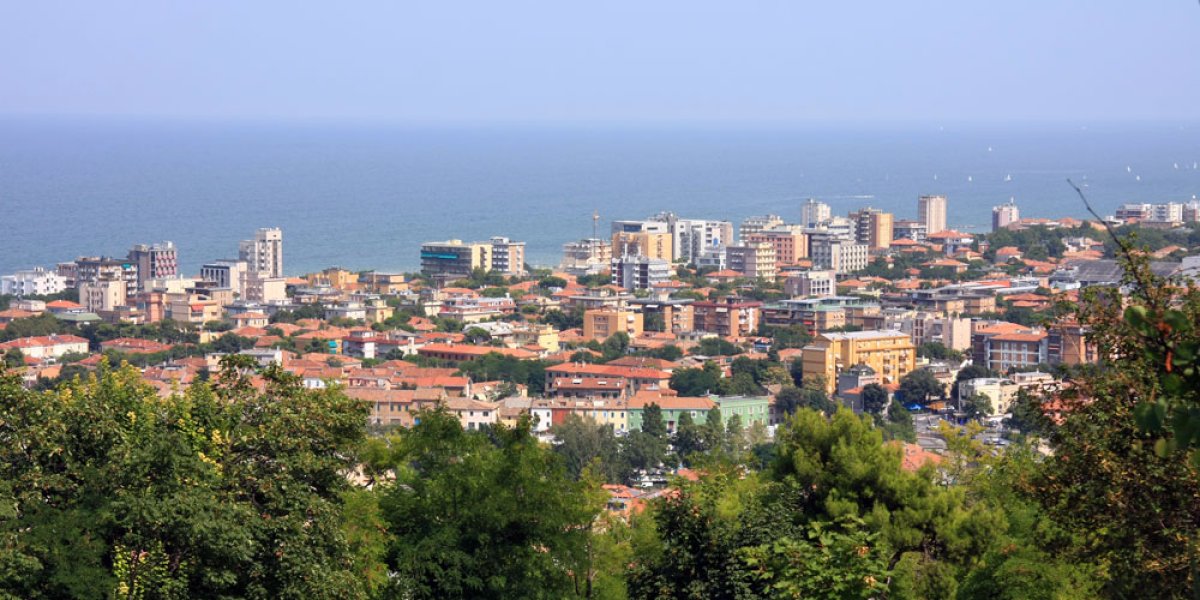
From Rocca Costanza walk north on Viale della Repubblica through the leafy public gardens — twelve minutes under plane trees and the city ends abruptly at Piazzale della Libertà, where Arnaldo Pomodoro's 'Sfera Grande' sits on a polished travertine disc: a four-metre bronze sphere fractured to reveal a glittering geometric core, set against open sea. This is the postcard shot of Pesaro. From here, keep walking north along the Lungomare Nazario Sauro — a 4 km arc of broad sand, art-nouveau villas in faded pink and turquoise, and a tessellated tile pavement designed in the 1920s. After about an hour you'll reach Baia Flaminia, where the coast lifts into the white cliffs of Monte San Bartolo. Push another twenty minutes up Strada Panoramica Adriatica — the road climbs through pine and broom, and the city shrinks behind you to a thin strip between mountain and sea.
Tip: Photograph the sphere from the west side facing the sea — between 16:30 and 17:30 the sun lights the bronze's cracked interior and the Adriatic is in the background. Skip the rented sunbeds along Lungomare Sauro (the 'concessioni') unless you want to commit €20+ for the day; the free public beach 'Spiaggia Libera' is the stretch just before Baia Flaminia and has the same sand without the gates.
Open in Google Maps →19:30
Food
Continue twenty more minutes up Strada Panoramica Adriatica — the restaurant sits on a terrace cut into the cliff above the sea, a low white building with cream awnings and a vine-shaded patio. Da Alceo has been the address for Pesarese seafood since 1973, run now by Alceo's son and grandson, and the dining room balcony hangs over fifty metres of empty Adriatic. Order the brodetto pesarese (€32) — the local fish stew with thirteen species cooked in vinegar and saffron, a recipe written into Marchigian law — and start with the tagliolini ai frutti di mare (€22), all hand-cut pasta and shellfish from this morning's port. Save room for the bartolaccio dessert (€8), a cliff-honey panna cotta unique to this stretch of coast. Budget €70–90 per person with a glass of Bianchello.
Tip: Reserve at least three days ahead and specifically request a 'tavolo sulla terrazza' (terrace table) — the indoor dining room has the same kitchen but none of the sunset. Sunset in May–September here falls around 20:30, so arriving at 19:30 lets you toast the light over the gulf. One last warning before you head back to town: do not be tempted by the brightly lit 'menu turistico' restaurants along the central Lungomare Sauro near Piazzale della Libertà — €40 fixed menus there are reheated frozen fish, padded service charges, and Marchigiani would never eat there. If you don't make it to Da Alceo, return to the old town and try Lo Scudiero instead — never the beach-strip glass boxes.
Open in Google Maps →
Trip builder
Plan this trip around Pesaro
Turn this guide into a bookable rail itinerary with FlipEarth.
Keep exploring
Related cities
More in the same country
FAQ
Frequently asked questions
How many days do you need in Pesaro?
Most travelers enjoy Pesaro in 1 days, with enough time for headline sights and a slower meal or museum stop.
What's the best time to visit Pesaro?
The easiest season for most travelers is May-Sep, especially if you want good weather and manageable crowds.
What's the daily budget for Pesaro?
A practical starting point is about €120 per person per day before hotels, then adjust based on museums, dining, and transport.
What are the must-see attractions in Pesaro?
A good first shortlist for Pesaro includes Piazza del Popolo & Palazzo Ducale, Casa Rossini, Rocca Costanza.