City Guide
Pavia
Italy · Best time to visit: Apr-Oct.
Day-by-day plan
Choose your pace
Trip length
08:35
Landmark
From Pavia FS, board the 08:35 regional train toward Milano — ten quiet minutes later you step off at Certosa di Pavia station and walk a poplar-lined 1.5 km lane toward Italy's most ornate facade. The Visconti raised this Carthusian monastery as their dynastic mausoleum, and its front is a Renaissance jewelry box of pink Verona stone, white Carrara, and green serpentine — you don't need to enter to feel the weight of it. Circle to the eastern side for the brick apse framed by Lombard cypresses, the angle every Italian guidebook chases.
Tip: The west-facing facade sits in soft, even light until 11:00 — perfect for capturing the carved inlay before harsh midday shadows obscure the detail. Skip the interior tour (loses 45 minutes for a Latin-mumbled monk-led walk) and catch the 11:25 train back to Pavia FS.
Open in Google Maps →12:00
Food
Exit Pavia FS and walk east along Viale Vittorio Emanuele II for 8 minutes into Strada Nuova — the university spine — landing at the green-marble counter of Vigoni, in business since 1878. Grab a panino al prosciutto crudo (€5) standing at the bar, then move to the dessert case for a slice of Dolce di Pavia (€4.50) — the almond-and-chocolate cake that pilgrims to the Certosa have been buying for over a century. This is the city's edible institution, and the queue at the bar moves fast.
Tip: Order at the cashier first, then bring the receipt to the bar — going to the seated room doubles the price for the same coffee. The Dolce di Pavia is vacuum-sealed for travel and survives a flight home; buy a whole one (€18) as the single best edible souvenir from the trip.
Open in Google Maps →13:00
Landmark
Step out of Vigoni and head north on Strada Nuova for 600 meters — the porticoed boulevard runs past the University's 14th-century courtyards where Volta taught and Columbus briefly studied — until the Castello Visconteo rises behind a wide grass moat, four corner towers still standing. Galeazzo II built it in 1360 as a country palace, not a fortress, and Petrarch came here to organize the library that became one of the great Renaissance collections. Walk the full perimeter through the gardens; the south facade with its arched loggia is what the photographs are for.
Tip: Approach from the southeast corner — the diagonal view through the rose garden frames all four towers with the loggia in front, the exact angle every Pavia wedding shoot uses. Circle the moat clockwise to keep the sun behind you; the grass is open and benches are scarce, so don't plan to sit.
Open in Google Maps →14:30
Religious
Leave the Castello by its south gate and walk Strada Nuova straight south for 700 meters — passing the University's main courtyards (open and free, peek in) — until the boulevard spills into Piazza della Vittoria, the city's medieval heart lined with porticoed cafes and a Saturday produce market. One block west sits the Duomo: third-largest dome in Italy at 97 meters, consulted on by Leonardo and Bramante, and almost entirely empty of tourists. The brick exterior is unfinished, raw, and somehow more moving for it.
Tip: Walk to the small rise behind the Duomo on Piazza del Duomo for the only angle that fits the full dome in your frame — from the piazza itself the building is too close. The brick pile beside it is the foundation of the Torre Civica, which collapsed without warning in 1989 killing four people, and is unique to Pavia.
Open in Google Maps →16:00
Landmark
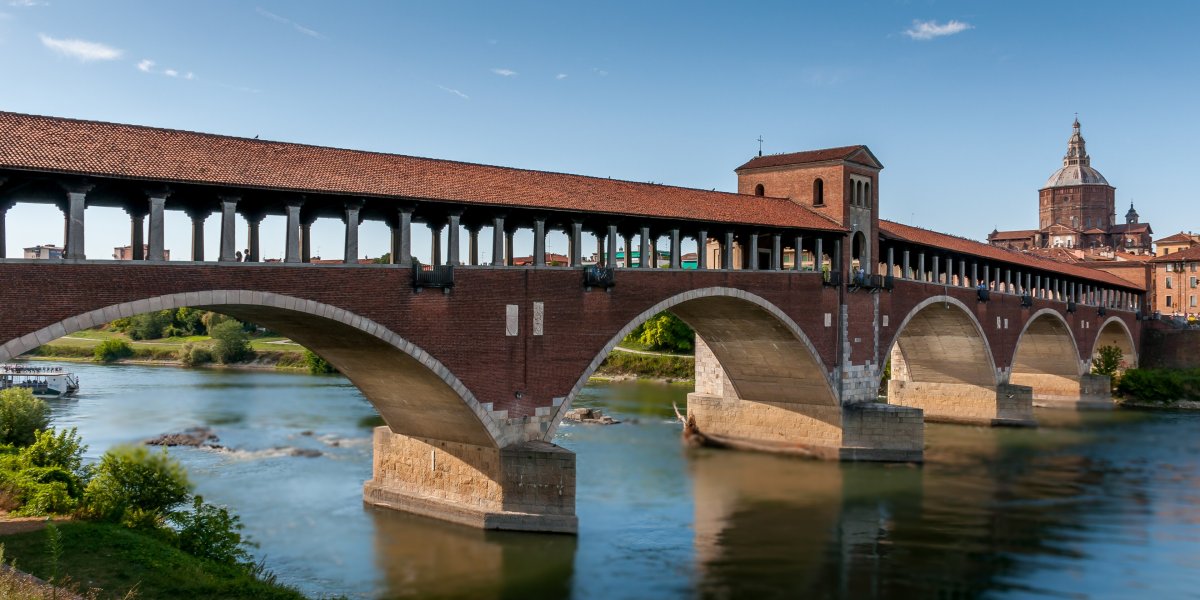
From the Duomo, walk south on Via Cardinal Riboldi for 5 minutes — the streets narrow, medieval brickwork closes in — and the Ticino River opens at your feet. The Ponte Coperto is Pavia's symbol: a covered bridge with a small chapel mid-span, rebuilt after WWII bombing but faithful to the 14th-century original. Cross to Borgo Ticino, the old fishermen's quarter on the far bank, where laundry still hangs from balconies and the riverside path catches the golden hour.
Tip: Stand mid-bridge facing upstream around 17:30 in summer (16:30 in autumn) — the sun drops directly down the river, framing the Castello towers in silhouette. The signature Instagram shot is from the riverside path 200 m downstream on the Borgo Ticino side, where the chapel aligns perfectly with the Duomo dome behind. Avoid the cafes directly facing the bridge — they're tourist traps charging €8 for an espresso with slow service; locals drink at Bar San Teodoro on the city side, and the riverside scams (fake 'gold ring' finders, rose-pushers) cluster on warm evenings, so keep wallets front-pocketed.
Open in Google Maps →19:30
Food
Stay in Borgo Ticino — walk west along the river for 3 minutes from the bridge and Osteria della Malora is the corner trattoria with no sign, just a wooden door and a chalkboard. 'Malora' is Lombard dialect for 'ruin' — a joke from when the founders bought a derelict building in the 1980s — and inside is everything Pavia eats: risotto alla certosina (€16) with frogs from the Ticino rice paddies, and the slow-braised stracotto d'asino (€18). Pair with a glass of Bonarda dell'Oltrepò, the local fizzy red.
Tip: Reserve by phone the morning of (eight tables, no online booking, full by 19:30 on weekends). If the risotto alla certosina is on the chalkboard (seasonal, roughly May to October when the rice paddies are flooded), order it immediately and order nothing else first — the kitchen makes it to order, the texture takes 20 minutes, and that texture is the entire point of the dish.
Open in Google Maps →
Trip builder
Plan this trip around Pavia
Turn this guide into a bookable rail itinerary with FlipEarth.
Keep exploring
Related cities
More in the same country
FAQ
Frequently asked questions
How many days do you need in Pavia?
Most travelers enjoy Pavia in 1 days, with enough time for headline sights and a slower meal or museum stop.
What's the best time to visit Pavia?
The easiest season for most travelers is Apr-Oct, especially if you want good weather and manageable crowds.
What's the daily budget for Pavia?
A practical starting point is about €90 per person per day before hotels, then adjust based on museums, dining, and transport.
What are the must-see attractions in Pavia?
A good first shortlist for Pavia includes Certosa di Pavia, Castello Visconteo, Ponte Coperto & Borgo Ticino.