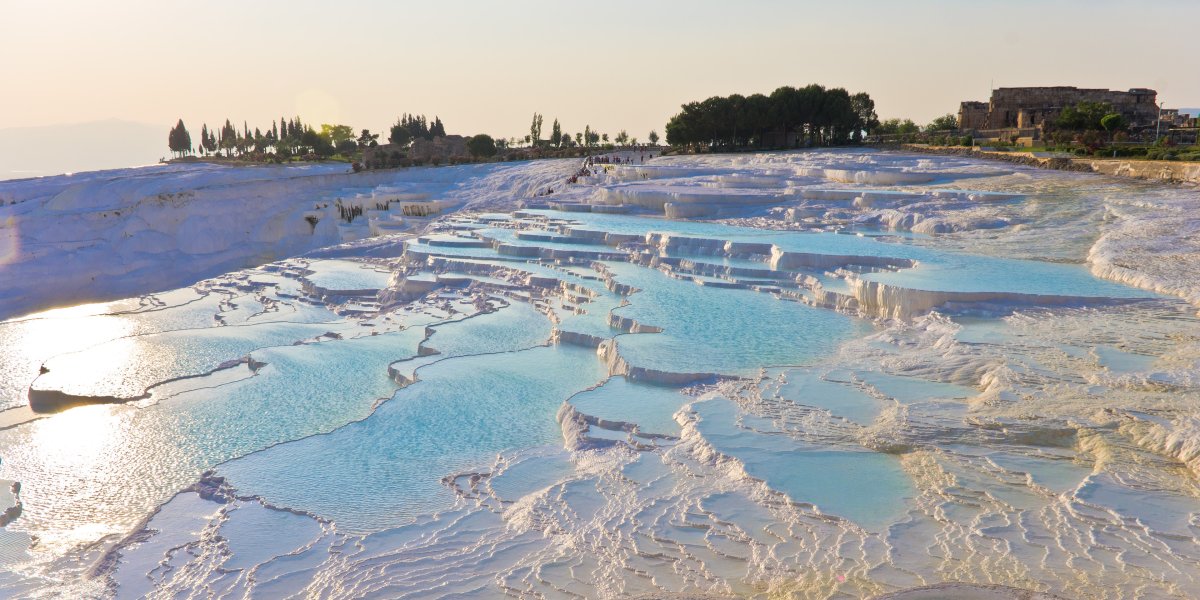
City Guide
Pamukkale
Türkiye · Best time to visit: Apr-Jun, Sep-Oct.
Day-by-day plan
Choose your pace
Trip length
07:30
Landmark
Take a taxi from the village directly to the Kuzey Kapısı (North Gate) — not the busier South entrance. Turkey's largest ancient cemetery opens in front of you: over 1,200 tombs carved from local travertine, sarcophagi cracked open by centuries of earthquakes, and round Hellenistic tumuli scattered across the slope. Low morning sun rakes the stone at a sharp angle, and for the first hour you'll be alone with the crows and the wind — every coach tour on the mountain is still queuing at the far gate.
Tip: Forget the 'sunrise Pamukkale' tours — they all dump at the South Gate and sprint to the terraces. A taxi from the village to the North Gate costs 400-500 TRY (€12-15) and buys you 90 minutes of completely empty ruins before the first buses arrive at 09:30. The single entry ticket covers every site on the plateau for the whole day — do not lose it.
Open in Google Maps →10:00
Landmark
Walk south down Frontinus Street — the original Roman decumanus, still paved in its original limestone — passing beneath the three-arched Domitian Gate built in AD 83. After roughly 12 minutes of colonnaded ruins, the theatre opens on your left: fifty rows of seats cut into the hillside, the imperial box and much of the scaenae frons (stage wall) still standing. Climb to the top tier for the shot that pulls it all together — the Roman stone in the foreground, the white travertine cliff behind, and the Lykos valley stretching to the horizon.
Tip: Enter through the side staircase on the right (not the front), which puts you directly onto the upper seating without the scramble. Morning light hits the stage wall head-on until about 11:30 — after that the front of the scaenae falls into shadow, so shoot early. Bring 1 L of water per person; there's no shade between the theatre and the pool.
Open in Google Maps →12:30
Food
Walk down from the theatre through the fallen columns of the Temple of Apollo and past the Plutonium — the famous 'Gate to Hell' where CO2 still seeps out of the fissure (you can smell it; do not lean in). The on-site restaurant at the Antique Pool entrance is deliberately no-frills: order a tavuk şiş wrap (grilled chicken skewer, €8), a spinach-and-cheese gözleme (€6), and a cold ayran. Eat under the pines — this is fuel for the afternoon, not a meal to linger over.
Tip: Skip the cold drinks at the pool-side kiosk inside (€4 for a small water) — load up on 1.5 L bottles at the cafeteria for €1.50. The stray cats here are shameless; guard your wrap with your forearm or you will lose half of it to a tabby called — apparently by everyone — 'Cleo'.
Open in Google Maps →13:30
Landmark
Two-minute walk from the restaurant through the pool entrance. This is the only place on earth where you can swim among toppled Roman columns — a marble portico shaken into the water by a 7th-century earthquake and left exactly where it fell. The thermal water stays at 36°C year-round and is carbonated enough to fizz audibly on your skin. Midday is deliberate: the vertical sun cuts straight through the water and lights the columns beneath you, and most tour groups are eating off-site — by 14:15 you'll share the pool with a dozen swimmers instead of two hundred.
Tip: The pool ticket is separate from the Hierapolis entry (€25 for 90 minutes in the water). Enter the water from the far-right steps — the submerged columns are densest along the right-hand wall, and that's also where the hottest fresh spring enters. Waterproof phone pouch is worth it; the underwater column shot is the photo you came here for.
Open in Google Maps →14:45
Landmark
Exit the pool and walk five minutes southwest to where the white cascades begin their drop toward the valley. Remove your shoes — mandatory, the travertine is a protected UNESCO surface — and walk down the designated barefoot path. The flowing water is warmer than expected (around 35°C), the stone has a grippy, slightly gritty texture, and descending is the correct direction: the afternoon sun sits behind your shoulder, lighting each turquoise pool from above, and by 17:30 the entire cliff shifts to pink-gold as golden hour begins. Take it slowly — every bend reveals a new terrace, and the bottom half is quieter than the top.
Tip: Stay strictly on the official barefoot path — rangers fine people €50 on the spot for stepping on dry, fragile travertine to get a 'better angle'. The best photo spot is not the famous top-of-terrace view (crowded and roped off) but halfway down on the right, where a single empty pool frames the whole cliff below. Carry your shoes in a plastic bag; you'll exit at the village dusty and wet.
Open in Google Maps →19:30
Food
Six-minute walk from the terrace exit into the centre of Pamukkale village — past the swan-shaped fountain, left at the pension strip. Mehmet's has been run by the same family for over three decades and is still where most villagers send their own guests. Order the testi kebab (pottery kebab, €18): lamb and vegetables sealed inside a clay jar, slow-baked, and cracked open at your table with a small hammer. Add a cold meze plate with haydari and muhammara (€10), and a glass of local Denizli red. Budget €25-30 per person.
Tip: Reserve 30 minutes ahead by phone or walk in by 19:15 — the terrace fills with Istanbul weekenders after 20:00. Order the testi kebab when you sit down; it takes 40 minutes to bake. Area pitfall: ignore anyone on the main street handing out flyers for a 'traditional Turkish night with belly dance' — those are tour-bus restaurants charging €60 for microwaved kofte. The second scam to dodge is the 'village hammam experience' leaflet; the only real, clean hammam is inside the Pam Thermal Hotel — the street ones are touts.
Open in Google Maps →
Trip builder
Plan this trip around Pamukkale
Turn this guide into a bookable rail itinerary with FlipEarth.
Keep exploring
Related cities
More in the same country



FAQ
Frequently asked questions
How many days do you need in Pamukkale?
Most travelers enjoy Pamukkale in 1 days, with enough time for headline sights and a slower meal or museum stop.
What's the best time to visit Pamukkale?
The easiest season for most travelers is Apr-Jun, Sep-Oct, especially if you want good weather and manageable crowds.
What's the daily budget for Pamukkale?
A practical starting point is about €115 per person per day before hotels, then adjust based on museums, dining, and transport.
What are the must-see attractions in Pamukkale?
A good first shortlist for Pamukkale includes Necropolis of Hierapolis, Hierapolis Theatre, Cleopatra's Antique Pool.